

Custom Hoodies and Sweatshirts Manufacturer in Bangladesh: OEM Process From Tech Pack to Bulk
How to choose a custom hoodies and sweatshirts manufacturer in Bangladesh: tech pack contents, artwork choices, sampling, approval and bulk inspection.
Short answer
To choose a custom hoodies and sweatshirts manufacturer in Bangladesh, send one complete tech pack covering fabric, hood construction, measurements, print or embroidery and labels to every candidate, compare itemized quotations on one delivery term, approve a pre-production sample in your actual fabric and artwork in writing, then inspect bulk against that sample before the export filing.
On this page
Key takeaways
A custom order is made to your specification: the tech pack, not a photo, defines the fabric, hood construction, artwork and labels that bulk repeats.
Compare factories only on itemized quotations written against the same tech pack and the same delivery term, with MOQ stated per style and per color.
Approve the pre-production sample in writing in the actual fabric, artwork and labels, and inspect bulk against a sealed reference sample.
For the EU, fibre composition labelling follows Regulation (EU) No 1007/2011 by name and percentage by weight in descending order.
Exportain verification is a document and photo review, not a factory inspection, and a badge is not a guarantee.
Choosing a custom hoodies and sweatshirts manufacturer in Bangladesh is different from buying a stock style. A custom manufacturer works to your specification: your fabric, your hood and pocket construction, your print or embroidery, and your labels. This guide covers the tech pack, comparing factories on one specification, and sampling, approval and inspection.
Hoodies and sweatshirts are knitwear. The Bangladesh Knitwear Manufacturers and Exporters Association (BKMEA), established in 1996, is the apex trade body for the knitwear sector and represents approximately 2,540 knitwear member factories.1 The Bangladesh Garment Manufacturers and Exporters Association (BGMEA), which started in 1983, represents the woven garments, knitwear and sweater sub-sectors, and around 40 percent of its member factories are knitwear and sweater manufacturers.2 Knitwear exports reached $5.963 billion in July to September 2026, up 6.88 percent year on year, within ready-made garment exports of $10.578 billion, according to data released by the Export Promotion Bureau (EPB).3 That scale gives you a wide choice. It does not tell you which factory can build your garment, so the selection work sits in the specification and the samples.
Why this matters for buyers and sellers
A custom order repeats whatever the tech pack says, in every unit. If the hood depth, pocket placement or artwork size is wrong on paper, bulk repeats the error at full quantity. Caught on the pre-production sample, the same point costs one sample round.
For the buyer, choosing on specification rather than on a headline price decides fit, hand feel and print quality in the finished stock. For the seller, a complete tech pack allows an accurate quotation, with a minimum stated for that exact garment instead of for a generic hoodie.
This guide covers the custom route only. The minimum order quantity (MOQ) drivers are covered in the hoodies and sweatshirts MOQ guide.
What should you know first about hoodies and sweatshirts?
Three points shape a custom order before you contact any factory.
Classification. In the Harmonized System, heading 6110 covers jerseys, pullovers, cardigans, waistcoats and similar articles, knitted or crocheted.4 Record the indicative heading, then confirm the full national code in your destination tariff. The HS code for hoodies and sweatshirts guide sets out the classification.
Fibre labelling for the destination. If you sell into the European Union, Regulation (EU) No 1007/2011 states that a textile product shall be labelled or marked with the name and percentage by weight of all constituent fibres in descending order.5 Put the exact label wording in the tech pack, because a wording change after approval means a new label run.
Manufacturer or trading company. A manufacturer cuts and sews in its own factory. A trading company places your order with a factory it selects. Both models can deliver, but record in writing which one you have contracted with and whose name appears on the export documents.
What a custom tech pack for hoodies must state
A photograph shows a style. A tech pack states a specification, including the points that make a hoodie different from a basic crew neck.
Section | State in the tech pack |
|---|---|
Fabric | Composition, construction (fleece or loopback), weight, brushed or unbrushed finish, color per style |
Hood or neck | Pullover hood, zip-front hood or crew neck; hood lining, drawcord, eyelets and cord ends; rib neck for sweatshirts |
Body construction | Kangaroo or side pockets, set-in or raglan sleeves, rib cuffs and hem, side seams |
Measurements | Chart for every size, including body length, chest, sleeve, hood depth and pocket position |
Artwork | Print or embroidery, artwork file, finished size, placement measured from a named point, colors |
Trims and labels | Zip type where fitted, woven and size labels with exact wording, hang tags, packing by size and color |
Fabric choice drives the rest of the order. A brushed fleece, a loopback fabric and a lighter sweatshirt fabric sew, print and pack differently, and each carries its own dye lot. State whether each color is stocked or dyed to order, because that answer sets both the minimum and the earliest cutting date.
Artwork method is a specification decision, not a finishing detail. A printed chest design, an embroidered logo and a sleeve print each need different set-up work. State the method, size and placement for every position, and ask where that work is done.
Example figures: one pullover hoodie style in two colors, with a chest print in one position and sizes split across five sizes per color. Example figures: the same total restated as one color only, with embroidery instead of print. The two versions carry different set-up work and different minimums at the same total, and show structure only, not a typical MOQ, price or lead time. See the MOQ definition guide.
Step-by-step: how it works
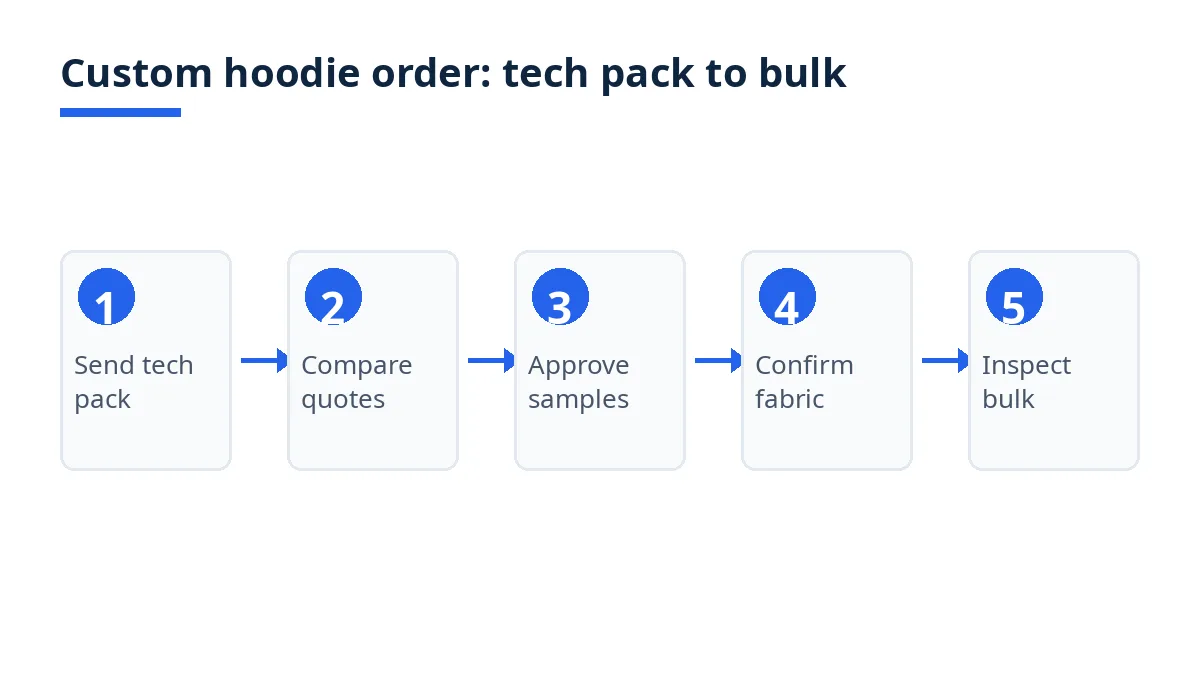
Send one tech pack to every candidate. Send the identical file to each factory, or the quotations describe different garments and cannot be compared.
Ask each factory what it makes itself. Ask which stages sit in its own factory: cutting, sewing, printing, embroidery and finishing. A custom order needs correction rounds, so record who you deal with at each stage.
Compare itemized quotations on one delivery term. Ask for fabric, making, artwork set-up, trims, labels and packing priced apart, with the MOQ per style and per color. On Exportain, every quotation is versioned and records unit price, MOQ, lead time, Incoterm, payment terms and validity.6
Order a proto sample, then correct it in writing. The first sample checks style, fit and construction, often in a fabric close to your specification. Measure it, wash it, and return corrections in writing with marked photos.
Approve the pre-production sample in writing. This sample uses your actual fabric, color, hood construction, artwork and labels, packed as bulk will be packed. Check it against the tech pack and keep a sealed reference sample.
Confirm fabric and trims before cutting. After approval, the factory books fabric and orders the trims and labels made for your order. Confirm in writing that they match the approved sample before cutting starts, and agree the inspection window.
Inspect bulk against the approved sample, then file for export. Inspect the finished goods under the sampling plan in your purchase order, then confirm cartons, packing list and export filing agree with the order.
For inspection, ISO 2859-1 defines a system of acceptance sampling plans for inspection by attributes, indexed by acceptance quality limit (AQL) for lot-by-lot inspection.7 AQL is the maximum average percentage of defective items considered acceptable during random sampling, and it determines sample sizes and acceptance or rejection thresholds.7 The hoodies and sweatshirts quality control checklist gives the garment-level points.
Costs, timelines and documents
What are the typical costs and timelines?
There are no typical costs or timelines a guide can state as fact for a custom order. Each factory prices your fabric, hood and pocket construction, artwork method, trim and label runs, finishing and packing, and the delivery term you choose. A brushed fleece dyed to order with a zip front and an embroidered logo prices differently from a stocked loopback crew neck with one print position.
Ask for the schedule as separate lines: proto sample, pre-production sample, fabric ready, trims ready, cutting, sewing, finishing and inspection. Sampling depends on fabric availability and correction rounds, and bulk on dyeing, finishing, trim delivery and line capacity.
On delivery terms, the Incoterms 2020 rules set out 11 rules with a clear allocation of cost, risk and obligations.8 State one rule and one named place in the enquiry, the quotation and the purchase order.
Which documents are needed?
The documents fall into three groups.
Group | Documents | What you check |
|---|---|---|
Order documents | Tech pack, versioned quotation, purchase order | Specification, price, MOQ per style and color, lead time, Incoterm and payment terms agree across all three |
Production documents | Written sample approvals, fabric and trim confirmations, inspection report | Approvals are written and dated, and the report is judged against the approved pre-production sample |
Export documents | Commercial invoice, packing list, EXP form, certificate of origin, Bill of Export | Description, quantity and value match the purchase order |
For export clearance in Bangladesh, goods may not be loaded unless an export declaration, the Bill of Export or Shipping Bill, is submitted to Customs and approved.9 Enclosed documents include the export contract or purchase order where there is no export letter of credit, the commercial invoice, the packing list, the EXP form certified by an authorized dealer, and a certificate of origin issued by the EPB or a Chamber of Commerce and Industry.9
Bangladesh-specific rules and tips
Confirm association claims at the source. Hoodies and sweatshirts sit in the knitwear sector, so BKMEA is the sector association for this product.1 BGMEA also covers knitwear alongside woven garments and sweaters.2 If a supplier claims membership of either body, confirm it with the association itself. Membership signals an active garment business, not that the factory can run your fabric, artwork method or size range.
Keep one legal name across every paper. The export declaration names the exporter and the foreign buyer,9 so the name on the trade licence, quotation, proforma invoice and payment account should match.
Ask which inputs are bought in for your order. Zips, eyelets, drawcords and some yarns may be bought in for your specification, and a bought-in trim can set both the minimum and the earliest production date.
Separate the factory from the trading company on paper. On Exportain, Factory Verified means Exportain has reviewed photos of the manufacturer factory, while Trading Company Verified means it has reviewed photos of the trading company office or warehouse.10
Mistakes and red flags
What are the most common mistakes?
Sending a photo instead of a tech pack. Without fabric weight, measurements, hood construction and artwork placement in writing, each factory quotes a different garment, and the lowest price usually belongs to the lightest specification.
Choosing on the unit price alone. A price that excludes artwork set-up, labels or packing is not lower, it is incomplete. Compare only itemized quotations on the same tech pack and the same Incoterm.8 6
Approving the sample verbally. If the approval or the corrections are not in writing, there is no standard to inspect bulk against.
Changing fabric, color or artwork after pre-production approval. After approval, fabric is dyed and trims and labels are ordered for your specification. A change restarts sampling and can restart the fabric order, so the delivery date moves with it.
Reading a badge as a guarantee. A badge records a document or photo review. It is not a guarantee of production capacity, product quality or delivery,10 and it does not test whether a factory can make your hoodie.
Skipping the inspection to save time. Sampling under ISO 2859-1 checks a lot against an agreed AQL,7 the last control that compares bulk with the sample you approved.
Checklist
Before you confirm, every line should be answered in writing.
Tech pack complete: fabric, hood or neck, pockets, measurements, artwork, trims, labels, sizes and packing.
Indicative HS heading 6110 recorded, with the full destination code confirmed in the destination tariff.4
Fibre label wording set for each destination, with EU wording following Regulation (EU) No 1007/2011 where the EU is the destination.5
Factory or trading company status stated in writing, with any BKMEA or BGMEA membership claim confirmed with the association.1 2
Artwork method, size and placement confirmed for every position, with set-up priced apart from the unit price.
Itemized quotations compared on the same tech pack and the same Incoterm.8 6
Proto sample corrected in writing, then pre-production sample in the actual fabric and artwork approved in writing.
Fabric and trim confirmation received before cutting, with the inspection window agreed.
Inspection level and AQL values written into the purchase order, with the inspector named.7
Export document set checked against the purchase order before loading.9
How Exportain helps
On Exportain, search the catalogue by keyword and category, filter to suppliers holding the Exportain Verified badge, sample availability and OEM or ODM capability, and sort by MOQ or lead time.6 Each profile shows the verification level, location, main products and declared certifications.6 Post a request for quotation (RFQ) stating quantity and unit, target price, destination, Incoterm, required certifications and deadline, with your tech pack summary attached, so factories quote against the same specification.6
Read the badges for what they record. Exportain Verified means Exportain has checked identity, phone, email and business registration, and Export Verified means it has checked the Export Registration Certificate (ERC).10 Factory Verified means it has reviewed photos of the manufacturer factory, while Trading Company Verified means it has reviewed photos of the trading company office or warehouse.10 Verification is a document review by staff, and every submission is reviewed before a badge is approved.11 Verification is free, and membership plans never grant a trust badge.11 It is not a factory inspection,10 11 so sample approval and inspection stay with you. See how supplier verification works on Exportain. On acceptance, Exportain creates one order and issues one proforma invoice from the accepted terms.10
FAQs
What should I know first about hoodies and sweatshirts?
A custom order is made to your specification, so the tech pack decides the result. Knitted hoodies and sweatshirts sit under HS heading 6110, which covers jerseys, pullovers, cardigans, waistcoats and similar articles, knitted or crocheted.4 Set the fabric, hood construction, artwork method and label wording before you ask for prices.
What are the typical costs and timelines?
There are no typical figures a buyer can rely on, because each factory sets its price, MOQ and lead time for your specification. Fabric, construction, artwork set-up, the split per color and the delivery term drive the price,8 and sampling rounds, dyeing, finishing and line capacity drive the timeline.
Which documents are needed?
You need three sets. The order set is the tech pack, the versioned quotation and the purchase order. The production set is the written sample approvals, fabric and trim confirmations and the inspection report. The export set filed with the Bill of Export includes the commercial invoice, the packing list, the EXP form certified by an authorized dealer, and a certificate of origin issued by the EPB or a Chamber of Commerce and Industry.9
What are the most common mistakes?
The most common mistakes are sending a photo instead of a tech pack, choosing on an incomplete unit price, approving samples verbally, changing the specification after pre-production approval, and reading a badge as a guarantee. A badge is not a guarantee of capacity, quality or delivery.10
Next steps on Exportain
Browse suppliers in the knitwear categories and filter for OEM capability and sample availability, then post your tech pack summary on the RFQ board so factories quote against the same specification. Before you confirm, read how supplier verification works on Exportain and how to import hoodies and sweatshirts from Bangladesh.
Sources
- BKMEA at a Glance. BKMEA (accessed )
- BGMEA at a glance. Bangladesh Garment Manufacturers and Exporters Association (BGMEA) (accessed )
- Exports up over 6% to $13.1bn in Q1 of current fiscal. United News of Bangladesh (accessed )
- Classification Detail — HS Code 6110. United Nations Statistics Division (accessed )
- Regulation (EU) No 1007/2011 on textile fibre names and related labelling and marking of the fibre composition of textile products. European Union, (accessed )
- How to source and buy from Bangladesh. Exportain (accessed )
- ISO 2859-1:2026 - Sampling procedures for inspection by attributes — Part 1: Sampling schemes indexed by acceptance quality limit (AQL) for lot-by-lot inspection. ISO (accessed )
- Incoterms® 2020. International Chamber of Commerce (ICC) (accessed )
- Customs Clearance Procedures for Export. Bangladesh Customs, National Board of Revenue (accessed )
- Trust & Safety Center. Exportain (accessed )
- Supplier verification: Earn trust badges buyers can see. Exportain (accessed )
- supplier verification
- knitwear
- buyer guide
- Bangladesh sourcing
- bangladesh garments
- Hoodies and sweatshirts
About the author
Sourcing from Bangladesh?
Post a request for quotation and suppliers on Exportain can send you their quotes directly.
Post an RFQ


