Custom Cardigans Manufacturer in Bangladesh: OEM Process From Tech Pack to Bulk
Custom cardigans from Bangladesh are made to your tech pack. Follow the OEM process from tech pack to bulk, controlling gauge, button band, button stance, fit approval, minimums, and documents.
Short answer
A custom cardigans manufacturer in Bangladesh makes cardigans to your tech pack through an OEM process: agree the pack, source yarn and trims, approve a proto sample, approve fit across sizes, approve a pre-production sample in bulk materials, then run bulk. Control the process with written approvals at each gate, specifying gauge, the button band, button stance per size, and labels before bulk starts.
On this page
Key takeaways
A custom cardigan order is controlled by the tech pack: gauge, button band, button stance per size, collar, and labels must be locked in writing before quoting.
OEM production runs through written approval gates: tech pack, yarn and trim sourcing, proto, fit across sizes, pre-production sample in bulk materials, then bulk.
The button band and button stance must be specified and graded per size; a stance approved on one size is not approved on the size set.
There is no typical cost, minimum, or timeline: each factory prices your specification, and minimums sit per color, per style, and per size split.
Exportain verification is a document and photo review, not a factory inspection, and a badge is not a guarantee of capacity, quality, or delivery.
A custom cardigans manufacturer in Bangladesh does not sell you a finished design. The factory makes the cardigan you specify, from your tech pack, and the quality of that pack decides how close bulk production comes to the sample you approved. This guide follows the OEM process from tech pack to bulk: gauge, the button band, button stance, collars, and labels.
OEM, or original equipment manufacturing, means the factory produces to the buyer's specification. Your control comes from written approvals at each gate.
The tech pack is the order
Treat the tech pack as the order itself. A supplier who quotes from a photo and a short description is quoting a different garment from the one you pictured.
Start with the garment identity: open-front cardigan, wearer group, intended use, and season. Then lock the construction: fully fashioned panels or cut-and-sew, stitch type, and how the front band is made and attached. State the closure in full: button type, material, size, color, and number of buttons.
What to put in a cardigan tech pack
Every line below should be answered before you ask for a price.
Tech pack section | Lock this before quoting | Why it moves bulk |
|---|---|---|
Garment and fit | Wearer group, fit, length, measurements per size, tolerances | Fit approval starts here |
Gauge and stitch | Machine gauge, stitches and rows, stitch pattern per panel | Gauge sets drape, weight, and yarn use |
Yarn and fiber | Fiber mix and percentages, yarn count and ply, color references, dye method | Fiber mix decides the label and dye lot |
Panels and linking | Panel construction, linking method, shoulder and armhole construction | Linking shows at the band and shoulders |
Front band and buttons | Band width and construction, button size and material, stance per size, buttonhole finish | The band is checked as a separate run |
Collar, pockets, and trims | Collar shape and construction, pocket type and placement, all trims with sizes | Each trim has its own supply line |
Labels and packing | Fiber content, care, and size labels, hang tag, carton and fold method | Label runs are ordered apart from the garment |
Inspection and delivery | Measurement method, inspection level and AQL values, delivery term and named place | Agreed before bulk |
Send the same pack, with the same revision date and number, to every candidate. When you revise a detail, send the new revision to every factory still in the running.
Custom cardigans manufacturer bangladesh: briefing the OEM factory
Briefing is a test of capability. Ask each candidate to show, for cardigans specifically, how it handles the open front: a proto sample with a finished band and button stance marked per size. Ask which machine gauges it runs, and whether the band is knitted on the same gauge. Gauge is the number of stitches and rows per inch or centimeter, measured from a swatch, and on a knitting machine it also describes machine fineness, counted by needles across a set width.1
Ask how shade is controlled across two fronts, the body, and the sleeves. Panels knitted or dyed in separate lots can read as two different colors when the cardigan is worn open. Ask whether the two fronts are knitted and dyed together, how shade is compared, and at what stage a shade difference stops the run. Ask the same about the band. The Bangladesh Knitwear Manufacturers and Exporters Association (BKMEA) was established in 1996 and represents approximately 2,540 knitwear member factories.2 Confirm any membership claim with the association.
The OEM process, gate by gate
Each gate ends with a written approval or a written correction list.
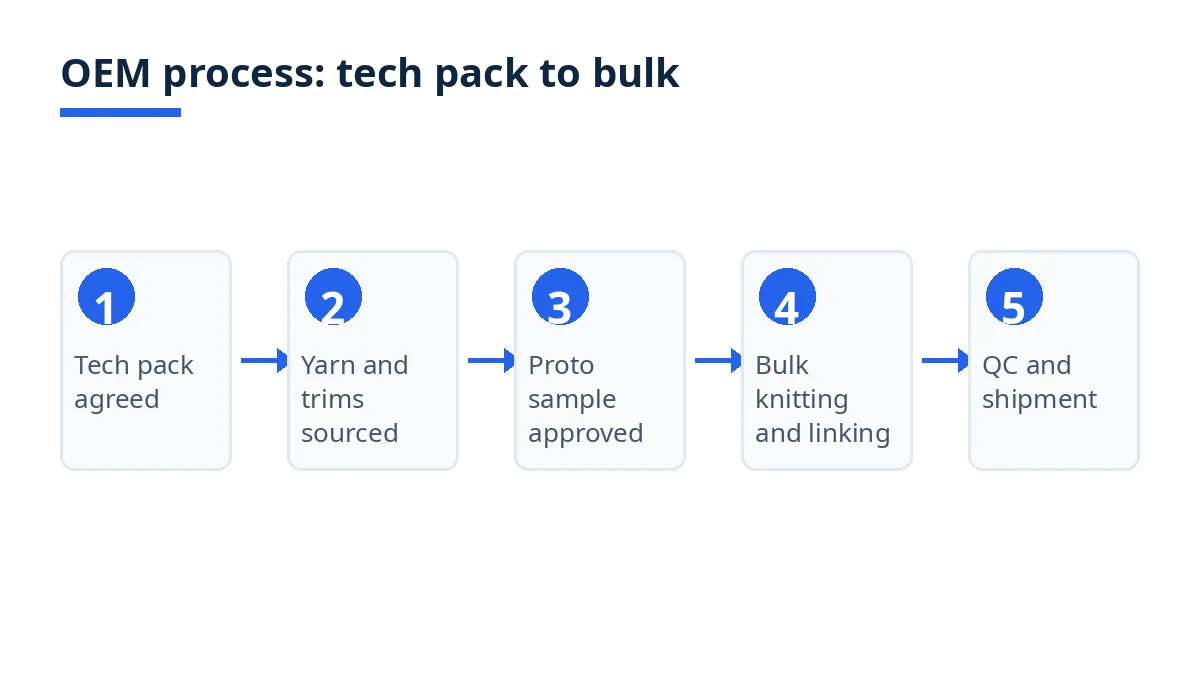
Agree the tech pack. Send the pack, confirm the revision, and get the factory to confirm each section in writing.
Source yarn and trims. The factory confirms yarn count, fiber mix, and dye method against the pack, and confirms button, buttonhole, label, and trim supply. Record whether each input is stocked or bought for your order.
Knit and approve the proto sample. The proto tests construction: gauge, band, collar, button stance, and fit on one size. Measure it against the pack.
Approve fit across sizes. Button stance must be re-marked per size, because a stance copied unchanged from the sample size sits too high or too low on the smallest and largest sizes.
Approve the pre-production sample. This sample is made in the bulk yarn, bulk color, bulk buttons, and bulk labels. It is the last chance to catch a shade difference between the fronts or a label with the wrong fiber percentages.
Run bulk knitting and linking. Changes during bulk need a new written approval.
Inspect, pack, and ship. Inspection follows the level and AQL values agreed before bulk. Packing follows the pack.
Specification decisions that only cardigans force
Gauge, drape, and weight
Gauge decides how the cardigan hangs when worn open. A fine gauge gives a lighter, closer drape and a band that sits flat. A coarse gauge gives a heavier garment and a band with more body. State the gauge, the stitch pattern for each panel, and the finished weight, and measure the proto swatch before the proto garment.
The button band and button stance
The band is the structural spine of a cardigan. Specify its width, stitch, whether it is knitted as part of the front panel or attached separately, and how it is stabilized. Specify the button stance as a measurement from a fixed point, per size, with the number of buttons and the distance between the first and last button.
Buttons need a full specification: material, size, color reference, and shank or sew-through. Buttonholes need the same treatment: worked, bound, or taped, with the finished length stated.
Collars, pockets, and linking
Specify the collar shape, its construction, and how it meets the band at the neck. Pockets sit on a moving front, so specify pocket type and placement measured from fixed points.
Linking joins the panels at the shoulders, armholes, and band. State the linking method and check the join on the proto by pulling the fronts gently apart.
Fiber, color, and labels
State the fiber percentages as they must appear on the label, and confirm them against the bulk yarn before the pre-production sample. For sales into the European Union, Regulation (EU) No 1007/2011 states that a textile product shall be labelled or marked with the name and percentage by weight of all constituent fibers in descending order.3
Color needs a reference both sides can hold: a physical swatch, a named color standard, or an approved lab dip.
A worked example: one cardigan, two button stances
Example figures: a buyer orders a mid-weight open-front cardigan in two colors, with five buttons. The tech pack states the button stance for the sample size only. At fit approval, the smallest size keeps the same first-button distance, so the top button sits high and the collar pulls when worn open. The largest size keeps the same spacing, so the lowest button sits above the expected hem line.
The correction is a stance table, one row per size, with illustrative distances. A stance specified per size can be measured at inspection.
Size | First button from neck point | Last button from hem | Spacing between buttons |
|---|---|---|---|
Small | Set per size | Set per size, measured on the proto | Even, stated in the pack |
Medium (sample size) | As approved on the proto | As approved on the proto | As approved on the proto |
Large | Set per size, measured on the fit set | Set per size, measured on the fit set | Even, stated in the pack |
The same method applies to pocket placement and collar meeting points.
Reading the quotation and the calendar
What are the typical costs and timelines?
There is no typical cost or timeline for a custom cardigan that a guide can state as fact. Each factory prices your gauge, yarn, band construction, button and trim supply, label runs, and delivery term. Ask for the quotation split into lines: yarn, knitting and linking, dyeing and finishing, buttons and trims, labels and packing, inspection, and delivery under the stated term. Ask for set-up lines apart from the unit price: proto, button or label tooling, and a dye lot that serves only your order. The Incoterms 2020 rules provide 11 rules with a clear allocation of cost, risk, and obligations,4 so compare quotations only when they state the same rule and named place.
For timelines, ask for sampling, yarn ready, trim ready, production, inspection, and shipment as separate dates.
Which documents are needed?
The order documents are the tech pack with its revision number, the itemized quotation, the purchase order, and the written approvals at each gate. The purchase order should carry the pack revision, the split, the inspection level and AQL values, and the delivery term.
For the shipment, ask the supplier to list the export papers it will provide, and confirm the list before bulk starts. The commercial invoice and packing list should match the purchase order. Export Verified means Exportain has checked the Export Registration Certificate (ERC).5
Minimums inside an OEM order
An OEM minimum is rarely one number. It is a set of minimums underneath the order: a yarn dye lot per color, a button and trim run, a label print run, and a knitting run per style. The binding minimum is the one your split hits first.
Negotiate the structure, not the number. Fewer colors raise the quantity per color at the same total. One yarn and one color shared across two cardigan styles can share a dye lot, if the factory confirms it in writing. Stocked yarn and stock buttons remove a bought-in lot. Where the floor comes from a label run or button tooling, ask for that cost as a separate line. Read the MOQ definition guide, and ask each reply to state its minimums per style, per color, and per size split in writing.
Where OEM cardigan orders go wrong
What are the most common mistakes?
Approving the proto and skipping the pre-production sample. The proto proves construction; the pre-production sample proves bulk yarn, color, buttons, and labels.
Copying the button stance across sizes. A stance approved on one size is not approved on the size set. Grade the stance and measure it at inspection.
Leaving the band to standard practice. The band is the part most often left vague. Specify its construction, gauge, and stabilization.
Comparing quotations on different packs or different terms. A lower price on a lighter gauge or a different delivery term is a different offer. Compare only replies to the same pack revision on the same Incoterm.4
Reading a profile or a badge as capability. A profile is a starting point. It does not test whether a factory can knit your gauge, and a badge is not a guarantee of capacity, quality, or delivery.5
Inspecting without a written plan. ISO 2859-1 defines a system of acceptance sampling plans for inspection by attributes, indexed by acceptance quality limit (AQL) for lot-by-lot inspection.6 AQL is the maximum average percentage of defective items considered acceptable during random sampling.6 Write the inspection level and AQL values into the purchase order before bulk, and use the cardigan quality control checklist at inspection.
Pre-bulk checklist
Tech pack sent with a revision number; factory has confirmed each section.
Gauge, stitch, yarn, and fiber percentages locked; label percentages match the pack.
Band construction, button stance per size, button and buttonhole specification, and collar meeting point stated.
Yarn and trim status recorded per input: stocked or bought for this order.
Proto measured, worn, and approved in writing, with corrections listed by measurement point.
Fit set approved size by size, including button stance and pocket placement.
Pre-production sample in bulk yarn, bulk color, bulk buttons, and bulk labels, approved in writing.
Minimums confirmed per style, per color, and per size split; binding line named.
Inspection level and AQL values in the purchase order.6
Quotations compared on the same pack revision and Incoterm.4
Export papers listed by the supplier and confirmed before bulk starts.
How Exportain helps
On Exportain, browse suppliers and post a request for quotation on the RFQ board with your tech pack summary, gauge, band and button specification, split per color and size, and delivery term. Ask each reply for its sample process, minimums per color, and inspection plan. When you accept a quotation, Exportain creates one order and issues one proforma invoice from the accepted terms.5
Read the badges for what they record. Exportain Verified means Exportain has checked identity, phone, email, and business registration, and Export Verified means it has checked the Export Registration Certificate (ERC).5 Factory Verified means it has reviewed photos of the manufacturer factory.5 Verification is a document review by staff, free, and never granted by membership plans.7 It is not a factory inspection.5 7 See how supplier verification works on Exportain.
FAQs
What should I know first about cardigans?
A cardigan is an open-front knitted garment. The two fronts, the band, and the button stance are checked together, because shade, band stability, and button alignment show at once when worn open. Knitted cardigans sit under HS heading 6110, which covers jerseys, pullovers, cardigans, waistcoats, and similar articles, knitted or crocheted.8 Confirm the full code with the HS code guide for cardigans.
What are the typical costs and timelines?
There are no typical figures a buyer can rely on, because each factory sets its price, minimum, and lead time for your specification. Gauge, yarn, band construction, button and trim supply, the split, and the delivery term drive the price,4 and yarn and trim availability, correction rounds, and dyeing drive the timeline. Ask for both as separate lines, and compare only quotations written to the same pack revision.
Which documents are needed?
The order documents are the tech pack, the itemized quotation, the purchase order, and the written approvals at the proto, fit, and pre-production gates. For the shipment, ask the supplier to list the export papers it will provide and confirm that list before bulk starts.
What are the most common mistakes?
The most common mistakes are approving the proto and skipping the pre-production sample, copying the button stance across sizes, leaving the band to standard practice, comparing quotations written to different pack revisions,4 and reading a badge as a guarantee of capability.5
Next steps on Exportain
Browse suppliers, then post your tech pack summary, gauge and button-band specification, and split per color and size on the RFQ board. Before you confirm, read how supplier verification works on Exportain and the cardigan quality control checklist.
Sources
- Gauge (textile crafts). Wikipedia (accessed )
- BKMEA at a Glance. BKMEA (accessed )
- Regulation (EU) No 1007/2011 on textile fibre names and related labelling and marking of the fibre composition of textile products. European Union, (accessed )
- Incoterms® 2020. International Chamber of Commerce (ICC) (accessed )
- Trust & Safety Center. Exportain (accessed )
- ISO 2859-1:2026 - Sampling procedures for inspection by attributes — Part 1: Sampling schemes indexed by acceptance quality limit (AQL) for lot-by-lot inspection. ISO (accessed )
- Supplier verification: Earn trust badges buyers can see. Exportain (accessed )
- Classification Detail — HS Code 6110. United Nations Statistics Division (accessed )
About the author
Sourcing from Bangladesh?
Post a request for quotation and suppliers on Exportain can send you their quotes directly.
Post an RFQ