

Curtains Price in Bangladesh: FOB Cost Breakdown for Buyers
A curtains FOB price in Bangladesh is not one number to look up. It is the sum of fabric, dyeing or printing, labour, trims, packing, inspection and port delivery costs, and each driver moves for a different reason. This guide breaks the build-up down line by line.
Short answer
A curtains price in Bangladesh quoted FOB is the price of the finished curtain delivered on board the vessel at the named port of shipment, covering fabric, dyeing or printing, cutting and sewing labour, trims, packing, inspection and inland transport to the port. Ocean freight and import costs sit outside it. Because each driver depends on your specification, compare quotes line by line on the same fabric, construction, trims and port, never on the headline unit price alone.
On this page
Key takeaways
A curtains FOB price covers the finished curtain up to loading on board at the named port of shipment, and ocean freight, insurance and import costs sit outside it.
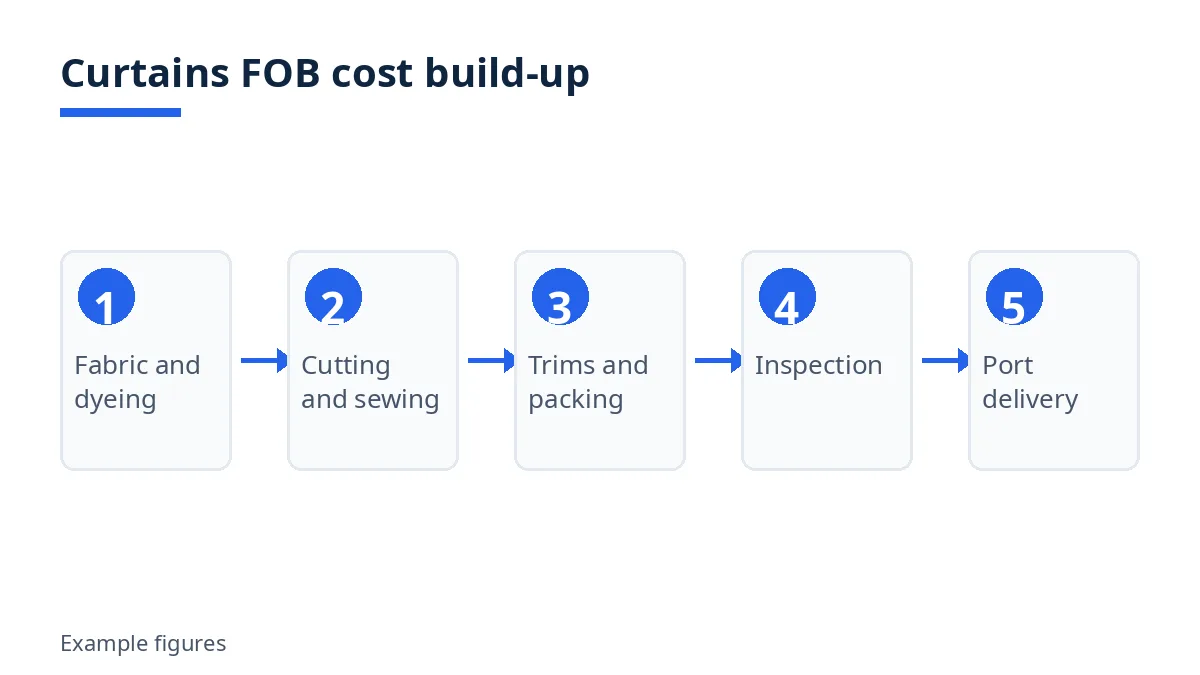
Fabric, dyeing or printing, labour, trims, packing, inspection and inland transport to the port are the seven lines that make up the FOB figure.
Example figures show the structure only: fabric is usually the largest line, so check weight, width and colour source first when a quote looks high.
Compare quotes only after converting them to the same unit, finished size, specification and port, and only on the same Incoterm.
Exportain verification is a document and photo review, not a factory inspection, and a badge is not a guarantee of capacity, quality or delivery.
Ask three suppliers for a curtains price in Bangladesh and you will get three different FOB figures for what looks like the same curtain. The difference is rarely a mystery once the quote is broken into its parts. A curtains FOB price is a build-up: fabric, dyeing or printing, cutting and sewing, trims, packing, inspection and delivery to the port, each priced for your specification. This guide breaks that build-up down driver by driver, so you can read a quote line by line and see which part moves the price.
What a curtains FOB price actually contains
FOB stands for Free On Board. It is one of the Incoterms 2020 rules published by the International Chamber of Commerce (ICC), a set of 11 rules with a clear allocation of cost, risk and obligations between seller and buyer.1 Under FOB, the seller delivers the goods on board the vessel nominated by the buyer at the named port of shipment, having cleared them for export. Risk passes to the buyer once the goods are on board, and the buyer pays the main carriage, insurance and import costs that follow. That boundary is what makes FOB useful for comparison: everything up to loading is inside the price, and everything after it is not.
What should I know first about curtains?
Start with the product, not the price. In the Harmonized System, heading 6303 covers curtains (including drapes) and interior blinds, and curtain or bed valances.2 Subheading 630391, for example, covers curtains of cotton, not knitted or crocheted.2 A cotton voile panel, a lined polyester blackout curtain and a jacquard drape sit under the same heading but carry different fabric, finishing and sewing costs, so quote them as different products. State fabric, construction, finished size, lining, heading style and hardware in every enquiry. See the HS code for curtains guide and the curtains manufacturers in Bangladesh listicle.
Settle the unit early too. Curtains are quoted per piece, per pair or per set, and a per-pair price can look lower than a per-piece price for the same curtain. Ask every supplier to state the unit, finished size and whether hardware is included. Without that, two FOB figures cannot be compared at all.
The FOB cost breakdown, driver by driver
Seven drivers make up almost every curtains FOB price. Each one is described below with what moves it and what to ask about it.
1. Fabric. Fabric is usually the largest single driver. Cost turns on fibre, yarn count, weave, weight per square metre, width and colour. A heavier blackout fabric uses more yarn per panel than a light voile, and a wide fabric cuts with less waste than a narrow one. A custom colour adds a dye lot, while a stocked colour may avoid it. Ask for composition, weight, width and colour source.
2. Dyeing and printing. Dyeing and printing are priced apart from the base fabric when the colour or pattern is made for your order. The driver is the lot: a dye lot has a minimum quantity, and a print run has set-up work for each colour in the design. Ask whether dyeing or printing is inside the fabric price or a separate line, and how many colours the design uses.
3. Labour: cutting and sewing. Labour covers cutting, sewing, hemming, heading formation and finishing. Panel size, layers and detail drive it. A lined, interlined curtain with a pinch-pleat heading takes more time than an unlined rod-pocket panel. Ask how the heading is made, whether lining is included, and how finished size is measured, so a cheaper quote is not simply a smaller or simpler curtain.
4. Trims and hardware. Trims include thread, lining, interlining, tape, rings, hooks, eyelets, tiebacks and labels. Each trim has its own lot or print run, and a trim bought in for your order can set both price and earliest start date. Ask for trims and hardware itemized, with material and colour, rather than as a lump sum.
5. Packing. Packing covers the inner bag, carton, carton marking and folding or hanging method. Curtains are bulky relative to weight, so pieces per carton affect both packing cost and later freight volume, which the buyer pays outside FOB. Ask for pieces per carton, carton dimensions and what marking is included.
6. Inspection. Inspection is the pre-shipment check of the finished lot against the agreed specification and acceptance level. ISO 2859-1 defines a system of acceptance sampling plans for inspection by attributes, indexed by acceptance quality limit (AQL) for lot-by-lot inspection.3 AQL is the maximum average percentage of defective items considered acceptable during random sampling, and it determines sample sizes and acceptance or rejection thresholds.3 Cost moves with sample size, checks required and inspector. Agree the level, AQL values and inspector before production, and ask whether the charge sits inside the FOB price or apart from it.
7. Inland transport and port delivery. The last FOB driver is moving packed cartons from factory to port of shipment, including export clearance and loading on board. For export clearance in Bangladesh, goods may not be loaded unless an export declaration, the Bill of Export or Shipping Bill, is submitted to Customs and approved.4 The enclosed documents include the export contract or purchase order where there is no export letter of credit, the commercial invoice, the packing list, the EXP form certified by an authorized dealer, and a certificate of origin issued by the EPB or a Chamber of Commerce and Industry.4 Inland cost moves with factory-to-port distance, carton volume and port handling.
Example figures: how one quote adds up
Example figures: the table below builds one illustrative FOB price per piece for a lined polyester blackout curtain in a single stocked colour. The figures show structure only, not market prices and not a quotation for any factory.
Line | Example figure per piece |
|---|---|
Fabric | 3.20 |
Dyeing and printing | 0.85 |
Labour: cutting and sewing | 1.10 |
Trims and hardware | 0.45 |
Packing | 0.30 |
Inspection | 0.12 |
Inland transport and port delivery | 0.38 |
Example FOB total per piece | 6.40 |
In this example, fabric is half the FOB price, labour is the second largest line, and inspection is the smallest. That shape is the point: when a supplier quotes a higher FOB figure, the first question is which line grew. If the fabric line grew, check weight and colour source. If the labour line grew, check lining and heading. If the inland line grew, check the port and carton volume. A quote that gives only a total hides all of that, so ask for the build-up in the same seven lines before you compare.
The worked example also shows why the unit matters. The same build-up quoted per pair would read as 12.80 in example figures, and per set of two pairs as 25.60, without any change in the curtain. Convert every quote to the same unit, finished size and port before you rank suppliers.
How each driver moves the price
Change | What moves | Check on the quote |
|---|---|---|
Heavier fabric | Fabric line rises with yarn per panel | Weight and width per fabric line |
More print colours | Set-up per colour | Colour count in the design |
Custom dye colour | Adds a dye lot | Stocked or dyed colour per colour |
Lining added | Second fabric, cutting and sewing | Lining included or not |
Pinch-pleat heading | Extra handwork | Heading type and measurement |
Bought-in trim | Own minimum and lead time | Stocked or bought-in per trim |
Wider inspection scope | Sample size and inspector cost | Level, AQL values, inspector3 |
Do not remove inspection to lower the FOB price. Inspection is the last control before the goods become your stock, so agree its level and AQL values in writing and keep the charge visible.3
What is NOT in an FOB price
Ocean freight is not in an FOB price, and neither is marine insurance, import clearance or import duty in your market. Those costs sit with the buyer once the goods are on board, under the FOB boundary described above.1 A supplier quote that bundles freight into an FOB figure is quoting a different term, and it should be re-quoted as FOB or compared only against other freight-inclusive terms.
Two further exclusions catch buyers out. Destination charges at the arrival port are outside FOB, as is any cost of a change after loading, such as re-routing or re-packing at destination. If your budget must show a landed cost, build it as FOB plus freight, insurance, destination charges and duty, with each line sourced separately, rather than treating the FOB figure as the full cost.
If you sell into the European Union, fibre labelling is a separate compliance line, not a price line. Regulation (EU) No 1007/2011 covers textile fibre names and the labelling and marking of the fibre composition of textile products.5 Confirm the fibre composition of the finished curtain with the supplier and keep it on the label specification, so the labelling matches the fabric actually shipped.
Costs, timelines and documents
What are the typical costs and timelines?
There are no typical FOB costs or timelines a guide can state as fact, because each factory prices your fabric, colour, construction, trims, packing and port for your order, and each order moves through dyeing, cutting, sewing and inspection on its own schedule. The Incoterms 2020 rules allocate cost, risk and obligations for each rule,1 so compare costs only on the same term, the same port and the same specification.
For timelines, ask for separate dates rather than a single delivery week: fabric ready, dyeing or printing complete, cutting and sewing complete, inspection date and loading date. A delay in a bought-in trim or a dye lot moves the whole schedule.
Which documents are needed?
The order documents are the tech pack, the itemized quotation with the seven FOB lines, and the purchase order naming fabric, construction, trims, packing, inspection level, port and Incoterm. The export set is the Bill of Export, commercial invoice, packing list, EXP form certified by an authorized dealer, and a certificate of origin issued by the EPB or a Chamber of Commerce and Industry.4 Keep one legal name across quotation, proforma invoice and export declaration, since the declaration names the exporter and the foreign buyer.4
Mistakes and red flags
What are the most common mistakes?
Comparing totals on different specifications. A lower FOB figure on an unlined curtain, a stocked colour or a different port is a different offer. Compare only replies to the same tech pack, the same unit and the same Incoterm.1
Accepting a lump-sum quote. A single total hides which driver is high. Ask for the seven lines, and re-ask when a line is missing. A supplier that will not break the price down may not be expensive, but its quote cannot be compared.
Treating FOB as a landed cost. Ocean freight, insurance, destination charges and duty sit outside FOB.1 A budget built on the FOB figure alone will fall short by exactly those lines.
Removing inspection to save money. Sampling under ISO 2859-1 checks a lot against an agreed AQL,3 the last control before the goods become your stock. Keep inspection as a visible line and agree its scope in writing.
Reading a badge as a guarantee. A profile is a starting point for enquiries. Verification on Exportain is a document review by staff, not a factory inspection, and a badge is not a guarantee of production capacity, product quality or delivery.6 Sample approval and inspection stay with you.
Checklist: read a curtains FOB quote line by line
Before you confirm, every line below should be answered in writing.
Unit stated: per piece, per pair or per set, with finished size.
Fabric stated: fibre, weight, width, colour source, stocked or dyed to order.
Dyeing or printing stated: colours in the design, included or separate line.
Construction stated: lining, heading type, hardware included or not.
Trims itemized: tape, rings, hooks, eyelets, labels, with material and colour.
Packing stated: pieces per carton, carton dimensions, marking included.
Inspection stated: level, AQL values, inspector, inside or outside the FOB price.3
Port and term stated: named port of shipment, FOB under Incoterms 2020.1
Export set agreed: Bill of Export, invoice, packing list, EXP form, certificate of origin.4
Quotes converted to the same unit, size, port and term before ranking.
How Exportain helps
On Exportain, browse suppliers and post a request for quotation (RFQ) on the RFQ board with your curtain specification, finished size, lining and heading, trim list and named port, so suppliers quote against the same description. Ask each reply for the seven FOB lines above, not only a total. When you accept a quotation, Exportain creates one order and issues one proforma invoice from the accepted terms.6
Read the badges for what they record. Verification is a document review by staff, free, and never granted by membership plans, and it is not a factory inspection.6 See the curtains quality control checklist before you agree inspection, and the how to import curtains from Bangladesh guide for the wider import steps.
FAQs
What should I know first about curtains?
Know the product before the price: heading 6303 covers curtains (including drapes) and interior blinds, and curtain or bed valances,2 but fabric, lining, heading and hardware decide the cost. State the full specification and the unit, per piece or per pair, in every enquiry.
What are the typical costs and timelines?
There are no typical figures a buyer can rely on, because each factory prices your fabric, colour, construction, trims, packing and port for your order. Ask for the seven FOB lines and separate stage dates, and compare only on the same term and port.1
Which documents are needed?
The order documents are the tech pack, itemized quotation and purchase order naming the specification, inspection level, port and term. The export set is the Bill of Export, commercial invoice, packing list, EXP form certified by an authorized dealer, and a certificate of origin issued by the EPB or a Chamber of Commerce and Industry.4
What are the most common mistakes?
The most common mistakes are comparing totals on different specifications or terms,1 accepting a lump-sum quote, treating FOB as a landed cost, removing inspection to save money,3 and reading a badge as a guarantee.6
Next steps on Exportain
Browse suppliers, then post your curtain specification, finished size, lining and heading, and named port on the RFQ board so suppliers return the seven FOB lines. Before you confirm, read the how to import curtains from Bangladesh guide and the curtains quality control checklist.
Sources
- Incoterms® 2020. International Chamber of Commerce (ICC) (accessed )
- Classification Detail — HS Code 630391. United Nations Statistics Division (accessed )
- ISO 2859-1:2026 - Sampling procedures for inspection by attributes — Part 1: Sampling schemes indexed by acceptance quality limit (AQL) for lot-by-lot inspection. ISO (accessed )
- Customs Clearance Procedures for Export. Bangladesh Customs, National Board of Revenue (accessed )
- Regulation (EU) No 1007/2011 on textile fibre names and related labelling and marking of the fibre composition of textile products. European Union, (accessed )
- Trust & Safety Center. Exportain (accessed )
About the author
Sourcing from Bangladesh?
Post a request for quotation and suppliers on Exportain can send you their quotes directly.
Post an RFQ


