

How to Compare CPT Quotations From Bangladeshi Suppliers
Compare CPT quotations from Bangladeshi suppliers on a landed-cost basis: reprice every quotation to one destination place, split out the carriage element, record the handover point, add the same onward costs, and rank by landed cost per unit.
Short answer
To compare CPT quotations from Bangladeshi suppliers, fix one specification, name one destination place and one warehouse, split each CPT price into its goods and carriage elements, record the handover point and first carrier, reprice every quotation to the common destination, add the same onward costs, and rank by landed cost per unit. The lowest headline price often loses once a different destination, an excluded handling charge, or an earlier insurance start is corrected.
On this page
Key takeaways
A CPT comparison starts with one named place of destination: different destination places carry different carriage, so headline CPT prices do not cover the same journey.
Split each CPT price into its goods element and its carriage element, record the handover point and first carrier, then reprice every quotation to the same destination place before ranking.
Add the same onward costs to every quotation: insurance the buyer arranges from the handover point, destination handling not in the carriage contract, duty and taxes from the schedule amount for the confirmed code, confirmed with a broker, broker fees, and warehouse delivery, then rank by landed cost per unit.
Carriage paid is not risk covered: risk passes on handover to the first carrier, and CPT imposes no insurance duty on either party.
A CPT quotation answers two questions at once, and a buyer who reads only the total misses the second one: what the goods and carriage to the named destination cost, and where the seller hands the goods to the carrier, because that handover is the delivery, and risk passes to the buyer there. CPT means Carriage Paid To. Under Incoterms 2020, the seller contracts and pays for carriage to the named place of destination, while delivery and risk pass when the goods are handed to the carrier the seller contracted.1 CPT works for any mode, including multimodal journeys, and the seller clears the goods for export while the buyer clears them for import, with neither party obliged to insure the cargo.2
This article covers the comparison method only. CIP is the insured counterpart: the same handover and carriage pattern, with a seller insurance duty added.
The method normalises every CPT quotation before ranking: fix one destination place, one specification, and one warehouse. Split each price into goods and carriage, record the handover point and first carrier, reprice every quote to the common destination, add the same onward costs, and rank by landed cost per unit. A cheapest headline can be the most expensive after them.
Why this matters for buyers and sellers
For the buyer, a CPT headline blends the goods price, the carriage price to a particular destination, and the carriage contract behind that price. Two suppliers quoting CPT to two different inland terminals have quoted two different journeys, even when product and quantity match. A lower headline may come from a shorter carriage leg, a contract leaving destination handling to the buyer, or a handover point starting the buyer's risk and insurance period earlier.
The risk split is the part buyers most often misread. Under the C rules, delivery and destination are distinct: delivery and risk sit at the handover to the carrier, while the named destination is where seller-paid carriage ends.1 The seller keeps paying for the journey after handover, but the buyer already carries the risk of loss or damage. A buyer who treats a CPT price as a delivered price will leave the transit uninsured from the handover point, or find at destination that unloading and onward transport were never inside the price. For the seller, the same split protects a fair price: a supplier farther from the handover point carries a longer inland leg. See the Incoterms for shipments from Bangladesh guide for how CPT sits among the eleven rules.
Step-by-step: how it works
Rank no quotation until it has passed all of them.
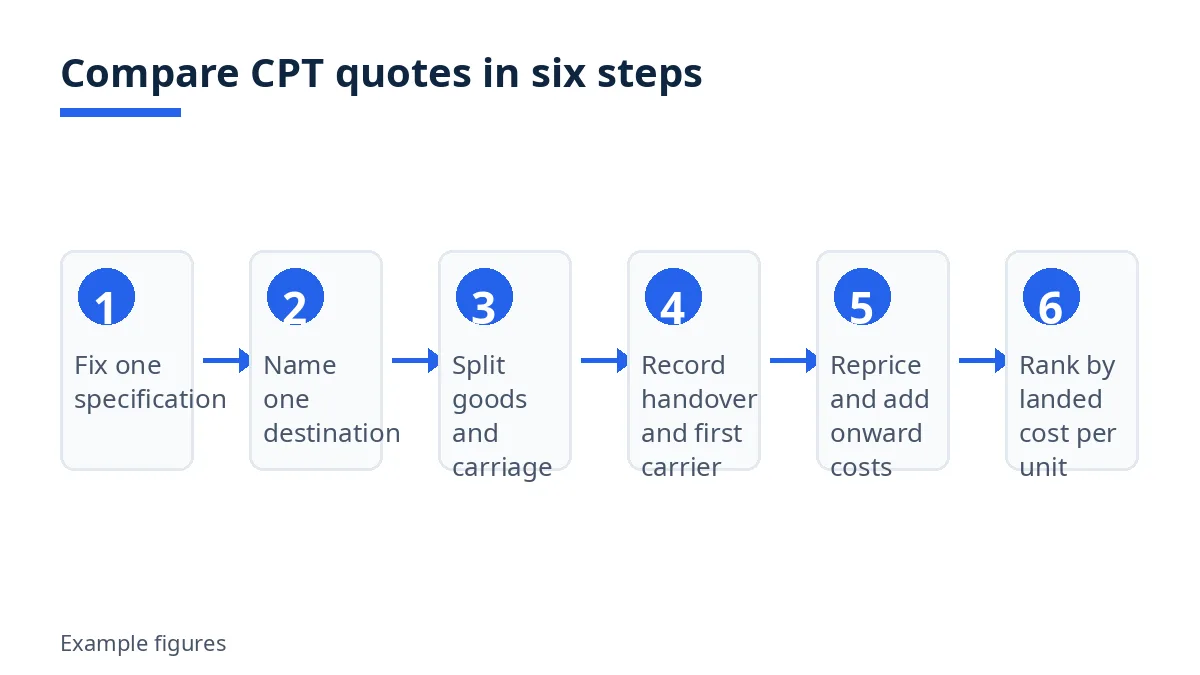
Fix one specification. Send the same product, material, dimensions, quantity and unit, quality standard, packing, marking, and inspection requirement to every supplier.
Name one destination place and one warehouse. Write the destination in full, with country, as in CPT Vienna rail terminal, Austria, Incoterms 2020, and name the warehouse where every landed total will end.
Split each CPT price into goods and carriage. Ask every seller to state the two elements separately, and what the carriage contract already covers: whether destination terminal handling and unloading sit inside seller-paid carriage, or fall to the buyer at arrival. If the contract covers that handling, the seller has paid it, and the destination agent should not invoice the buyer for it again.2 A quotation that will not split is not yet comparable.
Record the handover point and the first carrier. For each quotation, write where the seller hands the goods to the first carrier, and which carrier takes them first. Where several carriers handle successive legs, delivery is on handover to the first carrier.3 This record fixes the risk point and the insurance start.
Reprice every quotation to the common destination. Replace each quotation's carriage element with one common carriage figure to that place, obtained from a forwarder for the same cargo form, mode, and departure window. Keep the original prices on the sheet, so the repricing stays auditable.
Add the same onward costs. To each repriced CPT price, add insurance the buyer arranges from its own handover point, destination handling not in the carriage contract, duty and taxes from the schedule amount for the confirmed code, confirmed with a broker, broker fees, and warehouse delivery, all to the same warehouse.4 5 Use one currency and quantity for every quotation.
Rank by landed cost per unit, then test the ranking. Divide each total by the same quantity, then change one variable at a time: a higher carriage figure, a later departure, or a different handling position. A ranking that flips on a small change is a sign to confirm that line first. Confirm validity, handover window, carrier and route, payment terms, and document set in writing before accepting.
Costs, timelines and documents
Cost lines in a CPT comparison
Build the total in this order: CPT price as quoted, goods and carriage elements inside it, repriced CPT price to the chosen destination, insurance the buyer arranges from the handover point, destination handling not in the carriage contract, duty and taxes from the schedule amount for the confirmed code, confirmed with a broker, broker fees, and warehouse delivery. The CPT price covers goods, packaging and marking, inland transport to the handover point, export clearance, and carriage to the named destination.4 Everything after the named destination is a buyer line, unless the contract says otherwise.
The table below uses Example figures only, for 3,600 woven cotton cushion covers. Quote C has the lowest headline price, but it names Prague, not Vienna, and its carriage contract leaves destination handling to the buyer. After repricing all three quotations to CPT Vienna and adding the onward costs, Quote A has the lowest landed cost per unit. Duty in each column is an example schedule amount: replace it with the schedule amount for your confirmed code, confirmed with a broker.
| Example figures: 3,600 woven cotton cushion covers | Quote A | Quote B | Quote C | | CPT price as quoted, example figure | $29,400 | $30,100 | $28,900 | | Destination place named in the quotation | Warsaw rail terminal, Poland | Vienna rail terminal, Austria | Prague rail terminal, Czechia | | Goods element, example figure | $23,200 | $25,000 | $25,500 | | Carriage element inside the CPT price, example figure | $6,200 | $5,100 | $3,400 | | Handover point | Factory in Gazipur | Dhaka inland depot | Chattogram terminal | | Repriced CPT Vienna rail terminal, example figure | $28,300 | $30,100 | $30,600 | | Insurance arranged by the buyer from the handover point, example figure | $410 | $380 | $360 | | Destination handling not in the carriage contract, example figure | $0 | $0 | $520 | | Duty and taxes, schedule amount for the confirmed code, confirmed with a broker, example figure | $1,820 | $1,960 | $2,010 | | Broker fees and warehouse delivery, example figure | $740 | $740 | $740 | | Landed total, example figure | $31,270 | $33,180 | $34,230 | | Landed cost per unit, example figure | $8.69 | $9.22 | $9.51 |
Read the table by column, not by headline. Quote C wins on headline price and loses on landed cost per unit, because its goods element is the highest and its low carriage figure flattered the headline. Quote A wins after repricing even though its original carriage element was the highest, because its goods element was the lowest.
Timelines
There are no typical costs or timelines that hold for every CPT order, because cargo form, mode, route, gateway, and destination schedule all change the total. Ask for separate dates rather than a single delivery promise: price expiry, production finish, handover window, departure, arrival window, and free time at the terminal. Record the notice the seller will give on handover, since risk passes there whether or not the notice has arrived.1
Documents
Ask for the document set in writing before ranking. It normally includes the commercial invoice showing the CPT price, named destination place, and handover point, the packing list, the export clearance papers the seller completes, the transport document covering carriage to the named destination place, and the insurance policy or certificate for the cover the buyer arranges from the handover point, plus the product code confirmation used for the schedule amount for the confirmed code, confirmed with a broker, and the import declaration papers for arrival. Where successive carriers handle the journey, the transport document should cover the full carriage contracted, not only the first leg.
Bangladesh-specific rules and tips
Start with the handover point, not the destination place. Bangladeshi suppliers may hand goods to the first carrier at the factory, a Dhaka inland depot, or a Chattogram terminal, and each handover starts the buyer's risk and insurance period at a different point. A quotation naming only the destination leaves the most important comparison line blank. Ask every supplier to name its handover point in the same form, so insurance is priced from known starting points.
Keep export clearance with the seller and import clearance with the buyer. Under the C rules, the seller completes export formalities and the buyer completes import formalities and any transit customs.1 If a supplier offers to handle import clearance as part of a CPT price, treat that as a separate service with its own price line.
Check the mode behind each carriage element, because CPT covers any mode and the carriage figure for an air leg, a sea leg, and a sea-plus-rail leg are not interchangeable. A quotation moving goods by air to Vienna airport and one moving them by sea and rail to Vienna rail terminal name different destinations as well as different journeys, even when both say Vienna. Reprice to one destination place and mode before ranking.
Check the destination handling position twice, because it is the most common double charge in a CPT file. If seller-paid carriage already covers destination terminal handling, that charge must not appear again as a buyer line.2 The same check applies to unloading: CPT ends at the named destination place, and unloading is for the buyer unless agreed otherwise.
Mistakes and red flags
Ranking on the headline CPT price, or comparing quotations naming different destination places, modes, or gateways as if they covered the same journey.
Reading a CPT price as a delivered price, and assuming risk stays with the seller until arrival, when risk passes on handover to the first carrier.1
Assuming insurance is included, when CPT imposes no insurance duty on either party, and leaving the transit uninsured from the handover point.
Accepting a quotation that names only the destination, with no handover point and no first carrier recorded.
Accepting destination handling twice: once inside the seller-paid carriage, and once from the destination agent.2
Using a duty figure copied from another product, supplier, or destination, instead of the schedule amount for the confirmed code, confirmed with a broker.
Leaving the insurance start point unwritten, so a loss in transit finds no cover in force from the handover point.
Checklist
One specification sheet sent in identical words to all suppliers.
One destination place in full, with country, and Incoterms 2020 beside the rule.
One warehouse, currency, and quantity for every landed total.
Every CPT price split into goods and carriage elements, carriage inclusions checked so handling and unloading appear only once, and handover point and first carrier recorded.
Every quotation repriced to the common destination place with one forwarder carriage figure.
Insurance arranged by the buyer from each handover point, start point written down.
Duty and taxes from the schedule amount for the confirmed code, confirmed with a broker, broker fees and warehouse delivery added on the same basis, then landed cost per unit calculated, and validity, handover window, carrier and route, payment terms, and document set confirmed in writing.
How Exportain helps
Post an RFQ stating the specification, quantity, destination place, and Incoterm, so every supplier quotes the same journey and goods. On Exportain, an RFQ states quantity and unit, target price, destination, Incoterm, required certifications, and deadline. Keep the destination place identical, and ask each quoting supplier for the goods and carriage split and the handover point before you rank. Exportain records quotations with unit price, MOQ, lead time, Incoterm, payment terms, and validity. Exportain is not a party to the contract for the goods.
FAQs
What should I know first about CPT?
Know first that CPT means Carriage Paid To, and that it applies to any mode of transport, including multimodal journeys.2 The seller contracts and pays for carriage to the named place of destination, delivers by handing the goods to the first carrier, and completes export clearance, while risk passes to the buyer at that handover.1 The buyer handles import clearance, duty, and taxes, and arranges any insurance from the handover point, since CPT imposes no insurance duty on either party.3
What are the typical costs and timelines?
No typical costs or timelines hold for every CPT order, because cargo form, mode, route, gateway, and destination schedule all change the total. The structure is stable: repriced CPT price to one destination place, insurance the buyer arranges from the handover point, destination handling not in the carriage contract, duty and taxes from the schedule amount for the confirmed code, confirmed with a broker, broker fees, and warehouse delivery, giving landed cost per unit.5 For timelines, ask for expiry, handover window, departure, arrival window, and free time separately.
Which documents are needed?
Confirm the commercial invoice showing the CPT price, named destination place, and handover point, the packing list, the export clearance papers the seller completes, the transport document covering carriage to the named destination place, the insurance policy or certificate for the cover the buyer arranges from the handover point, plus the product code confirmation used for the schedule amount for the confirmed code, confirmed with a broker, and the import declaration papers.
What are the most common mistakes?
Ranking on the headline CPT price, comparing quotations to different destination places or modes without repricing them, reading carriage paid as risk covered, assuming insurance is included, paying destination handling twice, accepting a quotation with no handover point or first carrier, and using a duty figure without checking the schedule amount for the confirmed code with a broker. Each mistake changes the landed cost per unit without changing the product.
Next steps on Exportain
Start with one destination place. Post a free RFQ on Exportain with the destination place, quantity, and Incoterm stated in full, then read the Incoterms guide for the full set of rules, the CIF guide for how a sea-only price with seller-bought insurance differs, and the how to buy guide for the quotation steps. Send back any quotation without a carriage split or handover point before ranking.
Sources
- Incoterms® 2020 C rules vs D rules: Risk transfer explained. ICC Academy (accessed )
- CPT Incoterm: Carriage Paid To, Risk vs Cost. Linbis (accessed )
- CPT Incoterms: Meaning, Freight & Risk. iContainers (accessed )
- CPT Incoterms 2020: Meaning, Costs and Responsibilities. Crane Worldwide Logistics, (accessed )
- What is Landed Cost? Definition, Components, Formula, Strategies, FAQs. SimpleGlobal (accessed )
About the author
Sourcing from Bangladesh?
Post a request for quotation and suppliers on Exportain can send you their quotes directly.
Post an RFQ


