

How Much Does Container Loading Check Cost in Bangladesh?
A container loading check is priced per container or per man-day, with no single Bangladesh price. What moves the total, what the inspector checks from empty container to seal, and how to read the report.
Short answer
A container loading check in Bangladesh has no single price. Firms charge per container supervised or per man-day of inspector time, plus travel, weekend or overtime terms, and any return visit. One firm's published 2026 guide gives 200 to 350 dollars per container and South Asia at 240 to 320 dollars per man-day. Compare quotes by total for the same containers and loading hours, and read the report against the count and seal number before the container leaves.
On this page
Key takeaways
A container loading check supervises one loading job, not a production lot: the empty container, the carton count by SKU, the loading order, the securing, and the seal.
There is no single Bangladesh price: firms charge per container supervised or per man-day, plus travel, weekend or overtime terms, and any return visit, so compare totals for identical scope.
The report must reconstruct the load: container condition with photographs, count by SKU against the packing list, staged loading photographs, and a seal number matching the shipping documents.
A loading check counts cartons and does not draw a lot sample: ISO 2859-1 sampling plans belong to lot-by-lot inspections such as a pre-shipment inspection.
A container loading check answers one narrow question: did the right cartons go into a sound, clean container, in a safe loading order, and was the container sealed with the seal number recorded? It is not a judgment on the quality of the goods inside the cartons. That distinction decides what you pay for and what the report can prove afterward.
The check usually takes place at the factory, when the products are loaded into the container in the exporting country, and the whole shipment quantity should already be fully packed before loading starts.1 There is no single Bangladesh price for this service: firms price it per container supervised, or per man-day of inspector time.
Why this matters for buyers and sellers
For the buyer, the loading check is the last physical verification before the doors close: after sealing, the cartons are next seen at destination, weeks later. A short count, a wrong product, a wet container, or a crushed stack found at destination is hard to attribute. A loading report with staged photographs, a reconciled count, and a recorded seal number narrows that dispute.
For the seller, the same record protects a correct load, and a verified seal closing the container before the goods leave the factory clarifies the exporter's position under FOB or EXW terms.1 One published 2026 pricing guide describes per-container pricing as the model used primarily for container loading checks.2 The work scales with containers and loading hours, not with units sampled.
Step-by-step: how it works
Book the check for the loading day. One firm's service page notes that a pre-shipment inspection is typically done one to two days before loading, with the loading check performed on the loading day itself.3 Confirm the sequence in writing for your loading date.
Confirm the booking. State the container size and type, the number of containers, the factory address, and the loading date and start time.
Send the quote pack. Include the purchase order, the packing list with carton counts by SKU, the carton-marking specification, the loading plan, and the seal requirement.
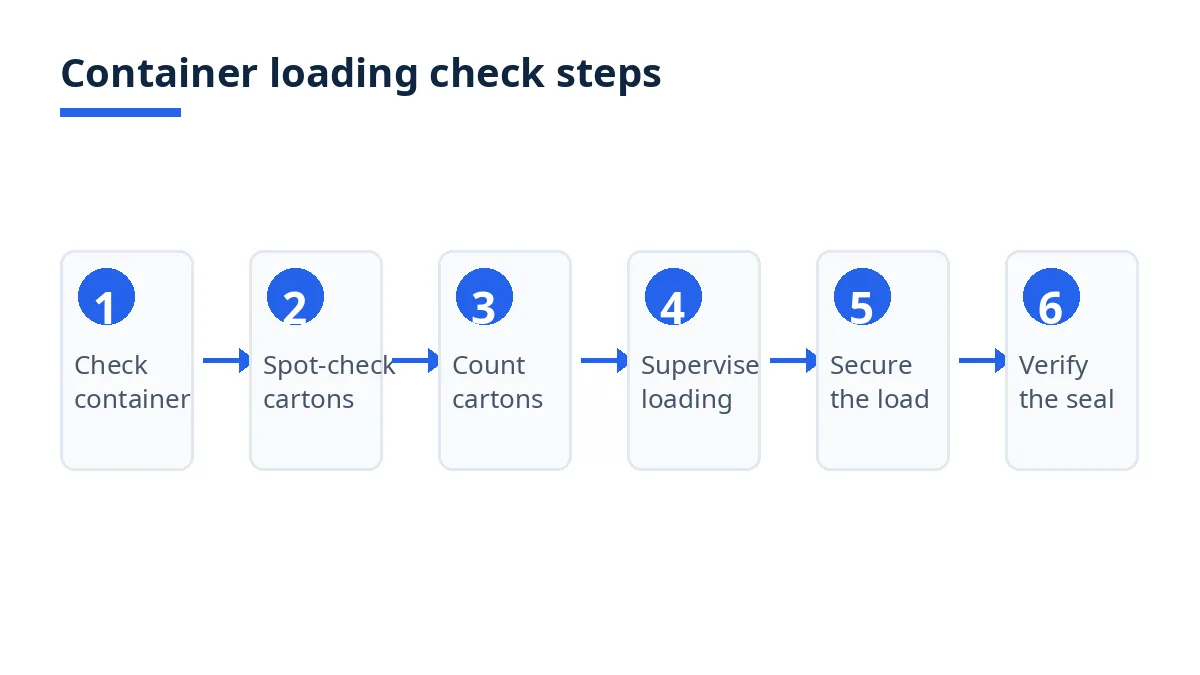
Check the empty container. The inspector examines it for structural damage, cleanliness, and odor, and checks the container number against the booking.4 A leaking, damaged, odorous, or dirty container should be reported at once and, where possible, replaced before loading starts.1
Spot-check cartons and marks. The inspector opens a few cartons to check that products and inner packing match what the buyer expects, and checks outer-carton condition and marks.1 Soft, crushed, or badly closed cartons are a warning: they will face weeks in a container plus handling at ports.1
Count every carton as it is loaded. The inspector verifies quantities against the packing list, confirms stacking that prevents transit damage, photographs the loading process, and records container and seal numbers.4 The count must be the inspector's own tally, not a copy of the loader's count.
Supervise the sequence and the securing. The buyer may send a loading plan or simple directives, such as the heaviest cartons at the bottom.1 The inspector watches that heavy cartons do not sit on light ones, that fragile cartons are not crushed by forklift handling, and that gaps are filled with dunnage.1 For flatrack loads, blocking, bracing, and lashing are verified against the CTU Code.4
Verify the seal last. The inspector verifies that a proper seal closes the container before the products leave the factory.1 The seal number, container number, and final count are recorded against the booking, with photographs of the applied seal.
Costs, timelines and documents
Per-container or per-man-day: which model applies
Ask each firm which model its quote uses: a per-container rate for supervising one container, or a man-day rate for one inspector for one day. A job that runs past one working day, or covers two containers in sequence, can exceed either single quote, so ask how the firm charges for a second container, a second inspector, or overtime.
One firm's published 2026 pricing guide gives a typical range of 200 to 350 dollars per container for container loading checks, or a bundled rate when combined with a pre-shipment inspection.2 The same guide gives South Asia at 240 to 320 dollars per man-day, with Bangladesh higher for non-textile products.2 Treat both ranges as that firm's published ranges, not as a Bangladesh market rate.
Example figures: a per-container fee of 275 dollars plus 60 dollars of separately agreed travel totals 335 dollars. A second container the same day at the same example fee adds 275 dollars. Example figures only, not a quotation for any order.
Cost component | What moves it | Ask for it as |
|---|---|---|
Container fees | Container count, loading hours | Per container, with second-container terms |
Travel | Distance from inspector base, extra sites | Included or separate, per site |
Report and booking | Photo report, cancellation terms | Included in writing, with timing |
What moves the total
Container count and SKU mix. Each container needs its own empty-container check, count, and seal record. A consolidated load, or several SKUs with different marks, counts slowly, because each carton must be matched to the right SKU and mark as it is loaded.1
Travel. The same guide lists a travel surcharge for remote factories of 50 to 150 dollars, and warns that a quote covering inspector time only can cost more than an all-inclusive quote once travel, report, and booking fees are added.2 Ask which factory address the price covers, and whether travel is included.
Weekend, holiday, and overtime loading. The same guide notes a weekend or holiday surcharge of 30 to 50 percent as standard.2 Loading days are often set by the vessel schedule, so ask whether the quote covers the actual loading day.
Report, booking, and a return visit. The same guide notes fees of 30 to 50 dollars for a detailed photo report from a few low-cost providers, free cancellation up to 24 to 48 hours before the inspection date, and a fee of 50 to 100 percent of the inspection cost after that window.2 Confirm the full photo report is included, and agree who pays for a return visit if loading stops.
Timelines
The binding dates are the loading date, the inspector's arrival, and the report. One firm's service page states 48-hour scheduling for its container loading checks, and its China service page states a timestamped photo report within 24 hours of the loading day.3 4 Treat both as that firm's stated terms, and leave room before the vessel cutoff for a seal-number correction or a recount.
Which documents are needed?
The firm needs the purchase order, the packing list with carton counts by SKU, the carton-marking specification, the loading plan, the seal requirement, and the booking details for each container. Keep the report with the shipment file afterward, because the seal number on the report must match the seal number on the shipping documents.
How to read the report
A report you can verify reconstructs the load: the container with empty-container photographs; the count by SKU against the packing list; staged photographs of the sequence, stacking, gap filling, and final wall; and the seal number photographed on the applied seal, matching the report and the shipping documents.
A loading check counts cartons; it does not draw a lot sample. ISO 2859-1:2026 specifies an acceptance sampling system of single, double, and multiple sampling plans for inspection by attributes, with sampling schemes indexed by acceptance quality limit (AQL).5 That system belongs to lot-by-lot sampling inspections, such as a pre-shipment inspection, and does not apply to a loading check. A loading report claiming a lot verdict from carton counting alone, or stating a pass with no count reconciliation and no seal photograph, cannot be checked against the loading job: treat it as unverified and ask for the missing lines before the container leaves.
Bangladesh-specific rules and tips
Bangladesh orders are usually garment orders, and that shapes the loading conversation in three ways. First, product type moves the price: one firm's published guide notes that Bangladesh rates can be higher for non-textile products within its South Asia range of 240 to 320 dollars per man-day.2 If your order is not garments, say so early and ask whether the quote assumes textile loading time or something slower.
Second, carton and container moisture deserve attention on Bangladesh loads. Cartons can soften in wet weather before loading, and a container with moisture, mold, or residue from a previous cargo is one of the common problems inspection firms report finding during loading checks, alongside short counts, wrong products, crush damage from stacking, mismatched seal numbers, and documentation errors.4 Ask the inspector to photograph carton condition on arrival at the factory, before wet or soft cartons are buried in the load.
Third, use the CTU Code as the shared reference for securing, especially for consolidated or non-standard loads. The 2014 Code of Practice for Packing of Cargo Transport Units (CTU Code) applies to packing and transport operations throughout the surface intermodal chain and was jointly developed by the International Maritime Organization (IMO), the International Labour Organization (ILO), and the United Nations Economic Commission for Europe (UNECE).6 It covers selecting a suitable unit, checking that the unit is sound and free from previous cargo residues, load distribution and effective blocking, bracing, and securing, and correct marking and documentation.6 A loading plan citing the CTU Code gives the inspector, the factory, and the carrier the same reference.
Example figures: two containers each hold 400 cartons of knitwear. In the first, heavy cartons form the base layers, light cartons sit on top, and dunnage fills the end gap. In the second, heavy and light cartons are mixed and the end gap is left open. Both hold the same count, but only the first load matches its loading plan. Example figures only, not a loading standard for any cargo.
Mistakes and red flags
What are the most common mistakes?
Comparing a per-container rate with a man-day rate as if they were the same job. Compare totals for the same containers, sites, and loading hours, not headline rates.
Booking for the production week instead of the loading day. If the inspector arrives before the container or before packing is complete, the visit cannot count or seal anything.1
Accepting a count taken from the loader. The inspector's count must be independent. A report repeating the factory tally proves nothing about a short shipment.
Letting the seal be applied before the count is finished. Once the seal is on, the load cannot be corrected without breaking the seal. The seal step comes last.
Treating a loading check as a lot-quality verdict. A loading check confirms identity, count, packing condition, loading order, and seal. One inspection guide states its limits plainly: it is not a replacement for more in-depth inspections, it can only confirm product quality at that stage because nothing can be repaired unless shipment is suspended, and it puts pressure on the factory to load properly.1 For a lot-quality decision, use a sampling inspection under a plan such as ISO 2859-1, agreed before production ends.5
Skipping the empty-container check. A clean count in a leaking or damaged container still ships a problem. If the empty-container photographs are missing, ask why.
Ignoring a seal-number mismatch. If the seal number in the report, on the photograph, and on the shipping documents differ, stop and reconcile them before the container moves. A mismatch found at destination is a dispute; a mismatch found at the factory is a correction.
Checklist
Before you book, every line should be answered in writing.
Containers defined: number, size, and type, with booking details per container.
Loading plan sent: stacking order, heavy-carton placement, dunnage, consolidation split.
Quote pack sent: purchase order, packing list by SKU, carton-marking specification, seal requirement.
Quote in components: basis, travel per site, weekend or overtime terms, report, cancellation terms.
Totals compared on the same containers, sites, and loading hours.
Loading day confirmed: container arrival, loading start, inspector arrival before loading starts.
Empty-container check agreed: condition, cleanliness, odor, and replacement if defective.1
Count method agreed: inspector's own tally against the packing list, by SKU.4
Seal step agreed last: seal number recorded and photographed after the final count.1
Report checked: container, count by SKU, staged photographs, seal number.
Recheck payer and scope agreed before loading day.
How Exportain helps
Exportain does not inspect goods itself. Its supplier verification is a document review by Exportain staff, not a factory inspection, and a badge is not a guarantee of production capacity, product quality, or delivery.7 Use the platform to find suppliers and state your loading requirements in the request itself, so suppliers quote against the same loading plan: post a free RFQ on Exportain.
For the loading check itself, contract directly with the inspection firm and read its quote against this guide's component list. Before you book, read the pre-shipment inspection guide and the AQL guide so the two jobs are booked separately, with separate scopes.
FAQs
What should I know first about container loading checks in Bangladesh?
Know that a loading check supervises one loading job, not a production lot: the empty container, the carton count, the loading order, the securing, and the seal. It is priced per container or per man-day, and there is no single Bangladesh price in published guides. One firm's 2026 guide gives 200 to 350 dollars per container and South Asia at 240 to 320 dollars per man-day, as that firm's published ranges.2
What are the typical costs and timelines?
Typical costs cannot be stated as fact: the total moves with container count, loading hours, SKU mix, travel, weekend or overtime loading, and report terms. Compare totals for identical scope. Book for the loading day, confirm lead time and report timing in the quote, and leave room before the vessel cutoff for a correction or a recount.3 4
Which documents are needed?
The firm needs the purchase order, the packing list with carton counts by SKU, the carton-marking specification, the loading plan or stacking instruction, the seal requirement, and the booking details for each container: container number, size, and type. Keep the report with the shipment file afterward.1 4
What are the most common mistakes?
The most common mistakes are comparing per-container and man-day rates as if they were the same job, booking for the production week instead of the loading day, accepting the loader's count, sealing before the count is finished, treating a loading check as a lot-quality verdict, and ignoring a seal-number mismatch.1 5
Next steps on Exportain
Post your loading requirements on the RFQ board so suppliers quote against the same loading plan. Before you book, read the pre-shipment inspection guide and the AQL guide.
Sources
- Container loading inspection: a guide for importers. QualityInspection.org (accessed )
- How Much Does Product Inspection Cost? 2026 Pricing. Tetra Inspection (accessed )
- Container Loading Inspection Services. Tetra Inspection (accessed )
- Container Loading Check in China. Tetra Inspection (accessed )
- ISO 2859-1:2026 — Sampling for Inspection by AQL. American National Standards Institute (ANSI) (accessed )
- Cargo Integrity. TT Club (accessed )
- Trust & Safety Center. Exportain (accessed )
About the author
Sourcing from Bangladesh?
Post a request for quotation and suppliers on Exportain can send you their quotes directly.
Post an RFQ


