How Much Does Colorfastness Testing Cost in Bangladesh?
Colorfastness testing checks whether a fabric keeps its color through washing, rubbing, light, perspiration, and water contact. This guide explains the methods to book, how to read each grade, what moves a lab quote in Bangladesh, and the terms to agree before samples leave the factory.
Short answer
Colorfastness testing checks whether a dyed or printed fabric keeps its color through washing, rubbing, light, perspiration, and water contact, and it reports the result as a grade for each test. This guide explains the ISO 105 and AATCC methods to book, how to read a colorfastness report, what moves a lab quote in Bangladesh, and what to agree in writing before samples leave the factory.

On this page
Key takeaways
Colorfastness testing reports color change and staining as separate grades for each test and colorway, with light fastness graded against blue wool references on a 1 to 8 scale instead of a gray scale.
The ISO 105 series and the AATCC methods are not interchangeable result for result, so the booking must name the exact method and edition for every test.
No grade figure in this guide decides a pass: the buyer specification governs acceptance, and every result is judged against the grade written into the purchase specification.
A lab quote follows tests, colorways, methods, preparation, report detail, and retest terms, so compare itemized written quotes for the same scope and hold shipment until each tested style is cleared in writing.
Colorfastness testing checks whether a dyed or printed fabric keeps its color through washing, rubbing, light, perspiration, and water contact, and it reports the result as a grade for each test. This guide explains the ISO 105 and AATCC methods to book, how to read a colorfastness report, what moves a lab quote in Bangladesh, and what to agree in writing before samples leave the factory.
A colorfastness result always has two sides. Color change describes how much the tested fabric itself faded or shifted, and staining describes how much dye moved onto an adjacent fabric. A garment can hold its own shade yet still stain a light fabric washed with it, so a report that gives only one of the two numbers cannot settle a complaint. For most tests, the two results are rated on gray scales, with 5 meaning no perceived change or staining and 1 meaning a severe change or staining, as described in the opened grading guide. Light fastness is the exception, comparing the specimen against blue wool references on a 1 to 8 scale.
Two method families frame most bookings, and they are not interchangeable result for result. The ISO 105 series is the international family, and the AATCC methods are the American family, and a buyer in the United States will often specify AATCC methods while a buyer in Europe will often specify ISO 105 methods. Name the exact method and edition in the booking, because wash temperatures, detergents, and adjacent fabrics differ between families, and a grade under one family does not translate into the same grade under the other. ISO 105-C06:2010 specifies methods for determining the resistance of textile color to domestic or commercial laundering using a reference detergent, and states that one single test closely approximates one laundering while one multiple test may in some cases be approximated by up to five launderings at temperatures not exceeding 70 degrees Celsius.1
Why this matters for buyers and sellers
For a buyer, a color that bleeds in the first wash becomes a return, a complaint, or a chargeback, often visible only after the goods reach the consumer. A laboratory colorfastness result, taken before bulk shipment, gives the buyer a dated record tied to a named method, a named colorway, and a named acceptance grade, so a dispute can be settled against paperwork rather than impressions.
For a seller, the same record protects good work. When the tested colorway matches production, a passing result shows that the dyed fabric met the agreed grade, and a failing result, with color change and staining shown separately, tells the dye house where to look first. A wash failure points to dye fixation, a rubbing failure to surface dye, and a light failure to dye selection.
Keep neighboring checks apart, because each is quoted and reported separately.
A general third-party engagement covers a separate scope of independent checking.
Fabric 4-point scoring covers a separate fabric roll scoring scope.
Piece-by-piece sorting covers a separate unit-by-unit segregation scope.
Sample inspection covers a separate approval sample scope.
Seam-strength cost covers a separate cost guide for a different laboratory test.
General lab testing covers a separate wider laboratory package scope.
This guide covers only colorfastness.
Step-by-step: how it works
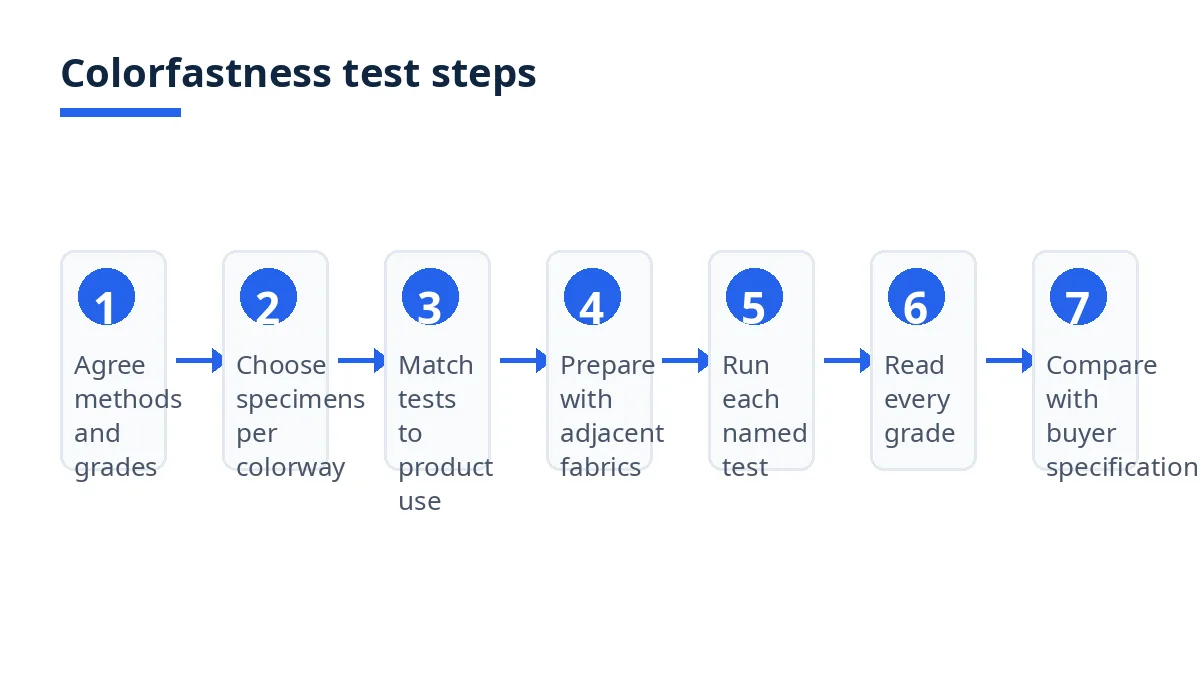
Agree the method, edition, tests, and acceptance grades in writing. Name the method family, the exact method and edition for each test, the colorways to be tested, and the acceptance grade for color change and for staining for each test. The acceptance grades are a buyer specification, agreed with the seller and written into the purchase specification, and no grade figure in this guide replaces them.
Choose the specimen source and keep colorways separate. Test fabric or a finished garment as agreed, and keep every colorway, dye lot, and fabric lot separate. A dark shade and a light shade averaged into one grade hide the weakest color in the group.
Match each test to how the product will be used. Do not book every color test for every style. Wash fastness matters most for garments laundered often, rubbing fastness for dark shades, denim, and prints that touch skin or light fabrics, light fastness for outerwear and home textiles exposed to sun, perspiration fastness for garments worn close to the body, and water, seawater, and chlorinated water fastness for swimwear and beachwear. For items that go in the mouth, ask the laboratory whether a saliva test is within its accredited scope and which method it will use.
Prepare specimens with their adjacent fabrics. In washing and perspiration tests, the specimen is tested in contact with adjacent fabrics so staining can be measured, and in rubbing tests a standard white cloth is rubbed against the specimen so transfer can be measured. Record specimen size, adjacent fabrics, detergent or solution, temperature, and conditioning, because a result without its conditions cannot be repeated.
Run each test under its named method. The table below names the methods used in this guide. Confirm the method and edition on the report before comparing two reports, and confirm whether a washing result is a single test or a multiple test, and whether a rubbing result is dry or wet.
Test | ISO method | AATCC method | What it checks |
|---|---|---|---|
Washing | ISO 105-C06 | AATCC 61 | |
Rubbing, also called crocking | ISO 105-X12 | AATCC 8 | Color transfer to a white cloth through friction, dry and wet2 3 |
Light | ISO 105-B02, and ISO 105-B01 for daylight | AATCC 16.3 | Fading under xenon arc light, against blue wool references2 3 |
Perspiration | ISO 105-E04 | AATCC 15 | Change and staining after artificial perspiration; ISO 105-E04 covers acidic and alkaline solutions, AATCC 15 covers acid perspiration2 |
Water | ISO 105-E01 | AATCC 107 | Change and staining after wet contact3 |
Seawater | ISO 105-E02 | Not named in this guide | Change and staining after salt solution contact2 |
Chlorinated water | ISO 105-E03 | AATCC 162 |
Read every grade in the report, not only the headline. A complete report shows, for each test and each colorway, the method and edition, the color change grade, the staining grade for each adjacent fabric, and for light fastness the blue wool grade. A report that gives one grade for a wash test, with no split between color change and staining, or a rubbing grade with no dry or wet statement, cannot guide a correction.
Compare each grade with the buyer specification and hold shipment on a fail. Judge every test and every colorway against the grade written in step 1. On a fail, agree the correction, the retest specimen source, and the retest scope before the bulk lot ships, and keep the failed report with the retest report.
Costs, timelines and documents
No single colorfastness testing fee applies across Bangladesh. A lab quote is built from the number of tests, the number of colorways, specimens per test, methods named, specimen preparation, report detail, photographs, courier or sample handling, and retest terms. A quote for one colorway and two tests cannot be compared with a quote for three colorways and five tests, and a quote that leaves retesting out looks cheaper until a fail makes a retest necessary.
Pricing models: per test, per colorway, or a package
Labs commonly quote per test, per colorway, or as a package for agreed styles and tests, sometimes with a separate charge for preparation or an urgent report. Ask what the quoted unit includes: preparation, conditioning, dry and wet rubbing, the written report, photographs, and one retest, or none of these.
Example figures: how a quote adds up
Every money figure in this table is an Example figure, invented to show the arithmetic, not quoted from any lab and not a market rate. Confirm every figure in the lab written quote.
Example case | Example figures arithmetic | Example figures total |
|---|---|---|
Example A: one style, wash and rubbing, standard report | Example figures: 2 test sets at 120 plus 1 report at 40 | Example figures: 280 |
Example B: two styles, wash, rubbing and light, photographs included | Example figures: 6 test sets at 120 plus 1 report at 40 plus photographs at 30 | Example figures: 790 |
Example C: one style plus a retest after wash staining | Example figures: 2 test sets at 120 plus 1 report at 40 plus 1 retest set at 120 | Example figures: 400 |
Example A and Example C differ only in the retest set, which is why a quote that leaves retesting out looks cheaper until a fail makes it necessary. Example B costs more than Example A because it tests more test sets.
Example timeline only, not a promise
Example timeline only. This timeline is an illustration, not a promise and not a lab turnaround. Confirm every date in the lab written booking confirmation. Agree the method, tests, colorways, and acceptance grades before sending samples, send specimens that match production, and receive the written report before authorizing shipment of the tested styles. Agree correction or retesting for a failed test set before the bulk lot ships.
Documents to prepare
Send the lab a reference set before testing: the purchase order with style, fabric, colorway, and quantity; the care label and wash conditions; the named method and edition for each test; the acceptance grade for color change and for staining for each test; the specimen list by style, colorway, fabric lot, and test; the report format; the payer, fail, and retest terms; and a shipment hold instruction until each tested style is cleared in writing.
Bangladesh-specific rules and tips
Colorfastness testing in Bangladesh usually runs through a commercial textile laboratory rather than at the factory. Intertek describes ISO 17025-accredited laboratories in Dhaka, Chattogram, and Gazipur, with textile testing capabilities that include color fastness.4 Ask a lab which colorfastness methods and editions its accreditation covers specifically.
For the service listing, note this caveat exactly: the Exportain inspection services page currently renders "No services published in this category yet", so use the link as a category page to watch rather than as a list of available providers. The link is inspection services with that caveat stated.
Plan around the factory calendar and courier time, not only lab time. Confirm when production colorways are ready, the courier route, and the lab booking date in one plan.
Mistakes and red flags
Booking a test with no named method or edition. Insist that the method family, exact method, and edition appear in the booking.
Accepting one grade for a wash test. Ask for color change and staining separately, for each adjacent fabric.
Comparing an ISO result with an AATCC result. Confirm the method family in every report before comparing grades.
Mixing colorways or dye lots into one averaged grade. Keep test sets separate.
Treating a commercial guide grade as a pass mark. Judge every result against the purchase specification.
Shipping before the report arrives. Hold shipment until each test is cleared in writing.
Booking light fastness on a wash-only turnaround. Allow extra time for exposure.
Red flags: no method, no split, no dry or wet statement, a light grade on a gray scale, and a retest from a different lot.
Checklist
Method family, exact method, and edition named for every test, current edition confirmed by the lab.
Tests matched to product use, plus saliva scope asked about for mouth-contact items.
Acceptance grade written for color change and for staining for each test, with light on its blue wool scale, in the purchase specification.
Specimens labeled by style, colorway, fabric lot, and test, duplicate set kept at the factory.
Dry and wet rubbing reported separately, single or multiple washing stated.
Written quote received with tests, colorways, report detail, photographs, and retest terms.
Report received before shipment, with method, edition, color change grade, staining grades, and light grade where booked.
Failed tests corrected and retested from the same production lot before shipment.
How Exportain helps
Exportain connects international buyers with Bangladeshi sellers and service providers. Write the colorways, methods, and acceptance grades into the order, then ask the seller which laboratory will run the tests.
For the service listing, note this caveat exactly: the Exportain inspection services page currently renders "No services published in this category yet", so use the link as a category page to watch rather than as a list of available providers. The link is inspection services with that caveat stated. Also read the pre-shipment inspection guide, which explains sampling of finished goods beside a laboratory result.
FAQs
What should I know first about colorfastness testing?
Colorfastness testing measures how well a fabric keeps its color under washing, rubbing, light, perspiration, and water contact, and it reports color change and staining as separate grades, with light fastness graded against blue wool references. The two method families are ISO 105 and AATCC, and the result only has meaning beside a written buyer specification, because no grade figure in this guide decides a pass. Book tests that match product use and keep colorways separate.
What are the typical costs and timelines?
There is no typical fee or turnaround that applies across Bangladesh, because a quote follows tests, colorways, methods, preparation, report detail, and retest terms, and light testing takes longer than wash or rubbing testing. Use the Example figures table to see how a quote adds up, and confirm every figure and date in the lab written quote before sending specimens.
Which documents are needed?
Send the purchase order, the care label and intended wash conditions, the named method and edition for each test, the acceptance grade for color change and for staining for each test, the specimen list by style, colorway, fabric lot, and test, the report format, and the payer, fail, and retest terms. A lab can only test the colorways described in those documents.
What are the most common mistakes?
The most common mistakes are booking a test with no named method or edition, accepting one grade for a wash test, comparing an ISO result with an AATCC result, averaging different colorways or dye lots into one grade, treating a commercial guide grade as a pass mark, and shipping before the report arrives.
Next steps on Exportain
Post a free RFQ on Exportain, describing the style, fabric, colorways, named methods, and acceptance grades you want tested. Read the pre-shipment inspection guide for finished-goods sampling beside the lab result, and the Acceptance Quality Limit guide for how sampling decisions are set.
Sources
- ISO 105-C06:2010 Textiles — Tests for colour fastness — Part C06: Colour fastness to domestic and commercial laundering. International Organization for Standardization, (accessed )
- Colorfastness Test Methods for Textiles: Complete Guide. QIMA (accessed )
- Colorfastness Testing: Methods and Grades Explained. Wave PLM (accessed )
- Softlines Bangladesh. Intertek (accessed )
About the author
Sourcing from Bangladesh?
Post a request for quotation and suppliers on Exportain can send you their quotes directly.
Post an RFQ