CIF Shipping From Bangladesh to UK: Costs, Steps and Timeline
CIF shipping from Bangladesh to UK: the Chattogram to Felixstowe lane, seller-paid freight and minimum Clause C insurance, Great Britain entry, example costs, and a buyer checklist.
Short answer
Under CIF Felixstowe, Incoterms 2020, a Bangladeshi seller delivers goods on board at Chattogram, clears them for export, pays ocean freight to Felixstowe, and buys minimum Clause C insurance cover at 110% of the contract price for buyer risk, which passes on board. The buyer appoints a UK broker, files the GB import entry, pays duty and import VAT as the broker advises, and arranges inland delivery on a forwarder-confirmed leg. This guide gives documents, example costs, checklist.
On this page
Key takeaways
Under CIF Felixstowe, Incoterms 2020, the seller delivers goods on board at Chattogram, clears them for export, pays ocean freight to Felixstowe, and buys insurance cover for the buyer risk, while risk passes to the buyer on board, not on arrival.
The CIF default insurance is minimum Clause C cover at an insured amount of at least 110% of the contract price; it is named-perils cover, not all-risks cover, so a buyer who needs broader protection must agree wider cover in the contract.
After the CIF price, the buyer pays Felixstowe port and terminal charges, a customs broker fee, import duty confirmed by a broker for the goods concerned, import VAT as the broker advises, and inland delivery only where a forwarder confirms the leg.
The core document set is the commercial invoice, packing list, bill of lading, insurance policy or certificate, and origin proof where a preference claim is intended, plus the United Kingdom import entry data the broker needs, including the buyer EORI number.
A buyer clearing a shipment at Felixstowe under CIF holds two documents that matter more than the headline price: the bill of lading and the insurance certificate. The first lets the buyer claim the cargo, and the second lets the buyer claim on the insurer if the voyage goes wrong. Both should be checked before sailing, because the risk they cover already belongs to the buyer by then.
CIF (Cost, Insurance and Freight) is a rule for sea and inland waterway transport only under Incoterms 2020.1 The seller delivers the goods on board the vessel at the named port of shipment, contracts and pays for carriage to the named port of destination, and procures minimum insurance cover for the buyer's risk.1 The seller clears the goods for export, while the buyer bears import clearance and duties.1 The point that changes how a buyer should read a CIF quotation is the risk point: risk passes to the buyer once the goods are on board at Chattogram, even though the seller keeps paying freight and insurance to Felixstowe.2
Why this matters for buyers and sellers
For the seller, CIF keeps freight and insurance decisions on the origin side, inside one price to Felixstowe. For the buyer, it removes the need to book the ocean leg and buy voyage cover, but also removes control over the carrier, the sailing, and the cover level. Agree that level in the contract, rather than discovering it after a loss.
The minimum cover under CIF is narrow by design. The seller must provide cover complying with Clause C of the Institute Cargo Clauses, or similar clauses, at at least 110% of the contract price.1 Clause C is minimum, named-perils cover for major casualties such as fire, explosion, stranding, sinking, collision, and jettison, while theft, breakage, freshwater damage, and many other common losses are not covered by Clause C alone.3 A buyer who needs broader protection should agree wider cover, for example Clause A, and who pays the extra premium.3
The contrasts with the nearest rules fit in one line each. FOB: the seller delivers on board and the buyer books and pays the main carriage and arranges insurance itself. CFR: the seller pays freight to the named destination port, as under CIF, but need not insure the buyer's voyage risk. CIP: the any-mode equivalent of seller-paid carriage plus insurance, but with Clause A as the default, and risk passing on handover to the first carrier, not on board a vessel.1
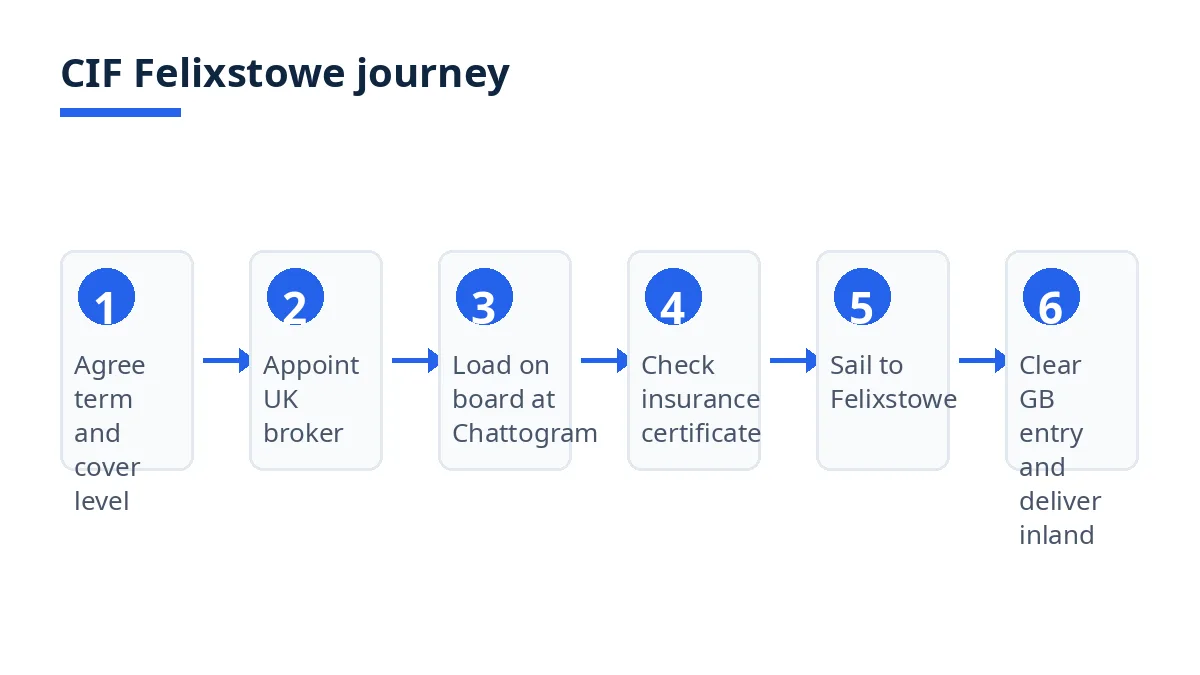
Step-by-step: how it works
Agree the port pair, insurance level, and broker appointment before the goods move.
Agree the term and the cover level in writing. Record "CIF Felixstowe, Incoterms 2020", the goods, quantity, price, payment method, and inspection terms in the contract, with the insurance level in the same clause: the Clause C minimum, or a wider level if agreed, with the insured amount and currency.
Appoint the United Kingdom customs broker before sailing. Agree whether the broker will act directly in your name or indirectly in its own name, and give the broker your EORI number, invoices and contracts as evidence, a description of the goods, and any licences or certification for restricted goods.4 Confirm commodity code, customs value basis, and origin position now, not after arrival.
Prepare, pack, and mark the goods for sea carriage. The seller packs and marks the goods; the buyer confirms the packing, marking, and labeling the United Kingdom market requires before dispatch.
Move the goods to Chattogram, clear them for export, and load on board. The seller arranges inland transport to the port, clears the goods for export, and loads them on board. At that moment delivery is complete and risk passes to the buyer, even though the seller's freight and insurance obligations run on to Felixstowe.2
Receive and check the insurance certificate before sailing. The seller gives the buyer the policy or certificate for a direct claim on the insurer.3 Check the insured amount against the 110% minimum, the cover level, the currency, and the cover period to at least Felixstowe, and have any failure corrected before sailing.
Receive the transport document. The seller provides the usual transport document, normally a bill of lading, covering carriage to Felixstowe.5 Check that parties, quantities, weights, and marks agree with the contract, invoice, and insurance certificate.
Sail the ocean leg and finish the entry file at sea. The seller's contracted carrier moves the cargo from Chattogram toward Felixstowe, through the Bay of Bengal, the Indian Ocean, the Red Sea and the Suez Canal, the Mediterranean, and the Atlantic.6 While the vessel is sailing, the buyer and broker reconcile the documents, so the Great Britain entry can be filed promptly on arrival.
Clear at Felixstowe and deliver inland only on a confirmed leg. The broker files the Great Britain import entry, duty and import VAT are settled as the broker advises, and the buyer arranges release. The CIF price ends at Felixstowe; onward transport is separate, booked only where a forwarder or haulier confirms it in writing, with address, vehicle size, and receiving hours agreed.
Costs, timelines and documents
No single freight rate, insurance premium, port charge, or fee describes a CIF shipment from Bangladesh to the UK, because each one moves with the carrier, the insurer, the season, the cargo, and the contract. The tables below use labeled example figures only; replace every figure with a written quotation for the actual order:
CIF price part | Example figure (USD) | Note |
|---|---|---|
Goods value, contract price | 9,500 | Example only |
Ocean freight, Chattogram to Felixstowe | 1,380 | Example only, seller-paid |
Insurance premium, seller-bought cover | 80 | Example only, never a market rate |
CIF price in this example | 10,960 | Sum of the three example lines |
Check the premium line separately from the arithmetic. The insured amount under CIF must be at least 110% of the contract price, so on a contract price of 9,500 the minimum insured amount is 10,450.1 The premium is what the insurer charges for that cover, not the insured amount, and a low example premium says nothing about a real premium.
The second table shows what the buyer still pays after the CIF price:
Buyer-side line after the CIF price | Example figure (USD) | Note |
|---|---|---|
Felixstowe port and terminal charges | 295 | Example only |
Customs broker fee | 160 | Example only |
Inland delivery to a Leeds warehouse | 240 | Example only, forwarder-confirmed leg only |
Subtotal of buyer-side lines in this example | 695 | Before duty and import VAT |
Duty and import VAT are left out of that subtotal on purpose. The duty rate follows the product classification and the United Kingdom tariff for that product, so no example figure can stand in for it, and this guide asserts no product-specific duty rate. Import VAT at the standard 20% rate is mentioned only as a conditional example: it applies only where the broker confirms that rate and the base for the goods concerned. Ask the broker to confirm classification, duty, and import VAT treatment before pricing for resale.
Great Britain versus Northern Ireland — price them separately. This lane ends at Felixstowe, in England, so it is a Great Britain entry. A delivery onward to, or directly into, Northern Ireland is not the same entry, and the broker must confirm which tariff and declaration apply to that destination before you price it. GOV.UK guidance for goods brought into Northern Ireland from Great Britain states that duty depends on "not at risk" status, origin preference, waiver, relief, or special procedure, and that if none apply, duty is payable at the applicable EU rate.7 Do not copy a Great Britain duty figure onto a Northern Ireland delivery, or the reverse.
On preference, keep the claim tied to proof. GOV.UK tariff material under the Developing Countries Trading Scheme (DCTS) states that for exporters in countries entitled to Comprehensive Preferences, a 0% import tariff applies on 99.8% of products, all products except arms and ammunition.8 That position helps only where the broker confirms the goods qualify and the origin proof is in order. Do not price a duty-free outcome until that confirmation is in writing.
For transit time, read only dated estimates for the exact route and port pair. A route guide updated 24 November 2024 gives 21 to 27 days for full container loads from Chittagong to Felixstowe, Southampton, or London Gateway, and 25 to 33 days for less than container loads.6 Treat that range as a planning estimate from that date, not as a carrier promise, and confirm the booked sailing. The same guide notes a Cape of Good Hope alternative during Suez disruption, adding about 7 to 10 days.6
The document set, with the insurance certificate setting it apart from CFR, is:
Document | Job on this lane |
|---|---|
Commercial invoice | Seller, buyer, goods, value, origin |
Packing list | Carton, quantity, weight, and marks |
Bill of lading | Contract of carriage, carrier receipt, and document of title for claiming the cargo5 |
Insurance policy or certificate | Seller-bought cover the buyer can claim on3 |
Origin proof | Supports any preference claim, in the form the broker confirms |
UK import entry data | EORI number, commodity code, customs value, origin, and licences for restricted goods, given to the broker4 |
Bangladesh-specific rules and tips
Chattogram is the lane in this guide because it is Bangladesh's principal seaport for container cargo; the route guide describes Chittagong, the former spelling of Chattogram, as handling about 92% of the country's international trade.6 Use the current spelling in the contract term.
Three Bangladesh points deserve attention before booking. First, most United Kingdom-bound cargo transships at a regional hub, and the route guide names Singapore as the most common hub, with Colombo, Port Klang, and Tanjung Pelepas as further options.6 Ask whether the booked service is direct or transshipping, and through which hub. Second, inland facilities near Dhaka let exporters stuff containers closer to factories before trucking to Chattogram.6 Third, the same guide notes monsoon effects from June to September, Eid factory closures, and a pre-Christmas peak from August to October.6 Orders in those windows should carry a buffer before sailing.
One caution applies to containers. Containers are normally handed over at a terminal before loading on board, so under CIF the gap between handover and the on-board risk point leaves the pre-loading leg outside the contractual delivery point. The ICC Academy notes that for goods in containers, FCA is often a better choice than FOB, even for maritime transport, for exactly this reason.2 The same logic points a container buyer toward discussing FCA or CIP before signing CIF, since CIP carries seller-bought insurance at Clause A level, with risk passing on handover to the carrier.1
Mistakes and red flags
Writing a bare "CIF UK" with no named port and no Incoterms edition.
Using CIF for air, road, or rail cargo, when CIF is sea and inland waterway only.1
Treating Felixstowe arrival as the risk point, when risk already passed on board at Chattogram.2
Reading a CIF price as duty-paid, when import clearance, duty, and inland delivery sit on the buyer side.3
Assuming seller-bought cover is all-risks cover, when the default is minimum Clause C cover.1
Accepting an insurance certificate without checking the insured amount against the 110% minimum.1
Checklist
[ ] Term written in full: "CIF Felixstowe, Incoterms 2020".
[ ] Insurance level agreed: Clause C minimum, or a wider level.
[ ] Insured amount checked against the 110% minimum.1
[ ] Broker appointed, with direct or indirect acting agreed in writing.
[ ] EORI number, commodity code, customs value, and origin position confirmed.
[ ] Insurance certificate received and checked before sailing.
[ ] Bill of lading checked: parties, quantities, marks.
[ ] Destination charges, broker fee, and inland delivery quoted in writing, inland leg confirmed.
How Exportain helps
Exportain connects buyers with Bangladeshi suppliers and trade-service providers. Before ordering, a buyer can compare supplier profiles and discuss the CIF term, the named destination port, and the insurance level in writing. During preparation, the buyer can line up forwarder and broker contacts for the Chattogram to Felixstowe lane. After loading, the buyer can check the documents against the checklist above, so a mismatch is caught before arrival. Exportain does not set freight rates, insurance premiums, duty rates, or sailing dates; those figures should always come from the carrier, the insurer, the broker, and the official tariff.
FAQs
What should I know first about CIF?
Know the insurance split before the price. Under CIF, the seller delivers on board at the named port of shipment, contracts and pays for carriage to the named port of destination, and buys minimum insurance cover for the buyer's risk, while risk passes on board at origin, not on arrival.1 The seller clears the goods for export, while the buyer bears import clearance and duties. Write the term as "CIF Felixstowe, Incoterms 2020", and check the certificate before sailing.1
What are the typical costs and timelines?
After the CIF price, the buyer pays Felixstowe port and terminal charges, a customs broker fee, import duty, import VAT as the broker advises, and inland delivery where a forwarder confirms the leg. Duty is left for the broker and the official tariff to confirm. For transit, a route guide updated 24 November 2024 gives 21 to 27 days for full container loads from Chittagong to Felixstowe, and 25 to 33 days for less than container loads.6
Which documents are needed?
The core set is the commercial invoice, the packing list, the bill of lading, and the insurance policy or certificate that lets the buyer claim directly from the insurer.3 The bill of lading combines the contract of carriage, the carrier receipt, and the document of title.5 Add origin proof where a preference claim is intended, and the United Kingdom import entry data the broker needs, including your EORI number and licences for restricted goods.4
What are the most common mistakes?
The most common mistakes are a bare "CIF" term with no named port, using CIF for a non-sea leg, treating Felixstowe arrival as the risk point, reading a CIF price as duty-paid, and assuming minimum Clause C cover is all-risks cover.
Next steps on Exportain
Read the CIF definition in full: CIF (Cost, Insurance and Freight) Meaning.
Compare all 11 rules for a Bangladesh shipment: Incoterms for Shipments From Bangladesh.
Price the buyer-side lines to your warehouse: Landed Cost for Imports From Bangladesh.
Sources
- Incoterms 2020 CIF: Spotlight on Cost, Insurance and Freight. Shipping Solutions (accessed )
- Place of delivery & risk transfer in trade contracts. ICC Academy (accessed )
- CIF Meaning (Cost, Insurance & Freight). Exportain (accessed )
- Check what you need to consider before getting someone to deal with customs for you. GOV.UK (accessed )
- Bill of Lading (B/L) Explained: Types, Functions, and How Freight Forwarders Use It in 2026. GoFreight (accessed )
- Shipping from Bangladesh to United Kingdom. GoCubic (accessed )
- How to bring your goods into Northern Ireland from Great Britain without paying duty. GOV.UK (accessed )
- Identify tariffs by product under the Developing Countries Trading Scheme (DCTS). UK Government, Department for Business and Trade (accessed )
About the author
Sourcing from Bangladesh?
Post a request for quotation and suppliers on Exportain can send you their quotes directly.
Post an RFQ