CIF Shipping From Bangladesh to Netherlands: Costs, Steps and Timeline
CIF shipping from Bangladesh to Netherlands: the Chattogram to Rotterdam lane, seller-paid freight and minimum Clause C insurance, Dutch EORI and Rotterdam entry, example costs, and a buyer checklist.
Short answer
Under CIF Rotterdam, Incoterms 2020, the seller delivers goods on board at Chattogram, clears them for export, pays ocean freight to Rotterdam, and buys minimum Clause C insurance cover at 110% of the contract price, with risk passing on board. The buyer appoints a Dutch broker, confirms classification, Dutch EORI, and origin proof before production, files the Rotterdam entry, pays duty and import taxes as the broker advises, and arranges inland delivery only on a forwarder-confirmed leg.
On this page
Key takeaways
Under CIF Rotterdam, Incoterms 2020, the seller delivers goods on board at Chattogram, clears them for export, pays ocean freight to Rotterdam, and buys insurance cover for the buyer risk, while risk passes to the buyer on board, not on arrival.
The CIF default insurance is minimum Clause C cover at an insured amount of at least 110% of the contract price; it is named-perils cover, not all-risks cover, so a buyer who needs broader protection must agree wider cover in the contract.
After the CIF price, the buyer pays Rotterdam port and terminal charges, a customs broker fee, import duty and import taxes confirmed by a broker for the goods concerned, and inland delivery only where a forwarder confirms the leg.
Before production finishes, the buyer appoints the Dutch broker and asks the broker to confirm classification, the Dutch EORI position, origin proof for any preference claim, and the Dutch VAT position including any Article 23 question; the core documents are the commercial invoice, packing list, bill of lading, insurance policy or certificate, and origin proof, plus the Rotterdam entry data.
Before a CIF price from Bangladesh to the Netherlands is compared with any other quotation, open the Rotterdam entry file. Appoint a Dutch customs broker, and ask that broker to confirm four things before production finishes: tariff classification, the Dutch EORI position, the origin proof for any preference claim, and the Dutch VAT position, including whether an Article 23 question applies. A shipment that reaches Rotterdam with an entry the broker has not prepared faces questions or delay at the port, while the CIF price itself has already stopped at Rotterdam.
CIF (Cost, Insurance and Freight) is a rule for sea and inland waterway transport only under Incoterms 2020.1 Under CIF Rotterdam, the Bangladeshi seller delivers the goods on board at Chattogram, clears them for export, pays carriage to Rotterdam, and buys marine insurance cover for the buyer risk.1 Risk passes to the buyer on board at Chattogram, not on arrival at Rotterdam.2 The buyer bears import clearance, duty, and import taxes at Rotterdam, and arranges onward delivery.1 Example figures here are labelled as examples.
Why this matters for buyers
The insurance term is the reason to read a CIF quotation line by line. The minimum cover under CIF complies with Clause C of the Institute Cargo Clauses, or similar clauses, at an insured amount of at least 110% of the contract price.1 Clause C is minimum, named-perils cover: it covers major casualties such as fire, explosion, stranding, sinking, collision, and jettison, while theft, breakage, and freshwater damage are not covered by Clause C alone.3 A buyer who needs broader protection should agree wider cover, for example Clause A, in the contract.3
The cost and risk split is what separates CIF from its neighbors. In the C-rules, the seller arranges and pays for transport to the named destination, but risk for that transport is borne by the buyer.2 Under FOB, the buyer books and pays the main carriage and arranges insurance itself. Under CFR, the seller pays freight as under CIF, but need not insure the voyage risk. Under CIP, the seller also buys insurance, but at the wider Clause A level, and risk passes on handover to the first carrier.1
One caution applies to containers. Containers are normally handed over to the carrier at a terminal before loading, so under CIF the gap between physical handover and the on-board risk point leaves the pre-loading leg outside the contractual delivery point. The ICC Academy notes that for containers, FCA is often a better choice than FOB, even for maritime transport, for this terminal-handover reason.2 A container buyer should therefore discuss FCA or CIP before signing CIF.
The Rotterdam entry is what makes this lane different from a generic port-to-port quotation. Dutch Customs states that when a person first submits a customs declaration, or has one submitted on their behalf, an EORI number is required.4 A buyer who has a third party submit declarations in the Netherlands must apply for an EORI number, which is free of charge.4
Step-by-step: how it works
Start with the Rotterdam entry, then the contract, then the cargo.
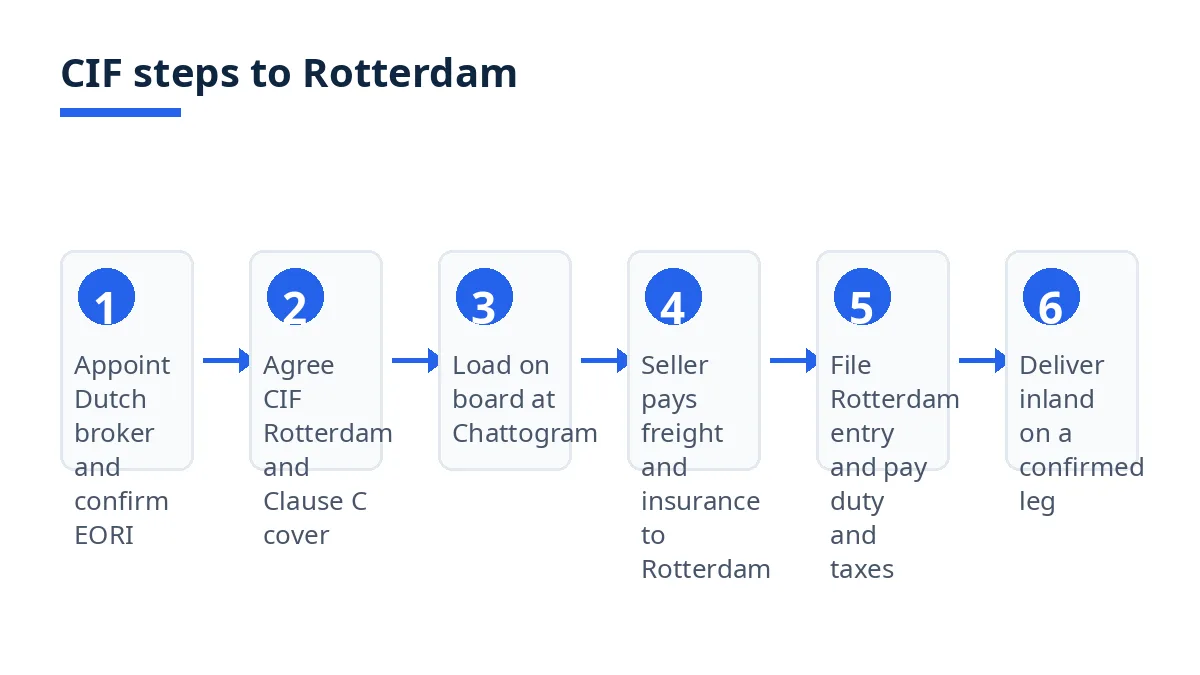
Appoint the Dutch broker before production finishes. Give the broker the product description and HS code, and ask the broker to confirm classification, the Dutch EORI position, duty treatment, origin proof, and the Dutch VAT position, including whether an Article 23 question arises. The Belastingdienst states that the reverse-charge mechanism on import means VAT on import need not be paid immediately, but can be paid when the VAT return is filed, and that an Article 23 permit is needed.5 A foreign entrepreneur cannot apply for an Article 23 permit itself, but can engage a tax representative.5
Agree the term in writing. Record "CIF Rotterdam, Incoterms 2020", the goods, quantity, price, payment method, and inspection terms in the contract, with the insurance level in the same clause: the Clause C minimum, or a wider level if agreed.
Prepare, pack, and mark the goods for sea carriage. Ask the broker to confirm the labeling checks at Rotterdam and the origin documentation for any preference claim.
Move the goods to Chattogram, clear them for export, and load on board. At that moment delivery is complete and risk passes to the buyer.2
Receive the transport document and the insurance certificate. The seller provides the usual transport document, normally a bill of lading, covering carriage to Rotterdam, and gives the buyer the insurance policy or certificate for a direct claim on the insurer.3 Check names, quantities, weights, and marks across all four documents.
Sail from Chattogram toward Rotterdam via the Suez Canal passage, approximately 7,800 nautical miles.6 Most services transship at Singapore, Colombo, or Port Klang, adding 3 to 7 days compared with a direct service.6 Confirm the transshipment port and onward sailing in writing.
Handle the Rotterdam arrival. The buyer or its broker files the import entry using the EORI number and the entry data confirmed before production.4 Pay the duty and import taxes the broker confirms before release. After release, deliver inland only on a confirmed leg: the CIF price ends at Rotterdam, so onward transport is booked only where a forwarder confirms it in writing, whether by road, rail, or Rhine barge.6
Costs, transit time and documents
No single freight rate, premium, port charge, or fee describes a CIF shipment on this lane, because each moves with the carrier, insurer, season, cargo, and contract. The tables below use labelled example figures.
CIF price part | Example figure (USD) | Note |
|---|---|---|
Goods value, contract price | 17,600 | Example only |
Ocean freight, Chattogram to Rotterdam | 1,475 | Example only, seller-paid |
Insurance premium, seller-bought cover | 138 | Example only, never a market rate |
CIF price in this example | 19,213 | Sum of the three example lines |
The insured amount under CIF must be at least 110% of the contract price, so on a contract price of 17,600 the minimum insured amount is 19,360.1 The premium is the insurer charge, not the insured amount. The buyer still pays the following after the CIF price:
Buyer-side line after the CIF price | Example figure (USD) | Note |
|---|---|---|
Rotterdam port and terminal charges | 340 | Example only |
Customs broker fee | 210 | Example only |
Inland delivery to a Utrecht warehouse | 265 | Example only, forwarder-confirmed leg only |
Subtotal of buyer-side lines in this example | 815 | Before duty and import taxes |
Duty is left out of that subtotal, and this guide asserts no product-specific Dutch duty rate. Duty follows the classification and the EU tariff for that product. On preference, this guide goes only as far as the European Commission source states it: as a least developed country, Bangladesh benefits from the Everything But Arms arrangement, which grants duty-free, quota-free access for all exports except arms and ammunition.7 Whether a given shipment qualifies is origin-proof dependent, so ask the broker to confirm the proof required before claiming any preference.
Dutch VAT is shown here only as a conditional illustration, not as part of the subtotal above. This guide states no VAT rate, asserts no VAT-base formula, and draws no conclusion about recoverability. As an illustration only, on a broker-confirmed base of EUR 32,000, ask the broker to confirm the Dutch VAT amount payable; that amount stays outside the example subtotal until the broker confirms it. On Article 23, this guide goes only as far as the Belastingdienst source states it: if a tax representative is used, the representative will declare the VAT required on the VAT return for that period and deduct this VAT as input tax on the same VAT return, so the buyer will not be required to pay this VAT in advance on import.5
For transit time, read only dated guide estimates for the exact route and port pair, as planning figures, not facts about a booked sailing. A route guide updated 24 November 2024, re-opened and re-verified for this guide, gives 22 to 28 days for FCL via transshipment, the most common pattern, 20 to 24 days for a direct FCL service, and 26 to 34 days for LCL once consolidation time is added.6 Peak seasons, monsoon disruption, and Chattogram congestion can move a booked sailing away from a guide figure, so confirm the sailing and arrival window in writing.6
The document set is small:
Document | Job on this lane |
|---|---|
Commercial invoice | Seller, buyer, goods, value, origin |
Packing list | Carton, quantity, weight, marks |
Bill of lading | Contract of carriage and document of title |
Insurance policy or certificate | Seller-bought cover the buyer can claim on3 |
Origin proof | Origin and any preference claim, as the broker confirms7 |
Rotterdam entry data | Import filing at Rotterdam, using the EORI number4 |
Bangladesh-specific rules and tips
Chattogram is the lane in this guide because it is Bangladesh's principal seaport, handling over 90% of Bangladesh's international trade.6 If cargo loads at Mongla instead, write that port into the term, because term, sailing, and documents must all name the same loading port.
On origin, keep the EBA statement and the shipment claim separate. The European Commission states that 91% of Bangladesh's exports to the EU enter duty- and quota-free, and that Bangladesh is the largest beneficiary under the Everything But Arms arrangements.7 That describes the trade flow as a whole, not one consignment. For one consignment, the broker confirms the classification, origin rule, and proof the seller must supply before filing. A route guide notes the same point: claiming EBA benefits requires rules-of-origin compliance, with GSP Form A or a Registered Exporter System self-declaration for larger values, plus supporting records.6
Use Rotterdam as the EU entry point, with onward distribution as a separate, forwarder-confirmed leg. Rotterdam offers Rhine barge, rail, road, and warehousing capacity, but none is inside the CIF price.6 Price the inland leg to the actual warehouse address.
Mistakes and red flags
Writing a bare "CIF Netherlands" with no named discharge port and no Incoterms edition.
Using CIF for air, road, or rail cargo, when CIF is sea and inland waterway only.1
Treating arrival at Rotterdam as the risk point, when risk already passed on board at Chattogram.2
Reading a CIF price as a delivered, duty-paid price, when import clearance, duty, import taxes, and inland delivery sit on the buyer side.3
Assuming the seller-bought cover is all-risks cover, when the default is minimum Clause C cover.1
Accepting an insurance certificate without checking the insured amount against the 110% minimum.1
Leaving the broker, EORI, classification, and origin-proof questions until the vessel sails.
Claiming an EBA preference without the origin proof the broker confirms.7
Adding a VAT figure into the subtotal before the broker confirms the base and amount.
Booking the inland leg before the entry is filed and release is clear.
Checklist
[ ] Term written in full: "CIF Rotterdam, Incoterms 2020".
[ ] Dutch broker appointed, with acting basis agreed in writing.
[ ] Classification, Dutch EORI position, and duty treatment confirmed by the broker before production finishes.
[ ] Origin proof for any preference claim confirmed by the broker, and seller proof requested in writing.
[ ] Dutch VAT position confirmed by the broker, including whether an Article 23 question arises.
[ ] Insurance level agreed in the contract: Clause C minimum, or a wider level.
[ ] Insured amount checked against the 110% minimum on the certificate.1
[ ] Insurance certificate received and checked before sailing.
[ ] Ocean service confirmed: sailing date, transshipment routing, Rotterdam discharge.
[ ] Duty and import taxes confirmed by the broker; VAT illustration kept out of the subtotal until the broker confirms the base and amount.
[ ] Rotterdam port charges, broker fee, and inland delivery quoted in writing, inland leg confirmed by the forwarder.
[ ] Entry documents filed, with names, quantities, weights, and marks agreeing across invoice, packing list, bill of lading, and insurance certificate.
How Exportain helps
Exportain connects buyers with Bangladeshi suppliers and trade-service providers. Before ordering, a buyer can compare supplier profiles and discuss the CIF term, discharge port, and insurance level in writing. After loading, the buyer can check the four core documents against the checklist above.
FAQs
What should I know first about CIF?
Know the Rotterdam entry before the price. Under CIF, the seller delivers on board at shipment, pays carriage to Rotterdam, and buys minimum insurance cover for the buyer risk, while risk passes on board at origin, not on arrival.1 Write "CIF Rotterdam, Incoterms 2020", appoint the Dutch broker before production finishes, and ask the broker to confirm classification, EORI, origin proof, and VAT.4
What are the typical costs and timelines?
After the CIF price, the buyer pays Rotterdam port and terminal charges, a broker fee, import duty and import taxes as the broker advises, and inland delivery where a forwarder confirms the leg. Duty is left for the broker and the official tariff to confirm. The VAT illustration is kept out of the example subtotal until the broker confirms the base and amount. For transit, a route guide updated 24 November 2024 gives 22 to 28 days for FCL via transshipment, 20 to 24 days for a direct FCL service, and 26 to 34 days for LCL, as a planning figure only.6
Which documents are needed?
The core set is the commercial invoice, packing list, bill of lading, and insurance policy or certificate that lets the buyer claim directly from the insurer.3 Add origin proof where a preference claim is intended, and the Rotterdam entry data, using the EORI number the broker confirms.4 7
What are the most common mistakes?
The most common mistakes are writing a bare "CIF Netherlands" with no named port, treating arrival at Rotterdam as the risk point, reading a CIF price as duty-paid, assuming Clause C cover is all-risks cover, claiming a preference without the origin proof the broker confirms, and leaving the broker questions until the vessel sails. Each is fixed by writing the full term, checking the certificate against the 110% minimum, and getting the broker answers before production finishes.1 4
Next steps on Exportain
CIF Meaning (Cost, Insurance and Freight) — the full CIF rule, its insurance minimum, and how the CIF value is used at customs.
Incoterms for Shipments From Bangladesh — all 11 rules compared, and when FCA or CIP fits a container shipment better than CIF.
Landed Cost for Imports From Bangladesh — build the full warehouse cost from a CIF price, line by line.
Sources
- Incoterms 2020 CIF: Spotlight on Cost, Insurance and Freight. Shipping Solutions (accessed )
- Place of delivery & risk transfer in trade contracts. ICC Academy (accessed )
- CIF Meaning (Cost, Insurance & Freight). Exportain (accessed )
- How to obtain an EORI-number. Dutch Customs (accessed )
- Reverse-charge mechanism on import: Article 23. Belastingdienst (accessed )
- Shipping from Bangladesh to Rotterdam. GoCubic (accessed )
- EU trade relations with Bangladesh. European Commission, (accessed )
About the author
Sourcing from Bangladesh?
Post a request for quotation and suppliers on Exportain can send you their quotes directly.
Post an RFQ