CIF Shipping From Bangladesh to Canada: Costs, Steps and Timeline
CIF shipping from Bangladesh to Canada: the Chattogram to Vancouver lane, broker-led CBSA entry, seller-paid freight and minimum Clause C insurance, buyer-side costs, bilingual labelling, example figures, documents, and a buyer checklist.
Short answer
Under CIF Vancouver, Incoterms 2020, a Bangladeshi seller delivers goods on board at Chattogram, clears them for export, pays ocean freight to Vancouver, and buys minimum Clause C insurance at 110% of the contract price for the buyer, while risk passes on board. The buyer appoints a licensed Canadian customs broker, completes the CBSA entry at Vancouver, settles duty and GST as the broker confirms, and arranges inland delivery as a forwarder-confirmed option.
On this page
Key takeaways
Under CIF Vancouver, Incoterms 2020, the seller delivers on board at Chattogram, clears export, pays freight to Vancouver, and buys minimum Clause C insurance at 110% of the contract price, while risk passes to the buyer on board, not on arrival.
Start at the Canadian end: appoint a licensed customs broker, complete CARM registration and delegation, and confirm classification, tariff treatment, and origin proof before pricing the order.
The CIF default insurance is minimum Clause C named-perils cover, not all-risks cover, so a buyer who needs wider protection must agree it in the contract and agree who pays the extra premium.
After the CIF price, the buyer pays Vancouver port and terminal charges, a broker fee, duty and GST as the broker confirms, and inland delivery only where a forwarder confirms the leg for the actual warehouse address.
A buyer planning a CIF shipment from Bangladesh to Canada should start at the Canadian end of the journey, not at the loading port. The first decisions are the arrival port, the licensed Canadian customs broker who will handle the entry, and the warehouse the goods must reach after release. The arrival port sets the broker routing and the inland leg, so this guide follows that order: Vancouver entry first, then the sea leg back to Chattogram, then the costs, documents, and checks around both ends.
Under CIF Vancouver, Incoterms 2020, the seller delivers the goods on board the vessel at Chattogram, clears them for export, contracts and pays for carriage to Vancouver, and buys marine insurance for the buyer. Risk passes to the buyer when the goods are placed on board at Chattogram, not when they arrive in Vancouver.1 CIF is a sea and inland waterway rule only, and it is one of only two Incoterms 2020 rules that require the seller to buy insurance.1 The split that causes most disputes is built into the rule: the seller pays freight and insurance to the destination port, while risk already sits with the buyer from loading onward.
Why this matters for buyers
A CIF price to Vancouver covers the goods, the ocean freight to Vancouver, and minimum insurance. It does not cover Vancouver port and terminal charges outside the freight contract, the customs broker fee, import duty, Canadian GST, or inland delivery to the warehouse. A buyer who budgets only the CIF price has covered the sea leg, not the landed cost. The CBSA notes that goods imported into Canada are generally subject to the 5% Goods and Services Tax and potentially subject to customs duties, with duties based on tariff classification, country of origin, and value.2 That is why the broker conversation must happen before the order is priced, not after the vessel sails.
The Vancouver entry also changes the timing of the work. To import commercial goods, a buyer needs a Canada Revenue Agency business number and access to the CBSA Assessment and Revenue Management system, known as CARM, and a buyer using a customs broker first registers in CARM and then delegates authority to the broker through the CARM Client Portal.2 If that registration and delegation wait until the vessel is close to Vancouver, any missing origin proof or classification question becomes a delay at the port. Appointing the broker early turns the entry into a planned step.
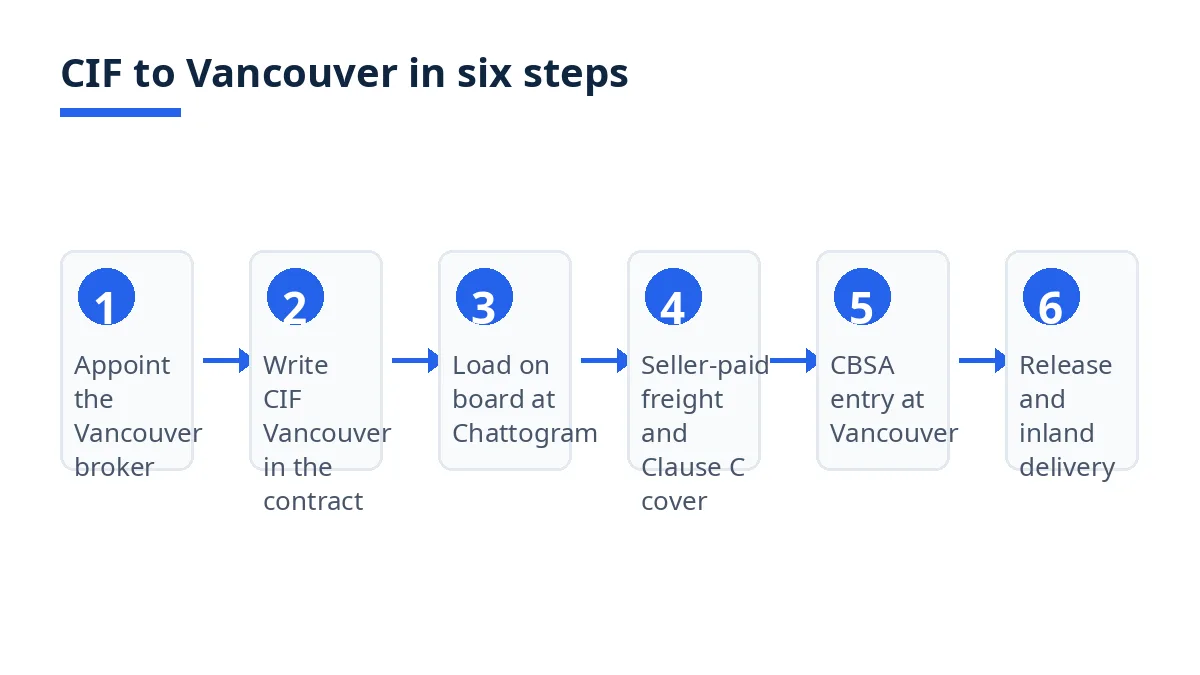
Step-by-step: how it works
The lane in this guide is Chattogram to Vancouver throughout. Keep that pair fixed while planning, because a different Canadian arrival port changes the entry routing, the broker file, and the inland leg. Vancouver is the primary port here because it is the Pacific gateway for this lane, with onward rail connections for goods moving inland.3
Appoint the licensed Canadian customs broker and fix the arrival plan. Record the term in full, for example "CIF Vancouver, Incoterms 2020", together with the goods, quantity, price, payment method, and inspection terms. At the same time, appoint the broker, register in CARM, and delegate authority to the broker in the portal.2
Agree the insurance level in writing. The CIF default is minimum cover complying with Clause C of the Institute Cargo Clauses, at an insured amount of at least 110% of the contract price.1 4 Clause C is named-perils cover for listed major casualties, not every loss, so a buyer who needs wider protection must agree it in the contract and agree who pays the extra premium.4
Confirm the freight terms to Vancouver, including what happens on arrival. The seller contracts and pays for carriage to Vancouver, but the contract of carriage decides who bears unloading costs and which destination charges are already included.4 Ask the seller to confirm in writing whether unloading, terminal handling, and documentation charges at Vancouver sit inside the freight price or will be billed on arrival.
Load on board at Chattogram and collect the on-board evidence. The seller delivers the goods on board, clears them for export, and provides the transport document, normally a bill of lading, that lets the buyer claim the goods from the carrier at Vancouver.4 Check that the bill of lading, invoice, packing list, and insurance certificate agree on goods, quantity, marks, and value before departure, because a mismatch found at Vancouver is far harder to correct than one caught at Chattogram.
File the Vancouver entry through the broker. The broker prepares the entry in CARM, using the classification, value, and origin confirmed at step 1. The CBSA notes that importers unsure about classification, value, or origin can request an advance ruling, and that some goods also need permits, certificates, or inspections from other government departments before release.2 Raise any permit or inspection question with the broker before the vessel arrives.
Take release at Vancouver and arrange the inland leg as a separate, confirmed option. Once the entry is accepted and the duty and GST positions are settled as the broker advises, the goods are released for onward movement. The inland leg is not part of the CIF price, so it needs its own forwarder confirmation for the actual warehouse address and delivery window. Do not price the order on an assumed inland rate.
Costs, timelines and documents
The example below is built for this guide only. Every figure is an example figure, not a quoted price, freight rate, or charge for any supplier, route, or shipment, and all figures are in Canadian dollars.
Line | Example figures (CAD) |
|---|---|
Goods value | 13,800.00 |
Ocean freight, Chattogram to Vancouver, seller-paid | 1,540.00 |
Insurance premium, minimum Clause C cover | 135.00 |
CIF value, Vancouver | 15,475.00 |
Minimum insured amount, 110% of goods value | 15,180.00 |
Vancouver port and terminal charges, buyer-side | 295.00 |
Customs broker fee | 165.00 |
Inland delivery, Vancouver to Calgary warehouse, forwarder-confirmed option | 265.00 |
Buyer-side subtotal, before duty and GST | 725.00 |
Duty is not in the subtotal, and no duty rate is stated for any product in this guide. The CBSA country list marks Bangladesh as a designated beneficiary country for the Least Developed Country Tariff, alongside the Most Favoured Nation and General Preferential Tariff treatments.5 That listing alone does not fix the duty for an order: the broker must confirm the treatment for the exact tariff item, the origin proof the entry requires, and the fallback treatment if the claim is not proved.
GST is shown here only as a conditional illustration, kept outside the subtotal. The CBSA states that imported goods are generally subject to the 5% GST, with duties potentially applying on top.2 As a conditional illustration only, 5% on a broker-confirmed example base of 15,475.00 CAD gives 773.75 CAD. That illustration is not added to the subtotal above, no provincial tax figure is stated, and no conclusion is drawn about recovery. The broker confirms the base and treatment for the actual entry before pricing.
For transit, use a dated estimate and confirm the booked sailing. A route guide updated November 24, 2024 gives 26 to 33 days for standard full container load ocean transit from Bangladesh to Vancouver, with transshipment through Singapore or Colombo.3 That figure is a dated guide estimate, not a promise for any sailing, and it excludes loading, release, and any inland leg. Ask the forwarder for the current routing and the allowance for Vancouver release and the inland leg, and build customer delivery promises from the forwarder answer, not from the guide figure.
The document set for the Vancouver entry is short, and each document has a distinct job. The commercial invoice states goods, value, and origin. The packing list itemizes the cargo so the broker, carrier, and any examiner can match cartons to the invoice. The bill of lading is at once the contract of carriage, the carrier receipt, the document of title that lets the holder claim the cargo at destination, and the primary evidence used for damage or loss claims.6 The insurance policy or certificate lets the buyer claim directly from the insurer for a covered loss.1 Add the origin proof the broker specifies where a tariff treatment is claimed, and keep the CARM delegation and business number records with the entry file.2
Bangladesh-specific rules and tips
First, the loading point matters more than the country name: write "CIF Vancouver" with Chattogram as the port of shipment, and confirm that the seller will load on board at Chattogram rather than handing the container to a terminal and treating that handover as delivery. CIF delivery and risk pass only when the goods are placed on board, so a container handed over at a terminal before loading sits in a gap between physical handover and contractual delivery.4 If the real handover is at a terminal, ask the broker and forwarder whether CIF still matches the operation or whether a carrier-handover rule fits better, and record the answer in the contract.
Second, labelling for the Canadian market should be settled with the supplier before production, not after arrival. For prepackaged non-food consumer products, the federal guide states that the product identity declaration must be shown in English and French, and that the net quantity declaration is likewise bilingual, while the dealer name and principal place of business may appear in either official language.7 Food, textile, and other regulated products carry their own labelling rules, so confirm the exact label set for the product with the broker or the relevant Canadian authority and send approved artwork to the supplier before cartons are printed.
Third, keep the origin file as carefully as the shipping file. The CBSA list confirms Bangladesh as a designated beneficiary for the Least Developed Country Tariff, but the entry still turns on the tariff item, the origin criteria, and the proof the broker asks for.5 Ask the supplier early for the origin documentation the broker specifies, check that the invoice, packing list, and origin proof describe the same goods, and keep the file for the period the broker advises.
Mistakes and red flags
The most common mistakes on this lane are a bare "CIF" term with no named port or edition, treating Vancouver arrival as the risk point, reading a CIF price as duty-paid, and assuming minimum Clause C cover is all-risks cover. A further mistake is pricing before the broker confirms classification, tariff treatment, and the GST base. Copying a duty or GST treatment from another order, product, or Canadian port is the same error in a different form, because treatment follows the tariff item and the entry, not the lane.
Red flags in a quotation deserve a pause before signature. A CIF price that will not break out goods, freight, and premium hides the freight terms and makes the broker entry harder, and a seller who cannot name the insurer, the Clause C certificate, or the Vancouver unloading terms is asking the buyer to accept the points that matter most under CIF on trust. In each case, get the missing point in writing before loading, while the buyer still holds the choice of supplier and sailing.
Checklist
Term written in full: "CIF Vancouver, Incoterms 2020", with Chattogram as the port of shipment.
Licensed Canadian customs broker appointed, CARM registration complete, delegation recorded.
Classification, tariff treatment, and origin proof confirmed by the broker before pricing.
Insurance agreed in writing: minimum Clause C at 110% of the contract price, or wider cover with the extra premium agreed.
Freight terms confirmed: which Vancouver unloading, terminal, and documentation charges sit inside the freight price.
Bill of lading, invoice, packing list, and insurance certificate checked against each other before departure.
Labelling artwork for the Canadian market approved and sent to the supplier before production.
Inland leg from Vancouver to the warehouse confirmed by the forwarder for the actual address.
Transit planned from a forwarder-confirmed sailing, with release and inland allowances added.
Buyer-side budget built from the CIF value plus broker fee, port charges, duty and GST as the broker confirms, and inland delivery, with no line copied from another order.
How Exportain helps
Exportain helps a buyer compare Bangladesh suppliers on the same basis, so a CIF Vancouver quotation can be checked line by line against the checklist above before it is accepted. A buyer can ask a supplier, through Exportain, to break out goods, freight, and premium, to name the insurer and the Clause C cover, and to confirm the Vancouver unloading terms in writing.
FAQs
What should I know first about CIF?
Know the entry plan and the insurance split before the price. Under CIF Vancouver, Incoterms 2020, the seller delivers on board at Chattogram, contracts and pays for carriage to Vancouver, and buys minimum Clause C insurance at 110% of the contract price for the buyer, while risk passes on board at Chattogram.1 4
What are the typical costs and timelines?
After the CIF price, the buyer pays Vancouver port and terminal charges, a customs broker fee, import duty as the broker confirms for the tariff item, GST as the broker confirms, and inland delivery where a forwarder confirms the leg. In the example in this guide, the buyer-side subtotal before duty and GST is 725.00 CAD. For transit, a route guide updated November 24, 2024 gives 26 to 33 days for standard full container load ocean transit from Bangladesh to Vancouver via Singapore or Colombo, as a dated estimate only.3 Confirm the booked sailing.
Which documents are needed?
The core set is the commercial invoice, the packing list, the bill of lading, and the insurance policy or certificate that lets the buyer claim directly from the insurer.1 The bill of lading combines the contract of carriage, the carrier receipt, and the document of title.6 Add the origin proof the broker specifies where a tariff treatment is claimed, and keep the CARM and delegation records with the entry file.2 5
What are the most common mistakes?
The most common mistakes are a bare "CIF" term with no named port, using CIF for a non-sea leg, treating Vancouver arrival as the risk point, reading a CIF price as duty-paid, and assuming minimum Clause C cover is all-risks cover. Pricing before the broker confirms classification and tariff treatment, copying a duty treatment from another order, and leaving the inland leg unconfirmed are further mistakes, each fixed by getting the missing point in writing before loading.
Next steps on Exportain
Read the CIF definition in full: CIF (Cost, Insurance and Freight) Meaning.
Compare all 11 rules for a Bangladesh shipment: Incoterms for Shipments From Bangladesh.
Price the buyer-side lines to your warehouse: Landed Cost for Imports From Bangladesh.
Sources
- Incoterms 2020 CIF: Spotlight on Cost, Insurance and Freight. Shipping Solutions (accessed )
- The CBSA shares tips on importing commercial goods to Canada for FIFA World Cup 2026. Canada Border Services Agency (accessed )
- Shipping from Bangladesh to Vancouver. GoCubic (accessed )
- CIF (Cost Insurance and Freight) | Incoterms 2020. Röhlig Logistics (accessed )
- List of Countries and Applicable Tariff Treatments - 2020. Canada Border Services Agency (accessed )
- Bill of Lading (B/L) Explained: Types, Functions, and How Freight Forwarders Use It in 2026. GoFreight (accessed )
- Guide to the Consumer Packaging and Labelling Act and Regulations. Innovation, Science and Economic Development Canada (accessed )
About the author
Sourcing from Bangladesh?
Post a request for quotation and suppliers on Exportain can send you their quotes directly.
Post an RFQ