

Top Chino Trousers Manufacturers in Bangladesh: How to Find and Verify Them
Bangladeshi chino trousers supply is organised by factory type, not by ranking: nine types, what each controls, what drives price and MOQ, and how to verify each one before you pay.
Short answer
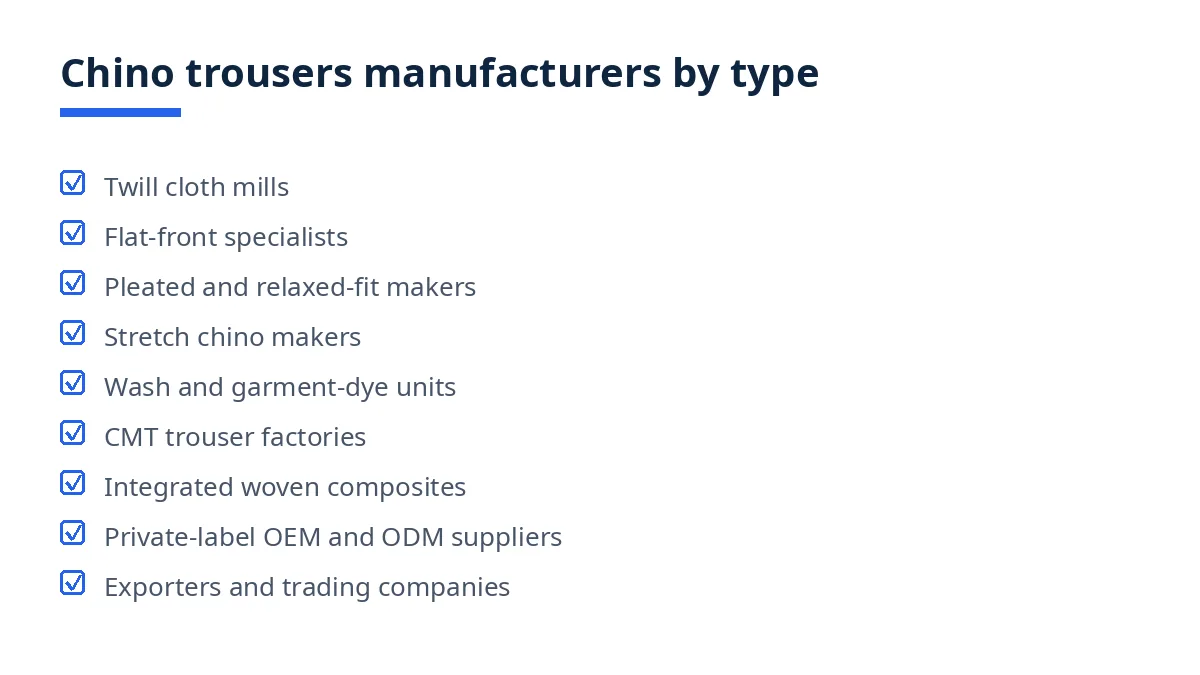
Chino trousers manufacturers in Bangladesh fall into nine types: twill cloth mills, flat-front specialists, pleated and relaxed-fit makers, stretch chino makers, wash and garment-dye units, cut-make-trim trouser factories, integrated woven composites, private-label OEM and ODM suppliers, and exporters and trading companies. Match the type to your cloth, cut and wash needs, then verify membership, documents, washed samples and inspection terms before paying.
On this page
Key takeaways
Chino trousers are woven cotton twill, so the supplier pool is the woven sector, with woven exports of US$4.614 billion in the first quarter of fiscal 2026-27.
Production is sorted by what each supplier controls: cloth, flat-front or pleated cut, stretch, wash and dye, sewing, or the order itself, and no single type fits every program.
Price and MOQ are set per style: cloth weight and blend, quantity, wash, trims and packing move the quote more than location does.
Verification is a sequence the buyer runs: association membership, document review, a washed sample in bulk cloth and trims, and an agreed AQL inspection before payment.
Exportain badges record document and photo checks reviewed by the Exportain team; they are not factory inspections or quality guarantees.
A chino a customer keeps is decided by three things that never show up on a sales page: its twill, its waistband and its wash. Cotton twill gets its diagonal face when weft yarns cross over several warp yarns in a stepped sequence, and that diagonal gives chino cloth its firm hand and its resistance to creasing.1 Cloth in the 180–220 grams per square metre range is a frequent middle choice for trousers that need to hold a crease without turning board-stiff, but the right weight still depends on season, fit and whether elastane sits in the blend.1 A supplier that understands those three pressures differs from one that simply sews trousers.
Bangladesh is a sensible place to look for that work because woven trouser production is a large, established part of its garment trade. Export Promotion Bureau data reported by The Financial Express put woven garment exports at US$4.614 billion in the first quarter of fiscal 2026–27, a 5.11 percent rise year on year, within ready-made garment exports of US$10.578 billion.2 The Bangladesh Garment Manufacturers and Exporters Association (BGMEA) describes more than 4,000 factories serving buyers in more than 150 countries.3 Scale alone does not sort the market, though. A mill, a trouser line and a trader quote different things even when the trouser looks identical in a photograph.
The nine entries below sort suppliers by the part of the order each one actually runs. Start from your own weak point rather than from the top of the page: if shade drift has hurt you before, begin with wash; if waistbands have failed, begin with cut and construction; if repeat orders have drifted, begin with the groups that hold cloth and wash under one roof. No company is named or ranked here.
The list: chino trousers manufacturers in Bangladesh by type
The order below moves from cloth behavior in wear toward the commercial arrangements that wrap it, so a buyer can stop at the capability that matters and skip the rest.
1. Stretch chino makers
These suppliers build their day around cotton-elastane twill and the engineering that keeps a stretch trouser looking tidy after hours of wear. Pocketing has to move with the cloth rather than fight it, waistbands have to spring back after sitting and standing, and seat and inseam seams need thread and stitch settings that extend instead of snapping when the fabric gives. Slim, tapered and travel chinos belong here, along with any everyday range where the customer expects movement without a baggy knee by evening.
Do not judge stretch on a first pull. Wear the sample, wash it, then pull the waistband and the knee again and measure how far each returns, and repeat the check at the seat seam, where a rigid thread on a stretch cloth usually fails first.
2. Chino twill cloth mills and fabric-led suppliers
Mills and cloth suppliers in this group weave or stock chino twill in cotton and cotton blends, across weights, twill directions and finishes, and some dye the cloth to a buyer shade before any cutting happens. Their value is control at the source: a lighter twill for a summer chino, a heavier cloth for a cold-weather trouser, or a named blend with elastane for a stretch program.
The evidence to collect is written, not verbal. Get twill construction, weight in grams per square metre, fiber content and dye method on paper, and cut the approval sample from the bulk cloth lot rather than from a showroom swatch book. Look for an even diagonal rib across the full width, since uneven ribs turn into distortion once panels are cut, and settle shade tolerance before ordering, because a chino color that drifts between lots will fail a retail check even when the sewing is clean.
3. Wash and garment-dye chino units
Laundries and dye units in this group give a finished chino its final shade and hand feel, through washing, enzyme washing, garment dyeing or pigment dyeing, sometimes with softening, silicone or wrinkle-resist finishes on top. Garment-dyed color programs, washed khaki and olive ranges, and broken-in vintage looks all depend on this stage, because the color is created after sewing rather than bought as dyed cloth.
Color agreed on a swatch is not color agreed on a trouser. Approve the wash on a sewn sample in your own cloth, then wash that sample again under home-laundry conditions before signing it off, and write down the wash recipe reference and the shade tolerance alongside it.
4. Flat-front chino specialists
These sewing factories spend their month on the flat-front chino: a clean front with no pleats, a shaped waistband, slant front pockets, welt or flap back pockets, and a zip fly closed with a button or hook. Smart-casual and office ranges, uniform programs and any line where the front must sit flat under a tucked shirt belong with this type, because the whole garment is judged on a surface that shows every ripple.
Measure the sample rather than admiring it. Check waistband, pocket openings and fly against your size chart, and open the trouser up: waistband curtain, belt loops and pocket bags say more about the line than the outside does. Then wash the sample and look again for ripple once the twill relaxes.
5. Pleated and relaxed-fit chino makers
Factories in this group build pleated chinos and relaxed fits: single or double pleats at the waist, a higher rise, a fuller thigh and a straight or tapered leg that still drapes. Heritage and comfort ranges, older customer groups, workwear-inspired lines and markets where a relaxed chino still sells all sit here, and the skill is keeping that extra fullness controlled rather than shapeless.
Pleats are a wash test before they are a style choice. Check that pleats stay in place and fall evenly after laundering, and that rise and thigh measurements hold across sizes, and ask for a graded sample set rather than one middle size, so the pleat pattern can be judged at the smallest and largest sizes.
6. Integrated woven composite groups
These groups weave or dye cloth, then cut, sew, wash and pack chinos within the same company, so an order moves between sister units rather than between unrelated firms. Larger repeat programs belong here, where the same chino must return season after season in the same cloth, shade and fit, because repeat consistency usually comes from holding cloth and wash under one roof.
Integration is a claim to verify, not a label to accept. Get in writing which stages are truly in-house for your order and which are sent out, and check that trousers are a regular woven output of the group.
7. Cut, make and trim (CMT) trouser factories
CMT factories cut, sew and trim chinos from cloth the buyer supplies or nominates, and their skill is trouser construction itself: pattern, cutting, waistband setting, pocket building and pressing. Buyers who already source their own twill, buyers testing a new chino style in a smaller quantity, and buyers who want one sewing line across several cloth sources fit this type.
Because cloth quality stays with the buyer, the pre-production sample has to be made from bulk cloth with bulk trims, button, zip, thread and pocketing included, and judged as a whole. Ask what the cutting and pressing line was set up to do day to day, since crease setting on trousers is its own routine rather than a shirt routine carried over.
8. Exporters and trading companies
A trader earns its place when a chino program is too mixed for a single line: flat-front office trousers from one plant, garment-dyed relaxed fits from another, and a small stretch capsule from a third, all shipped as one program. The trader coordinates cloth bookings, wash slots and carton packing across those plants and carries the export paperwork, and that coordination is the offer. The trousers themselves still come from the plants, so a trader warehouse visit tells you nothing about waistband or wash quality.
Distance from the sewing line is the risk to manage. Put the name of the factory sewing each style and the unit washing it into the order document before any deposit is paid, and inspect or independently check the producing factory itself, so a fault can be traced to its line.
9. Private-label OEM and ODM chino suppliers
Suppliers in this group make chinos under the buyer's label. Under an original equipment manufacturer (OEM) arrangement they sew to your tech pack; under an original design manufacturer (ODM) arrangement they offer their own chino patterns and fits for you to label. Brands and retailers that need their own labels, waistband branding, size sets, hangtags and retail packing belong here, as do importers that want a ready chino range without developing every pattern from scratch.
For OEM work, send a complete tech pack covering cloth, weight, fit, pocket construction, waistband detail, wash and packing, and compare the counter-sample with it section by section, recording every gap before bulk cutting begins. For ODM work, confirm the patterns on offer were developed by that supplier, and settle label and packing rules for your market early, since label changes after cutting are costly.
Summary table
Type | Suits | Decisive check |
|---|---|---|
Stretch chino makers | Slim, tapered and travel chinos | Recovery after washing, seat seam stretch |
Chino twill cloth mills | Cloth control, set weights and blends | Bulk-lot sample, twill and shade in writing |
Wash and garment-dye units | Garment-dyed and washed color programs | Sewn sample washed twice, recipe and tolerance recorded |
Flat-front chino specialists | Smart-casual, office and uniform chinos | Washed sample measured, waistband and pockets opened up |
Pleated and relaxed-fit makers | Heritage, comfort and workwear-inspired ranges | Graded samples, pleat fall after laundering |
Integrated woven composites | Large repeat programs, shade consistency | Stages genuinely in-house, trousers a regular output |
CMT trouser factories | Buyer-supplied cloth, smaller trials | Bulk-cloth, bulk-trim pre-production sample |
Exporters and trading companies | Mixed orders, one contract | Sewing plant and wash unit named in the order |
Private-label OEM / ODM | Own-label brands and retailers | Tech pack comparison, pattern and label ownership |
How Exportain helps
A chino quote moves with the style, not with the country label. Twill weight and fiber mix, the number of pieces, the wash recipe, trims and packing each shift the figure, and a change in any one of them makes two quotes incomparable, so ask every shortlisted supplier to quote the same cloth, the same wash, the same delivery term and the same packing. Example figures illustrate the direction only: a short first run spreads pattern work, dye lots and line setup across fewer trousers, so its per-piece figure sits above a repeat run in identical cloth. For how minimums behave across a range, read the guide to MOQ in the supply chain.
Run the same evidence chain whichever route brought the supplier to you. Treat a BGMEA member listing as a registration check only,3 approve a pre-production sample cut from bulk cloth with bulk trims and washed under home-laundry conditions, and agree the inspection level and sampling plan in writing before cutting starts. ISO 2859-1 specifies sampling schemes indexed by acceptance quality limit (AQL) for lot-by-lot inspection, so an inspector can accept or reject a shipment against a published rule instead of an opinion.4
On Exportain, the catalogue filters and the quotation thread let a buyer record that specification and compare replies on matching fields, and the platform guide to buying explains the steps.5 Treat any badge as an opening filter rather than a verdict: badges record document and photo checks reviewed by the Exportain team rather than factory inspections, and the verification guide states what each badge does and does not cover.6
FAQs
What is the biggest mistake?
The costliest shortcut is treating an unwashed showroom trouser as proof. Twill relaxes in the wash, so a front that lay flat on a rail can ripple, a pleat can soften out of shape, a garment-dyed shade can move, and a stretch waistband can stop springing back. None of that shows before laundering, which is why the only sample that settles a chino is a sewn one in bulk cloth and bulk trims, washed the way the end customer will wash it and measured again after drying.
How can I avoid it?
Put every decision on a single sheet that travels with the order, and give every quoted supplier the same sheet. It should carry twill construction and weight, fiber mix, rise and fit, pocket and waistband build, wash recipe with shade tolerance, labels and packing. Add the sewing plant and the wash plant to the order document, approve the washed pre-production sample before bulk cutting, and agree the inspection level and sampling plan in writing.
Who is responsible?
The split follows the paperwork. The factory answers for building the trouser to the sheet and to the washed sample it approved. The buyer answers for writing a sheet that can be measured, and for checking the shipment against it before it leaves. When the two sides disagree later, the sheet, the sealed sample and the inspection report carry more weight than any recollection of a call.
Where can I get help?
Use separate records for separate questions. BGMEA member listings answer registration.3 The issuer of any audit or fiber certificate answers whether that certificate covers the producing site. An independent inspector answers the pre-shipment question. Inside the platform, read the badge guide before leaning on a badge,6 and keep questions and replies in one thread so the agreed terms stay traceable. The chino trousers quality control checklist turns the inspection step into trouser-level checks.
Next steps on Exportain
Open Bangladeshi suppliers and narrow the woven listings by badge, MOQ and private-label capability, then post a free RFQ carrying your chino sheet, cloth weight, wash, quantity, destination and delivery term, and compare the replies on matching fields. Then run the chino trousers quality control checklist over waistband, pockets and wash.
Sources
- What Is Cotton Twill? Fabric Properties and Uses. Fabric-fabric (accessed )
- Merchandise exports rise 6.34pc to $13.09b in Q1 FY27: EPB. The Financial Express, (accessed )
- BGMEA | Home. Bangladesh Garment Manufacturers and Exporters Association (BGMEA) (accessed )
- ISO 2859-1:2026 — Sampling for Inspection by AQL. American National Standards Institute (ANSI) (accessed )
- How to source and buy from Bangladesh. Exportain (accessed )
- Supplier verification: Earn trust badges buyers can see. Exportain (accessed )
About the author
Sourcing from Bangladesh?
Post a request for quotation and suppliers on Exportain can send you their quotes directly.
Post an RFQ


