How to Choose the Named Place for CFR Correctly
How to pick one specific port as the CFR named place: vessel and terminal fit, freight-contract service, onward haul, and identical wording on every document, with Bangladesh loading-port checks.
Short answer
Choose one specific seaport or inland waterway port as the CFR named place, written as CFR [named port of destination], Incoterms 2020. Check that the seller's freight service calls at that port and terminal, that the vessel and cargo fit, and that the onward haul and destination broker work from that port. The seller pays freight to the named port while risk passes on loading, and CFR imposes no insurance obligation, so arrange cover separately and price every candidate port to the warehouse.
On this page
Key takeaways
The CFR named place must be one specific seaport or inland waterway port, written as CFR [named port of destination], Incoterms 2020; a country, region, inland city, or airport name does not meet the test.
Risk passes on loading on board while the seller pays freight to the named port, and CFR imposes no insurance obligation on either party, so the buyer arranges cover from loading.
Check the vessel and terminal fit, the seller's freight service to that port and terminal, and the onward haul and broker from that port before naming it, and price each candidate port to the warehouse.
Keep the port name, spelling, and edition identical on the quotation, order, invoice, packing list, and bill of lading, and use a location code only as a cross-check.
The named place in a CFR term is the port where the seller's paid freight ends. It is not a label for the destination country, the region, or the city where the warehouse sits. Choosing it well means the freight contract, the destination broker, and the onward haul all point to the same place.
Under CFR (Cost and Freight), the seller contracts and pays for carriage to the named port of destination, while delivery and risk transfer happen when the goods are loaded on board at the port of shipment.1 The Incoterms 2020 rules allocate cost, risk, and obligations between seller and buyer for each rule.2 CFR imposes no insurance obligation on either party, so the buyer arranges cover from loading unless agreed otherwise.1
Why this matters for buyers and sellers
A buyer who treats the named place as the delivery point will expect the seller to carry the sea risk. A seller who treats it as a general destination will book the cheapest service to any port in the region.
For the buyer, the named place decides the freight endpoint and the starting point of every buyer-paid line that follows: destination unloading and handling outside the carriage contract, import clearance, duties and taxes, and inland transport.1 For the seller, it decides which service to buy and which terminal the carrier will serve.
Write the term as "CFR [named port of destination], Incoterms 2020", using one port only. A country, region, or inland city name does not name a port. CFR applies exclusively to maritime or inland waterway transport, so an airport name can never be a CFR named place.1 Where goods travel by air, agree a rule that fits air carriage, such as FCA.
For all eleven rules, read the Incoterms guide for shipments from Bangladesh,
Step-by-step: how it works
Work through the five checks in order. Drop a port that fails an early check, even when it looks cheaper.
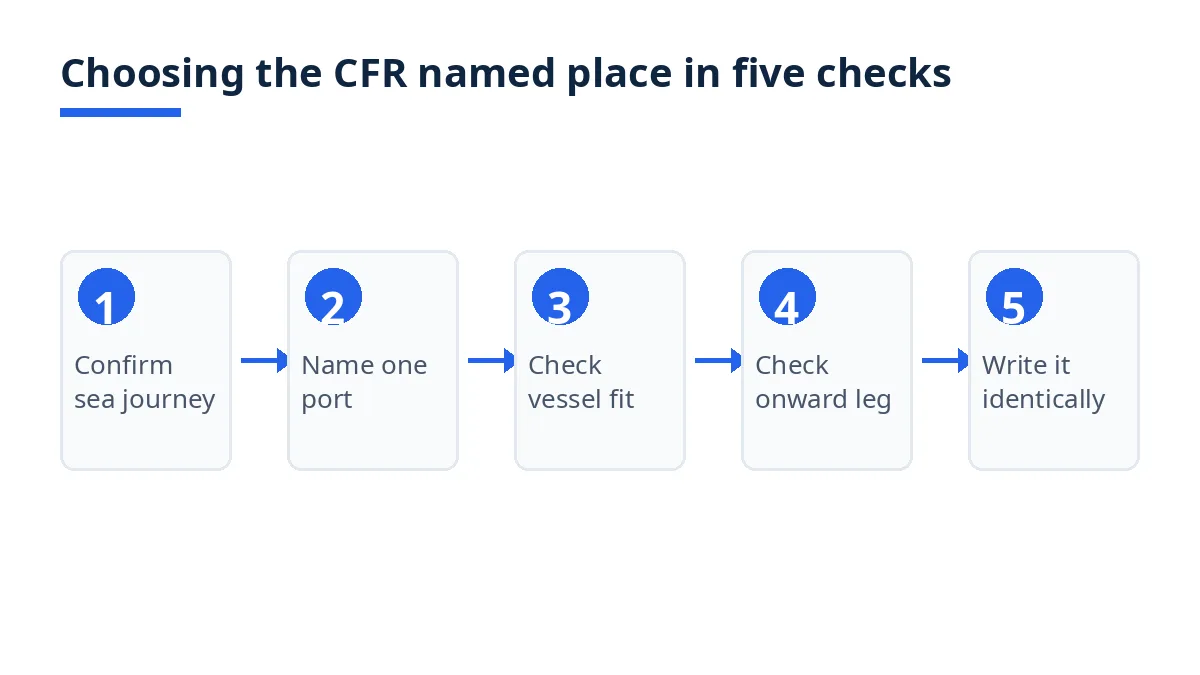
Confirm the journey fits CFR. The goods must travel by sea or inland waterway, with delivery on board the vessel. For container cargo, the terminal handover does not normally transfer risk, because delivery and risk transfer occur on board.1 Where the handover matters more, discuss CPT or CIP first.1
Shortlist by the warehouse, not by the map. Start from the final warehouse and work backward: which ports give a workable onward haul, which broker can file there, and which port the buyer's storage already covers. Ask the broker to confirm in writing that it can handle the port.
Check that the port can take the vessel and the cargo. A port name covers several terminals, berths, and depths. Confirm the draft, terminal, and cargo type with the seller and the carrier, and confirm which terminal the freight contract names.
Check that the seller's freight contract serves that port. Ask the seller to confirm the service, terminal, and sailing pattern in writing, and which destination charges sit inside the freight price. The buyer pays destination unloading and handling charges not included for the seller's account in the carriage contract, so treat a charge named in neither document as the buyer's until the broker confirms otherwise.1
Write the name identically everywhere. Use the same port name, spelling, and edition wording on the quotation, order, invoice, packing list, and bill of lading. Record the location code from the booking confirmation as a cross-check, not a substitute. The code is five characters: a two-letter country code plus a three-letter location code; Antwerp and Rotterdam are BEANR and NLRTM.3 Verify any code against the official UNECE database.3
Port | Terminal and vessel check | Confirm with broker |
|---|---|---|
Rotterdam, Netherlands | Maasvlakte II: about 47.5 hectares, 1,000 metres of deep-sea quay, about 2 million TEU capacity.4 | Which Maasvlakte terminal the contract names |
Antwerp, Belgium | A 16-metre draft is in effect for container ships sailing to the Deurganck dock, with a gain of about 1,000 TEU.5 | Whether the vessel calls at the Deurganck dock or another terminal |
Felixstowe, United Kingdom | Nine berths across two terminals; Trinity Terminal has a 2,354-metre quay; Berths 8 and 9 have 18 metres depth.6 | Which terminal and berth the service uses |
Jebel Ali, United Arab Emirates | Over 80 weekly services to more than 150 ports; Terminal 1 has 3,242 metres of quay, 10 berths, and 37 quay cranes.7 | Which terminal the contract names, and the charges inside the freight price |
All three checks must pass before the name goes into the contract.
Costs, timelines and documents
How the named place moves the bill
The named place moves the bill in two directions at once. A longer sea leg can raise the CFR price, while a shorter onward leg can lower the total to the warehouse. A low CFR price to a distant port can produce a high total once the buyer adds the onward haul, handling, broker fee, and duty. Price every candidate port to the warehouse.
Example figures: one container of garments, Chattogram to Europe, goods value USD 40,000, illustrative only. To Rotterdam, the example freight build is USD 1,800 and the example onward lines total USD 620, giving USD 42,420 before duty and tax. To Felixstowe, the example freight build is USD 1,650 and the example onward lines total USD 940, giving USD 42,590 before duty and tax. The lower freight build produces the higher total here, because the onward leg differs.
Insurance sits outside the freight comparison. CFR imposes no insurance obligation on either party, unlike CIF, where the seller must provide cover.1 The buyer arranges cover from loading on board and states the insurance position in writing before sailing. Where the seller should arrange insurance instead, use CIF: Institute Cargo Clauses (C) remains the default CIF level, with a higher level by agreement.2 Compare the terms in the CIF guide.
Timelines the named place affects
No typical transit or clearance time can be stated as fact for a CFR shipment, because the service, terminal, sailing pattern, and destination filing each set their own timeline. The named place affects the timeline through the vessel call pattern, the handling after discharge, and the broker's readiness at that port. Ask the seller and the broker for the service, filing, and release steps in writing.
Documents that carry the name
The named place must appear, spelled the same way, on the quotation, purchase order, invoice, packing list, and bill of lading. The bill of lading proves loading on board, names the ports and parties, and carries the freight-prepaid mark, so a differing port name creates a document the broker must query. Check a draft bill of lading against the invoice and packing list before sailing.
The export declaration must be submitted and approved before loading.8 Keep names and descriptions identical across both sets.
Bangladesh-specific rules and tips
Name the loading port as carefully as the destination port, and keep the two fields separate. The CFR named place is the destination port; the port of shipment is a different field. Most container exports load at Chattogram, and the New Mooring Container Terminal, including its Overflow Container Yard, sits at Chittagong Port under the ownership of the Chittagong Port Authority, with operation and maintenance under a 15-year concession signed in October 2026.9 Confirm which terminal and yard the booking names, and use its spelling in the bill of lading.
Mongla is the second loading option to test, not a default substitute. Mongla Port is the country's second-largest seaport, and it handled 25,250 TEU containers between July 2025 and 15 April 2026, passing the total for the whole of the 2024-25 fiscal year.10 New anchor berths at Hiron Point were trialled with ships of 9.00-metre draught, for vessels up to 200 metres in length.10 A vessel or load needing deeper water should load at Chattogram instead. Confirm which loading port the service actually calls at.
Export clearance belongs to the seller under CFR and happens before loading. The documents enclosed with the Bill of Export include the export letter of credit, or the approved contract, purchase order, or guarantee where there is no letter of credit, the signed invoice, the packing list, the EXP form certified by Authorized Dealers, the certificate of origin issued by the Export Promotion Bureau or a Chamber of Commerce and Industry, the VAT registration certificate, and the Taxpayer Identification Number.8 Request the EXP form and certificate of origin first, because both depend on third parties. Check the declared description, value, quantity, and buyer name against the invoice before submission.8
Mistakes and red flags
Naming a country, a region, or a trade lane. "CFR Europe", "CFR USA", "CFR UK", and "CFR Middle East" name no port. The seller then chooses the freight endpoint. Name one port in full, with the edition, on every document.
Naming an inland city or a warehouse as the CFR place. A CFR named place must be a port or an inland waterway place the vessel can serve. A warehouse address belongs in a D-rule term. Name the port and state the warehouse as the onward destination separately.
Naming an airport, an airport city, or an air cargo terminal. CFR applies exclusively to maritime or inland waterway transport, so no airport wording can make a CFR term work for air freight.1 Agree FCA for the air leg and remove the CFR wording.
Naming a port the service does not call at. A port can be the right market and the wrong service: the carrier may call at a neighbouring port, a different terminal, or the same port on a different rotation. The 16-metre Antwerp draft applies only to the Deurganck dock.5 Ask the seller to confirm the service and terminal in writing.
Naming a port without checking the onward leg. The cheapest freight endpoint can be the most expensive arrival when the onward haul, storage, or broker filing costs more than the freight saving. Price each candidate port to the warehouse.
Copying a port name from another quotation. A port that suited another buyer, cargo type, or season may not suit this shipment. Run the five checks again and record the answers.
Letting a location code replace the port name. A five-character location code is a cross-check, not a contract term. The code examples BEANR and NLRTM identify Antwerp and Rotterdam, but the contract must still name the port in words, with the edition.3 Write the name in full and keep the code secondary.
Accepting the seller's default port without written confirmation. A seller may quote its usual port out of habit, even when the buyer's warehouse, broker, or cargo needs a different one. Ask the seller to confirm the port, terminal, and freight inclusions in writing, and hold the order until it does.
Checklist
Before the order is confirmed, every line should be answered in writing.
Journey confirmed as sea or inland waterway; air freight routed to FCA instead.1
One named destination port agreed, in the form "CFR [named port of destination], Incoterms 2020",
Vessel and terminal fit confirmed: draft, terminal, and cargo type checked for the named port and the service.5 4
Freight contract confirmed to serve the named port and terminal.
Destination charges confirmed in writing: which unloading and handling lines sit inside the freight price, and which stay with the buyer.1 Confirm with broker on every open line.
Onward leg priced to the warehouse for each candidate port, with broker, haul, and storage stated separately.
Insurance position stated: buyer-arranged cover from loading, or seller-arranged cover agreed as a separate term.1
Port name identical on every document; location code only as a cross-check.3
Loading port confirmed separately; Bill of Export set approved before loading.8
Landed cost repriced to the warehouse, with no CFR quotation treated as a delivered or insured cost.
Next steps on Exportain
On Exportain, post a request for quotation stating the quantity, the named destination port, the full CFR wording, and the insurance position, so suppliers quote against the same port and the same basis. The buying steps on Exportain ask the buyer to state the destination and the Incoterm in the RFQ, and every quotation is versioned, so counter-offers and acceptances stay in the same thread with the terms recorded.11 Compare replies on the same port, inclusions, and validity, and ask which destination charges sit inside each freight price. Read the how-to-buy guide for the steps from search to shipment.11 Read each badge for what it records: badges record which checks the Exportain team has reviewed, and a badge is not a capacity or quality guarantee.11
Post a free RFQ on Exportain and get quotes from Bangladeshi suppliers →
What should I know first about CFR?
CFR is a sea and inland waterway rule under which the seller pays freight to the named destination port, while delivery and risk transfer occur when the goods are loaded on board at the port of shipment.1 CFR imposes no insurance obligation on either party, so the buyer arranges cover from loading. The named place must be one specific port, written as "CFR [named port of destination], Incoterms 2020".
What are the typical costs and timelines?
There are no typical CFR costs or transit times a guide can state as fact, because the freight build, destination charges, duty basis, and service pattern depend on the route, port, terminal, and shipment. The seller bears the goods, export clearance, and freight to the named port, while the buyer bears destination charges outside the carriage contract, import clearance, duty, tax, and onward transport.1 Ask for the freight build, validity, and destination lines in writing, and confirm with broker on every line.
Which documents are needed?
The contract set is the quotation, purchase order, commercial invoice, and packing list, each carrying the same CFR wording and port name. The transport set is the bill of lading, checked in draft form for the ports, vessel, on-board notation, and freight-prepaid mark. The export set is the Bill of Export with the invoice, packing list, EXP form, certificate of origin, VAT certificate, and Taxpayer Identification Number.8 Send the checked set to the destination broker before sailing.
What are the most common mistakes?
The most common mistakes are naming a country, region, inland city, or airport instead of one port; naming a port the seller's service does not call at; pricing the choice on the CFR price alone without the onward leg; copying a port name from another quotation; and letting a location code replace the port name.5 3 Fix each the same way: run the five checks, get the port and inclusions in writing, and keep the wording identical everywhere.
Sources
- CFR Incoterms: Meaning, Costs & Risk. iContainers (accessed )
- Incoterms® 2020. International Chamber of Commerce (ICC) (accessed )
- International Port Codes 2025: Complete Guide & UN/LOCODE. FreightAmigo, (accessed )
- Port of Rotterdam Authority and APM Terminals sign the agreement for over 1 billion euros for the expansion of Maasvlakte II container terminal. Port of Rotterdam Authority, (accessed )
- Reception of the largest container ships possible thanks to official 16 meters draft in the Deurganck dock. Port of Antwerp-Bruges, (accessed )
- Container Terminals Port of Felixstowe. Port of Felixstowe (accessed )
- Jebel Ali Port | Port Operations. DP World (accessed )
- Customs Clearance Procedures for Export. Bangladesh Customs, National Board of Revenue (accessed )
- Bangladesh's Chittagong Port Authority and DP World sign 15-year concession for New Mooring Container Terminal. DP World, (accessed )
- Mongla port sets new record in container handling. BSS News, (accessed )
- How to source and buy from Bangladesh. Exportain (accessed )
About the author
Sourcing from Bangladesh?
Post a request for quotation and suppliers on Exportain can send you their quotes directly.
Post an RFQ