CFR Freight Cost: Who Pays and How It Is Calculated
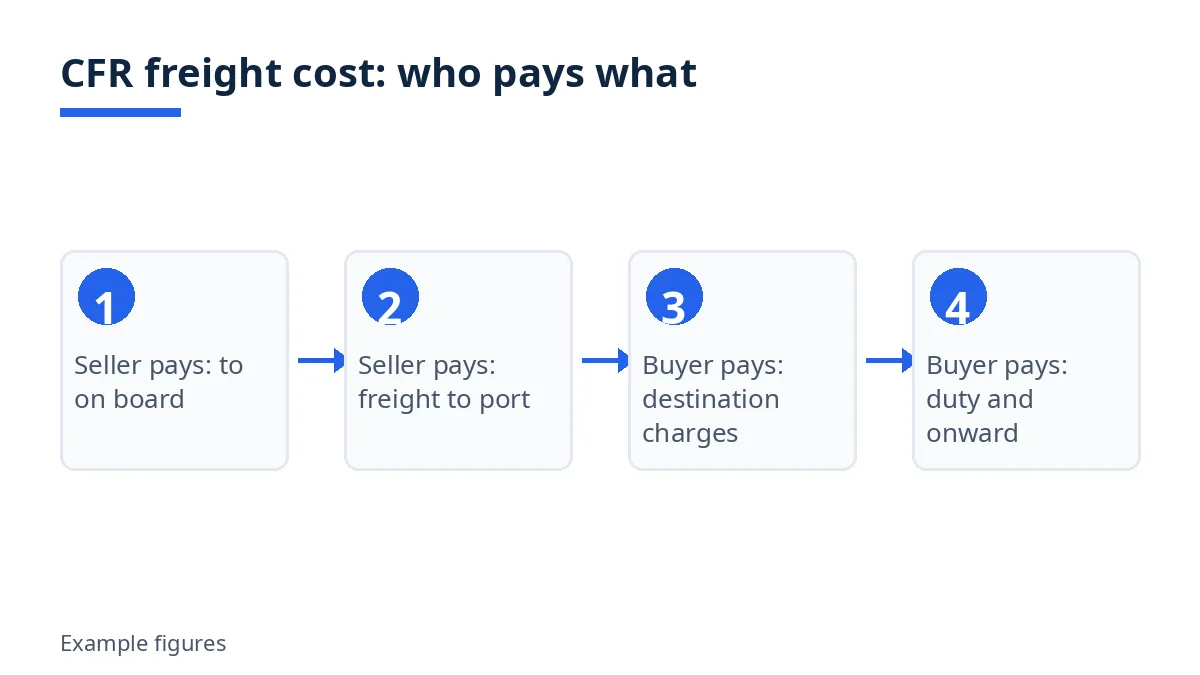
Under CFR the seller pays freight to the named destination port, but the buyer pays destination charges, duty and onward transport. This guide breaks down the freight build and how to estimate it.
Short answer
Under CFR, the seller pays the main carriage to the named destination port, while risk passes to the buyer when the goods are loaded on board at the port of shipment. The freight charge is built from a basic rate plus surcharges such as fuel, terminal handling and peak season charges. The buyer pays destination charges outside the carriage contract, import clearance, duty and onward transport. CFR is sea and inland waterway transport only, and it imposes no insurance obligation on either party.
On this page
Key takeaways
Under CFR, the seller pays main carriage to the named destination port, while risk passes to the buyer on board at loading and the buyer pays destination charges outside the carriage contract.
Freight is built from a basic rate plus surcharges: fuel (BAF), terminal handling, peak season, currency and security charges, each fixed by route, container, date and contract.
For shared loads, the charge follows the greater of weight and volume; for a full container, it follows container type and size. Confirm the build and price calculation date with the broker or forwarder on every line.
CFR is sea and inland waterway transport only, with no insurance obligation on either party, and a CFR price is not a landed cost: duty, tax and onward transport stay with the buyer.
A CFR price bundles the goods with the main carriage to the named destination port, but not the whole journey. Under CFR, the seller pays the freight to that port, while the buyer pays destination charges outside the carriage contract, plus import clearance, duty and onward transport. Reading a CFR quotation as a delivered price leaves a second bill unpaid.
CFR is Cost and Freight, one of the 11 Incoterms 2020 rules published by the International Chamber of Commerce, which allocate cost, risk and obligations between seller and buyer.1 CFR applies only to sea and inland waterway transport, delivery and risk transfer happen on loading on board at the port of shipment, and the seller has no obligation to insure the cargo.2 The freight question is narrower: what sits inside the seller-paid freight charge, how it is calculated, and which lines stay with the buyer.
Why this matters for buyers and sellers
For the buyer, the CFR price answers only the first cost question. The buyer still faces the destination terminal, the import filing, duty and tax, and the haul to the warehouse. The line most often missed is destination unloading and handling: the buyer pays destination unloading and handling charges that are not included for the seller's account in the carriage contract.2 Confirm with broker or forwarder, in writing, which destination lines the carriage contract already covers before the goods sail.
For the seller, the freight charge decides whether the quotation still makes money on the sailing date. Ocean freight is bought spot, for one shipment at the price available when booking, or under a contract negotiated for a period and often tied to volumes.3 A FAK (Freight All Kinds) rate is one level regardless of commodity, and in the cited carrier announcement it excluded THC and other surcharges.3 The date used also matters: spot and other bookings can take different dates for the surcharge that applies, so two quotes a few days apart can include different surcharges.3 State validity, basis and included surcharges. Confirm with broker or forwarder on every cost line before accepting a quotation.
Under CIF the seller also buys minimum insurance for the buyer; under CFR the seller buys none and the buyer carries the risk from loading.1 2 For all 11 rules, read the Incoterms guide for shipments from Bangladesh.
Step-by-step: how it works
The freight cost is built in sequence. Each step fixes who pays the next line.
Name the term, the port and the edition in full. Write "CFR [named destination port], Incoterms 2020" on the quotation, order, invoice and bill of lading.
Build the origin lines on the seller side. The seller covers the goods to loading, export clearance, origin port charges and sea carriage to the destination port.2 Name origin terminal handling separately: it is charged per container and can sit inside or outside the quoted figure.4
Contract the main carriage. The seller contracts with the carrier and pays the freight to the named destination port.2 Record the spot or contract basis, validity dates, and price calculation date.3
Calculate the freight from the shipment shape. For a full container, the carrier sets a basic rate per container by route, container type and size.4 For a shared container, the charge follows the greater of weight and volume.4
Load on board and pass the risk. Delivery and risk transfer occur on board at the port of shipment, while the seller's freight payment continues to the destination port.2
Settle the destination lines on the buyer side. The buyer pays destination charges outside the carriage contract, clears import customs, pays duty and tax, and arranges onward transport.2 Appoint the destination broker before sailing and ask for each line in writing. Confirm with broker or forwarder on every destination cost line.
Costs, timelines and documents
What the freight charge is built from
Ocean freight is not a single rate. The carrier sets a basic freight rate by route, container type and size, usually per TEU, FEU or ton/cubic meter, then adds surcharges.4 The surcharges most often seen are the bunker adjustment factor (BAF), from fuel prices and voyage distance, the currency adjustment factor (CAF), from exchange rate fluctuations, terminal handling charges (THC), per container at origin and destination, and peak season and security surcharges.4 The BAF is revised periodically from a fuel price index,3 peak season surcharges apply during high-demand periods,4 and a general rate increase (GRI) raises the base rate for a scope and date.3
Cost line | How it is set | Who pays by default | Check |
|---|---|---|---|
Basic ocean freight to the named port | Per container, or per ton/cubic meter for shared loads4 | Seller | Confirm with broker or forwarder |
Surcharges: BAF, peak season, general rate, currency and security | Fuel and distance, demand periods, base-rate increases, exchange rates, security4 3 | Seller, where part of the carriage charge | Confirm with broker or forwarder |
Origin terminal handling charge | Per container at the loading port4 | Seller, where part of the carriage charge | Confirm with broker or forwarder |
Destination terminal handling and unloading | Per container; unloading only where the carriage contract includes it2 4 | Buyer, where outside contract | Confirm with broker or forwarder |
Inland transport to the port of shipment | Distance and mode, factory to port4 | Seller | Confirm with broker or forwarder |
Import clearance, duty, tax and onward transport | Destination tariff, broker schedule, distance and mode2 | Buyer | Confirm with broker or forwarder |
Marine insurance for the sea leg | No CFR obligation on either party2 | Buyer, separately | Confirm with broker or forwarder |
Demurrage and detention sit outside the freight table. If a container is not picked up within a free period, demurrage is the rental charge, whereas detention is due if it is not returned empty within a free period.5 Confirm the free days and the return point before arrival. Confirm with broker or forwarder on every demurrage and detention line.
Worked example: one container, two bills
Example figures: one 40-foot container of garments, Chattogram to Rotterdam, CFR Rotterdam, Incoterms 2020, illustrative only and not a market rate or quotation. The goods value is USD 30,000. The seller-paid build is a basic rate of USD 1,350, a BAF of USD 210 and an origin THC of USD 140, giving USD 1,700 and an example CFR value of USD 31,700. The buyer-paid lines are a destination THC of USD 185, unloading and handling of USD 95, a broker fee of USD 150 and onward transport of USD 320, giving USD 750 before duty and tax, excluded because only the destination tariff or broker schedule confirms the rate.
Example line | Example figure | Bill | Check |
|---|---|---|---|
Goods value | USD 30,000 | Seller invoice | Confirm with broker or forwarder |
Basic ocean freight, 40-foot container | USD 1,350 | Seller | Confirm with broker or forwarder |
Bunker adjustment factor (BAF) | USD 210 | Seller | Confirm with broker or forwarder |
Origin terminal handling charge | USD 140 | Seller | Confirm with broker or forwarder |
Example CFR value | USD 31,700 | Goods + build | Confirm with broker or forwarder |
Destination terminal handling charge | USD 185 | Buyer | Confirm with broker or forwarder |
Destination unloading and handling | USD 95 | Buyer | Confirm with broker or forwarder |
Destination broker fee | USD 150 | Buyer | Confirm with broker or forwarder |
Onward transport to warehouse | USD 320 | Buyer | Confirm with broker or forwarder |
Duty and tax at destination | Per broker schedule, not in example total | Buyer | Confirm with broker or forwarder |
For a shared container, LCL freight is charged on the greater of actual weight and volumetric weight, where volumetric weight is cubic meters multiplied by 1,000.4 In general, freight is based on cubic meters or tons, depending on which predominates.5 For FCL, the basic rate is set per container.4
Ask for validity, the price calculation date and the sailing date as separate lines, and reprice if any moves.3
Bangladesh-specific rules and tips
Export clearance belongs to the seller under CFR, and it happens before loading. Section 131 of the Customs Act, 1969 requires clearance for export, and goods shall not be loaded or stuffed for export unless the Bill of Export is submitted and approved.6 Request the EXP form and the certificate of origin first, because they depend on the authorized dealer bank and the issuing body.6 Check the declared description, value, quantity and buyer name against the invoice.
The origin leg needs the same itemized treatment as the sea leg. Inland transport to Chattogram or Mongla, origin port charges and loading on board sit on the seller side under CFR,2 but name the origin THC separately, because port handling charges vary by port and are typically listed separately from the base freight rate.4 For containers, note the handover mismatch: containers are often handed to a carrier at a terminal before loading, and under CFR that handover does not normally transfer risk, because delivery and risk transfer occur on board.2 Discuss FCA, CPT or CIP where the handover matters more.2
Destination differences across the United States, the United Kingdom, the European Union and the United Arab Emirates appear in the buyer lines, not in the freight build. The destination THC, the unloading position, the import filing, duty and tax treatment and onward haul are all set at destination, so the same freight build can produce four different landed costs. Get each market's lines in writing; do not transfer a Rotterdam figure elsewhere. Confirm with broker or forwarder on every destination cost line.
Mistakes and red flags
Treating the CFR price as the landed cost. The CFR value covers goods plus freight to the named port, not destination handling outside the carriage contract, import clearance, duty, tax or onward transport.2 Reprice every quotation to the warehouse. Confirm with broker or forwarder on every added line.
Comparing headlines across different terms. A CFR, FOB and CIF price contain different journeys, and a lower headline can carry a larger destination bill. Price every quotation to the same point before choosing. The CIF guide shows the element that separates CIF from CFR, the seller-bought minimum insurance.
Accepting a lump-sum freight figure with no build. A single freight number hides whether BAF, THC, PSS, CAF and security charges are inside it, and which date fixes them.4 3 Ask for the base rate, surcharges, THC lines and price calculation date separately.
Assuming destination unloading is included. Under CFR the buyer pays destination unloading and handling charges that are not included for the seller's account in the carriage contract.2 If no document names the line, treat it as the buyer's until confirmed. Confirm with broker or forwarder before sailing. Arrange insurance separately too: CFR imposes no insurance obligation on the seller.2
Using CFR for air freight or for a container handover without checking. CFR applies exclusively to maritime or inland waterway transport.2 For air freight use FCA; for a terminal-handed container, check the handover point before agreeing CFR.2
Forgetting free time at destination. Demurrage and detention charges run once free time ends, and free time depends on the contract and the locations.3 5 Confirm free days and the empty-return point before arrival.
Checklist
Before sailing, answer every line in writing, keeping the two bills separate.
Term, edition and named port agreed, with identical wording on all documents.
Freight build itemized: base rate, BAF, origin THC, PSS or GRI, CAF and security lines, with the price calculation date and validity stated.4 3 Confirm with broker or forwarder on every line.
Shipment shape confirmed: FCL container type and size, or LCL chargeable weight and volume on the greater-of rule.4
Destination lines confirmed: THC, unloading position, broker fee, duty and tax basis, free time.2 5
Insurance position stated: buyer-arranged cover agreed separately, or seller-arranged cover named with clause and value, before loading.2
Export set complete and approved before loading: Bill of Export with contract or letter of credit, invoice, packing list, EXP form, certificate of origin, VAT certificate and Taxpayer Identification Number.6
Bill of lading checked: on-board notation, freight-prepaid mark, ports, vessel, names, quantities and weights matching the invoice and packing list.
Landed cost repriced to the warehouse, with no CFR quotation treated as a delivered cost.
Next steps on Exportain
Ask suppliers to quote CFR with the freight build, validity and excluded destination lines shown separately. Read the how-to-buy guide for the steps from search to shipment.
Post a free RFQ on Exportain and get quotes from Bangladeshi suppliers →
What should I know first about CFR?
Under CFR, the seller pays the main carriage to the named destination port and delivers the goods loaded on board at the port of shipment, where risk passes to the buyer.2 CFR is sea and inland waterway transport only, it imposes no insurance obligation on the seller, and the buyer pays destination charges outside the carriage contract, import clearance, duty and onward transport.2 Start every quotation check from the freight build, not the headline price.
What are the typical costs and timelines?
There are no typical freight costs or transit times to quote as fact, because the basic rate depends on route, container type and size, and surcharges move with fuel prices, exchange rates, port charges, season and the price calculation date.4 3 Example figures in this guide show structure only. Ask for the freight build, validity and destination lines in writing, and reprice if sailing moves. Confirm with broker or forwarder on every cost line.
Which documents are needed?
The freight documents are the itemized quotation, the commercial invoice with the freight line shown separately, the packing list and the bill of lading with the on-board notation and freight-prepaid mark. The export set is the Bill of Export with the contract or letter of credit, invoice, packing list, EXP form, certificate of origin, VAT certificate and Taxpayer Identification Number.6 The destination broker needs the invoice, packing list and bill of lading details before sailing to prepare the import filing.
What are the most common mistakes?
The most common mistakes are treating the CFR price as a landed cost, comparing CFR, FOB and CIF headlines without repricing to the warehouse, accepting a lump-sum freight figure with no surcharge build, assuming destination unloading or insurance is included, using CFR for air freight, and forgetting demurrage and detention free time at destination.2 5 Fix each the same way: get both bills in writing, with the price calculation date stated, before sailing. Confirm with broker or forwarder on every cost line.
Sources
- Incoterms® 2020. International Chamber of Commerce (ICC) (accessed )
- CFR Incoterms: Meaning, Costs & Risk. iContainers (accessed )
- Ocean Freight Rates Explained: Spot, Contract, FAK, BAF. OneChain TMS, (accessed )
- Ocean Freight Rates and Cost Composition: Key Insights. Hong Ocean (accessed )
- Information on freight calculation sea freight. Transway Ocean (accessed )
- Customs Clearance Procedures for Export. Bangladesh Customs, National Board of Revenue (accessed )
About the author
Sourcing from Bangladesh?
Post a request for quotation and suppliers on Exportain can send you their quotes directly.
Post an RFQ