CFR Shipping From Bangladesh to USA: Costs, Steps and Timeline
CFR from Bangladesh to USA: the seller pays ocean freight to your named port, but you carry the sea risk from loading, arrange insurance, and clear and pay for the import.
Short answer
Under CFR, the Bangladeshi seller pays ocean freight to your named United States port, while you carry the cargo risk from loading on board, arrange insurance, clear the import and pay duty. Confirm the named port, insurance and carriage inclusions in writing before loading.
On this page
Key takeaways
Under CFR, the seller pays ocean freight to your named United States port, but risk transfers to you when goods are loaded on board at the Bangladesh port.
CFR includes freight, not insurance: neither party must insure, so arrange cover from loading onward or agree it in the contract.
You pay destination handling outside the carriage contract, United States import clearance, duty, government fees and inland transport.
Commercial vessel cargo at a covered United States port carries a harbor maintenance fee of 0.125 percent of its value.
Name the exact United States port, appoint your broker before loading, and file the entry summary within 10 working days after entry when it is not filed at entry.
The vessel is loaded at Chattogram, the seller has paid the ocean freight to a United States port, and the cargo is still on the water. Under CFR, that is where many buyers misunderstand their position: the seller paid for the voyage, but the risk on that voyage is already yours. This guide explains CFR shipping from Bangladesh to the USA from the buyer side, so you can price the parts the seller does not pay, arrange insurance before loading, and clear the import without a surprise at the destination port.
CFR stands for Cost and Freight. It is one of the 11 Incoterms 2020 rules, which give a clear allocation of cost, risk and obligations.1 CFR applies only to sea and inland waterway transport.2 The seller contracts and pays for carriage to the named port of destination, but delivers when the goods are placed on board the vessel at the port of shipment, and risk transfers to the buyer at that loading point.2 Neither party is obliged to arrange insurance under CFR.2
Why this matters for buyers and sellers
What should I know first about CFR?
First, CFR splits cost and risk at different points. Cost runs to the destination port because the seller pays the main freight. Risk stops at the loading port because delivery happens on board at origin. A CFR price therefore looks like a delivered-to-port price while leaving sea risk, insurance, import clearance and duty with you.
Second, CFR is not CIF. The two rules share the same risk point and freight payment, but under CIF the seller must arrange insurance for the buyer, while under CFR there is no insurance obligation on either side.2 If you want the seller to insure, say so in the contract as a separate line, or arrange your own cover.
Third, CFR is not delivery to your warehouse, and it is not DAP. Under DAP the seller bears transport risk until the goods reach the named place, ready for unloading. Under CFR the seller bears freight cost to the port, but risk passes at loading, and everything after the destination port is yours. Compare CFR, DAP and CIF quotations only after adding the buyer-side lines to each, so all three end at the same finish line.
For the seller, CFR is a middle position: control of export clearance and the main carriage, without taking on United States import clearance or the sea risk after loading. For you, the trade is control over insurance and the import side, in exchange for carrying the risk from loading onward.
Step-by-step: how it works
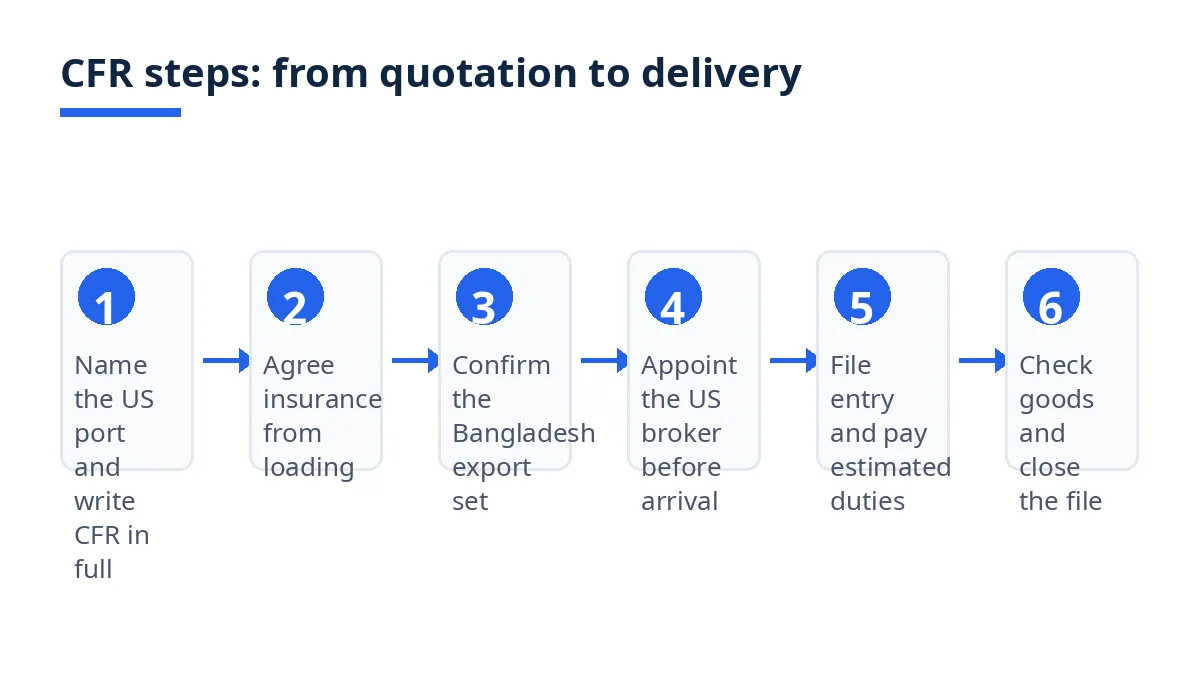
Write the term in full, with the named port. State "CFR [named United States port], Incoterms 2020" in the quotation and purchase order, with goods, quantity, price, currency and validity. A city name alone is not enough: the port decides where seller-paid freight ends.
Agree insurance in writing before loading. Decide who insures, from which point, for which value, and against which risks. Under CFR the seller has no duty to insure, so a silent contract leaves a gap from loading to arrival.2 Get the policy, or a written agreement that the seller will insure on your behalf, before sailing.
Confirm the export set with the seller before shipment. The seller handles export clearance in Bangladesh, but check that the invoice, packing list and bill of lading match on description, quantity, weight, value and port names.
Appoint your United States customs broker before the vessel arrives. Give the broker the invoice, packing list, bill of lading and product description early, and ask the broker to confirm the tariff classification and duty treatment. Do not wait until the vessel berths to find a broker.
Track the sailing and prepare the entry documents. Entry documentation to secure release must include the entry form, evidence of the right to make entry, the commercial invoice, a packing list where appropriate, and any other required documents.3 Pass the bill of lading and arrival notice to the broker at once.
File the entry, pay the estimated duties and fees, and arrange inland transport. If the entry summary is not filed at the time of entry, it must be filed, with estimated duties attached, within 10 working days after the time of entry.4 Book inland transport only after you know the release position.
Check the goods on arrival and close the file. Compare the delivered cartons, marks and quantities against the packing list and bill of lading, note any damage or shortage on the delivery record at once, and notify the insurer within the policy time.
Costs, timelines and documents
What are the typical costs and timelines?
There is no typical CFR freight rate or transit time a guide can state as fact. Freight depends on the route, vessel, cargo, season and market at booking, and transit depends on the sailing schedule and any transshipment. Ask the seller for the freight basis — which port, which carrier service, and what the carriage contract includes — and ask your broker and forwarder for the buyer-side lines separately.
The cost split is fixed in structure, even though every figure moves. The seller pays export clearance, origin handling under the carriage arrangement, and ocean freight to the named port.2 You pay insurance if you arrange it, destination handling not included in the carriage contract, import clearance and broker charges, United States duty, port and government fees, and inland transport.2
One fee is fixed by regulation and can be calculated in advance. Commercial cargo loaded on or unloaded from a commercial vessel is subject to a harbor maintenance fee of 0.125 percent of its value at a covered United States port.5 Example figures: on a customs value of $40,000, the fee is $50; on $200,000, it is $250. Those are arithmetic examples only, not a duty estimate, because duty depends on your tariff classification.
Cost line | Who pays under CFR | Check before you confirm |
|---|---|---|
Export clearance in Bangladesh | Seller | Bill of Export set complete |
Ocean freight to the named United States port | Seller | Port, carrier service and inclusions in writing |
Cargo insurance | Buyer, unless the contract says otherwise | Cover starts at loading, not at arrival |
Destination unloading and handling not in the carriage contract | Buyer | Which terminal charges sit in the freight contract |
United States import clearance and broker charges | Buyer | Broker appointed before arrival |
United States duty and government fees | Buyer | Classification and duty confirmed by the broker |
Inland transport from the port | Buyer | Truck or rail booked against the release position |
For timelines, work in phases rather than a single promised week: production and export clearance, loading, the ocean leg, United States entry and release, and inland delivery. Ask for each phase as a separate line — sailing date, arrival window, document handover date and release step — and treat any single date covering all five phases as unconfirmed. Delays most often sit in document handover, examination, or a truck booked before release.
Which documents are needed?
For export clearance in Bangladesh, goods shall not be allowed to load or be stuffed in containers for export unless an export declaration, known as the Bill of Export or Shipping Bill, is submitted to Customs in the prescribed format and approved by the Customs authority.6 Documents enclosed with it for all consignments include the export letter of credit or, where there is none, the export contract or purchase order or export guarantee approved by the negotiating bank, the commercial invoice, packing list, EXP form certified by an authorized dealer, certificate of origin issued by the Export Promotion Bureau or a Chamber of Commerce and Industry, VAT registration certificate, and taxpayer identification number.6
For the United States entry, the broker works from the same commercial set: invoice, packing list and bill of lading, plus the entry documentation above.3 The entry summary carries the classification, value and duty calculation, and must be filed with estimated duties within 10 working days after entry when it is not filed at the time of entry.4 Keep one name, address and product description across the invoice, packing list, bill of lading and entry, because a difference between any two documents is the most common reason an entry is queried.
Bangladesh-specific rules and tips
Match the seller's export papers to your import papers. The Bill of Export names the exporter, foreign buyer and transport operator, with the description and value of the goods.6 Check that the seller's legal name matches the quotation and purchase order, and that the buyer name on the Bill of Export matches the importer of record on the United States entry.
Confirm product-specific papers early. The Bangladesh export list adds product-specific documents for some categories, such as an Export Registration Certificate for jute, jute goods and tea, and a phytosanitary certificate for agricultural goods where required.6 Ask which additional papers your product needs before production, not after loading.
Treat the container handover with care. Containers are often handed to a carrier at a terminal before loading. Under CFR, that handover does not normally transfer risk: delivery and risk transfer occur on board at the shipment port.2 That gap matters for damage between terminal handover and loading, because proving when damage occurred can be difficult. If your cargo moves in containers, ask your forwarder about CPT or CIP, where the risk point follows handover to the carrier, and choose the term deliberately rather than by habit.
Mistakes and red flags
What are the most common mistakes?
Assuming CFR includes insurance. CFR includes freight, not insurance. The seller has no obligation to insure, and the buyer carries the sea risk from loading.2 A quotation that says "CFR" and says nothing about insurance is a quotation without insurance.
Assuming the seller bears the sea risk because the seller paid the freight. Cost and risk split at different points under CFR. If cargo is damaged at sea, the question is not who paid the freight but who held the risk, and under CFR that is the buyer from loading onward.2 Insurance, not the freight payment, is the protection.
Reading "CFR New York" as delivery to your warehouse. The named port is where seller-paid freight ends. Import clearance, duty, terminal handling outside the carriage contract and inland transport still sit with you.
Comparing CFR, CIF and DAP prices without converting them. A CFR price without insurance, a CIF price with seller-arranged insurance, and a DAP price with risk carried to your named place are three different finishes. Add insurance, clearance, duty, handling and inland transport to each before you call one cheaper.
Appointing the broker after arrival. The entry summary clock runs from entry, not from the day you find a broker.4 A broker appointed after arrival starts behind, while port and storage charges continue.
Leaving the carriage contract inclusions unasked. Destination charges not included for the seller's account in the carriage contract fall on the buyer.2 Ask, in writing, which destination charges the freight contract includes and which it leaves out, and price the remainder before you confirm.
Checklist
Before you confirm a CFR order from Bangladesh to the USA, every line should be answered in writing.
Term in full: "CFR [named United States port], Incoterms 2020", with goods, quantity, price, currency and validity.
Insurance agreed: who insures, from loading onward, for which value and risks.
Freight inclusions confirmed: port, carrier service, destination handling in the carriage contract.
Export set agreed: Bill of Export, invoice, packing list, EXP form, certificate of origin, VAT and taxpayer documents, plus product-specific papers.6
United States broker appointed before loading; classification and duty confirmed.
Entry documents ready: entry form, evidence of the right to make entry, invoice, packing list, agency documents.3
Entry summary plan: filed at entry or within 10 working days after entry, with estimated duties.4
Harbor maintenance fee in the landed-cost build: 0.125 percent of cargo value for covered vessel cargo.5
Inland transport booked against the release position, not a guessed arrival day.
Damage procedure agreed: note it on delivery, notify the insurer in policy time, keep the full file.
How Exportain helps
On Exportain, browse suppliers and post a request for quotation on the RFQ board stating "CFR [named United States port], Incoterms 2020", your specification, quantity and the insurance position you want quoted. Ask each reply to state freight inclusions, document handover timing and whether insurance is included or excluded.
Read the badges for what they record. Verification is a document and photo review by staff, not a factory inspection, and membership never grants a badge.7 It does not replace sample approval, a pre-shipment check, cargo insurance or your broker's classification work.
FAQs
What should I know first about CFR?
CFR is a sea and inland waterway rule under Incoterms 2020 in which the seller pays ocean freight to your named port, while risk transfers to you when goods are loaded on board at the Bangladesh port.2 There is no insurance obligation on either side, so arrange insurance from loading onward.
What are the typical costs and timelines?
There is no typical freight rate or transit time to quote as fact, because both depend on route, service, cargo and market at booking. The seller pays export clearance and freight to the named port, while you pay insurance, destination handling outside the carriage contract, clearance, duty and inland transport.2 Covered vessel cargo carries a harbor maintenance fee of 0.125 percent of its value.5
Which documents are needed?
The Bangladesh export set is the Bill of Export with the export letter of credit or contract, invoice, packing list, EXP form certified by an authorized dealer, certificate of origin, VAT certificate and taxpayer number, plus product-specific papers where they apply.6 The United States entry set is built from the invoice, packing list and bill of lading, with entry documentation including evidence of the right to make entry.3
What are the most common mistakes?
The most common mistakes are assuming CFR includes insurance, assuming the seller bears the sea risk because the seller paid the freight, reading the named port as delivery to your warehouse, and comparing CFR, CIF and DAP prices without adding the buyer-side lines to each one.2
Next steps on Exportain
Browse suppliers, then post your specification with "CFR [named United States port], Incoterms 2020" and your insurance position on the RFQ board, so suppliers quote on the same finish line. Before you confirm, read the Incoterms for shipments from Bangladesh guide and the landed cost for imports from Bangladesh guide.
Sources
- Incoterms® 2020. International Chamber of Commerce (ICC) (accessed )
- CFR Incoterms: Meaning, Costs & Risk. iContainers (accessed )
- 19 CFR 142.3 | Entry documentation required. eCFR (accessed )
- 19 CFR 142.12 - Time for filing or submission for preliminary review. eCFR (accessed )
- 19 CFR 24.24 - Harbor maintenance fee. eCFR (accessed )
- Customs Clearance Procedures for Export. Bangladesh Customs, National Board of Revenue (accessed )
- Supplier verification: Earn trust badges buyers can see. Exportain (accessed )
About the author
Sourcing from Bangladesh?
Post a request for quotation and suppliers on Exportain can send you their quotes directly.
Post an RFQ