CFR Shipping From Bangladesh to UK: Costs, Steps and Timeline
CFR from Bangladesh to the UK: the seller pays ocean freight to your named UK port, but you carry the sea risk from loading, arrange insurance, and clear the UK import and pay duty and import VAT.
Short answer
Under CFR, the Bangladeshi seller pays ocean freight to your named UK port, while you carry the cargo risk from loading on board, arrange insurance, clear the UK import through a CDS declaration and pay UK duty and import VAT. Confirm the named port, insurance and VAT treatment in writing before loading.
On this page
Key takeaways
Under CFR, the seller pays ocean freight to your named UK port, but risk transfers to you when goods are loaded on board at the Bangladesh port.
CFR includes freight, not insurance: neither party must insure, so arrange cover from loading onward or agree it in the contract.
You pay destination handling outside the carriage contract, UK import clearance, duty, import VAT treatment and inland transport.
Get a GB EORI number and appoint your UK customs agent before sailing, and agree postponed VAT accounting in writing before the declaration is filed.
Confirm the commodity code and any DCTS preference claim in the UK tariff, with valid proof of origin, before the goods arrive.
The arrival notice lands while the container is still on the water: which UK port is named, who files the customs declaration, and how is import VAT handled? This guide answers those questions for CFR shipping from Bangladesh to the UK, so you can agree the term, port and VAT treatment before sailing.
CFR stands for Cost and Freight. It is one of the 11 Incoterms 2020 rules, which give a clear allocation of cost, risk and obligations.1 CFR applies only to sea and inland waterway transport.2 The seller contracts and pays for carriage to the named port of destination, but delivers when the goods are placed on board the vessel at the port of shipment, and risk transfers to you at that loading point.2 Neither party is obliged to arrange insurance under CFR.2
Why this matters for buyers and sellers
What should I know first about CFR?
First, CFR separates the freight bill from the risk. The seller pays to move the goods to your named UK port, but loss or damage risk during the voyage sits with you from loading in Bangladesh. A price including ocean freight is not a price including protection at sea.
Second, CFR is not CIF. Both share the same risk point and seller-paid freight, but under CIF the seller must arrange insurance for you, while under CFR neither side must insure.2 If you want seller-arranged cover, write it in as its own line, or buy your own marine cover from loading onward.
Third, CFR ends at the UK port, not your warehouse. CDS clearance, UK duty, import VAT, terminal charges outside the carriage contract and inland transport are all yours. For the seller, CFR keeps export clearance and the main carriage in their hands, without UK import clearance or sea risk after loading. For you, the trade is control over insurance, the UK declaration and the onward leg, in exchange for carrying the risk from loading and settling every UK-side charge. See the Incoterms for shipments from Bangladesh guide.
Step-by-step: how it works
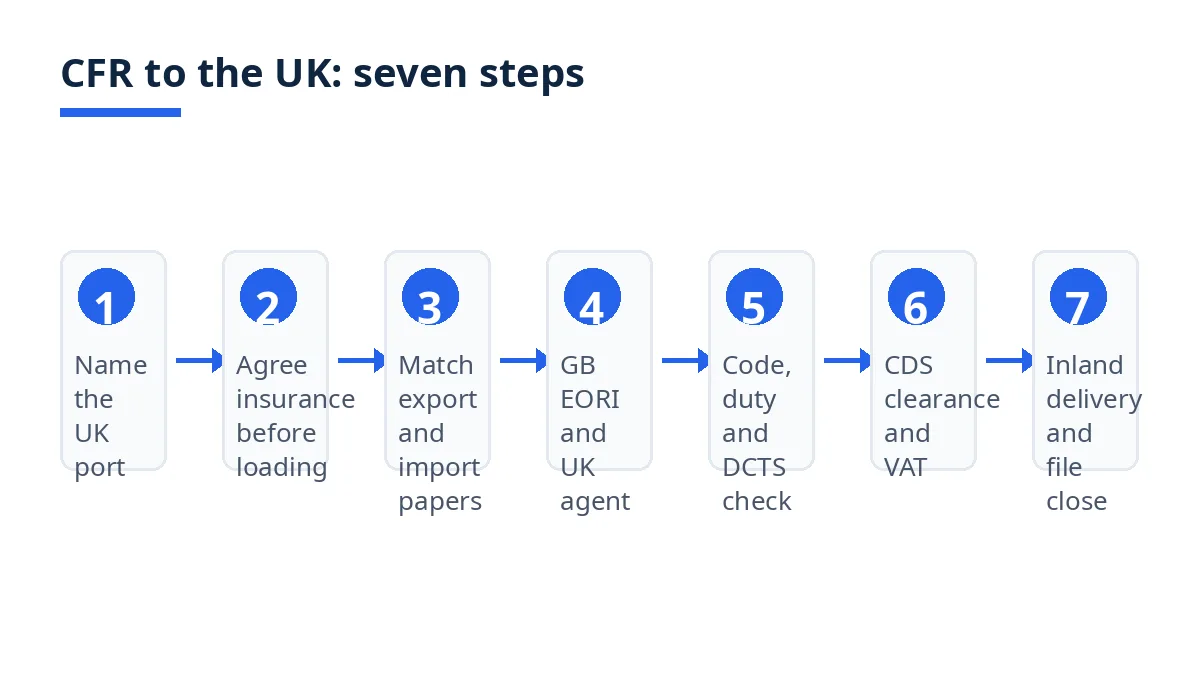
Name the UK port in full, with the edition. Write "CFR [named UK port], Incoterms 2020" in the quotation and purchase order, with goods, quantity, price, currency, validity. Name a port, such as Felixstowe or London Gateway: it decides where seller-paid freight ends and your UK leg begins.
Settle insurance before loading. Decide who insures, from loading onward, for which value and risks. Under CFR the seller has no duty to insure, so silence on insurance leaves the ocean leg uncovered.2 Hold the policy, or a written seller agreement to insure, before sailing.
Match the Bangladesh export set to the UK import set before shipment. Check that invoice, packing list and bill of lading agree on description, quantity, weight, value and port names, and that the seller's legal name matches the quotation.
Get your GB EORI number and appoint your UK customs agent before sailing. You need a GB-starting EORI number to import into England, Wales or Scotland.3 Give the agent the invoice, packing list, bill of lading and product description early, and agree in writing whether you will use postponed VAT accounting (PVA). Anyone importing on your behalf must hold your written PVA instructions before filing.4
Confirm the commodity code, duty treatment and preference claim before arrival. The commodity code on your import declaration determines the duty rate and whether you need an import licence.5 Ask your agent to check the code in the UK Integrated Online Tariff, the GOV.UK DCTS guidance tool for commodity codes, duty and VAT rates.6 If you claim a Developing Countries Trading Scheme (DCTS) preference, confirm the origin rule and proof of origin first, rather than assuming a lower rate.
Clear the goods on arrival and settle duty and VAT correctly. Goods may be held at the border if duty or VAT is wrong, licences are missing, or inspection fails.3 Pay duty as the declaration requires. Postponed VAT accounting means you declare and recover import VAT on the same VAT return, rather than paying it upfront and recovering it later.4 You cannot change that choice once submitted,4 so decide PVA before filing.
Move the goods inland and close the file. Book inland transport only once you know the release position, check cartons, marks and quantities against the packing list and bill of lading, and note damage or shortage on the delivery record at once. Keep the invoices and customs paperwork, including the C79 where VAT was paid at the border, or the monthly postponed VAT statement where PVA was used.5 4
Costs, timelines and documents
What are the typical costs and timelines?
There is no typical CFR freight rate or transit time a guide can state as fact. Freight depends on route, vessel, cargo, season and market at booking; transit depends on sailing schedule and any transshipment. Ask the seller for the freight basis — UK port, carrier service, carriage inclusions — and your UK agent and forwarder for the buyer-side lines.
The cost split is fixed in structure, even though every figure moves. The seller pays export clearance, origin handling and ocean freight to the named UK port.2 You pay insurance if you arrange it, destination handling outside the carriage contract, UK clearance and agent charges, duty, import VAT treatment, and inland transport.2
Cost line | Who pays under CFR | Check before you confirm |
|---|---|---|
Export clearance in Bangladesh | Seller | Bill of Export set complete |
Ocean freight to the named UK port | Seller | Port, carrier service and inclusions in writing |
Cargo insurance | Buyer, unless the contract says otherwise | Cover starts at loading, not at arrival |
Destination unloading and handling not in the carriage contract | Buyer | Which terminal charges sit in the freight contract |
UK import declaration and agent charges | Buyer | Agent appointed before sailing; GB EORI ready |
UK duty | Buyer | Commodity code and any DCTS claim confirmed |
Import VAT | Buyer, by PVA or payment at the border | PVA choice agreed in writing before the declaration |
Inland transport from the UK port | Buyer | Haulage booked against the release position |
Example figures: a UK buyer imports jute bags CFR Felixstowe. Illustrative buyer-side lines: insurance £210, destination handling outside the carriage contract £340, agent charges £180, inland transport £260 — £990 before duty and import VAT. Duty and import VAT are left for the buyer to complete from the tariff for the actual code.
For timelines, work in phases: production and export clearance, loading, the ocean leg, UK release, and inland delivery. Ask for each phase separately. Delays most often sit in document handover, a declaration query, an inspection hold, or haulage booked before release.
Which documents are needed?
For export clearance in Bangladesh, goods shall not be allowed to load or be stuffed in containers for export unless an export declaration, known as the Bill of Export or Shipping Bill, is submitted to Customs in the prescribed format and approved by the Customs authority.7 Enclosed for all consignments: the export letter of credit or, where there is none, the export contract, purchase order or export guarantee approved by the negotiating bank, commercial invoice, packing list, EXP form certified by an authorized dealer, certificate of origin from the Export Promotion Bureau or a Chamber of Commerce and Industry, VAT certificate, and taxpayer number.7
For the UK import, the agent works from the same commercial set, plus your GB EORI number, commodity code, customs value, VAT number where PVA is used, and any licence, certificate or proof of origin required.5 3 4 Keep one name, address and product description across every document: a difference between any two is the most common reason a declaration is queried.
Bangladesh-specific rules and tips
Match the seller's export papers to your UK papers. The Bill of Export specifies goods description, value, exporter, foreign buyer or importer, and transport operator.7 Check the buyer name matches the UK declaration importer, and port names match on every document.
Confirm product-specific papers early. The Bangladesh export list adds product-specific documents for some categories, such as an Export Registration Certificate (ERC) for jute, jute goods and tea, and a phytosanitary certificate for agricultural goods where required.7 Ask which extra papers your product needs before production, not after loading.
Do not treat a certificate of origin as an automatic DCTS claim. The seller's certificate of origin and the proof of origin for a UK preference claim are two different jobs. Confirm what proof the CDS declaration needs. GOV.UK notes that eligible goods shipped or warehoused before 1 January 2026 can still qualify if declared for free circulation on or after that date with valid proof, and that a backdated preference claim is possible where proof arrives only after release.6 That route is a safety net, not a plan: get the proof before arrival where you can.
Treat the container handover with care. Containers are often handed to a carrier at a terminal before loading. Under CFR, that handover does not normally transfer risk: delivery and risk transfer occur on board.2 That gap matters for damage between handover and loading, because proving when damage occurred can be difficult. For containers, ask about CPT or CIP, where risk follows handover to the carrier, and choose deliberately rather than by habit.
Use the UK tariff, not a neighbouring country's rules. The UK left the European Union's preference system, so an EU duty treatment does not transfer to a UK import. Check code, duty and VAT rates in the UK Integrated Online Tariff,6 and confirm them with your UK agent.
Mistakes and red flags
What are the most common mistakes?
Assuming CFR includes insurance. CFR includes freight, not insurance. The seller has no duty to insure; you carry the sea risk from loading.2 A "CFR" quotation silent on insurance is a quotation without insurance.
Assuming the seller bears the sea risk because the seller paid the freight. Cost and risk split at different points under CFR. If cargo is damaged at sea, the question is who held the risk — under CFR, the buyer from loading onward.2 Insurance, not freight payment, is the protection.
Reading "CFR Felixstowe" as delivery to your warehouse. The named port is where seller-paid freight ends. UK clearance, duty, import VAT, terminal handling outside the carriage contract and inland transport remain yours.
Leaving the PVA choice until after the declaration is filed. You cannot change how you want to account for import VAT on your import declaration once you have submitted it.4 Agree PVA in writing with your agent before filing, with your VAT registration number on the declaration.4
Assuming a DCTS preference without checking code and proof. A preference claim needs the right code, origin rule and valid proof. An undocumented claim cannot be relied on, and a wrong code can change duty and licence requirements.5 6
Comparing CFR, CIF and DAP prices without converting them. A CFR price without insurance, a CIF price with seller-arranged insurance, and a DAP price with risk to your named place are three different finishes. Add insurance, clearance, duty, import VAT treatment, handling and inland transport to each before calling one cheaper. See the landed cost for imports from Bangladesh guide.
Appointing the UK agent after arrival. Goods may be held at the border if duty or VAT is unpaid, licences are missing, or inspection fails.3 A late agent starts behind while storage charges continue.
Checklist
Before you confirm a CFR order from Bangladesh to the UK, every line should be answered in writing.
Term in full: "CFR [named UK port], Incoterms 2020", goods, quantity, price, currency, validity.
Insurance agreed: who insures, from loading onward, for which value and risks.
Freight inclusions confirmed: port, carrier service, handling in the carriage contract.
Export set agreed: Bill of Export, invoice, packing list, EXP form, certificate of origin, VAT and taxpayer documents, plus product papers.7
GB EORI number ready; UK customs agent appointed before sailing.3
PVA choice agreed in writing before filing; VAT number on the declaration.4
Commodity code confirmed in the UK tariff; duty and DCTS claim checked with proof.5 6
UK documents ready: invoice, packing list, bill of lading, value, licences and certificates where required.
Release plan agreed: duty route, import VAT route, holder of the C79 or postponed VAT statement.4
Inland transport booked against the release position, not a guessed arrival day.
Damage procedure agreed: note it on delivery, notify the insurer in time, keep the full file.
How Exportain helps
On Exportain, browse suppliers and post a request for quotation on the RFQ board stating "CFR [named UK port], Incoterms 2020", your specification, quantity and insurance position. Ask each reply to state freight inclusions, handover timing, whether insurance is included, and which UK port the price covers.
Read the badges for what they record. Verification is a document and photo review by staff, not a factory inspection, and membership plans are a separate product that never grant a trust badge.8 It does not replace sample approval, pre-shipment checks, cargo insurance, or your agent's classification and DCTS work.
FAQs
What should I know first about CFR?
CFR is a sea and inland waterway rule under Incoterms 2020: the seller pays ocean freight to your named UK port, while risk transfers to you on loading on board in Bangladesh.2 Neither side must insure, so arrange cover from loading onward.
What are the typical costs and timelines?
There is no typical freight rate or transit time to quote as fact, because both depend on route, service, cargo and market at booking. The seller pays export clearance and freight to the named UK port; you pay insurance, destination handling outside the carriage contract, UK clearance, duty, import VAT treatment and inland transport.2 Work in phases — production, loading, ocean leg, UK release, inland delivery.
Which documents are needed?
The Bangladesh export set is the Bill of Export with the export letter of credit or contract, invoice, packing list, EXP form, certificate of origin, VAT certificate and taxpayer number, plus product-specific papers.7 The UK set adds your GB EORI number, commodity code, VAT details for PVA, and any licence or proof of origin required.5 3 4
What are the most common mistakes?
The most common mistakes are assuming CFR includes insurance, assuming the freight payer bears the sea risk, reading the named UK port as warehouse delivery, leaving the PVA choice until after filing, and assuming a DCTS preference without checking code and proof.2 4 6
Next steps on Exportain
Browse suppliers, then read the Incoterms for shipments from Bangladesh guide and the landed cost for imports from Bangladesh guide, so quotation, declaration and landed-cost build share one finish line.
Sources
- Incoterms® 2020. International Chamber of Commerce (ICC) (accessed )
- CFR Incoterms: Meaning, Costs & Risk. iContainers (accessed )
- Get UK customs clearance when importing goods into the UK: step by step. GOV.UK (accessed )
- Check when you can account for import VAT on your VAT Return. GOV.UK (accessed )
- Import goods into the UK: step by step. GOV.UK (accessed )
- Update: Improved Rules of Origin under the Developing Countries Trading (DCTS) are now in effect.. GOV.UK (accessed )
- Customs Clearance Procedures for Export. Bangladesh Customs, National Board of Revenue (accessed )
- Supplier verification: Earn trust badges buyers can see. Exportain (accessed )
About the author
Sourcing from Bangladesh?
Post a request for quotation and suppliers on Exportain can send you their quotes directly.
Post an RFQ