CFR Shipping From Bangladesh to UAE: Costs, Steps and Timeline
CFR from Bangladesh to UAE: who pays freight to Jebel Ali, where risk passes, what mainland duty and VAT add, and which documents clear both ends of the shipment.
Short answer
Under CFR Incoterms 2020, a Bangladeshi seller pays ocean freight to the named UAE port, Jebel Ali, while risk passes to the UAE buyer when goods are placed on board at Chattogram. The seller handles Bangladesh export clearance, the buyer handles UAE import clearance, mainland duty and VAT, and onward delivery, and neither party must arrange cargo insurance, so the buyer should insure from loading.
On this page
Key takeaways
Under CFR, the seller pays ocean freight to Jebel Ali, but risk passes to the buyer when goods are placed on board at Chattogram.
CFR carries no insurance obligation for either party, unlike CIF, so the buyer should arrange cover from the loading point.
A UAE mainland entry typically adds 5 percent duty on the CIF value and 5 percent VAT on the import value, while a free-zone entry suspends duty until any later mainland movement.
Port-to-port transit is planned at about 11 to 15 days, with routing and transhipment deciding where in that window a sailing lands.
The contract must name one destination port, CFR Jebel Ali, since the port fixes the freight, the arrival procedure and the onward route.
A buyer in Dubai agrees CFR Jebel Ali with a supplier in Chattogram, and both sides sign a contract that names the port, the goods and the price. The shipment still leaves room for a costly misunderstanding, because CFR splits cost and risk at two different points. The seller pays the ocean freight to Jebel Ali, but the risk of loss or damage passes to the buyer much earlier, when the goods are placed on board the vessel at the port of shipment.1 This guide works through that split for the Bangladesh to UAE lane, with mainland duty and VAT on the buyer side and the free-zone and re-export choices that set this lane apart.
What should I know first about CFR?
CFR stands for Cost and Freight, and it is one of the four rules for sea and inland waterway transport in Incoterms 2020. The International Chamber of Commerce describes the Incoterms rules as eleven three-letter trade terms that clarify the tasks, costs and risks involved in the delivery of goods from sellers to buyers.2 CFR applies only to sea and inland waterway transport, and it remains unchanged in Incoterms 2020.1
Three points define the rule. First, the seller contracts and pays for carriage to the named port of destination, here Jebel Ali. Second, delivery happens when the goods are placed on board the vessel at the port of shipment, and risk passes at that same point. Third, neither party is obliged to arrange cargo insurance under CFR, which is the one difference from CIF, where the seller must procure insurance.1 A buyer who wants cover for the sea leg must arrange it, and should do so from the loading point, not from arrival.
The container point matters on this lane. Containers are often handed to a carrier at a terminal days before loading, but under CFR that terminal handover does not normally transfer risk, since delivery and risk transfer occur on board at the shipment port.1 If the parties still choose CFR for a container, the contract should state the position in plain words, so neither side treats gate-in as delivery.
Why this matters for buyers and sellers
For a UAE buyer, CFR looks attractive because one price covers the goods and the freight to Jebel Ali, and the buyer keeps control of UAE import clearance, duty and VAT, and onward delivery. For a Bangladeshi seller, CFR keeps control of export clearance and the ocean booking. The bargain only works when both sides price the same split.
The UAE end adds a decision that a European CFR lane does not present in the same form. Goods imported into the UAE mainland are subject to duty, typically 5 percent of the Cost, Insurance and Freight (CIF) value under the GCC Common Customs Tariff, while goods imported directly into a designated free zone are generally exempt from customs duties.3 If free-zone goods later move into the mainland, they are treated as an import into the mainland and the standard duty becomes payable.3 A buyer who plans to re-export from Jebel Ali Free Zone (JAFZA) therefore faces a different cash position from a buyer who clears straight into mainland Dubai, even on identical CFR terms.
Jebel Ali itself shapes the choice. It is the largest port in the Middle East, with four terminals handling over 15 million twenty-foot equivalent units (TEUs) a year of container cargo, alongside bulk, breakbulk and roll-on roll-off cargo.4 That scale brings frequent sailings, but it also means the named port in the contract should be exact: CFR Jebel Ali and CFR Khalifa Port are different bargains, so the contract must name one port, not a country.
Step-by-step: how it works
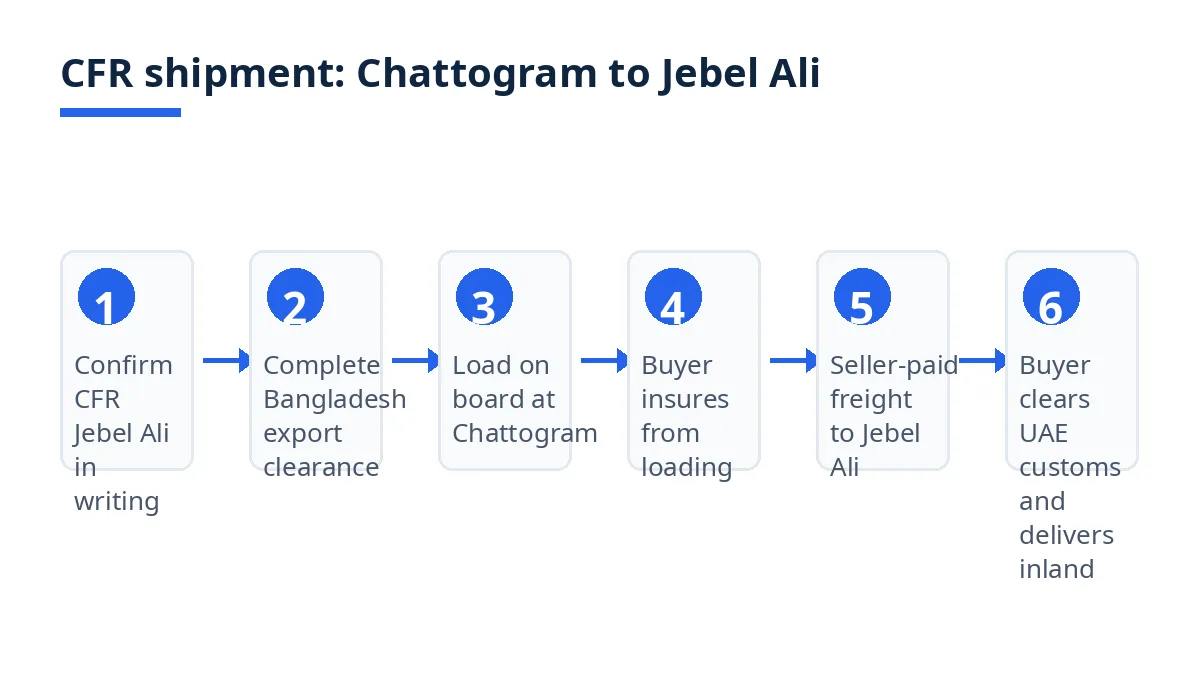
Write CFR Jebel Ali in full. State "CFR Jebel Ali, UAE Incoterms 2020" in the quotation, proforma invoice and purchase order, with the goods, quantity, unit price and payment terms. A contract that says only "CFR UAE" leaves the destination port open, and the freight the seller priced may not match the port the buyer expected.
Confirm insurance before loading. The buyer arranges cargo insurance from the on-board point, or the parties record in writing that the buyer accepts the transit risk uninsured. Do not leave this point until after loading, when the risk has already passed.
Complete Bangladesh export clearance. The seller, or its agent, submits the Bill of Export and the export document set, and loads the goods once Customs approves the declaration.5
Load on board at Chattogram. Delivery and risk transfer occur when the goods are placed on board the vessel at Chattogram. The bill of lading should record the on-board position, since that document anchors both the risk point and the buyer import set.
Move on seller-paid freight to Jebel Ali. The seller carries the freight cost to Jebel Ali under the carriage contract it booked. Freight paid does not mean risk carried: a loss at sea after loading falls on the buyer side, subject to whatever insurance the buyer arranged.
Clear UAE customs as the buyer. The buyer, or its broker, files the import declaration, pays duty and VAT for a mainland entry, and arranges onward transport. For a free-zone entry, the declaration type differs, and duty stays suspended until any later mainland movement.3
Release and deliver inland. Once duty and VAT are settled and any inspection is complete, Customs releases the goods and the buyer arranges collection and delivery to its warehouse, store or customer in the UAE, or onward re-export from the free zone.
Costs, timelines and documents
What are the typical costs and timelines?
There is no fixed CFR freight rate a guide can state for this lane, because ocean freight moves with vessel capacity, fuel surcharges, equipment availability and the sailing booked. What a buyer can fix in advance is the structure of the cost, and which side pays each line.
Cost line | Paid by | Notes |
|---|---|---|
Goods and export packing | Seller | Inside the CFR price unless the contract states otherwise |
Inland transport to Chattogram and origin port charges | Seller | Part of the seller cost to the vessel |
Bangladesh export clearance | Seller | Export declaration and export document set |
Ocean freight to Jebel Ali | Seller | The freight in CFR; check whether destination handling is inside the carriage contract |
Cargo insurance for the sea leg | Buyer, if arranged | No insurance obligation under CFR |
Destination unloading and handling not inside the carriage contract | Buyer | Confirm this line before signing, since carriage contracts differ |
UAE import declaration, duty and VAT | Buyer | Mainland duty typically 5 percent of CIF value; VAT 5 percent on the import value |
Onward transport in the UAE | Buyer | From Jebel Ali to the buyer premises or free-zone facility |
On the UAE tax lines, the figures are standard rates, not a quote for any one shipment. Goods imported into the UAE mainland are subject to duty, typically 5 percent of the CIF value, and VAT is payable at 5 percent on the import value, recoverable if the importer is VAT-registered.3 Import VAT is calculated on the sum of CIF value and customs duty, so freight and insurance form part of the base even though the seller paid the freight.6 Some categories are zero-rated or exempt, and excise goods attract far higher rates, so the rate must be confirmed against the goods HS code before the order is priced.3
For transit, plan on a port-to-port window of about 11 to 15 days, then add clearance time at each end. A current schedule listing for Chattogram to Jebel Ali shows transit of 10 days and 9 hours,7 while the Bangladesh India Gulf Express service launched by CMA CGM was reported at launch with fast transit times of 14 days to Jebel Ali and 15 days to Abu Dhabi.8 The difference reflects routing and transhipment: some sailings move via Colombo and Indian west-coast ports before reaching the Gulf.8 Ask for the sailing schedule, the transhipment ports and the free days at Jebel Ali, rather than planning on a single transit figure.
Which documents are needed?
The document set has two halves, and a mismatch between them is a common cause of delay at Jebel Ali.
For the Bangladesh export half, goods may not be loaded unless an export declaration, the Bill of Export or Shipping Bill, is submitted to Customs and approved.5 The documents enclosed with it for all export consignments are the export letter of credit, or the export contract or purchase order where there is no letter of credit, the commercial invoice, the packing list, the EXP form certified by an authorized dealer, a certificate of origin issued by the Export Promotion Bureau or a Chamber of Commerce and Industry, the VAT registration certificate and the taxpayer identification number.5 Product-specific papers sit on top of that set, such as a phytosanitary certificate for agricultural goods or a quality control certificate for frozen fish.5
For the UAE import half, the core set is the commercial invoice, the packing list, the bill of lading, the certificate of origin and the importer customs code, with the declaration filed electronically, in Dubai through Mirsal 2.3 The importer must hold a valid trade licence that permits import activities, and must register as an importer with the customs department of the emirate where the goods will enter.3 Product-specific approvals apply by category, such as health certificates for food and conformity certificates for regulated products.3
One consistency rule covers both halves: the seller name, buyer name, goods description, quantity, value, HS code and port names should match across the invoice, packing list, bill of lading, certificate of origin and both customs declarations. A value or description that changes between the Bangladesh set and the UAE set invites a valuation query or an inspection at Jebel Ali.
Bangladesh-specific rules and tips
Keep the EXP form and the payment route aligned. The EXP form certified by an authorized dealer supports realization of export proceeds,5 so the payment terms in the contract, the invoice value and the bank route should agree. A CFR price that differs from the invoice value used for the EXP form creates a paper gap that follows the shipment to the buyer import file.## Mistakes and red flags
What are the most common mistakes?
Assuming CFR covers duty, VAT and delivery to the warehouse. Import clearance, duty, VAT and onward transport sit with the buyer,1 and mainland duty and VAT are assessed on the CIF value at entry.3 A CFR price that looks complete at signing still leaves those buyer-side lines to pay at arrival.
Leaving destination handling unclear. The buyer pays destination unloading and handling charges that are not included for the seller account in the carriage contract.1 Carriage contracts differ, so the contract should state whether Jebel Ali terminal handling sits inside the seller freight or outside it.
Mixing mainland and free-zone plans. Free-zone goods are generally exempt from duty until they enter the mainland,3 so a buyer who clears as a free-zone entry but delivers to a mainland customer without a mainland declaration has created a customs gap. The declaration type must match the real destination of the goods.
Checklist
Before the vessel loads, every line should be answered in writing.
Contract states "CFR Jebel Ali, UAE Incoterms 2020" with goods, quantity, price and payment terms.
Insurance for the sea leg arranged by the buyer from the on-board point, or the uninsured risk accepted in writing.
Bangladesh export set complete: Bill of Export, invoice, packing list, EXP form, certificate of origin, VAT and TIN papers.5
Bill of lading records the on-board position at Chattogram and matches the invoice and packing list.
Sailing confirmed: service, transhipment ports, departure and arrival dates, free days at Jebel Ali.
Carriage contract checked for whether Jebel Ali terminal handling sits inside the seller freight.
UAE importer code and trade licence current, and the declaration route confirmed for mainland or free-zone entry.3
Duty and VAT budgeted on the CIF base: mainland duty typically 5 percent, VAT 5 percent on the import value.3
Product-specific UAE approvals confirmed before loading, such as health or conformity certificates where they apply.3
Onward transport from Jebel Ali booked, or the free-zone facility and any later mainland declaration planned.
How Exportain helps
On Exportain, browse suppliers and post a request for quotation on the RFQ board with the named port, CFR Jebel Ali Incoterms 2020, and the cargo details, so suppliers quote against the same destination and the same term. Ask each reply to state the sailing route, the transhipment ports and whether Jebel Ali terminal handling sits inside the freight, since those three lines decide whether two CFR quotations can be compared.
Read the Incoterms guide before you confirm a term, and use the landed cost guide to build the buyer-side lines on top of the CFR price.
FAQs
What should I know first about CFR?
CFR means the seller pays cost and freight to the named destination port, here Jebel Ali, while risk passes to the buyer when the goods are placed on board at the port of shipment.1 It is a sea and inland waterway rule only, and it carries no insurance obligation for either party, which is what separates it from CIF.1
What are the typical costs and timelines?
Costs split at Jebel Ali: the seller pays goods, export clearance and ocean freight to the port, while the buyer pays insurance if arranged, destination handling outside the carriage contract, UAE duty and VAT, and onward transport.1 Mainland duty is typically 5 percent of CIF value and VAT is 5 percent on the import value.3 Port-to-port transit is planned at about 11 to 15 days.8 7
Which documents are needed?
The Bangladesh set is the Bill of Export with the export contract or letter of credit, commercial invoice, packing list, EXP form, certificate of origin, VAT registration and TIN.5 The UAE set is the commercial invoice, packing list, bill of lading, certificate of origin, importer customs code and electronic declaration, plus product-specific approvals where they apply.3
What are the most common mistakes?
The most common mistakes are treating CFR as delivery to Jebel Ali, assuming insurance is included, assuming duty and VAT sit inside the CFR price, leaving destination handling unclear, and mixing a free-zone entry with a mainland delivery.1 3 Each mistake comes from reading CFR as a door-to-door price, when it is a port-to-port freight bargain with risk passing at loading.
Next steps on Exportain
Browse suppliers, then post your CFR Jebel Ali requirement on the RFQ board with the goods, quantity and sailing needs, so suppliers quote on the same named port and term. Before you confirm, read the Incoterms guide and the landed cost guide to check the full buyer-side cost of the shipment.
Sources
- CFR Incoterms: Meaning, Costs & Risk. iContainers (accessed )
- Incoterms® rules. International Chamber of Commerce (ICC) (accessed )
- UAE Import and Export Compliance: Trade Regulations Guide. Nour Attorneys (accessed )
- All Jebel Ali terminals are operating normally: DP World. Aletihad News Center (WAM) (accessed )
- Customs Clearance Procedures for Export. Bangladesh Customs, National Board of Revenue (accessed )
- VAT on Customs Duty in the UAE: Documents and Payment Process. Global Trade Plaza (accessed )
- Chittagong to Jebel Ali FCL Shipping Rates | Schedules & Transit Time. Cogoport (accessed )
- Shipping on Ctg-Dubai route begins. The Business Standard (accessed )
About the author
Sourcing from Bangladesh?
Post a request for quotation and suppliers on Exportain can send you their quotes directly.
Post an RFQ