

CFR Shipping From Bangladesh to Germany: Costs, Steps and Timeline
CFR shipping from Bangladesh to Germany explained for buyers: who pays freight to Hamburg, when risk moves on board at Chattogram, what the buyer still pays at arrival, and which documents each side needs.
Short answer
Under CFR, a Bangladeshi seller pays the ocean freight to a named German port such as Hamburg, while risk transfers to the German buyer when the goods are loaded on board at Chattogram. The buyer arranges cargo insurance, clears the German import, and pays duty, import VAT, and inland transport, so the CFR price is not the full landed cost.
On this page
Key takeaways
Under CFR, the seller pays ocean freight to Hamburg or Bremerhaven, but risk transfers to the buyer when the goods are loaded on board at Chattogram.
The CFR price excludes cargo insurance, German import clearance, duty, import VAT, and inland transport, all of which sit on the buyer.
Name one German discharge port in the contract and confirm whether Hamburg discharge handling is inside the seller's carriage contract.
Sea transit from Bangladesh to Germany takes three to six weeks, usually by feeder vessel to a transshipment hub and then by mother vessel to North Europe.
A German buyer confirms the EORI number, customs representative, and duty and import VAT treatment while the goods are still at sea.
A CFR shipment from Bangladesh to Germany puts one split at the center of the deal: the seller pays the ocean freight to a named German port, but the buyer carries the risk from the moment the goods are loaded on board at Chattogram. That split shapes the price, the insurance decision, and every document that follows. This guide explains CFR Bangladesh to Germany for a buyer importing through Hamburg or Bremerhaven.
CFR stands for Cost and Freight. It is one of the 11 Incoterms 2020 rules published by the International Chamber of Commerce, which allocate cost, risk, and obligations between seller and buyer.1 CFR applies only to sea and inland waterway transport, and is written as CFR followed by a named port of destination, for example CFR Hamburg, Incoterms 2020.2
Why this matters for buyers and sellers
For the seller, CFR means one price that already includes the main carriage. For the buyer, it means the freight decision is already made, while the sea risk and the German import bill are not. The buyer therefore needs to price what the CFR price does not contain: cargo insurance, German import clearance, duty and import VAT, and inland transport from the German port.2
The cost-risk split also decides who acts when cargo is damaged at sea. The buyer holds the risk even though the seller paid the freight, so the buyer needs an insurance policy in place before the vessel sails, not after the damage is reported.2
Hamburg is the natural named port for most Bangladesh cargo bound for Germany: it is Germany's largest seaport, handling 114.6 million tonnes in total throughput and 8.3 million TEU in 2025.3 Bremerhaven is the alternative named port where a carrier service or a buyer warehouse location makes it the better discharge point. The contract must name one port, because freight, discharge, and onward transport all price from that port.
Step-by-step: how it works
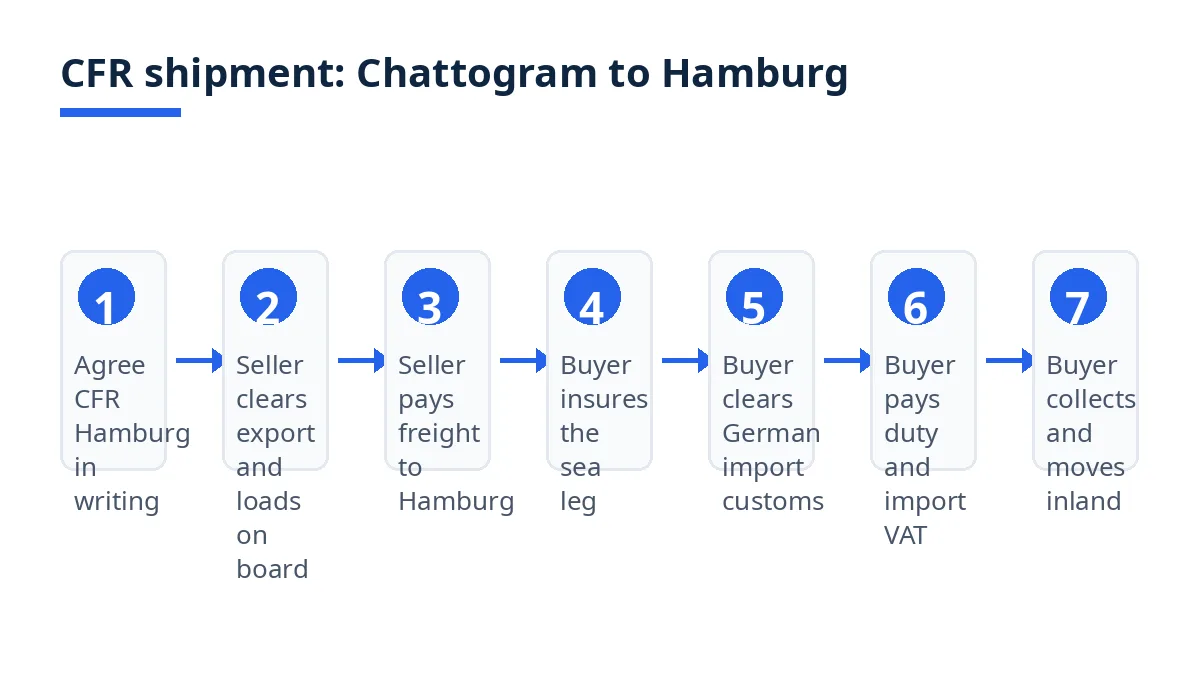
Agree the term in writing, with the port named. Write "CFR Hamburg, Incoterms 2020" or "CFR Bremerhaven, Incoterms 2020" into the sales contract and the purchase order. A term without a named port is incomplete, and a port named only in an email thread invites a dispute about which discharge point the freight price covered.
Seller prepares, packs, and moves the goods to Chattogram, the port still widely listed as Chittagong. The seller handles inland transport in Bangladesh, export clearance, and port charges at origin, and delivers the goods on board the vessel at the port of shipment.2
Seller contracts and pays the freight to the named German port. The seller books the voyage and pays the ocean freight to Hamburg or Bremerhaven. The seller also provides the commercial documentation for the shipment.2
Risk transfers when the goods are on board. Delivery under CFR happens when the goods are placed on board the vessel at Chattogram, and risk passes to the buyer at that point, even though the seller continues to pay for the voyage.2
Buyer arranges cargo insurance for the sea leg. CFR places no insurance obligation on either party, so the buyer arranges cover from the on-board point onward, or agrees in writing that the seller will arrange it as a separate service.2
Vessel sails, usually by feeder and mother vessel. Chattogram cargo typically moves by feeder vessel to a hub such as Singapore or Colombo, then by mother vessel to North Europe ports including Hamburg.4 Carrier schedules show feeder departures to Singapore feeding services that call at Rotterdam, Hamburg, and Antwerp.5
Buyer clears the import in Germany and moves the goods inland. On arrival, the buyer handles import clearance, pays duty and import VAT and any destination charges not included in the seller's carriage contract, and arranges inland transport.2
What should I know first about CFR?
Know the split before you compare prices. A lower CFR price can still be the worse deal if it names a less convenient port, excludes discharge handling you must then pay at Hamburg, or leaves you uninsured for a voyage you assumed was covered. Compare quotations only on the same named port, the same Incoterms 2020 version, and the same statement of freight inclusions.
Costs, timelines and documents
What are the typical costs and timelines?
No guide can state a fixed CFR freight rate for this lane, because freight moves with vessel capacity, fuel, season, container type, and the transshipment route on the sailing date. What a buyer can fix in advance is the structure: which lines sit inside the CFR price and which sit outside it.
Cost line | Paid by | Inside the CFR price |
|---|---|---|
Goods and packing | Buyer, through the goods price | Yes, as the goods value |
Inland transport in Bangladesh | Seller | Yes, up to loading |
Export clearance and origin port charges | Seller | Yes |
Ocean freight to Hamburg or Bremerhaven | Seller | Yes |
Cargo insurance for the voyage | Buyer, unless agreed otherwise | No |
Destination unloading and handling, if excluded from the carriage contract | Buyer | No, unless the carriage contract includes it |
German import clearance | Buyer | No |
Import duty and import VAT | Buyer | No |
Inland transport in Germany | Buyer | No |
Example figures: a CFR Hamburg price built from a goods value of 10,000 dollars, Bangladesh inland and export costs of 400 dollars, and ocean freight of 1,800 dollars gives a CFR price of 12,200 dollars. The example shows structure only, not a quotation, a typical freight rate, or a duty figure. The buyer-side bill on top of that price is insurance, clearance, duty, import VAT, and inland transport, each priced for the actual goods and the actual arrival.
For timelines, sea shipping from Bangladesh to Germany takes three to six weeks.6 The feeder and transshipment pattern behind that range takes about 40 days from Chattogram to Europe in reported trade coverage.4 Add production and export clearance before sailing, plus German import clearance and inland transport after discharge, and plan from the sailing date plus the full range, not from the shortest figure. Confirm the vessel schedule and the transshipment hub on the booking, because a missed feeder connection moves the arrival by a sailing, not by a day.
Which documents are needed?
On the Bangladesh side, goods may not be loaded for export unless an export declaration, the Bill of Export or Shipping Bill, is submitted to Customs and approved.7 The documents enclosed with the Bill of Export include the export letter of credit or, where there is none, the export contract or purchase order approved by the negotiating bank, the commercial invoice, the packing list, the EXP form certified by an authorized dealer, the certificate of origin issued by the Export Promotion Bureau or a Chamber of Commerce and Industry, the VAT registration certificate, and the taxpayer identification number.7
The buyer-side set for a CFR Hamburg shipment is the commercial invoice, the packing list, the bill of lading, the certificate of origin where a preference or a buyer requirement calls for it, the cargo insurance certificate, and the German import declaration with the EORI number of the declarant and the consignee. The bill of lading matters twice: it is the carriage document the seller tenders, and the document the buyer or the buyer's agent presents to take delivery at Hamburg or Bremerhaven.
Bangladesh-specific rules and tips
Name the discharge port, not only the country. "CFR Germany" leaves the freight destination open between Hamburg, Bremerhaven, and Wilhelmshaven. Name Hamburg or Bremerhaven in the contract, and check that the booked carrier service actually discharges there, since a service routed through Rotterdam with onward movement to Hamburg changes the arrival date and the handling chain.5
Confirm the transshipment route at booking. Chattogram cargo moves through hubs before the mother vessel leg to North Europe.4 Ask the seller or forwarder for the feeder vessel, the hub, and the mother vessel service, and record them on the booking confirmation, so a delay can be chased with the right carrier at the right leg.
Keep one legal name across every paper. The export declaration names the exporter and the foreign buyer,7 so the name on the trade licence, the quotation, the proforma invoice, the bill of lading, and the German import declaration should match. A name mismatch between the bill of lading and the import declaration is a clearance delay at Hamburg that no freight term can fix.
Treat container handover with care. Containers are often handed to a carrier at a terminal days before loading, but under CFR delivery and risk transfer still occur on board at the shipment port.2 That gap is a known CFR weakness for container cargo, and one reason some buyers prefer a rule that transfers risk at handover. If the cargo is containerized, discuss the gap with the seller before signing CFR, and make sure the buyer's insurance covers the goods from terminal handover, not only from sailing.
Check the German side before the vessel sails. The buyer side of a CFR deal is German import procedure, not a second negotiation with the seller. The EORI number is the identifier German customs uses for economic operators: an operator established in the European Union applies in the member state where it is resident, and there is an obligation to quote an EORI number on customs declarations.8 A German buyer confirms its EORI number, customs representative, and duty and import VAT treatment while the goods are still at sea, so arrival does not wait on registration.
Mistakes and red flags
What are the most common mistakes?
Assuming freight paid means risk covered. The most common CFR mistake is reading a seller-paid freight line as seller-carried risk. Risk passes on board at Chattogram, and cargo insurance is the buyer's decision under CFR.2 No insurance line in the quotation means no insurance, not included insurance.
Leaving the named port vague. A contract that says CFR Germany without a port, or a quotation that prices Hamburg while the booking discharges Bremerhaven, creates a second freight and handling bill at arrival. Name one port in the contract and match the booking to it.
Forgetting destination charges. The buyer pays destination unloading and handling charges that are not included for the seller's account in the carriage contract, together with import clearance, duty, and import VAT.2 Ask the seller in writing whether Hamburg discharge handling is inside the freight price, and get the answer on the quotation.
Comparing CFR with CIF or FOB as if they were the same price. CFR and CIF share the same risk point, but CIF adds a seller insurance obligation that CFR does not carry.2 FOB stops the seller's cost at loading, so the buyer pays the freight as well. Compare only quotations on the same term and the same named port. See the Incoterms for shipments from Bangladesh guide and the CFR quotations compared guide.
Skipping the insurance decision until arrival. Arrange cargo cover before loading, with the insured value, the voyage, and the handover point stated.
Treating the CFR price as the landed cost. The CFR price is not the cost of the goods in the buyer's warehouse. Duty, import VAT, clearance, handling, and inland transport sit on top of it, and the landed cost for imports from Bangladesh guide shows how to build the full per-unit figure.
Checklist
Before you confirm a CFR Bangladesh to Germany order, every line should be answered in writing.
Term written as CFR plus one named port, Hamburg or Bremerhaven, with Incoterms 2020 stated.
Freight inclusions confirmed: whether Hamburg discharge handling is inside the seller's carriage contract.
Cargo insurance arranged by the buyer from the on-board point, or agreed otherwise in writing.
Export set confirmed: Bill of Export, commercial invoice, packing list, EXP form, certificate of origin.7
Bill of lading details matched to the contract: shipper, consignee, port of loading, port of discharge, goods description.
Feeder vessel, transshipment hub, and mother vessel service recorded on the booking.4 5
German EORI number confirmed, customs representative appointed, import declaration route agreed.8
Duty and import VAT treatment checked for the goods classification before arrival.
Inland transport from Hamburg or Bremerhaven booked for the discharge window.
Arrival buffer planned on the three-to-six-week sea range, not on the shortest figure.6
How Exportain helps
On Exportain, browse suppliers and post a request for quotation on the RFQ board with the term written as CFR Hamburg, Incoterms 2020, so suppliers quote against the same named port and the same rule. Ask each reply to state whether Hamburg discharge handling is inside the freight price and whether any insurance is included, since neither answer is implied by the CFR term itself.
Read badges for what they record: Exportain verification is a document and photo review, not a factory inspection, and a badge is not a guarantee of capacity, quality, or delivery. Keep sample approval, inspection, and insurance decisions with you.
FAQs
What should I know first about CFR?
Under CFR, the seller pays the ocean freight to the named German port, but risk transfers to the buyer when the goods are loaded on board at Chattogram. CFR applies only to sea and inland waterway transport, and neither party is obliged to arrange cargo insurance, so the buyer arranges cover for the voyage.2
What are the typical costs and timelines?
There is no fixed CFR freight rate for this lane. The seller's CFR price covers the goods, Bangladesh inland transport and export clearance, origin port charges, and ocean freight to Hamburg or Bremerhaven, while the buyer pays insurance, German import clearance, duty, import VAT, and inland transport.2 Sea transit from Bangladesh to Germany takes three to six weeks.6
Which documents are needed?
The Bangladesh export set is the Bill of Export, the commercial invoice, the packing list, the EXP form certified by an authorized dealer, the certificate of origin, the VAT registration certificate, and the taxpayer identification number.7 The buyer also needs the bill of lading, the cargo insurance certificate, and the German import declaration with the EORI number quoted.8
What are the most common mistakes?
The most common mistakes are assuming seller-paid freight means seller-carried risk, leaving the German discharge port unnamed, forgetting destination handling charges, comparing CFR with CIF or FOB prices as if they were the same offer, and treating the CFR price as the full landed cost.2
Next steps on Exportain
Browse suppliers, then post your CFR Hamburg requirement on the RFQ board with the named port and the freight inclusions stated. Before you confirm, read the Incoterms for shipments from Bangladesh guide and the landed cost for imports from Bangladesh guide.
Sources
- Incoterms® 2020. International Chamber of Commerce (ICC) (accessed )
- CFR Incoterms: Meaning, Costs & Risk. iContainers (accessed )
- Port of Hamburg: Throughput figures for 2025 at a glance. AJOT, (accessed )
- Direct routes from Ctg to major ports halve shipment time and cost. The Business Standard (accessed )
- Week 40, 2026 - Chittagong to North Europe services. CMA CGM (accessed )
- Shipping from Bangladesh to Germany. ShipHub (accessed )
- Customs Clearance Procedures for Export. Bangladesh Customs, National Board of Revenue (accessed )
- Using the EORI number. German Customs (Zoll) (accessed )
About the author
Sourcing from Bangladesh?
Post a request for quotation and suppliers on Exportain can send you their quotes directly.
Post an RFQ


