CFR Shipping From Bangladesh to Canada: Costs, Steps and Timeline
CFR from Bangladesh to Canada: the seller pays freight to your named port, but risk passes to you at loading in Chattogram. Costs, timelines, CARM steps and documents explained.
Short answer
Under CFR, the Bangladeshi seller pays export clearance and ocean freight to a named Canadian port, while risk passes to the Canadian buyer when the goods are loaded on board at Chattogram. The seller has no obligation to arrange cargo insurance, so the buyer should insure from loading. The buyer also pays destination charges outside the seller carriage contract, import clearance, any duty, GST and inland transport after arrival.
On this page
Key takeaways
Under CFR the seller pays freight to the named Canadian port, but risk passes to the buyer when the goods are loaded on board at Chattogram, so insurance must be arranged from loading.
The CFR price is not the landed cost: add insurance, destination charges outside the seller carriage contract, brokerage, any duty, GST and inland transport.
Name the exact Canadian port, because Vancouver, Halifax and Montreal give different transit times and different onward transport costs.
Complete CARM registration, including a CRA business number and broker delegation, before the goods ship, since a broker cannot register the business for you.
Confirm the duty treatment for your classification at order time, because Canada restructured its preference programs in 2025 and Bangladesh was scheduled for LDCT removal during 2026.
A CFR shipment from Bangladesh to Canada puts the ocean freight inside the seller price and the sea risk on the buyer from the moment the goods are loaded on board at Chattogram. Under CFR (Cost and Freight), the Bangladeshi seller contracts and pays for carriage to a named Canadian port, while the Canadian buyer carries the risk of loss or damage during the sea voyage and handles import clearance, any duty and tax, and inland transport after arrival. That split is the point most buyers misunderstand: a CFR price covering freight to Vancouver, Halifax or Montreal still leaves buyer-side costs at the Canadian border.
This guide is written for the buyer side of the deal, with the seller steps included so both sides can check the same file. It covers the named port choice, the cost structure inside and outside the CFR price, realistic transit ranges, the Canadian import file in CARM, and the tariff check that matters most in 2026. It is not a quotation. Freight rates and transit times move with the carrier, the route and the season, so every figure here is a structure or a planning range, never a fixed rate or a promised date.
Why this matters for buyers and sellers
For a Canadian buyer, CFR is attractive because one supplier price covers export clearance and ocean freight to a named Canadian port. For a Bangladeshi seller, CFR keeps control of the main carriage and the carrier booking. The trade-off sits in the middle of the voyage. The Incoterms 2020 rules give a clear allocation of cost, risk and obligations for each rule,1 and under CFR the cost line and the risk line fall in different places: cost runs to the named destination port, while risk passes to the buyer when the goods are placed on board the vessel at the port of shipment.2
That gap decides the insurance conversation. CFR is a sea and inland waterway rule only, and unlike CIF, the seller has no obligation to arrange cargo insurance for the buyer.2 The buyer should therefore arrange cover that starts at loading in Bangladesh, not at arrival in Canada.
The named port matters more on the Canada lane than on a short regional lane. Vancouver is the Pacific gateway, while Halifax and Montreal serve the east coast, and ShipHub lists Vancouver, Toronto, Montreal and Halifax among the main Canadian cargo ports.3 A west-coast arrival suits buyers in British Columbia and the Prairies, and an east-coast arrival suits buyers in Ontario, Quebec and Atlantic Canada. Name the port in full and write "CFR [named port], Incoterms 2020" into the purchase order. "CFR Canada" does not say which port the seller freight covers, and a vague port is where freight and demurrage arguments start.
CFR is not the same deal as DAP, where the seller carries cost and risk to a named place in Canada. Read the DAP shipping guide for Bangladesh to Canada before choosing between the two terms.
Step-by-step: how it works
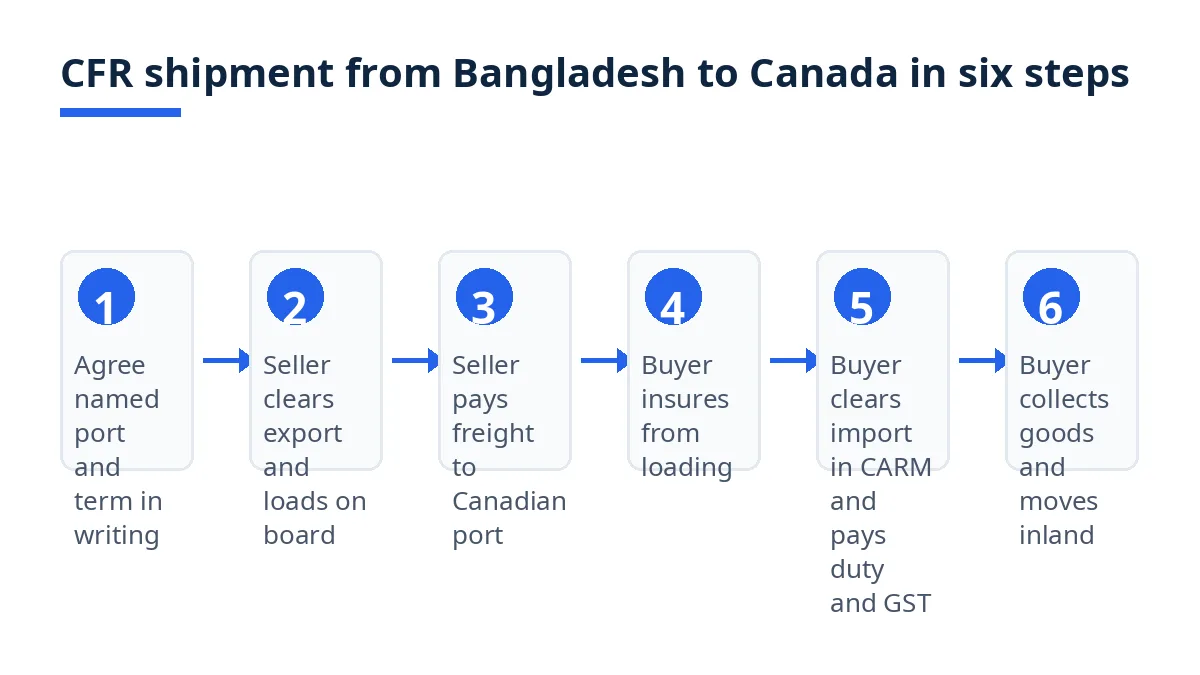
Agree the named port, the goods and the price basis in writing. State the exact Canadian port, the product specification, the quantity, and that the price is CFR to that port under Incoterms 2020. Confirm who pays for destination unloading and handling, who arranges insurance, and who bears demurrage and detention if clearance or collection is slow. Under CFR the buyer pays destination unloading charges not included for the seller account in the carriage contract.2
Seller completes export clearance in Bangladesh. Goods may not be loaded for export unless an export declaration, the Bill of Export or Shipping Bill, is submitted to Customs and approved.4 Enclosed documents include the export contract or purchase order where there is no export letter of credit, the commercial invoice, the packing list, the EXP form certified by an authorized dealer, and a certificate of origin.4
Seller loads the goods on board and the risk passes to the buyer. Delivery under CFR happens when the goods are placed on board the vessel at the port of shipment, and risk transfers at that same point.2 Ask the seller to confirm the Bill of Export number, the vessel name and the bill of lading number once loading is confirmed, so the Canadian broker can prepare the import file before arrival.
Buyer arranges insurance from loading, not from arrival. Because the seller has no insurance obligation under CFR,2 the buyer policy should attach when risk passes at loading in Bangladesh and run through arrival and inland transport. Confirm the insured value and claims contact before the vessel sails.
Buyer prepares the Canadian import file before the vessel arrives. To import commercial goods for use or sale, a buyer needs a Canada Revenue Agency business number and access to the CARM Client Portal.5 Register in CARM first, then delegate authority to a broker, since the broker cannot complete the business registration for you.5 A non-resident importer must contact the CRA for a business number, because it cannot obtain one through the portal.5
Buyer clears the import, pays duty and tax, and collects the goods. Importing requirements include determining the 10-digit tariff classification and the applicable duty rate, determining whether the goods are subject to other duties or taxes including GST, and submitting the required CBSA documents and paying duties and taxes owing before release.6 After release, the buyer pays for inland transport and checks the goods against the packing list before signing.
Costs, timelines and documents
What are the typical costs and timelines?
There is no single CFR cost from Bangladesh to Canada, because the CFR price bundles the seller side while the buyer side depends on the goods, the port and the tariff treatment.
Cost item | Inside the CFR price | Buyer pays separately |
|---|---|---|
Export clearance and origin port charges | Yes, seller | No |
Ocean freight to the named Canadian port | Yes, seller | No |
Cargo insurance from loading | No, unless agreed | Yes, buyer |
Destination unloading, where not in the seller contract | No | Yes, buyer |
Import brokerage in Canada | No | Yes, buyer |
Customs duty, where applicable | No | Yes, buyer |
GST, and HST where it applies | No | Yes, buyer |
Inland transport from the Canadian port | No | Yes, buyer |
The seller obligations under CFR include inland transport in the country of origin, export customs clearance, port charges at origin, and booking and payment of sea freight up to the destination port.2 The buyer obligations include payment for the goods, import customs clearance, payment of duties and taxes, and inland transport to the final destination.2 Where the carriage contract already includes destination terminal handling, ask the seller to state which destination charges its freight booking already covers.
On timelines, plan in ranges. Ocean freight from Bangladesh to Canada takes about 30 days port to port,3 and the Bangladesh to Vancouver lane runs 26 to 33 days by ocean with transshipment through Singapore or Colombo.7 Most vessels from Bangladesh to Vancouver transit through major Asian transshipment hubs, because of vessel size limits at Chattogram.7 East-coast arrivals at Halifax or Montreal sit at the longer end of the range, and the door-to-door journey runs longer still once transshipment, port handling, clearance and inland transport are added. Rail from Vancouver reaches Toronto in 4 to 5 days and Montreal in 5 days.7 Build buffer weeks around monsoon-season disruption from June to September and peak garment-season pressure from August to October.7
Example figures: a buyer agrees a CFR price of 12,000 dollars covering goods and freight to Vancouver, confirms a duty rate of zero under a claimed preference, and pays GST of 600 dollars, which is 5 percent of the 12,000 dollar duty-paid value in this example. Inland rail and trucking from Vancouver are added after that. The example shows structure only, not a typical price or duty rate.
Which documents are needed?
The seller export set, from Bangladesh Customs, is the Bill of Export with the export contract or purchase order, commercial invoice, packing list, EXP form certified by an authorized dealer, certificate of origin, VAT registration certificate and taxpayer identification number.4 Product-specific papers sit on top of that set where they apply.4
The buyer import set is the commercial invoice and packing list, the bill of lading, any origin document supporting a tariff claim, and the CARM accounting declaration. The CBSA checklist requires invoices, certificates of origin and any other required documents, plus the value for duty, before duties and taxes are paid and the goods are released.6 Keep import records for six years following importation.6 If classification, origin or value is uncertain, request an advance ruling before the goods ship.5
Bangladesh-specific rules and tips
Confirm the tariff treatment for your classification before you price the order. Canada modernized its General Preferential Tariff and Least Developed Country Tariff programs effective January 1, 2025, with the LDCT giving duty-free treatment for virtually all goods from least developed countries.8 Bangladesh was scheduled for removal from the LDCT over a three-year period in 2026, alongside a new General Preferential Tariff Plus program.8 Bangladesh has had duty-free access to the Canadian market for most goods since 2003,3 but that history does not settle the rate for a shipment priced today. Confirm the treatment in CARM at order time.
Know the container gap before you rely on CFR for container cargo. Containers are often handed to a carrier at a terminal before they are loaded onto the vessel, while delivery and risk transfer under CFR occur on board at the shipment port.2 That gap can make it hard to establish when damage occurred. For container shipments, consider discussing CPT, or CIP if the seller also arranges insurance, before the order is confirmed.2
Mistakes and red flags
What are the most common mistakes?
Treating the CFR price as the landed cost. The CFR price excludes Canadian import clearance, duty, GST, unloading and inland transport.2 Add the buyer-side half before comparing suppliers.
Naming a vague port. "CFR Canada" does not say which port the seller freight covers. Name the exact port, and state whether destination unloading is included in the seller carriage contract.2
Assuming insurance is included. The seller pays freight but carries no insurance obligation under CFR.2 If the cargo is valuable, agree insurance expressly, with cover from loading.
Starting CARM registration after the goods ship. Commercial importers need a CRA business number and CARM access before they can account for goods,5 and a broker cannot register the business for you.5 Finish registration, broker delegation and any Release Prior to Payment enrolment before the vessel sails. Release Prior to Payment allows release before paying duties and taxes, but the business must post its own financial security.5
Leaving the duty rate as a guess. Customs duties are based on tariff classification, country of origin and value,5 and the 2026 LDCT transition makes an old duty assumption unsafe.8 Use the CARM duties and taxes calculation, and an advance ruling where the stakes justify it.5
Accepting documents that do not match. An invoice, packing list and bill of lading that disagree on quantity, weight or description will slow clearance at both ends. Reconcile them on receipt, before the goods arrive.
Checklist
Before you confirm a CFR order from Bangladesh to Canada, every line should be answered in writing.
Named port written in full: exact Canadian port, "Incoterms 2020" stated.
CFR price confirmed, with destination unloading, handling, insurance and demurrage stated separately.
Seller export set confirmed: Bill of Export, invoice, packing list, EXP form, certificate of origin.4
Buyer CARM registration complete: CRA business number, portal access, broker delegated.5
Insurance agreed: cover from loading at Chattogram, insured value confirmed.
Tariff classification and treatment checked; preference evidence confirmed where claimed.6 8
Duty and GST estimated in CARM; GST is generally 5 percent.5
Release Prior to Payment decided: pay before release, or post financial security.5
Product-specific Canadian permits, certificates, inspections and bilingual labelling checked.5 7
Carrier, vessel and bill of lading number shared before arrival.
How Exportain helps
On Exportain, post a request for quotation on the RFQ board stating that you want CFR pricing to your exact Canadian port under Incoterms 2020, with your product specification, quantity and target delivery window. Ask each reply to state the CFR price, the named port, what the freight booking includes at destination, whether insurance is included, and which origin document the seller will supply.
Read supplier badges for what they record. Exportain verification is a document and photo review, not a factory inspection, and a badge is not a guarantee of capacity, quality or delivery. Before you confirm, read the Incoterms guide for shipments from Bangladesh and the landed-cost guide for imports from Bangladesh to build the buyer-side half of your cost.
FAQs
What should I know first about CFR?
CFR means the seller pays cost and freight to the named destination port, while risk transfers to the buyer when the goods are loaded on board at the origin port.2 The seller handles export clearance and ocean freight. The buyer handles insurance if it wants cover, import clearance, duties and taxes, and inland transport.2
What are the typical costs and timelines?
There are no guaranteed figures. The CFR price covers export clearance, origin charges and ocean freight to the named Canadian port. The buyer pays insurance, destination charges not in the seller carriage contract, brokerage, any duty, GST on the duty-paid value, and inland transport.2 5 Ocean freight runs about 30 days port to port,3 with the Bangladesh to Vancouver lane at 26 to 33 days,7 and east-coast arrivals at the longer end of the range.
Which documents are needed?
The order documents are the itemized quotation and purchase order, with the named port and Incoterms 2020 stated on both. The export set is the Bill of Export, commercial invoice, packing list, EXP form certified by an authorized dealer, and certificate of origin.4 The import set is the invoice, packing list, bill of lading, origin evidence where a preference is claimed, and the CARM accounting declaration, with duties and taxes paid before release.6
What are the most common mistakes?
The most common mistakes are treating the CFR price as the landed cost, naming a vague port, assuming insurance is included,2 starting CARM registration after the goods ship,5 and leaving the duty rate as a guess during the 2026 tariff transition.8 Documents that do not match will slow clearance.
Next steps on Exportain
Browse suppliers, then post your product specification, target Canadian port and delivery window on the RFQ board so suppliers quote CFR to the same port. Before you confirm, read the Incoterms guide for shipments from Bangladesh and the landed-cost guide for imports from Bangladesh to complete the buyer-side half of your cost.
Sources
- Incoterms® 2020. International Chamber of Commerce (ICC) (accessed )
- CFR Incoterms: Meaning, Costs & Risk. iContainers (accessed )
- Shipping from Bangladesh to Canada. ShipHub (accessed )
- Customs Clearance Procedures for Export. Bangladesh Customs, National Board of Revenue (accessed )
- The CBSA shares tips on importing commercial goods to Canada for FIFA World Cup 2026. Canada Border Services Agency (accessed )
- Checklist for Importing Commercial Goods into Canada. Canada Border Services Agency (accessed )
- Shipping from Bangladesh to Vancouver. GoCubic (accessed )
- Canada's Updated Tariff Programs for Jan. 1, 2025. GHY International (accessed )
About the author
Sourcing from Bangladesh?
Post a request for quotation and suppliers on Exportain can send you their quotes directly.
Post an RFQ