CFR Shipping From Bangladesh to Australia: Costs, Steps and Timeline
CFR shipping from Bangladesh to Australia: seller-paid freight, Sydney arrival steps, Australian GST and biosecurity checks, and the documents to prepare.
Short answer
Under CFR (Cost and Freight), the seller pays ocean freight from Bangladesh to your named Australian port, but risk passes to you when the goods are loaded on board in Bangladesh, and the seller has no obligation to insure the voyage. Name the exact port, such as Port Botany in Sydney, arrange your own cargo cover from loading, and budget separately for Australian duty, GST, clearance, biosecurity and inland transport after arrival.
On this page
Key takeaways
Under CFR, the seller pays ocean freight to the named Australian port, but risk passes to the buyer when the goods are loaded on board in Bangladesh, and the seller has no obligation to insure the voyage.
Name the exact Australian port in the contract. Port Botany in Sydney handles containers as its primary trade.
When goods with a customs value of more than A$1,000 are imported into Australia, GST is payable at the border to the Australian Border Force.
Check the Biosecurity Import Conditions system (BICON) before you ship: some goods need an import permit, and most standard permits take 20 business days while non-standard permits take 40 business days.
The Bangladesh export set is the Bill of Export, commercial invoice, packing list, EXP form certified by an authorized dealer, and certificate of origin.
A CFR shipment from Bangladesh to Australia puts the ocean freight on the seller and the sea risk on you, the buyer, from the moment the goods are loaded on board in Bangladesh. That split shapes every decision that follows: which Australian port you name, how you insure the voyage, and what you budget for after arrival in Sydney.
Under CFR (Cost and Freight), the seller contracts and pays the freight to the named port of destination, but risk transfers to the buyer once the goods are loaded on board at origin, and the seller is not obligated to provide insurance under CFR.1 CFR is one of the 11 Incoterms® 2020 rules, which allocate cost, risk and obligations between seller and buyer.2 This guide works through the Australia leg: the Sydney arrival, Australian GST and biosecurity checks, and the documents to prepare on both sides.
Why this matters for buyers and sellers
For the buyer, CFR looks simple because one price covers the goods and the freight to Australia. The catch is that the price does not cover what happens after the ship berths: destination charges outside the seller's carriage contract, import clearance, any duty, GST and inland transport are yours. For the seller, CFR means carrying the freight booking and its cost to Sydney while no longer carrying the sea risk once loading is complete.
Australia adds two arrival gates that do not exist on the Bangladesh side: the border tax gate and the biosecurity gate. When goods with a customs value of more than A$1,000 are imported into Australia, GST is payable at the border to the Australian Border Force,3 and you may also need to pay customs duty and clearance charges at the border.3 Separately, the importation of some products is subject to biosecurity import conditions by law, and some products are only allowed in subject to meeting conditions that mitigate the biosecurity risk, which may include a biosecurity import permit.4 Neither gate sits inside the seller's freight price.
Step-by-step: how it works
The steps below follow one shipment from order to delivery in Sydney.
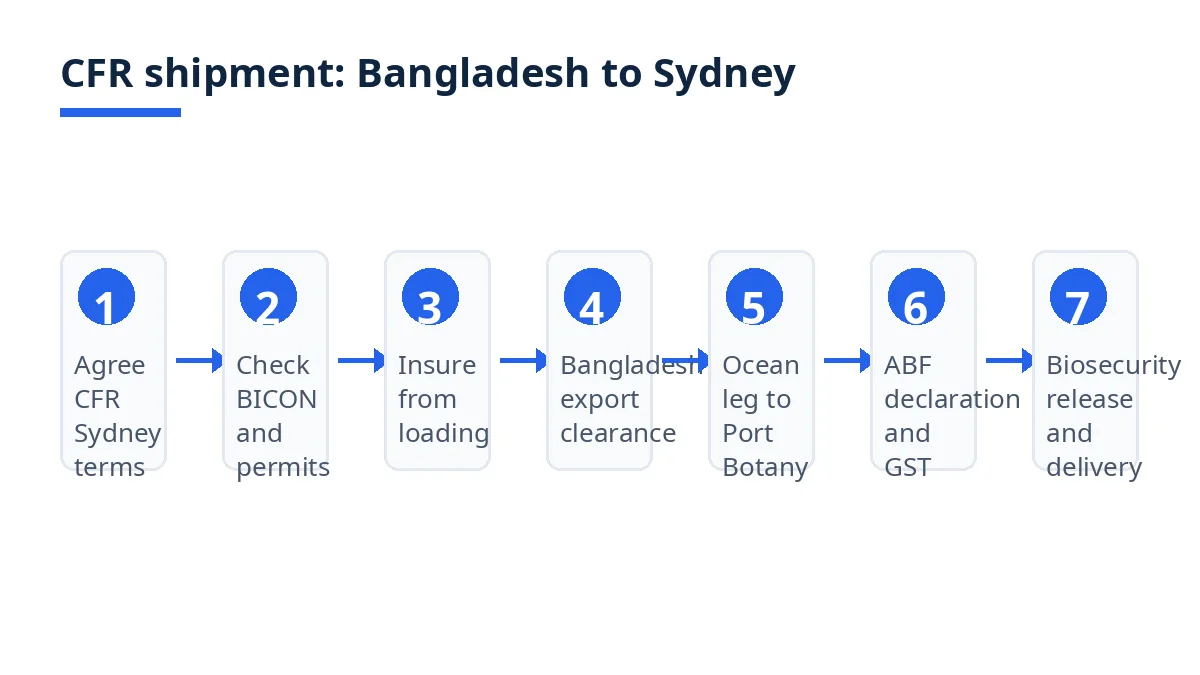
Agree CFR Sydney terms in writing. State "CFR Port Botany, Sydney, Incoterms® 2020" or the Australian port you actually want, with the goods description, quantity, unit price, payment terms and validity. A price that only says "CFR Australia" leaves the port, and therefore the freight and onward transport, undefined.
Check BICON before production finishes. Use the Biosecurity Import Conditions system to determine whether your commodity is permitted, is subject to import conditions, requires supporting documentation or treatment, or needs a biosecurity import permit.4 If a permit is needed, apply early: most standard permits are issued within 20 business days and non-standard permits within 40 business days after payment and a completed application.4
Arrange your own cargo insurance from loading. The seller has no obligation to insure under CFR,1 so place cover that starts when risk passes to you at loading in Bangladesh, not when the ship reaches Sydney.
Confirm the sailing and the freight inclusion. Ask the seller which sailing the goods are booked on, what the carriage contract includes at destination, and which destination charges sit outside it. Get the answers on the quotation, not by phone.
Complete Bangladesh export clearance. Goods shall not be loaded for export unless an export declaration, the Bill of Export or Shipping Bill, is submitted to Customs and approved.5 The enclosed set is the export contract or purchase order, commercial invoice, packing list, EXP form certified by an authorized dealer, and certificate of origin.5
Track the ocean leg and prepare the Australian entry. While the vessel is at sea, confirm your customs broker, the import declaration details, and the funds for duty, GST and clearance charges. When goods with a customs value of more than A$1,000 are imported, GST is payable at the border to the Australian Border Force,3 and goods are not released until border charges are settled.
Clear biosecurity, then move the goods inland. Answer any biosecurity inspection or treatment requirement, then arrange inland transport from Port Botany to your warehouse. Port Botany operates 24/7 and its primary trade is containers,6 but book inland transport before the vessel berths, since your delivery slot depends on terminal and carrier availability.
See the Incoterms guide for how CFR compares with the other 10 rules.2
Costs, timelines and documents
What are the typical costs and timelines?
There are no fixed CFR costs or transit times a guide can state as fact. The seller's freight price moves with the sailing, the route, fuel and terminal charges, and your post-arrival costs depend on the goods, their value and their biosecurity conditions. What you can fix in advance is the structure: which lines sit inside the CFR price and which sit outside it.
Cost line | Inside the CFR price | Paid by the buyer after arrival |
|---|---|---|
Goods and Bangladesh inland transport | Yes, in the seller's price | No |
Ocean freight to the named Australian port | Yes, seller contracts and pays1 | No |
Cargo insurance on the ocean leg | No, seller has no obligation1 | Yes, buyer arranges |
Destination charges outside the carriage contract | No | Yes |
Import clearance and broker fees | No | Yes |
Customs duty, if any | No | Yes |
GST at the border | No | Yes, when customs value exceeds A$1,0003 |
Biosecurity inspection or treatment | No | Yes, where conditions apply4 |
Inland transport from the port | No | Yes |
Example figures: a Sydney buyer agrees a CFR price of A$18,500 for goods plus freight to Port Botany, and separately budgets A$1,200 for cargo insurance, A$650 for destination and broker charges, and A$1,850 for duty at an assumed rate, plus GST on the border value. The example shows structure only, not a quote, a duty rate or a transit time. Ask your broker to price duty from your tariff classification before the vessel sails, because GST is payable at the border to the Australian Border Force when the customs value exceeds A$1,000.3
For timelines, work backwards from the sailing, not forwards from the order date. Sampling and production dates, the BICON permit window of 20 or 40 business days where a permit applies,4 the ocean leg, and the clearance and biosecurity steps after berthing are separate lines. Get each line as its own date on the quotation, and keep a buffer week after berthing for inspection or treatment queries.
Which documents are needed?
Two document sets matter: the Bangladesh export set and the Australian entry set. Keep one legal name and one goods description across both.
Bangladesh export set. Goods shall not be loaded unless an export declaration, the Bill of Export or Shipping Bill, is submitted to Customs and approved.5 Enclosed documents include the export contract or purchase order where there is no export letter of credit, the commercial invoice with a detailed description of goods signed by the exporter, the packing list with quantity, weight and packing information, the EXP form certified by an authorized dealer, and a certificate of origin issued by the EPB or a Chamber of Commerce and Industry.5 Product-specific papers may also apply, such as a phytosanitary certificate for agricultural goods.5
Australian entry set. The commercial invoice, packing list and bill of lading travel with the shipment, and your broker uses them for the import declaration. Add the BICON outcome for your commodity: whether it is permitted, what conditions apply, and whether a permit, documentation or treatment is required.4 If GST was paid at the point of sale, keep the supplier notice showing the GST registration number, since that information is needed to complete an import declaration and avoid paying GST twice.3
See the landed cost guide for how the post-arrival lines add up to a cost per unit.
Bangladesh-specific rules and tips
Get the EXP form and certificate of origin right first time. The EXP form must be certified by an authorized dealer,5 and the certificate of origin is issued by the EPB or a Chamber of Commerce and Industry.5 Ask the seller to confirm both are in hand before the container is stuffed, because a missing paper at loading delays the Bill of Export approval, not just the sailing.
Check BICON while production is still running, not after loading. A biosecurity permit takes 20 business days for most standard applications and 40 business days for non-standard applications after payment and a completed application,4 and longer where technical assessment or extra information is needed.4 A permit applied for after the vessel sails cannot be ready by berthing.
Confirm the named port, not just the country. Port Botany handles containers as its primary trade,6 but a CFR price to "Australia" does not tell you whether the freight ends at Sydney, Melbourne or Brisbane, and inland transport from the wrong port can cost more than the freight saving. Name the port in the contract.
Mistakes and red flags
What are the most common mistakes?
Assuming the CFR price includes insurance. The seller has no obligation to insure under CFR.1 A buyer who discovers this after loading has no cover for the ocean leg it already owns the risk for.
Assuming the CFR price includes Australian charges. Duty, GST, clearance, biosecurity and inland transport all sit outside the seller's freight price. When goods with a customs value of more than A$1,000 are imported, GST is payable at the border to the Australian Border Force,3 so budget for it before berthing, not after.
Leaving the port unnamed. "CFR Australia" is not a port. Without a named port, neither side can prove which freight was quoted or which inland leg was priced.
Skipping the BICON check. Some products are not permitted entry, and others are allowed only subject to import conditions that may include a permit, documentation or treatment.4 A shipment that fails the biosecurity gate is held, treated or refused regardless of a clean customs entry.
Comparing CFR quotes with different ports or inclusions. A CFR Sydney price and a CFR Melbourne price are different offers, and a lower price that excludes destination handling is not cheaper than a higher price that includes it. Compare only quotes that name the same port and state the same inclusions.
Treating a profile or badge as a guarantee. A supplier profile is a starting point for enquiries. Exportain's badges record document and photo reviews, not factory inspections or guarantees.7
Checklist
Before you confirm a CFR order to Australia, answer every line in writing.
Named Australian port in the contract, with Incoterms® 2020 stated.1 2
CFR price split confirmed: goods, freight to the named port, and destination charges outside the carriage contract listed separately.
Cargo insurance arranged from loading in Bangladesh, in your name.1
BICON outcome recorded: permitted, conditions, documentation, treatment or permit required.4
Permit applied for early where needed, allowing 20 or 40 business days.4
Bangladesh export set agreed: Bill of Export, invoice, packing list, EXP form, certificate of origin.5
Broker confirmed before sailing, with funds ready for duty, GST and clearance charges.3
Inland transport booked from the named port before the vessel berths.6
Goods description and legal names matched across quotation, invoice, declaration and entry.5
How Exportain helps
On Exportain, browse suppliers and post a request for quotation on the RFQ board stating "CFR Port Botany, Sydney, Incoterms® 2020" with your goods description and quantity, so suppliers quote against the same port and inclusions. Ask each reply to state the sailing, what the carriage contract includes at destination, and which destination charges sit outside it.
Read the badges for what they record. Exportain Verified means Exportain has checked identity, phone, email and business registration, and Export Verified means it has checked the Export Registration Certificate (ERC).8 Verification is a document review, not a factory inspection,7 so sample approval, insurance and the BICON check stay with you. See how to buy on Exportain for the order steps after you accept a quotation.
FAQs
What should I know first about CFR?
CFR means the seller pays ocean freight to your named Australian port, but risk passes to you when the goods are loaded on board in Bangladesh, and the seller has no obligation to insure the voyage.1 Name the port, arrange your own cargo cover from loading, and budget separately for duty, GST, clearance, biosecurity and inland transport after arrival.
What are the typical costs and timelines?
There are no fixed CFR costs or transit times. The CFR price covers goods and freight to the named port; insurance, destination charges, clearance, duty, GST and inland transport sit outside it. When goods with a customs value of more than A$1,000 are imported, GST is payable at the border to the Australian Border Force.3 Price duty from your tariff classification and allow the BICON permit window of 20 or 40 business days where a permit applies.4
Which documents are needed?
The Bangladesh export set is the Bill of Export, commercial invoice, packing list, EXP form certified by an authorized dealer, and certificate of origin issued by the EPB or a Chamber of Commerce and Industry.5 The Australian entry uses the invoice, packing list and bill of lading, plus the BICON outcome for your commodity, including any permit, documentation or treatment requirement.4
What are the most common mistakes?
The most common mistakes are assuming the CFR price includes insurance,1 assuming it includes Australian duty, GST and clearance,3 leaving the destination port unnamed, skipping the BICON check,4 and comparing quotes that name different ports or different destination inclusions. A badge is not a guarantee of capacity, quality or delivery.7
Next steps on Exportain
Browse suppliers, then post your goods description, quantity and "CFR Port Botany, Sydney" terms on the RFQ board so suppliers quote against the same port. Before you confirm, read the Incoterms guide and the landed cost guide to price the post-arrival lines.
Sources
- CFR Incoterms: Meaning, Costs & Risk. iContainers (accessed )
- Incoterms® 2020. International Chamber of Commerce (ICC) (accessed )
- GST and consumers – imported services, digital products and low value imported goods. Australian Taxation Office (accessed )
- Biosecurity Import Conditions system (BICON). Australian Department of Agriculture, Fisheries and Forestry (accessed )
- Customs Clearance Procedures for Export. Bangladesh Customs, National Board of Revenue (accessed )
- Port Botany. NSW Ports (accessed )
- Trust & Safety Center. Exportain (accessed )
- Supplier verification: Earn trust badges buyers can see. Exportain (accessed )
About the author
Sourcing from Bangladesh?
Post a request for quotation and suppliers on Exportain can send you their quotes directly.
Post an RFQ