Top Cargo Pants Manufacturers in Bangladesh: How to Find and Verify Them
Cargo pants supply in Bangladesh sorted by capability: eight supplier types covering ripstop and twill cloth, bellowed pockets, cargo wash, reinforced knees and trading, with checks for each.
Short answer
Cargo pants manufacturers in Bangladesh fall into eight types: ripstop and twill cloth mills, bellowed-pocket utility specialists, cargo wash and garment-dye units, reinforced-knee workwear makers, integrated woven composites, cut-make-trim factories, private-label OEM and ODM suppliers, and exporters and trading companies. Match the type to your cloth, pocket, knee and wash needs, then verify it with a washed, loaded sample and a written inspection plan before paying.
On this page
Key takeaways
Cargo pants are woven, not knitted, so the supplier pool is the woven sector: woven exports earned US$4.614 billion in Q1 FY27, up 5.11 per cent year on year.
The decisive cargo details are cloth, pocket build, knee reinforcement and wash: fix all four in one written specification before comparing quotes.
Ripstop stops a small tear at its reinforcement grid, while cotton twill holds structure: the cloth choice changes how pockets and knees behave after washing.
Price and MOQ are set per style: cloth, pocket construction, knee work, wash, trims, quantity and packing move the quote more than location does.
Verification is a sequence the buyer runs: BGMEA membership as a registration check, a washed and loaded sample in bulk cloth, and an agreed AQL inspection before payment.
A cargo pant earns its name on the leg, not on the label. The side pockets that expand, the knee panels that take repeated bending, the bartacks that hold pocket corners under load, and the wash that softens the cloth without shifting its shade are the parts a buyer has to judge. A factory that sews plain trousers cleanly may still fail on a bellowed pocket that gapes when loaded, or on a knee seam that puckers after the first wash. Sorting suppliers by cargo work already run keeps those faults visible before ordering.
Cargo pants sit in the woven side of Bangladesh garment trade. In the first quarter of fiscal 2026-27, woven garment exports earned US$4.614 billion, up 5.11 per cent year on year, within ready-made garment exports of US$10.578 billion, according to Export Promotion Bureau (EPB) data reported in the press.1 The Bangladesh Garment Manufacturers and Exporters Association (BGMEA) describes more than 4,000 factories on its home page, with garments reaching buyers in more than 150 countries.2 For classification, woven cotton trousers for men or boys fall under heading 6203.42 and woven cotton trousers for women or girls under heading 6204.62 in the Bangladesh Customs Tariff.3
The cloth decision comes first, because it sets what the pocket and knee work can achieve. Ripstop is a woven fabric in which stronger reinforcement yarns are interwoven at regular intervals in a crosshatch pattern, typically 5 to 8 millimetres apart, so that a small tear is stopped by the reinforcement instead of running across the fabric.4 Cotton twill gives a firm diagonal face and a heavier hand, which suits structured cargo styles that must hold their shape.
The list: cargo pants manufacturers in Bangladesh by type
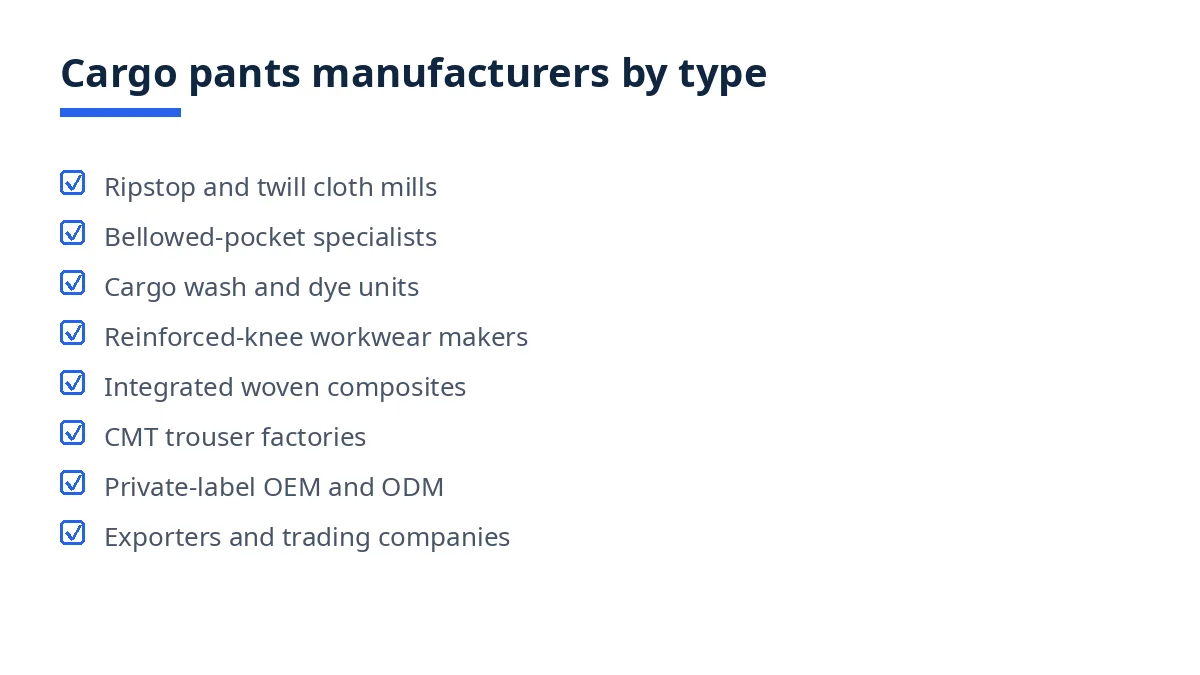
The eight profiles below describe the cargo work suppliers actually run, in the order a buyer meets it: cloth, pockets, wash, reinforcement, full production, sewing only, own-label work, and trading.
1. Ripstop and twill cloth mills and fabric-led suppliers
What they do. These suppliers weave or source the cargo cloth itself: ripstop with its reinforcement grid, cotton twill in set weights and blends, and cotton blends with elastane for stretch cargo styles. They set fibre content, weight, weave and shade range.
Why it matters for cargo pants. Pocket volume and knee reinforcement both depend on cloth behaviour. A light ripstop behaves differently from a heavy twill that holds a crease but stiffens the knee, and a stretch blend that recovers well at the waist may still bag at the knee after a day of wear.
How to check it. Ask for a bulk-lot cloth sample, not a swatch book cutting, and wash it before approving shade, weight and hand feel. Record fibre content, weight, weave and shade tolerance in writing, and confirm the lot on offer matches the sample lot.
2. Bellowed-pocket and utility construction specialists
What they do. These makers build their reputation on the cargo pocket system: bellowed side pockets that expand without pulling the leg out of shape, flap closures with buttons, snaps or hook-and-loop tape, internal pocket divisions, and reinforced pocket corners.
Why it matters for cargo pants. Pockets are the most visible cargo feature and the most common failure point. A pocket sewn too high rides against the hip, a pocket with shallow bellows flattens under a phone or tool, and a flap that closes cleanly on a flat sample may gape once the pocket is filled.
How to check it. Approve the pocket on a finished sample loaded with the items the wearer will actually carry, and measure pocket depth, flap overlap and closure strength after washing. Open the pocket up and look at the bartacks at each corner and at the stitching where the bellows meet the leg.
3. Cargo wash and garment-dye units
What they do. These units wash, dye and finish sewn cargo pants: enzyme and stone washes that soften twill, garment dyeing that colours the finished pant rather than the cloth, and tinted or faded finishes for fashion cargo ranges.
Why it matters for cargo pants. Wash changes everything measured on the unwashed sample. Twill relaxes and can shift leg width, pocket flaps can curl at the edge, and a garment-dyed shade can drift between batches. A wash unit that runs cargo regularly knows how much shrinkage and shade movement its own recipes produce.
How to check it. Send a sewn sample in bulk cloth with bulk trims, have it washed twice under the agreed recipe, and measure it again after drying. Record the recipe, the shade tolerance and the shrinkage allowance in the order, and keep one washed sample sealed as the shade and measurement reference.
4. Reinforced-knee and workwear cargo makers
What they do. These factories make cargo pants for work, outdoor and uniform use, where the knee panel, seat seam and pocket corners carry repeated stress. Their work includes double-layer knee panels, articulated knees shaped for bending, knee-pad openings, and bartack reinforcement at every stress point.
Why it matters for cargo pants. A fashion cargo pant and a work cargo pant look alike on a rail and fail in different places. The work pant fails at the knee seam, at the seat, and at the pocket corners, and those failures appear after weeks of wear rather than after one wash.
How to check it. Ask which workwear or uniform cargo styles the factory runs every month, and test the knee on a washed sample: bend it repeatedly, load the pockets, and check the bartacks and knee-panel seams for puckering or thread breakage. Confirm thread type and stitch density at stress points in writing.
5. Integrated woven composite groups
What they do. These groups weave or dye cloth, cut, sew and wash garments, and pack for export within one organisation. A cargo order can stay inside the group from cloth booking through wash and carton packing, with one management team carrying the shade, measurement and delivery decisions.
Why it matters for cargo pants. Integration helps most where shade and wash consistency matter across repeat orders. When the same group controls the cloth lot, the dyeing and the wash recipe, a second season in the same shade is a repeat of a known process rather than a new negotiation between separate firms.
How to check it. Ask which stages are in-house and which are sent out, and get the answer stage by stage in writing. A group that weaves twill but sends cargo washing to an outside unit is not integrated for the wash. Confirm that cargo pants, not only plain trousers, are a regular output of the sewing lines that will run your order.
6. Cut, make and trim trouser factories
What they do. These factories cut, sew and trim cargo pants from cloth the buyer supplies or nominates, and from trims the buyer approves. Their skill is trouser construction: pattern cutting, pocket building, waistband setting, knee-panel insertion and pressing.
Why it matters for cargo pants. A cut, make and trim factory suits buyers who already source their own ripstop or twill, buyers testing a new cargo style in a smaller quantity, and buyers who want one sewing line across several cloth sources. The buyer keeps cloth control and cloth risk, and the factory keeps construction risk.
How to check it. Make the pre-production sample from bulk cloth with bulk trims, including pocket fabric, closures, thread, buttons and zips, and wash it before approval. Agree who pays if a cloth lot fails inspection after cutting has started, and confirm the pressing routine for cargo legs, since a pressed crease that suits a plain trouser can flatten a bellowed pocket.
7. Private-label OEM and ODM cargo suppliers
What they do. These suppliers make cargo pants under the buyer's label. Under an original equipment manufacturer (OEM) arrangement they sew to the buyer's tech pack; under an original design manufacturer (ODM) arrangement they offer their own cargo patterns, fits and pocket systems for the buyer to label.
Why it matters for cargo pants. Own-label cargo ranges need the label, size set, pocket branding, hangtags and retail packing settled alongside the garment itself. An OEM supplier that already runs cargo construction can follow a detailed tech pack closely, while an ODM supplier can shorten development for a buyer who does not yet have cargo patterns.
How to check it. For OEM work, send a complete tech pack covering cloth, weight, pocket construction and dimensions, knee reinforcement, bartack positions, wash and packing, and compare the counter-sample with it section by section. For ODM work, confirm the patterns on offer were developed by that supplier, and settle label and packing rules before bulk cutting.
8. Exporters and trading companies
What they do. These companies hold export licences and sell cargo pants made in partner factories rather than on their own sewing lines. They aggregate capacity across several plants, coordinate cloth bookings and wash slots, and carry the export paperwork for the buyer.
Why it matters for cargo pants. A trader earns its place when a cargo program is too mixed for one line: ripstop workwear styles from one plant, garment-dyed fashion cargo from another, and a small stretch capsule from a third, all shipped as one program. The trousers still come from the plants, so a trader warehouse visit tells you nothing about pocket or knee quality.
How to check it. Name both factories in the order document before any deposit is paid — the unit sewing each style and the unit washing it — and inspect or independently check each producing factory itself. A trading company's export record does not tell you which sewing line makes your cargo pants.
Summary table
Type | Suits | Decisive check |
|---|---|---|
Ripstop and twill cloth mills | Cloth control, set weights and blends | Bulk-lot sample, washed, shade in writing |
Bellowed-pocket utility specialists | Pocket-led cargo, outdoor and utility ranges | Loaded, washed pocket sample, bartacks checked |
Cargo wash and garment-dye units | Washed, dyed and faded cargo programs | Sewn sample washed twice, recipe recorded |
Reinforced-knee workwear makers | Work, uniform and outdoor cargo | Knee and stress-point test on a washed sample |
Integrated woven composites | Large repeat programs, shade consistency | Stages genuinely in-house, cargo a regular output |
Cut, make and trim factories | Buyer-supplied cloth, smaller trials | Bulk-cloth, bulk-trim pre-production sample |
Private-label OEM / ODM | Own-label brands and retailers | Tech pack comparison, pattern ownership |
Exporters and trading companies | Mixed orders, one contract | Sewing plant and wash unit named in the order |
How Exportain helps
A cargo quote tracks the style, not the country label. Cloth weight and fibre mix, pocket construction, knee reinforcement, wash recipe, trims, quantity and packing each move the figure — so have every shortlisted supplier quote the same cloth, pocket build, wash, delivery term and packing. Example figures illustrate the direction only: a short first run spreads pattern work, dye lots and line setup across fewer pants, so its per-piece figure sits above a repeat run in identical cloth.
Hold every supplier to the same evidence, however you found them. A BGMEA listing only confirms registration. Demand a pre-production sample cut from bulk cloth, finished with bulk trims and washed under home-laundry conditions, and put the inspection level and sampling plan in writing before cutting starts. ISO 2859-1 specifies sampling schemes indexed by acceptance quality limit (AQL) for lot-by-lot inspection.5
On Exportain, buyers search published products by keyword and category, filter to suppliers holding the Exportain Verified badge, sample availability and OEM or ODM capability, and sort by MOQ or lead time.6 Each profile shows its verification level, location, main products and the certifications the supplier has declared.6 Treat any badge as an opening filter rather than a verdict: badges record document and photo checks reviewed by the Exportain team rather than factory inspections.7 If a funds hold is used, Exportain keeps a paid hold until the supplier files an export clearance document and the buyer confirms the trade is complete.6
FAQs
What is the biggest mistake?
Treating an unwashed, unloaded showroom pant as proof. Twill relaxes in the wash, so a leg that lay straight on a rail can narrow or twist, a pocket flap can curl, a garment-dyed shade can move, and a knee panel can pucker once the pant is worn and washed. Judge cargo only on a sewn sample in bulk cloth, washed and loaded as the wearer will use it, and measured after drying.
How can I avoid it?
Put every decision on a single sheet that travels with the order, and give every quoted supplier the same sheet: cloth construction and weight, fibre mix, pocket construction and dimensions, knee reinforcement and bartack positions, wash recipe with shade tolerance, labels and packing. Approve the washed and loaded pre-production sample before bulk cutting, and agree the inspection level in writing.
Who is responsible?
Responsibility follows the paperwork: building the pant to the sheet and to the washed sample it approved is the factory's, while writing a sheet that can be measured and checking the shipment against it before it leaves is the buyer's.
Where can I get help?
Do not ask one record to answer every question. A BGMEA member listing settles the registration question and nothing else; whether an audit or fibre certificate covers the producing site is for its issuer to confirm; pre-shipment condition is for an independent inspector. On the platform, consult the badge guide before leaning on a badge,7 and keep the whole exchange in one thread so agreed terms stay traceable. The cargo pants quality control checklist turns the inspection step into pant-level checks.
Next steps on Exportain
Browse Bangladeshi suppliers and narrow the woven listings by badge, MOQ and private-label capability. Before you order, read how supplier verification works on Exportain so you know what each badge covers. Then post a free RFQ carrying your cargo specification, cloth weight, pocket build, wash, quantity, destination and delivery term, and compare the replies on matching fields.
Sources
- Merchandise exports rise 6.34pc to $13.09b in Q1 FY27: EPB. The Financial Express, (accessed )
- BGMEA | Home. Bangladesh Garment Manufacturers and Exporters Association (BGMEA) (accessed )
- Bangladesh Customs Tariff, Chapter 62. Bangladesh Trade Portal (accessed )
- Ripstop. Wikipedia (accessed )
- ISO 2859-1:2026 — Sampling for Inspection by AQL. American National Standards Institute (ANSI) (accessed )
- How to source and buy from Bangladesh. Exportain (accessed )
- Supplier verification: Earn trust badges buyers can see. Exportain (accessed )
About the author
Sourcing from Bangladesh?
Post a request for quotation and suppliers on Exportain can send you their quotes directly.
Post an RFQ