

Typical MOQ for Batteries in Bangladesh (and How to Negotiate It Down)
No single batteries MOQ in Bangladesh: what sets the minimum per chemistry, cell size and pack, how to ask, and how to negotiate a smaller first order.
Short answer
There is no single typical MOQ for batteries from Bangladesh. Each supplier sets its minimum per chemistry, per cell size and per pack, driven by production runs, testing, label and carton runs, and transport classification. For lithium orders, the UN 38.3 test summary for the exact model comes first. Ask for every minimum line by line in writing, then negotiate the structure: fewer sizes, one shared cell, stocked inputs, and set-up paid separately.
On this page
Key takeaways
There is no single typical MOQ for batteries from Bangladesh, because each supplier sets its minimum per chemistry, per cell size and per pack for your specification.
Production runs, formation and testing, label and carton runs, transport classification and freight weight are the drivers that set the floor.
For lithium orders, ask for the UN 38.3 test summary for the exact model and written carrier confirmation before you fix quantities.
Negotiate the structure first: fewer sizes, one cell shared across packs, stocked inputs, and test and label set-up paid as a separate line.
Exportain verification is a document review, not a factory inspection, and a badge is not a guarantee.
Ask three suppliers for a batteries MOQ in Bangladesh and you will get three different answers. There is no single typical MOQ for batteries from Bangladesh, because each supplier sets its minimum for your chemistry, cell size, pack design and labelling, not for batteries in general.
The minimum that matters is almost always the smallest line underneath the headline: one chemistry, one cell size, one pack, one label. Get those lines in writing, and a total that looks large enough can still fail on one size or one label run.
What sets the batteries MOQ in Bangladesh
What should I know first about batteries?
Start with chemistry, because chemistry decides the classification, the test papers and the transport route, and each of those can set its own minimum. In the Harmonized System, heading 8506 covers primary cells and primary batteries, which are not rechargeable, while heading 8507 covers electric accumulators, which are rechargeable.1 The Bangladesh tariff schedule lists lithium primary cells under 8506.50, lead-acid accumulators for starting piston engines under 8507.10, nickel-cadmium under 8507.30, nickel-metal hydride under 8507.50 and lithium-ion under 8507.60.1 A supplier quoting across two headings is quoting two different products.
Chemistry and cell format. A dry-cell line, a lead-acid line and a lithium-ion line use different materials, equipment and safety controls, so a supplier strong in one chemistry may set a high minimum, or decline, in another. Cell format matters inside one chemistry too.
Cells and packs are separate minimums. Many buyers order finished packs, not loose cells. A pack adds cell matching, a battery management system where the design uses one, terminals, housing, wiring and final testing. Ask whether the quoted minimum is for cells, for packs, or for both.
Formation and testing. Rechargeable cells pass through formation and testing before they are packed. Do not accept a capacity figure without asking how it is measured and on how many samples. Put the test method and acceptance values in the purchase order.
Labels, manuals and cartons. One battery size printed in two languages, or packed in a private-label carton, needs its own print run. A supplier can meet the cell minimum and still fall below the label or carton run. State the label language, carton marking and manual for each size in the enquiry, and ask for those minimums apart from the cell minimum.
Transport classification. This is where battery MOQs differ most from other product MOQs. Lithium cells and batteries are tested under section 38.3 of the UN Manual of Tests and Criteria, which covers eight tests, T1 to T8, simulating altitude, thermal cycling, vibration, shock, external short circuit, impact or crush, overcharge and forced discharge.2 The test summary is model-specific, so a summary for a similar model does not cover your model, and any change to chemistry, capacity, protection circuitry or cell source can require re-testing.2 For air freight, the state-of-charge limit for lithium-ion batteries shipped alone and with or in equipment became mandatory for both UN 3480 and UN 3481 shipments above 2.7 Wh from 1 January 2026, under the IATA Dangerous Goods Regulations 67th edition.3 Confirm the current limit with your forwarder before you fix quantities. None of this applies in the same way to lead-acid or dry-cell batteries.
Weight and freight. Batteries are heavy for their size. A small order split across several sizes can cost more per unit in freight than a larger order in one size, so ask for freight quoted per carton and per size.
Example figures: a buyer splits an example order of 12,000 dry cells across six sizes at 2,000 per size. The total clears the factory minimum while each size sits below its per-size run minimum. The same 12,000 cells in two sizes at 6,000 per size can clear both lines. The example shows structure only, not a typical MOQ or price.
Why this matters for buyers and sellers
For the buyer, the MOQ decides how much cash sits in heavy stock that cannot easily be reworked if the size or label is wrong. A battery that cannot be shipped by the planned mode, or cannot be placed on the destination market, is not a bargain at any quantity. For the seller, the minimum protects runs that cannot be sold to another buyer: cells formed for your voltage and capacity, packs built to your housing, and labels printed with your brand.
Two controls keep the negotiation grounded: an inspection plan agreed before production, and one delivery term for every quotation. ISO 2859-1 defines acceptance sampling plans indexed by acceptance quality limit (AQL).4 The Incoterms 2020 rules set out 11 rules allocating cost, risk and obligations.5 Compare MOQs only on the same specification and term.
Step-by-step: how it works
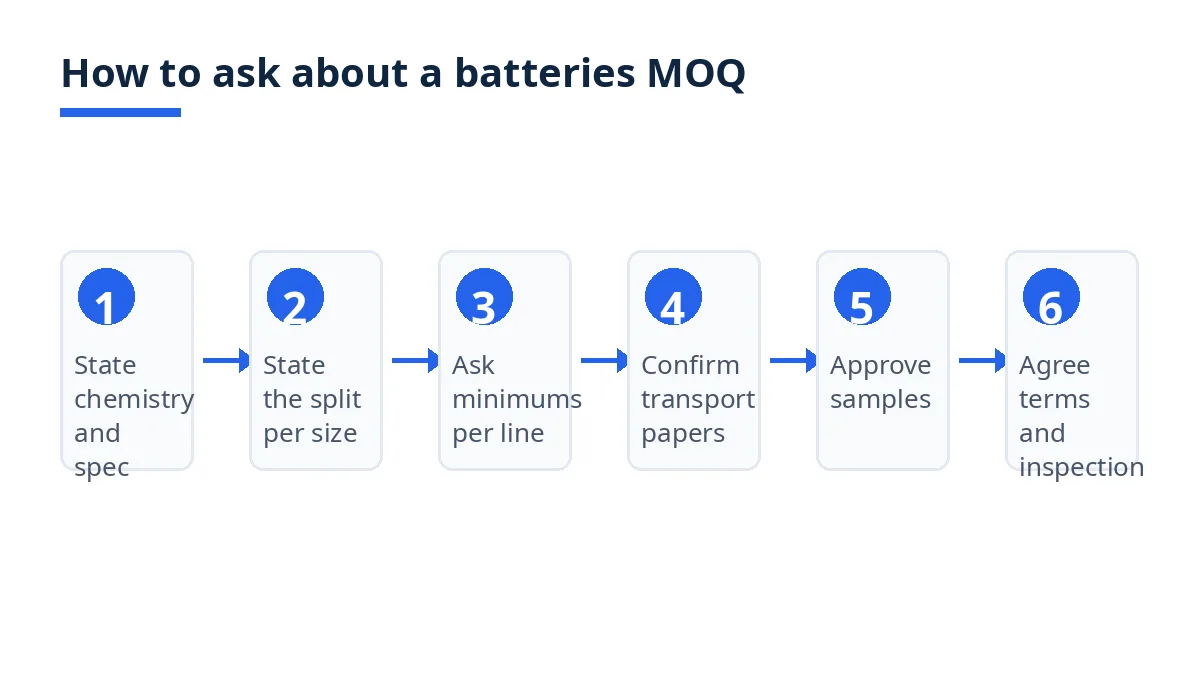
Send one specification to every candidate. State chemistry, primary or rechargeable, cell size and format, voltage and capacity, pack design, terminals, housing, label language and carton marking.
State the split, not only the total. Give the quantity per chemistry, per cell size and per pack, with carton quantities per size.
Ask for the minimums line by line. Ask for the MOQ per chemistry, per cell size, per pack design, and any separate label, manual and carton minimums, and which line is binding.
Ask what is stocked. Record whether each cell size, terminal, housing and label is stocked or made to order. Stocked inputs are where a lower minimum is most often possible.
Ask for transport papers before you fix quantities. For lithium orders, ask for the UN 38.3 test summary for the exact model,2 the safety data sheet, and written carrier confirmation of the current state-of-charge and packing rules.3 For other chemistries, ask the forwarder to confirm the classification and packing rules for your exact product in writing.
Approve samples in writing. Order samples in your actual chemistry, size, pack and label, then test capacity by the agreed method, check terminals and housing fit, and approve or list corrections in writing.
Agree inspection and delivery term before you confirm. Write the inspection level and AQL values into the purchase order,4 and state one Incoterm and named place for every quotation.5
How to negotiate or structure a smaller order
Negotiation works when you change the structure that creates the minimum, not when you ask for an exception. Get the result in writing.
Reduce the number of sizes first. Sizes multiply production runs, testing batches and label runs. Cutting one size raises the quantity per remaining size at the same total, which is the fastest route to clearing a per-size floor.
Share one cell across several packs. Two pack designs built around the same cell size and chemistry can share one cell run. Ask whether the cell minimum can be met across both packs combined, in writing.
Use stocked sizes, housings and one label version. A standard size already in production, with a stock terminal and housing, removes part of the set-up. One label language, one carton marking and one manual version reduce set-up further. Ask for the stock list before you finalise sizes.
Pay test and label set-up as a separate line. Where the floor comes from a test batch, a label run or a carton print, ask for those costs apart from the unit price. The run can then be shorter, and the same set-up serves the repeat order. Record which set-ups you have paid for.
Stage the order. If the supplier cannot move, place a smaller first order in fewer sizes, with a written repeat price and MOQ for the same specification. Do not negotiate by removing sample approval, capacity testing or transport paperwork.
Costs, timelines and documents
What are the typical costs and timelines?
There are no typical costs or timelines a guide can state as fact, for the same reason there is no typical MOQ. Each supplier prices your chemistry, cell size, pack design, testing, label and carton runs, freight weight and the delivery term you choose.5 Sampling depends on cell availability and correction rounds, and bulk production on cell supply, formation and testing capacity, pack assembly and carrier acceptance. Ask for sampling, cell ready, production, testing and inspection dates as separate lines. For lithium orders, add carrier acceptance as its own date.
Which documents are needed?
For export clearance in Bangladesh, the C and F agent submits the Bill of Export online, with the export contract or purchase order where there is no export letter of credit, the commercial invoice, the packing list, the EXP form certified by an authorized dealer, and a certificate of origin issued by the EPB or a Chamber of Commerce and Industry.6 Bangladesh Bank has also provided an electronic option for EXP form submission through its online reporting portal before customs formalities.7 For lithium shipments, add the UN 38.3 test summary for the exact model2 and the safety data sheet, and keep the carrier confirmation of packing and state-of-charge rules with the file.3
Bangladesh-specific rules and tips
Confirm BSTI claims at the source. Lead-acid batteries and uninterruptible power systems are among the products brought under the Bangladesh Standards and Testing Institution mandatory certification mark.8 A licensing guide lists Lead Acid Battery as BDS 1335 and Dry Cell Battery as BDS 80.9 Ask the supplier which BDS standard applies to your battery type, and for the certificate in writing, before you confirm.
Check destination market rules before you fix the label. Regulation (EU) 2023/1542 has applied since 18 February 2024, with specified rules phased in after that date, and it sets labelling and information requirements for batteries placed on the EU market, including a battery passport for light means of transport, industrial and EV batteries.10 If you sell into the EU, ask the supplier early which labelling and passport data it can supply for your battery category.
Mistakes and red flags
What are the most common mistakes?
Asking for a total MOQ only. The binding minimum is usually per chemistry, per size or per pack. An order can clear the total and still fall below the per-size minimum for one size, which then carries a surcharge or removal.
Comparing MOQs across chemistries. A lower minimum on a dry cell is not a better offer than a higher minimum on a lithium-ion pack. Compare only replies to the same specification, the same chemistry and the same Incoterm.5
Accepting a test summary for another model. A UN 38.3 summary for a similar lithium model does not cover your model, and a change to chemistry, capacity or protection circuitry can require re-testing.2 Ask for the summary that names your exact model, and check the model name letter by letter.
Applying one chemistry transport rules to all batteries. Lithium transport rules, including test summaries and state-of-charge limits,2 3 do not describe lead-acid or dry-cell shipments. Ask the forwarder to confirm the rules for your exact chemistry and mode.
Treating a profile or a badge as verification. A profile does not test whether a supplier can make your battery to your specification, and a badge is not a guarantee of capacity, quality or delivery.11
Skipping capacity testing to save time. Sampling under ISO 2859-1 checks a lot against an agreed AQL,4 and a capacity test on the sample checks the figure the whole order is sold on.
Checklist
Before you confirm, every line should be answered in writing.
Specification and split sent: chemistry, primary or rechargeable, size, format, voltage, capacity, pack, terminals, housing, label, carton, with carton quantities per size.
MOQ confirmed per chemistry, per size and per pack; binding line named.
Cell, label, manual and carton status recorded: stocked or made to order, with separate minimums confirmed.
Test method and acceptance values agreed; sample capacity tested and approved in writing.
Transport papers in hand: UN 38.3 summary for the exact lithium model,2 safety data sheet, carrier confirmation.3
Set-up costs itemized apart from the unit price; inspection level and AQL values in the purchase order.4
Quotations compared on the same specification, chemistry and Incoterm.5
Export set agreed: invoice, packing list, EXP form, certificate of origin, Bill of Export.6 7
How Exportain helps
On Exportain, browse suppliers and post a request for quotation (RFQ) on the RFQ board with your specification, split per size and pack, and delivery term, so suppliers quote against the same specification. Ask each reply for its per-chemistry, per-size and per-pack minimums, and for its transport papers where the order is lithium.11
Read the badges for what they record. Exportain Verified means Exportain has checked identity, phone, email and business registration, and Export Verified means it has checked the Export Registration Certificate (ERC).11 Factory Verified means it has reviewed photos of the manufacturer factory, while Trading Company Verified means it has reviewed photos of the trading company office or warehouse.11 Verification is a document review by staff,11 12 so sample approval, capacity testing and transport confirmation stay with you.
FAQs
What should I know first about batteries?
There is no single MOQ to look up. The minimum is set per chemistry, per cell size and per pack by production runs, testing, label and carton runs, and transport classification. Primary cells sit under heading 8506 and rechargeable accumulators under heading 8507.1 For lithium orders, the UN 38.3 test summary for the exact model is the first paper to ask for.2
What are the typical costs and timelines?
There are no typical figures a buyer can rely on, because each supplier sets its price, MOQ and lead time for your specification. Chemistry, cell size, pack design, testing, the split and the delivery term drive the price,5 and cell supply, formation, testing and carrier acceptance drive the timeline.3
Which documents are needed?
The order documents are the specification sheet, itemized quotation and purchase order, with the MOQ per chemistry, size and pack on both. The export set is the Bill of Export, commercial invoice, packing list, EXP form and certificate of origin.6 7 Lithium shipments add the UN 38.3 test summary for the exact model and the safety data sheet.2
What are the most common mistakes?
The most common mistakes are asking only for a total MOQ, comparing minimums across chemistries or terms,5 accepting a test summary for another model,2 applying lithium transport rules to every chemistry, and reading a badge as a guarantee.11
Next steps on Exportain
Browse suppliers, then post your specification, split per size and pack, and delivery term on the RFQ board so suppliers state their MOQ per chemistry, per size and per pack. Before you confirm, read how to import batteries from Bangladesh.
Sources
- Bangladesh Customs Tariff Schedule — Chapter 85. National Board of Revenue (NBR) (accessed )
- UN 38.3: A Practical Guide to UN 38.3 Transport Testing for Safe Lithium Battery Shipping. Kite Compliance (accessed )
- Shipping Lithium Batteries by Air and Sea: What the Regulations Actually Require. Dandy Booksellers (accessed )
- ISO 2859-1:2026 - Sampling procedures for inspection by attributes — Part 1: Sampling schemes indexed by acceptance quality limit (AQL) for lot-by-lot inspection. ISO (accessed )
- Incoterms® 2020. International Chamber of Commerce (ICC) (accessed )
- Customs Clearance Procedures for Export. Bangladesh Customs, National Board of Revenue (accessed )
- FE Circular No. 17: Introduction of electronic option of EXP Form submission for export of goods from Bangladesh. Bangladesh Bank, (accessed )
- BSTI mark mandatory for 36 more products. The Daily Star, (accessed )
- How to Obtain BSTI License in Bangladesh. LegalSeba LLP, (accessed )
- Regulation (EU) 2023/1542 concerning batteries and waste batteries. European Union (accessed )
- Supplier verification: Earn trust badges buyers can see. Exportain (accessed )
- Trust & Safety Center. Exportain (accessed )
About the author
Sourcing from Bangladesh?
Post a request for quotation and suppliers on Exportain can send you their quotes directly.
Post an RFQ


