

Top Bath Towels Manufacturers in Bangladesh: How to Find and Verify Them
Bath towel supply in Bangladesh is organised by factory type: seven types, what each suits, and the towel-specific checks that catch a weak supplier before you order.
Short answer
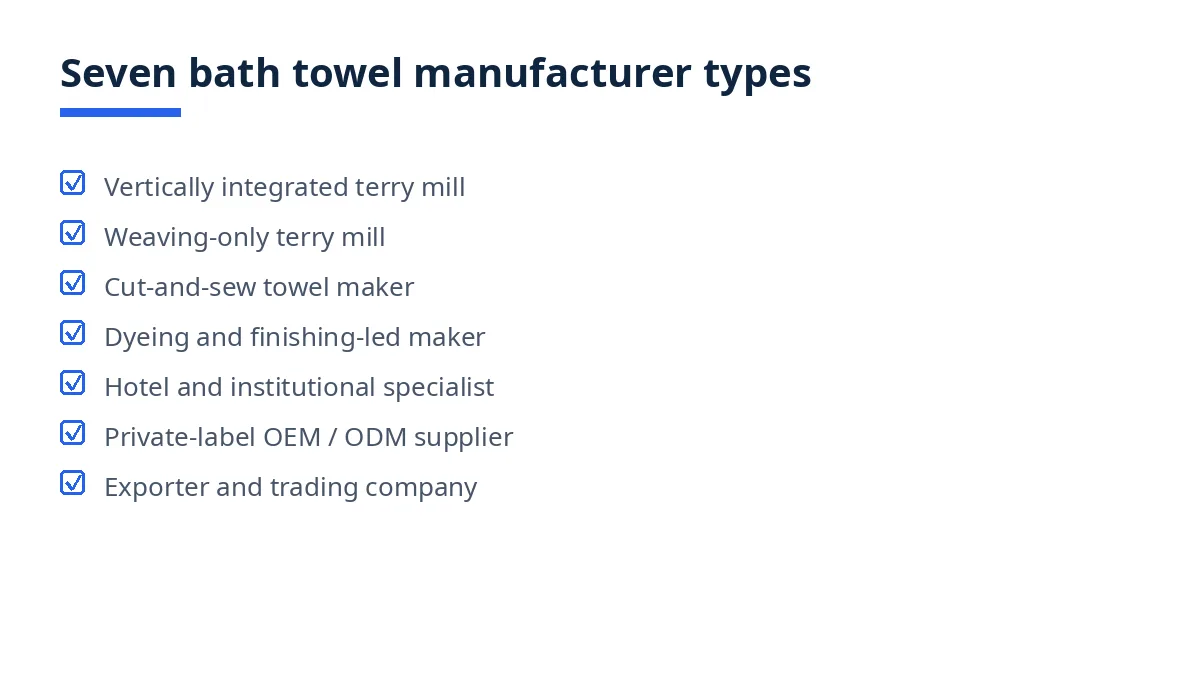
Bath towels manufacturers in Bangladesh fall into seven types: vertically integrated terry mills, weaving-only mills, cut-and-sew makers, dyeing and finishing-led makers, hotel and institutional specialists, private-label OEM and ODM suppliers, and exporters and trading companies. Match the type to your programme, then verify it with towel-specific checks on GSM, pile, absorbency, lint, edge stitching and wash durability before paying.
On this page
Key takeaways
Bath towels are loop-pile products, so judge a supplier on towel checks: GSM, pile, absorbency, lint, edge stitching and wash durability.
Bangladesh home textile exports earned US$871.57 million in fiscal 2024-25, up 2.42 per cent, per Export Promotion Bureau data.
No single factory type fits every towel programme: integrated mills, weaving-only mills, cut-and-sew makers and trading companies sell different offers.
Published terry towel parameters give absorbency of 35 to 80 per cent for bath towels and linting of 0.9 per cent or less.
Exportain badges record document and photo checks reviewed by the Exportain team; they are not factory inspections or quality guarantees.
Buyers searching for bath towels manufacturers in Bangladesh are not choosing from a ranked shortlist. They are choosing from a home textile sector that weaves, dyes, finishes and sews terry products for export, and the factory that fits a hotel programme is often a poor fit for a private-label retail range.
Bangladesh home textile exports earned US$871.57 million in fiscal 2024-25, up 2.42 per cent, per Export Promotion Bureau (EPB) data, with terry towels going mainly to the United States, Germany, France, the United Kingdom and Canada.1 The question is which type of maker fits your towel, and which towel-specific checks it must pass before you pay.
A bath towel is a loop-pile product, and its faults show up in use rather than on a table. The pile area is the main body of the towel and is responsible for absorption and cushioning, while the border, hems and selvedges are separate structures joined into one product.2 That is why this listicle judges each factory type by towel checks: grams per square metre (GSM) and weight per towel, pile evenness, absorbency, lint shedding, edge stitching and wash durability.
The list: bath towels manufacturers in Bangladesh by type
The seven types below cover the ways bath towels are actually made and sold from Bangladesh. One company can sit in more than one type. The type tells you what the supplier controls, what you must check yourself, and where an order goes wrong.
1. Vertically integrated terry mills
What they are. Mills that weave terry fabric, dye and finish it, then cut, hem and pack towels within the same company. A towel order stays inside one organisation from yarn to carton.
Who they suit. Buyers with larger, repeat programmes who need the same shade, weight and hand feel across seasons and colours. In-house dyeing gives the mill direct control over shade, which is where repeat towel orders usually fail.
How to verify. Ask which stages are in-house and which are subcontracted, and get the answer in writing. A mill that weaves but sends dyeing out is not integrated for your order, however it describes itself. Check pile evenness and shade consistency across a full carton from current production, not from a single showroom towel. If the check fails, move the order to a mill that controls the failing stage, or split the order so dyeing sits with a mill whose shade record you have already seen.
2. Weaving-only terry mills
What they are. Mills that weave terry fabric and sell it as greige or dyed fabric, rather than cutting finished towels. Their skill is loop-pile weaving and fabric weight control, not hemming and packing.
Who they suit. Buyers who already have a cut-and-sew partner, buyers developing a towel fabric before committing to a finished programme, and importers who buy fabric for their own factories.
How to verify. Ask for the fabric weight in GSM with its tolerance, the pile construction, and a washed fabric sample, then measure weight and dimensions after washing before committing to bulk fabric. If the washed weight or dimensions fall outside your tolerance, the fix is a revised fabric specification or a different loom plan, agreed before any fabric is dyed in bulk.
3. Cut-and-sew towel makers
What they are. Makers that buy terry fabric, cut it, hem all four sides, add labels and pack finished towels. Their skill is towel construction and finishing, not weaving.
Who they suit. Buyers running smaller or more varied programmes, buyers who want a specific fabric from one mill and sewing from another, and buyers testing a new towel style before committing to an integrated mill.
How to verify. Fabric quality becomes a shared responsibility, so inspect the fabric before cutting and agree shrinkage and shade tolerances in writing. Pull each hem gently along its length and check corners, because a towel hem that opens in the wash is a construction failure, not a fabric failure. If hems fail, the fix is a stitching and folding correction on a test towel before sewing restarts, not a concession agreed after packing.
4. Dyeing and finishing-led makers
What they are. Makers built around colour and finish: dyeing terry fabric to a shade standard, softening and finishing the pile, and holding shade across colours in a set. Some weave as well; the dyehouse is what sets them apart.
Who they suit. Multi-colour towel sets, hotel programmes where every colour in the set must match, and ranges where a soft hand feel is part of the product.
How to verify. Ask which colours the dyehouse runs every month and request shade evidence against your standard under the same light for body, border and hem thread. Wash the sample and check shade again, because dyeing and finishing change weight, dimensions and hand feel. If one colour drifts, the fix is re-sorting by dye lot or re-dyeing that colour, agreed before cartons are sealed.
5. Hotel and institutional towel specialists
What they are. Makers whose regular production is towels for hotels, spas, hospitals and laundries: heavier, plain or dobby-bordered towels made to survive repeated commercial laundering.
Who they suit. Hotel groups, spa operators, laundry suppliers and institutional buyers who value wash durability over fashion finishes.
How to verify. Ask for wash-durability evidence, not a softness claim. Check dimensions and weight after washing, look for open seams, broken stitches and rolling hems after laundering, and confirm the towel still absorbs after washing. Retail towel performance data gives a useful reference: published terry towel performance parameters list shrinkage after five laundry cycles, seam and hem durability with no open seams or broken stitches, and no visible rolling or distortion at the hem or seams after washing.2 If a towel fails after washing, the fix is a construction or finishing change tested on a fresh sample, not a lower wash standard.
6. Private-label OEM and ODM towel suppliers
What they are. Suppliers set up to make towels under the buyer's label. Original equipment manufacturers (OEM) produce to your specification; original design manufacturers (ODM) offer their own towel styles and borders for you to label.
Who they suit. Brands, retailers and hotel chains that need their own labels, size sets, borders, packaging and barcodes, and importers who want a ready towel range without developing every style.
How to verify. For OEM work, send a complete specification covering dimensions, GSM and tolerance, fibre composition, pile, border, labels and packing, and judge the counter-sample against it line by line. For ODM work, check that the offered styles are the supplier's own and confirm labelling rules for your market. If a sample misses the GSM or the label wording, the fix is a revised sample before bulk, with the change written into the order terms.
7. Exporters and trading companies
What they are. Export-licensed companies that sell towels made in partner mills rather than their own weaving lines. They aggregate capacity across several makers and handle export documentation for the buyer.
Who they suit. Buyers ordering several towel types at once, buyers whose quantities are too small or too mixed for one mill, and buyers who want one contract and one contact.
How to verify. Ask which mill will weave and finish each towel type, and get the mill named before you pay a deposit. The trading company's export record does not tell you which loom makes your towels. If the producing mill will not be named, the fix is to walk away from that quote or to make the order terms name the mill and the inspection point, so a failure has a known owner.
Summary table
Type | Best for | Main check before ordering |
|---|---|---|
Vertically integrated terry mill | Large repeat programmes, shade consistency | Which stages are truly in-house |
Weaving-only terry mill | Fabric buyers, own sewing partner | Washed fabric weight and dimensions |
Cut-and-sew towel maker | Smaller or varied programmes | Fabric inspection before cutting, hem pull check |
Dyeing and finishing-led maker | Multi-colour sets, soft hand feel | Shade under one light, re-checked after washing |
Hotel and institutional specialist | Hotels, spas, laundries | Wash durability: dimensions, seams, absorbency after washing |
Private-label OEM / ODM | Own-label brands and retailers | Specification match, label wording |
Exporter / trading company | Mixed orders, one contract | Producing mill named in writing |
Towel checks that apply to every type
Whichever type you choose, run the same towel checks, and write the limits into the order before production starts. Weight and GSM come first: weigh towels one by one against the agreed weight and tolerance, because a light towel usually means thinner pile than the approved sample. Pile comes next: check pile height and density against the approved sample, looking for thin patches, missing loops or ground weave showing through.
Absorbency and lint decide whether the towel works in use. Published terry towel performance parameters give absorbency of 35 to 80 per cent for bath towels, tested by ASTM D4772, and linting of 0.9 per cent or less, unless otherwise specified.2 Test absorbency in the condition the order specifies, and again after washing where required, because finishing left in the pile changes the result. Check lint by rubbing and shaking the towel and recording loose fibre against the sample and the agreed limit.
Edge stitching and wash durability close the list. Check hems on all four sides: even width, straight stitching, secure corners and no raw edge. Then wash the sample by the agreed procedure and measure again. The same published parameters list bath towel shrinkage after five laundry cycles and require no open seams, no broken stitches and no visible rolling or distortion at the hem or seams after washing.2 A towel that passes dry and fails washed is a failed towel, and the time to find that out is at sample stage.
Agree the inspection method in the same document. ISO 2859-1:2026 defines a system of acceptance sampling plans for inspection by attributes, and its acceptance quality limit (AQL) is the maximum average percentage of defective items considered acceptable during random sampling, used to set sample sizes and acceptance and rejection thresholds.3 Set the AQL, the inspection level and the defect classes before production, so an inspector accepts or rejects the shipment against a published rule instead of an opinion.
Labels are a legal check, not a decoration. Under Regulation (EU) No 1007/2011, a textile product shall be labelled or marked with the name and percentage by weight of all constituent fibres in descending order.4 Agree the fibre wording at sample stage and check that the percentages match the yarn you bought, because the labelled composition also supports your classification and your market claim.
How Exportain helps
Exportain is a B2B marketplace for sourcing from Bangladesh. Buyers search published products by keyword and category, and can filter to suppliers holding the Exportain Verified badge, sample availability and OEM or ODM capability, and sort by MOQ or lead time.5 Each supplier profile shows its verification level, location, main products and the certifications the supplier has declared.5 Buyers then post a request for quotation (RFQ) stating quantity, target price, destination, Incoterm, required certifications and deadline, and suppliers in that category quote against it.5
Use the badges as a starting filter, not a conclusion. Verification on Exportain is a document and photo review by the Exportain team, not a factory inspection, and a badge is not a guarantee of production capacity, product quality or delivery.6 7 Run the towel checks above on your shortlist and keep the whole exchange in the RFQ and message thread, so the agreed GSM, tolerances, inspection standard and label wording are recorded.
FAQs
What is the biggest mistake buyers make when sourcing bath towels from Bangladesh?
Choosing a supplier by the quoted price before checking the factory type. A weaving-only mill quoting fabric, a cut-and-sew maker quoting another mill's terry, and an integrated mill quoting its own dyed towel are three different offers at three different prices, and none of them is comparable until the towel specification is identical. Compare the same dimensions, GSM, fibre, pile, border, labels and packing from the same type of supplier, then verify the one you choose.
How can I avoid it?
Write one specification covering dimensions, GSM and tolerance, fibre composition, pile construction, border and hem treatment, labels and packing, and send the identical document to every supplier you quote. Name the producing mill in the order terms, approve a washed pre-production sample, and set the AQL inspection level in writing before production starts. A check with no agreed limit can be recorded, but it cannot fairly pass or fail a shipment.
Who is responsible for towel quality, the factory or the buyer?
Both, at different points. The factory is responsible for making towels to the agreed specification and the approved sample. The buyer is responsible for making that specification complete and checkable, for testing the sample after washing, and for inspecting against it before shipment. When a dispute starts, the side with the written specification, the sealed sample, the wash evidence and the inspection report is the side whose version counts.
Where can I get help verifying a bath towel supplier?
Start with the records that exist: the terry and home textile association listings for registration, the certificate issuer for any audit or fibre claim, and an inspection provider for the pre-shipment check.1 On Exportain, read what each profile badge covers before relying on it, and message the supplier through its profile so your questions and the answers stay in one thread.6 For the shipment itself, the bath towels quality control checklist turns the checks in this listicle into a numbered inspection sheet.
Next steps on Exportain
Browse Bangladeshi suppliers and filter the towel listings by badge, MOQ and OEM or ODM capability. Before you order, read how supplier verification works on Exportain so you know what each badge covers. Then post a free RFQ with your towel specification, quantity, destination and Incoterm, and compare the versioned quotations that come back. If your range is wider than bath towels, the guide to how to import bath towels from Bangladesh covers the ordering, duty and shipping steps that follow.
Sources
- Home textile sector rebounds after a two-year slump. TOB News, (accessed )
- Terry Towel - an overview. ScienceDirect (accessed )
- ISO 2859-1:2026 - Sampling procedures for inspection by attributes — Part 1: Sampling schemes indexed by acceptance quality limit (AQL) for lot-by-lot inspection. ISO (accessed )
- Regulation (EU) No 1007/2011 on textile fibre names and related labelling and marking of the fibre composition of textile products. European Union, (accessed )
- How to source and buy from Bangladesh. Exportain (accessed )
- Supplier verification: Earn trust badges buyers can see. Exportain (accessed )
- Trust & Safety Center. Exportain (accessed )
- supplier verification
- importing from Bangladesh
- Terry towels
- home textiles
- Private label apparel
- Bath towels
About the author
Sourcing from Bangladesh?
Post a request for quotation and suppliers on Exportain can send you their quotes directly.
Post an RFQ


