

Bath Towels Exporters in Bangladesh: Verified Supplier Checklist
A supplier checklist for bath towel exporters in Bangladesh: documents, towel programme evidence, samples, quality systems and repeat-order controls, scored block by block before the first bulk order.
Short answer
Use this checklist to judge a bath towel exporter in Bangladesh before the first bulk order: check identity and export standing, towel programme capability, approved samples and written specifications, the quality system and lab evidence, commercial terms, and repeat-order controls, and score each block on evidence tied to your towel types and colours.
On this page
Key takeaways
Check identity and export standing first, and read Exportain badges as document and photo reviews, not factory inspections or guarantees.
Ask for towel evidence tied to your programme: size and weight, pile, absorbency method and condition, lint, and edge and hem evidence.
Agree every tolerance, method and limit in writing before bulk, and keep one sealed counter-sample per towel type and colour.
Score each block on evidence tied to your towel types and colours, and re-approve the exporter when a trigger fires.
A repeat bath towel programme stands or falls on the exporter behind it, not on one good sample. This checklist helps a buyer in the USA, the UK, the EU or the UAE judge whether a Bangladeshi bath towel exporter can repeat the same towel, shade and finish order after order.
Why this checklist matters
A towel exporter sells a programme, not a single shipment. Yarn lots change, dye lots drift, and a second order arrives lighter or duller than the first. A buyer who checked documents, towel evidence, samples, quality systems and repeat-order controls has a file showing what was agreed and what still needs proof.
This checklist covers the exporter; use the companion bath towels quality control checklist for the shipment itself.
Before you start
Send every candidate the same specification pack: towel types and sizes, fibre composition, pile construction, the colour list with a reference standard per shade, border or logo treatment, label artwork, packing format and carton assortment. Ask for the same reply format: what is made in-house, what is bought in, and what evidence backs each claim.
Set pass rules before replies arrive: mandatory blocks, gaps a trial order can close, and gaps ending the conversation.
The full checklist (numbered, printable)
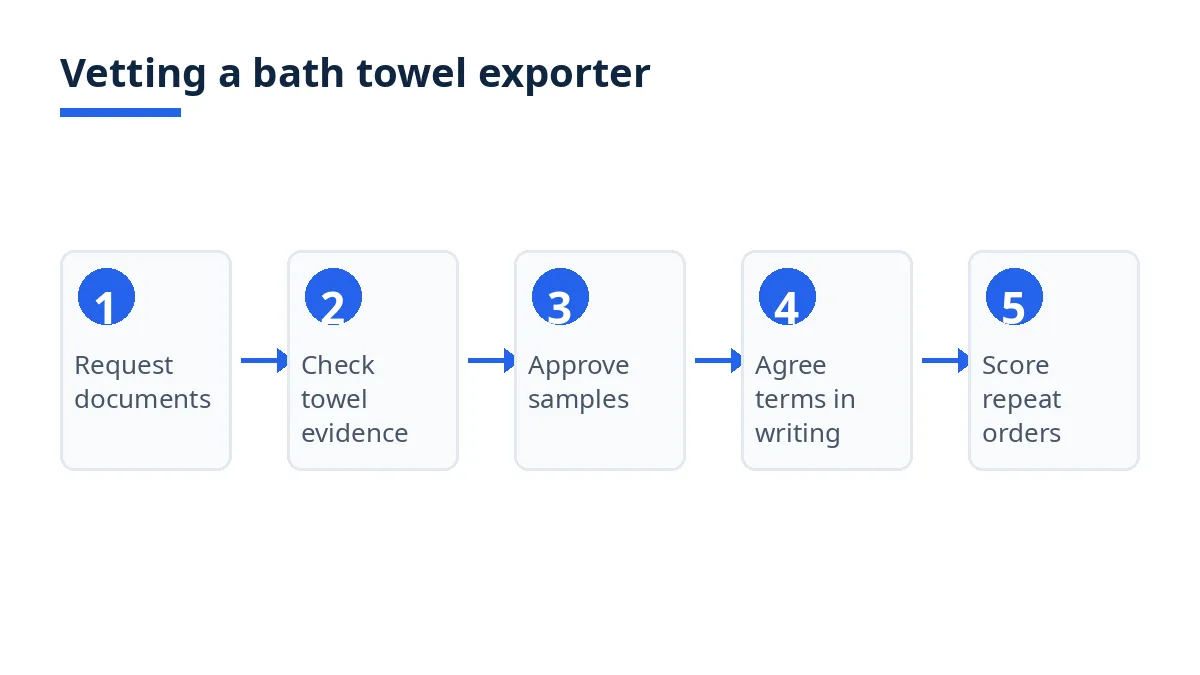
Identity and export standing
Confirm the legal name, address and contact person, and check the same name appears on every document, including the bank account.
Ask for the business registration documents held, such as a trade licence and, where provided, tax and incorporation documents.
Ask for the Export Registration Certificate (ERC), and check its name matches the legal name in item 1.
Ask whether the exporter is a manufacturer, a trading company, or both, and record the answer.
For a manufacturer, ask for dated facility photos showing terry weaving, dyeing or finishing, and sewing areas.
For a trading company, ask for office or warehouse photos, plus the production partner for your towel types.
Read any Exportain badges for what they actually are. Supplier verification on Exportain is a document review by staff, not a factory inspection and not a check against a government database.1 A badge is not a guarantee of production capacity, product quality or delivery.1
Check the seller verification page: verification is a document and photo review, not a factory inspection.2
Towel programme capability
Ask which terry towel types the exporter currently makes, in which sizes and colours, and request finished towels from current production.
Ask how yarn is sourced and dyed for your colours, and how a dye lot change is handled on a repeat order.
Ask for towel evidence for your programme: size and weight per towel type, pile against the approved sample, absorbency naming method and condition, lint for your colours, and edge and hem evidence.
Ask how shade is held: the reference standard per colour, how border yarn is matched to body yarn, and what happens on a mismatch.
Ask for the repeat-order record: how many repeat programmes currently run, how long each has run, and what changed since the first order.
Ask about capacity: towels of your types completed per week, what limits that figure, and what happens when another programme runs late.
Ask which stages are subcontracted, and whether subcontracting needs your written agreement first.
Samples and specifications
Require an approved sample per towel type and colour, made with production yarn, dyed in the production shade and finished the production way.
Write the specification into the order file: dimensions and weight with tolerances, pile construction, fibre composition, border and logo treatment, and agreed methods and limits for absorbency, lint and edges.
Agree the label artwork before bulk labels are printed. Under Regulation (EU) No 1007/2011, a textile product shall be labelled or marked with the name and percentage by weight of all constituent fibres in descending order.3
Agree the care symbols for each destination market. ISO 3758 establishes a system of graphic symbols for care labelling, based on the most severe treatments that do not cause irreversible damage.4
Agree the wash evidence you will hold. ISO 5077 specifies a method for determining dimensional change of textile articles in specified washing and drying procedures.5
Record every tolerance, method and limit in writing, with the date and person agreeing it.
Quality system and evidence
Ask how quality is managed day to day: who checks weaving, dyeing, finishing and sewing, and what record each check leaves.
Ask whether the exporter holds a quality management system certificate, read it for scope and dates, and record whether towel production falls inside it. ISO 9001 is the best-known standard for quality management systems, and its principles include customer focus, leadership, the process approach and continual improvement.6
Agree the sampling plan in the purchase order: standard, inspection level and acceptance numbers per defect class. ISO 2859-1 defines a system of acceptance sampling plans for inspection by attributes, indexed in terms of the acceptance quality limit (AQL).7 The numbers are your agreement with that exporter, not a figure this checklist sets.
Ask for lab reports naming fabric, colour tested, method used and lot covered, and reject any report not tied to your towel types and colours.
If a harmful-substances claim will appear on the product, check the certificate scope for your towel types and colours. Under OEKO-TEX STANDARD 100, every thread, button and accessory on a certified article has been tested against over 1,000 harmful substances, with stricter requirements as skin contact grows more intensive.8
Ask how failures are handled: who is told, how fast, what is sorted or remade, and who pays for re-inspection.
Commercial terms and delivery
Ask for the minimum order split by towel type, colour and packing format, and record it with the quote.
Compare quotes only after the specification is fixed, and ask what each price includes: yarn, weight per towel, packing and delivery term.
Agree payment terms, the account to be paid, and the process for verifying any bank detail change, before payment.
Agree the delivery term, shipment schedule per colour, packing format and carton assortment, and late or short delivery consequences, in the purchase order.
Agree change control: no change to yarn, dye, pile, border, label or packing without your written agreement, and a fresh sample where a change affects the towel.
Repeat-order controls
Score each block after the first order, using the same form for every exporter, and keep the scores on file.
Set re-approval triggers: a change of production partner, a new dye supplier, a failed inspection, or a shade or weight drift that repeats.
Common failures and how to fix them
The most common failure is a repeat order that differs from the first, because the specification was never written down in full. The fix is a written specification, an approved counter-sample and a change-control clause.
The second failure is evidence that cannot be tied to the order: a certificate for another product, a lab report for another colour, or photos from another site. Ask for the document naming your towel types and colours, and treat a substitute as no document.
The third failure is a badge read as a guarantee. Exportain badges record document and photo checks, and the trust page states plainly that a badge is not a guarantee of production capacity, product quality or delivery.1 Read badges as a starting point, not a substitute for your own checks.
The fourth failure is a price agreed before the specification. When weight, pile, shade and packing are unfixed, the cheapest quote is often simply the lightest towel. Freeze the specification first, then compare quotes on it.
Downloadable template / summary table
Copy the checklist into your supplier file, with columns for evidence held, evidence missing, and the closing action and date.
Block | Checks | Evidence to file |
|---|---|---|
Identity and export standing | Name, registration, ERC, maker or trader | Documents shown, badge meaning noted |
Towel programme capability | Current types, dye lots, shade, capacity, subcontracting | Current towels, repeat record, capacity note |
Samples and specifications | Approved samples, tolerances, labels, care symbols, wash evidence | Counter-samples, specification |
Quality system and evidence | Daily checks, QMS scope, sampling plan, lab reports, failure handling | Certificates read, reports tied to lot, colour |
Commercial terms and delivery | Minimum split, price inclusions, payment, delivery term, change control | Quote comparison, order terms |
Repeat-order controls | Block scores, re-approval triggers | Score form, trigger list |
Example figures: score each block from 0 to 2: 0 means no evidence, 1 means partial evidence, and 2 means evidence tied to your towel types and colours. A total of 10 or more out of 12, with no block at 0, suits a trial order.
How Exportain helps
Exportain is a B2B marketplace connecting buyers with Bangladeshi suppliers, so this checklist can be agreed at the enquiry stage. Browse suppliers, read the seller verification page for what each badge covers, and use the trust center page to check what verification does and does not do. Supplier profiles show which document and photo checks have been recorded, not factory inspections. Exportain is not a party to the goods contract and does not inspect goods.
FAQs
When should this checklist be used?
Use it before the first bulk order with a new exporter, and again before a repeat programme grows or adds a type or colour. For an existing exporter, use the repeat-order controls block at each reorder.
Who should complete it?
The buyer, a sourcing agent or an independent auditor can complete it, using the same pack and scoring form for every candidate. Whoever completes it needs the authority to stop a supplier that fails a mandatory block.
What are the most common failures?
A repeat order that differs from the first because the specification was never written down, evidence that cannot be tied to the order, a badge read as a guarantee, and a price agreed before the specification was fixed.
Can a third party do it?
Yes, if you share the specification pack, mandatory blocks, scoring form and pass rules first, and agree who pays for a repeat visit after a failure. A third party can gather evidence, but approval stays with you.
Next steps on Exportain
Before you shortlist exporters, write your specification pack and mandatory blocks, then read the bath towels quality control checklist and the AQL acceptance quality limit explainer. When ready, post through RFQs and compare replies against this checklist.
Sources
- Trust & Safety Center. Exportain (accessed )
- Supplier verification: Earn trust badges buyers can see. Exportain (accessed )
- Regulation (EU) No 1007/2011 on textile fibre names and related labelling and marking of the fibre composition of textile products. European Union, (accessed )
- ISO 3758:2023 - Textiles — Care labelling code using symbols. International Organization for Standardization (accessed )
- ISO 5077:2007 - Textiles — Determination of dimensional change in washing and drying. International Organization for Standardization (accessed )
- ISO 9000 family - Quality management standards including ISO 9001. International Organization for Standardization (accessed )
- ISO 2859-1:2026 - Sampling procedures for inspection by attributes — Part 1: Sampling schemes indexed by acceptance quality limit (AQL) for lot-by-lot inspection. International Organization for Standardization (accessed )
- OEKO-TEX Standard 100. OEKO-TEX (accessed )
About the author
Sourcing from Bangladesh?
Post a request for quotation and suppliers on Exportain can send you their quotes directly.
Post an RFQ


