

Retailers: Woven Garments & Denim Bangladesh
For retailers, buying woven garments and denim from Bangladesh works when the assortment, size curve and replenishment plan are fixed before the order: this guide covers MOQ per colour and size, store-ready packing, labelling, costs, documents and the checks that protect retail margin.
Short answer
Retailers sourcing woven garments and denim from Bangladesh should fix the assortment, the size curve per style and colour, the denim wash standard and the store-ready packing spec before ordering. Capacity is broad, but retail success depends on sizes arriving in the right ratio, washes matching across replenishment drops, and cartons that stores can sell from without rework.
On this page
Key takeaways
Fix the assortment, size curve per style and colour, denim wash standard and store-ready packing spec before you enquire.
Woven exports reached $4,614.80 million in July to September 2026, up 5.11 percent year on year, per EPB data.
Cotton trousers classify at 6203.42 for men and boys and 6204.62 for women and girls under HS Chapter 62.
EU textile labels must list fibre names and percentages by weight in descending order under Regulation (EU) No 1007/2011.
Exportain verification is a document and photo review, not a factory inspection, and a badge is not a guarantee.
Retail buying changes what a Bangladesh sourcing order has to get right. A wholesaler can absorb a mixed carton, but a retailer cannot: every size must arrive in the ratio the shop floor needs, every wash must match the garment already on the rail, and every piece must be ready to hang, scan and sell. This guide covers woven garments and denim for retailers buying from Bangladesh, from assortment planning and size curves through store-ready packing, labelling, costs, documents and replenishment.
Woven garments are a large part of what Bangladesh ships. In July to September 2026, woven garment exports reached $4,614.80 million, up 5.11 percent year on year, within ready-made garment exports of $10,578.56 million, according to data released by the Export Promotion Bureau (EPB).1 That scale means retailers can usually find capacity for woven shirts, trousers, dresses and denim, but it does not remove the retail risks: a wrong size curve, a shade shift between drops, or a carton packed for a warehouse rather than a store.
Why this matters for buyers and sellers
For a retailer, the order is only partly about the garment. The rest is about the shop: which sizes sell first, how many weeks of cover each style needs, and how fast a bestseller can be replenished before the size curve breaks. A style that sells out in medium and large while small and extra-large sit unsold is not a sourcing failure alone; it is a size-curve decision made before the order was placed.
For the seller, retail orders bring discipline and repetition. A retailer who confirms a size ratio, a wash standard and a packing spec in writing gives the factory a repeatable order, and repeat orders are where replenishment becomes possible. A retailer who changes the fit, the wash or the label mid-production gets a one-off order that cannot be repeated at the same cost.
The Bangladesh Garment Manufacturers and Exporters Association (BGMEA) reports around 4,500 member factories, of which about 60 percent are woven garment manufacturers, and states that its member factories account for 100 percent of woven garment exports.2 Membership signals an active woven business; it does not by itself prove that a factory can hold a wash standard across repeat drops or pack to a retail spec, so those points still need written confirmation.
Step-by-step: how it works
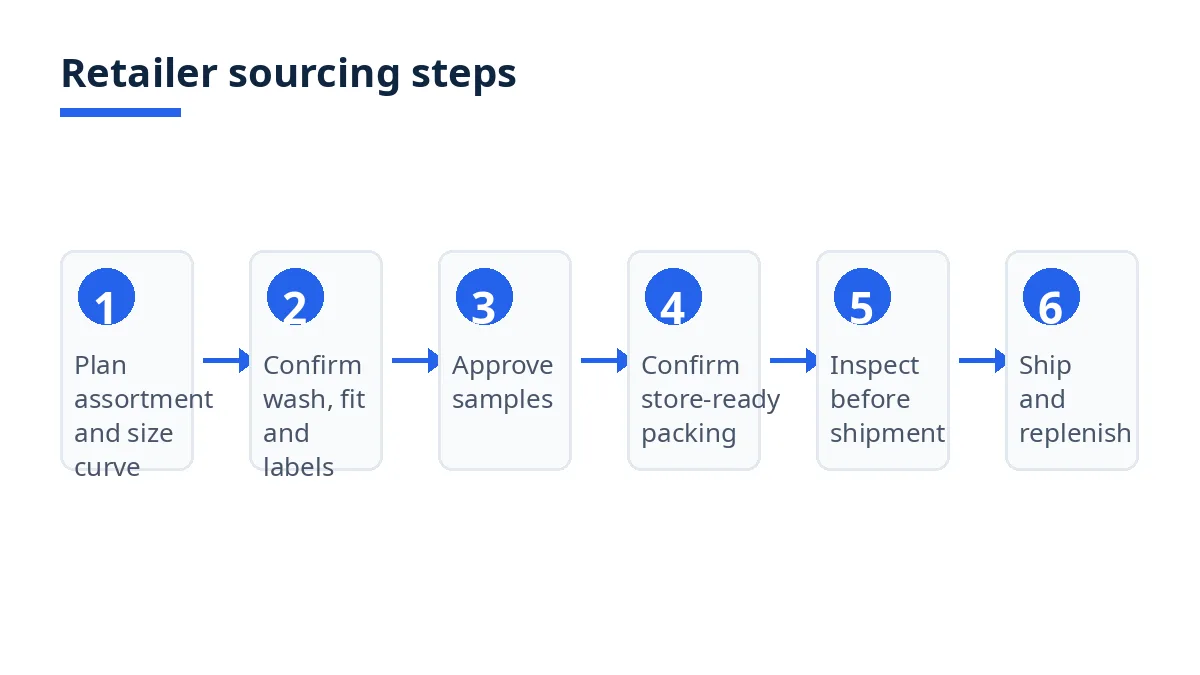
Plan the assortment before you enquire. List each style, its role (core, seasonal, or test), the stores or channels it serves, and the weeks of cover you want. A core denim jean and a seasonal printed dress need different order logic, and the factory should see that difference in the enquiry.
Fix the size curve per style. State the quantity per size, not only the total. A size curve is the ratio across sizes for one style and colour, and it decides what the shop can actually sell.
Confirm wash, fit and labels in writing. For denim, agree the wash recipe reference, the approved wash sample, and the tolerance for shade variation between lots. For every style, agree the fit sample, the measurement points, and the care and fibre label for each destination market.
Approve samples in the real spec. Approve a proto sample for fit, then a pre-production sample in the actual fabric, wash, trims and labels. Measure it, wash it where the care label requires it, and approve or correct it in writing.
Confirm store-ready packing before production. Agree polybag, hanger or flat-pack, size stickers, barcodes, carton marks and the packing list format, so the cartons arriving at the store need no rework.
Inspect, ship and set the replenishment trigger. Agree the inspection level before shipment, confirm the delivery term, and write down the stock level or date that triggers a repeat order while the first drop is still selling.
Costs, timelines and documents
What are the typical costs and timelines?
There are no typical costs or timelines a guide can state as fact for retail woven and denim orders. Each factory prices your fabric, wash, construction, trims, labels and packing, and the delivery term you choose changes who pays freight and insurance. Under Incoterms 2020 there are 11 rules, and for sea shipments the common retail choices are FOB, where risk passes when goods are on board the vessel, and CIF, where the seller also pays freight and minimum insurance to the destination port while risk still passes on board at origin.3 For container shipments, an any-mode rule such as FCA is often the better fit, because the container is handed over before it is loaded on board.3 Compare quotations only on the same rule and named place.
Timelines follow the same logic: sampling depends on fabric and wash availability, bulk production on dyeing, washing, trim delivery and line capacity, and replenishment on whether the fabric and wash can be repeated. Ask for sampling, fabric ready, production, inspection and ship dates as separate lines, not a single delivery week.
Which documents are needed?
For export clearance in Bangladesh, goods may not be loaded unless an export declaration, the Bill of Export or Shipping Bill, is submitted to Customs and approved.4 Enclosed documents include the export contract or purchase order where there is no export letter of credit, the commercial invoice, the packing list, the EXP form certified by an authorized dealer, and a certificate of origin issued by the EPB or a Chamber of Commerce and Industry.4 Keep one legal name for the exporter across the quotation, proforma invoice, packing list and payment account, because the export declaration names the exporter and the foreign buyer.4
How do size curves and retail margin work in practice?
A size curve is where retail money is made or lost. The table below is an example only, showing how one style can be split across sizes for a single store drop.
Size | Share of the style | Example pieces in a 1,000-piece drop |
|---|---|---|
XS | 5 percent | 50 |
S | 20 percent | 200 |
M | 30 percent | 300 |
L | 25 percent | 250 |
XL | 15 percent | 150 |
XXL | 5 percent | 50 |
Example figures: the shares above show structure only, not a typical size curve, price or lead time. Your own curve should come from your past sales by size, not from a supplier default, and it should differ between a slim jean and a relaxed shirt.
Retail margin needs the same discipline. Work from landed cost per piece (product price plus freight, insurance, duty and destination charges on the delivery term you chose) to the retail price, then check the margin after markdowns, not before them. Example figures: a landed cost of $12.00 per piece sold at $29.99 gives a gross margin of about 60 percent before store, staff and markdown costs, while the same piece marked down to $19.99 keeps about 40 percent. The example shows the calculation only; it is not a typical price, duty rate or margin for woven garments or denim.
Bangladesh-specific rules and tips
Classify woven garments and denim correctly. Woven apparel sits in Harmonized System Chapter 62, which covers articles of apparel and clothing accessories, not knitted or crocheted.5 Within it, heading 6203 covers men's or boys' suits, jackets, trousers and shorts, and heading 6204 covers the women's or girls' equivalents, with cotton trousers at 6203.42 for men and boys and 6204.62 for women and girls.5 Denim jeans are cotton trousers under those subheadings, not a separate denim heading, so confirm the subheading per style and gender before the invoice is raised. See the HS code for denim jeans guide.
Get labelling right for each market. In the European Union, Regulation (EU) No 1007/2011 states that a textile product shall be labelled or marked with the name and percentage by weight of all constituent fibres in descending order.6 A cotton-elastane denim therefore needs its fibre percentages in that order on the label, and the label spec should be part of the tech pack, not an afterthought at packing. Check the labelling rules of every destination market separately, since the EU rule is not a substitute for US or UK requirements.
Protect the wash across replenishment. Denim shade drift between drops is a retail problem, because a customer returning for the same jean expects the same wash. Keep the approved wash sample, the wash reference and the fabric lot details with the first order, and require the repeat order to be matched against that sample before shipment. If the fabric lot changes, approve a new wash sample before bulk washing.
Ask which inputs are imported for your order. Buttons, rivets, zips, elastane yarn and some woven fabrics may be bought in for your specification, and an imported trim can set both the minimum quantity and the earliest production date. Confirm trim availability before you promise a store launch date.
Confirm association claims at the source. If a supplier claims BGMEA membership, confirm it with the association itself. BGMEA membership signals an active woven business,2 not wash consistency, size-curve discipline or packing to a retail spec. Those still need written proof in samples and inspection.
Mistakes and red flags
What are the most common mistakes?
Ordering a total quantity with no size curve. A 1,000-piece order with no split per size cannot be packed for stores and will break on the shop floor when core sizes sell out. State the split per style, per colour and per size in the enquiry and on the purchase order.
Approving a wash by photo alone. Denim wash, hand feel and shade cannot be approved from a photo. Approve a physical wash sample, keep it as the reference, and check the bulk lot against it.
Packing for a warehouse when the store needs shelf-ready goods. Cartons without size stickers, barcodes or carton marks need rework at destination, which costs time and margin. Agree the store-ready spec before production, not at the packing table.
Comparing prices on different delivery terms. A lower price on FOB and a higher price on CIF are different offers, because under CIF the seller pays freight and insurance while risk still passes on board at origin.3 Compare only replies to the same tech pack on the same Incoterm.
Treating a profile or a badge as proof of retail capability. A profile is a starting point for enquiries. It does not test whether a factory can hold a wash standard or pack to a retail spec, and a badge is not a guarantee of capacity, quality or delivery.7
Letting replenishment start too late. If the repeat order starts only after the first drop sells out, the shop sits empty while fabric, washing and shipping run again. Set the reorder trigger in writing before the first shipment leaves.
Checklist
Before you confirm, every line should be answered in writing.
Assortment planned: each style marked core, seasonal or test, with weeks of cover.
Size curve stated per style, per colour and per size, with one ratio per colour.
Wash reference and approved wash sample kept for denim, with shade tolerance agreed.
Fit sample, measurement points and label spec approved per destination market.6
Fibre composition confirmed in descending order for EU-bound styles.6
HS subheading confirmed per style, including 6203.42 and 6204.62 for cotton trousers.5
Store-ready packing agreed: polybag or hanger, size stickers, barcodes, carton marks.
MOQ confirmed per style, per colour and per size; binding line named.
Inspection level agreed before production; delivery term and named place stated.3
Export set agreed: invoice, packing list, EXP form, certificate of origin, Bill of Export.4
Replenishment trigger written down: stock level or date that starts the repeat order.
How Exportain helps
On Exportain, browse suppliers and post a request for quotation (RFQ) on the RFQ board with your assortment plan, size curve, wash reference, packing spec and delivery term, so suppliers quote against the same retail specification. Ask each reply for its minimum per style, per colour and per size, and for its wash-repeat process. Read the badges for what they record: Exportain verification is a document and photo review, not a factory inspection, and a badge is not a guarantee.7 See the woven garments sourcing guide and the denim jeans quality control checklist before you confirm, and the how to import denim jeans from Bangladesh guide for the end-to-end import steps.
FAQs
What should I know first about Woven Garments & Denim Sourcing From Bangladesh for Retailers?
Start with the shop, not the factory: fix the assortment, the size curve per style and colour, the wash standard for denim, and the store-ready packing spec before you enquire. Woven exports reached $4,614.80 million in July to September 2026, up 5.11 percent year on year,1 so capacity is usually available, but retail success depends on size, shade and packing discipline that must be written into the order.
What are the typical costs and timelines?
There are no typical figures a buyer can rely on, because each factory prices your fabric, wash, construction, trims, labels and packing, and the delivery term changes who pays freight and insurance.3 Timelines depend on fabric and wash availability, trim delivery, line capacity and inspection, so ask for each stage as a separate date. Work retail margin from landed cost per piece, after markdowns, using example figures only for the calculation.
Which documents are needed?
The order documents are the tech pack, the size curve, the wash and label specs, the itemized quotation and the purchase order. The export set is the Bill of Export, commercial invoice, packing list, EXP form certified by an authorized dealer, and a certificate of origin issued by the EPB or a Chamber of Commerce and Industry.4 Confirm the HS subheading per style before the invoice is raised.5
What are the most common mistakes?
The most common mistakes are ordering a total with no size curve, approving a denim wash by photo, packing for a warehouse instead of a store, comparing prices on different delivery terms,3 and reading a badge as a guarantee.7 Each one is fixed before production by a written spec, a physical sample and an agreed inspection.
Next steps on Exportain
Browse suppliers, then post your assortment plan, size curve and packing spec on the RFQ board so suppliers quote on the same retail terms. Before you confirm, read the woven garments sourcing guide and the landed cost guide to check your margin from landed cost, not from the factory price alone.
Sources
- RMG exports rise 6.10pc to US$10.58b in July-Sept of FY27. The Financial Express, (accessed )
- BGMEA sets new membership criteria to ensure factory safety, operational standards. The Financial Express, (accessed )
- Incoterms 2020 Explained: Complete Guide (2026 Update). Inecta (accessed )
- Customs Clearance Procedures for Export. Bangladesh Customs, National Board of Revenue (accessed )
- HS Nomenclature — Chapter 62: Articles of apparel and clothing accessories, not knitted or crocheted. World Customs Organization (accessed )
- Regulation (EU) No 1007/2011 on textile fibre names and related labelling and marking of the fibre composition of textile products. European Union, (accessed )
- Trust & Safety Center. Exportain (accessed )
About the author
Sourcing from Bangladesh?
Post a request for quotation and suppliers on Exportain can send you their quotes directly.
Post an RFQ


