Government and Tender Buyers: Woven Garments and Denim From Bangladesh
Tender-only guide to woven garments and denim from Bangladesh: measurable specifications, documented competition, sealed samples, framework and phased delivery, and lot-by-lot inspection for public buyers.
Short answer
Government and tender buyers sourcing woven garments and denim from Bangladesh should run a documented competition on a measurable specification, prequalify the factory that will make the garment, approve a sealed sample in the actual fabric and colour, and accept delivery lot by lot against that sample, with inspection and audit records kept for every phase.
On this page
Key takeaways
A tender file, not a catalogue, decides success: measurable specification, documented competition, sealed sample and lot-by-lot inspection.
Bangladesh woven exports reached $4,614.80 million in July to September 2026, but capacity is not qualification for a specific uniform order.
A framework agreement can let several delivery points draw the same garment at agreed prices, provided terms, price rules and call-off records are written down in advance.
HS headings in this guide are indicative only; duty and import rules turn on the full code, fibre and origin in the buyer country tariff.
Exportain badges record document and photo reviews, not factory inspections, so sample approval, testing and lot inspection stay with the buyer.
A government or tender purchase is judged differently from an ordinary commercial order. The garment must match a written specification exactly, the price must survive a recorded evaluation, and every delivery must be traceable to a contract, a sample and an inspection record. This guide is for buyers who purchase woven garments and denim for public institutions, uniformed services, health and education bodies, and other tender-funded programmes from Bangladesh.
Woven garments here mean shirts, trousers, jackets, blazers, suits, skirts and overalls cut from woven fabric, including denim trousers and jackets. The focus is tender discipline: a defensible specification, a documented competition, a sample that locks the standard, and phased delivery an auditor can follow lot by lot.
Why this matters for buyers and sellers
For a tender buyer, the risk is not only a late shipment. A vague size chart, an unstated fabric weight, or a colour approved by one officer and rejected by another can turn a delivery into a recorded dispute over public money. The buyer needs a specification that a factory, an inspector and an auditor can all read the same way.
For a seller, a tender order is attractive because it is planned, sized and repeated: a known garment, fabric and delivery pattern makes fabric booking and line planning possible. Both sides gain when the tender document, sample and delivery record say the same thing.
Scale supports the choice of Bangladesh for woven supply. In July to September 2026, woven garment exports from Bangladesh reached $4,614.80 million, up 5.11 percent year on year, within ready-made garment exports of $10,578.56 million, according to data released by the Export Promotion Bureau (EPB).1 The Bangladesh Garment Manufacturers and Exporters Association (BGMEA) reports around 4,500 member factories, around 60 percent of them woven garment manufacturers, and states that its member factories account for 100 percent of woven garment exports from the country.2 Those figures describe capacity, not a promise about any single factory.
Step-by-step: how it works
The steps below follow the tender, from requirement to audit file. Keep each step in writing, with a date and a name attached.
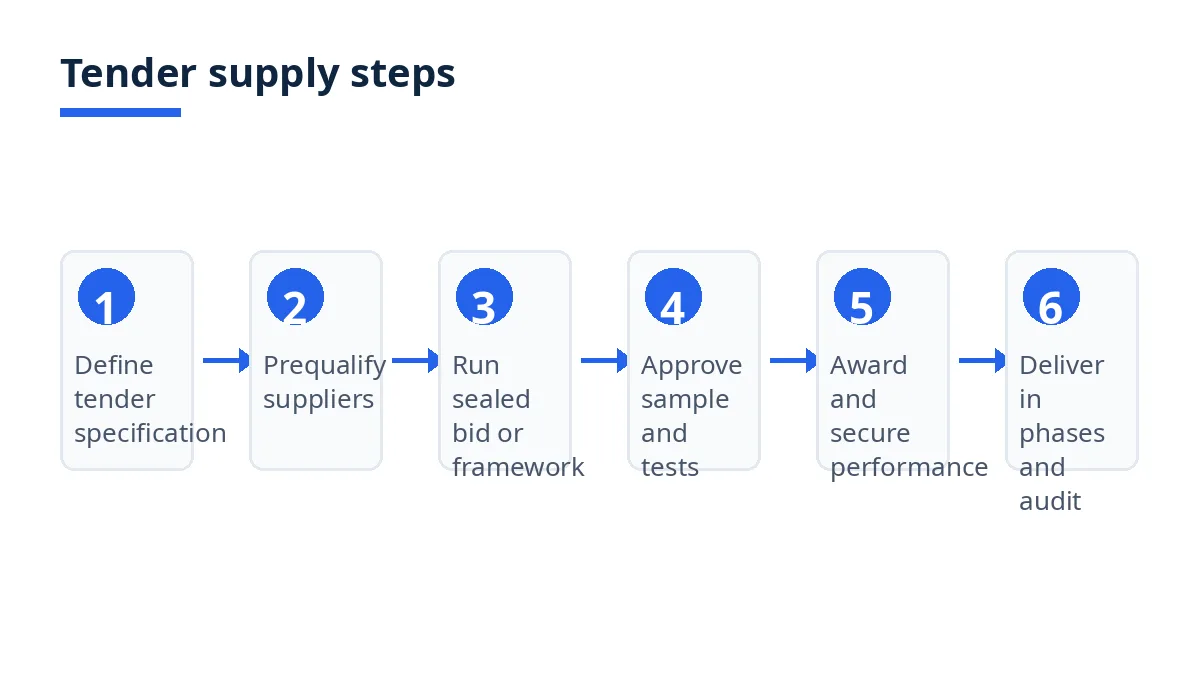
Define the requirement as a tender specification: garment, fabric composition and weight, colour standard, size range and ratio, construction, labelling, packing and delivery pattern, plus quantities per size and delivery point and the inspection standard.
Prequalify suppliers before price is discussed: business and export registration, factory location and capacity for the specific garment, comparable work without confidential client detail, and the quality system to be used. Record who passed, who failed and why, on the same criteria for all.
Run the competition on one document: the same specification, sample requirement, delivery pattern and evaluation criteria for every bidder. Score technical compliance, sample quality, delivery capacity and price separately, and keep the scoring sheets.
Approve a sealed sample and a test record: a pre-production sample in the actual fabric, colour, construction and labelling, measured against the size chart and washed where washing is part of use. Retain one sealed sample; bulk production must match it.
Award in writing, with performance protection: quantity, price, delivery term, phased schedule, inspection and rejection rules, payment terms and performance security or retention. Name the delivery points and the person authorised to accept or reject each lot.
Deliver in phases, inspect each lot, and close the audit file: inspect against the sealed sample and size chart before acceptance, record defects by lot, and keep invoice, packing list, inspection record and acceptance note together.
Costs, timelines and documents
What are the typical costs and timelines?
There are no typical costs or timelines that a guide can state as fact for tender supply, because each tender prices a different garment, fabric, size range, delivery pattern and inspection regime. The Incoterms 2020 rules set out 11 rules with a clear allocation of cost, risk and obligations,3 so compare bids only when they state the same rule and the same named place.
For timelines, ask for a date for each stage: specification and prequalification, sample and test, bulk fabric booking, production, inspection, and delivery to each point. Tender evaluation itself takes time, and a delivery date set before the award date already creates a delay. Example figures: a programme needing 12,000 uniform shirts across three delivery points in four phases might use 3,000 shirts per phase, each inspected and accepted before the next is released. The numbers show structure only, not a typical quantity, price or lead time.
Which documents are needed?
Two document sets matter. The tender set proves the competition was fair. The export set proves the goods may leave Bangladesh and enter the buyer country. Keep both sets in the same contract file.
Document set | Documents | Who reads it |
|---|---|---|
Tender set | Tender notice, specification, prequalification record, evaluation sheets, award letter, contract, sample record, inspection notes | Buying authority, auditor, unsuccessful bidders |
Bidder set | Business and export registration, factory statement, fabric specs, test reports, price schedule | Evaluation committee |
Export set | Contract or purchase order, invoice, packing list, EXP form, certificate of origin, Bill of Export | Bangladesh and buyer country customs |
For export clearance in Bangladesh, goods may not be loaded unless an export declaration, the Bill of Export or Shipping Bill, is submitted to Customs and approved.4 Enclosed documents include the export contract or purchase order where there is no export letter of credit, the commercial invoice, the packing list, the EXP form certified by an authorised dealer, and a certificate of origin issued by the EPB or a Chamber of Commerce and Industry.4
Bangladesh-specific rules and tips
The buyer country rules govern the tender: a foreign public buyer runs its competition under its own procurement law, while supplier country rules govern export, customs and factory compliance.
One Bangladesh development is worth noting for buyers who deal with Bangladeshi public bodies. Bangladesh passed a Public Procurement (Amendment) Bill in 2026 that introduces sustainable public procurement, makes use of the electronic government procurement portal mandatory for public procurement, and expands framework agreements, allowing multiple government entities to procure goods from pre-selected suppliers over a specified period.5 For a foreign tender buyer, the useful point is the model: a framework lets several delivery points draw the same garment at agreed prices over a set period, without a full competition for every call-off, provided terms, price rules and call-off records are written down in advance.
Classification and labelling need the same care. In the Harmonized System, heading 6203 covers men's or boys' suits, ensembles, jackets, blazers, trousers, bib and brace overalls, breeches and shorts, other than swimwear, and heading 6204 covers the corresponding women's or girls' garments.6 Heading 6205 covers men's or boys' shirts.6 The headings below are indicative only and must be checked against the official tariff of the buyer country before pricing, because duty and import rules turn on the full code, fibre and origin, not the heading alone.
Garment type | Indicative heading | Check before pricing |
|---|---|---|
Men's woven trousers, including denim | 6203; cotton at 6203.42 | Full subheading, fibre, origin |
Men's woven jackets and blazers | 6203.31 to 6203.39 by fibre | Fibre, lining |
Women's woven trousers, including denim | 6204; cotton at 6204.62 | Full subheading, fibre, origin |
Men's woven shirts | 6205; cotton at 6205.20 | Fibre, trim rule |
Women's woven blouses | 6206; cotton at 6206.30 | Full subheading, fibre |
For sales into the European Union, Regulation (EU) No 1007/2011 states that a textile product shall be labelled or marked with the name and percentage by weight of all constituent fibres in descending order.7 The same regulation allows labels to be replaced or supplemented by accompanying commercial documents when products are delivered under an order placed by a contracting authority, provided fibre names and descriptions are clearly indicated in those documents.7 State in the contract whether each lot carries a sewn label, a commercial document, or both, and who checks composition against the tested fabric.
Confirm association claims at the source. If a bidder claims BGMEA membership, confirm it with the association itself. BGMEA represents the woven, knitwear and sweater sub-sectors,2 so membership signals an active garment business, not capacity for a specific uniform or delivery performance on a tender. Ask for the factory, the line and the inspection record from comparable work.
See the woven garments sourcing guide, the woven garments industry guide and the men's woven shirts quality control checklist for the wider sourcing picture, capacity and clusters, and shirt measurement points that transfer to uniform shirts.
Mistakes and red flags
What are the most common mistakes?
Accepting a sample that does not match the specification. A sample in a substitute fabric, a close colour or a simplified construction is a new specification that was never evaluated. Record any difference, re-evaluate it, and amend the specification in writing before bulk production.
Scoring price before technical compliance. A low price for a garment that fails fabric weight, colour fastness or the size chart is a delivery that will be rejected or accepted under protest. Score compliance and sample quality first; let price decide only among bids that pass.
Leaving delivery points out of the price. One price for one warehouse does not cover ten schools, hospitals or depots with different access and acceptance arrangements. Price by delivery point and by lot, and state who unloads, who counts and who signs.
Allowing an unrecorded change. A colour change by phone, a size ratio changed in a message, or a fabric substitution accepted at the factory gate will not survive an audit. Every change needs a written variation, with price and delivery effect stated, before it is produced.
Treating a profile or a badge as a tender qualification. A profile is a starting point for prequalification, not a test of whether a factory can make a specific uniform to a specific standard, and a badge is not a guarantee of capacity, quality or delivery.8 Ask for the factory, line, fabric source and inspection plan.
Skipping lot inspection to meet a programme date. Garments in the wrong size mix or with inconsistent colour still fail the programme, even if they arrive on time. Inspection under an agreed sampling plan is the last control before the goods become public stock.
Red flags include a price with no fabric or trim breakdown, a capacity statement with no named factory, a sample in a different fabric from the one quoted, a refusal to accept lot inspection, and a schedule that starts before the award date. Ask a written question on any one; score down or exclude on two together.
Checklist
Before the tender is issued, every line should be answered in writing.
Garment, fabric, weight, colour, size range and ratio in measurable terms.
Quantities per size, lot and delivery point, with a phased schedule.
Prequalification criteria published, applied to all, and recorded.
One specification, sample requirement and evaluation criteria for every bidder.
Sealed sample approved in actual fabric, colour and construction, with a test record.
Contract states price by size and lot, delivery term, inspection, payment and performance protection.
HS headings indicative only; full code, fibre and origin confirmed before pricing.6
Labelling route agreed: sewn label, commercial document, or both, checker named.7
Export set agreed: contract, invoice, packing list, EXP form, origin certificate, Bill of Export.4
Acceptance, rejection and variation procedures written, signatory per delivery point named.
Audit file agreed: notice, evaluation sheets, award letter, sample and inspection records kept together.
How Exportain helps
On Exportain, browse suppliers and post a request for quotation (RFQ) on the RFQ board with the tender specification summary, quantities per size and lot, delivery points and inspection standard, so suppliers quote against the same document. State that the order is for a tender programme, that a sealed sample is required, and that delivery will be accepted lot by lot against that sample. When you accept a quotation, Exportain creates one order and issues one proforma invoice from the accepted terms.8
Read the badges for what they record. Exportain Verified means Exportain has checked identity, phone, email and business registration, and Export Verified means it has checked the Export Registration Certificate (ERC).8 Factory Verified means it has reviewed photos of the manufacturer factory, while Trading Company Verified means it has reviewed photos of the trading company office or warehouse.8 Verification is a document review by staff, free, and never granted by membership plans.9 It is not a factory inspection,8 9 so sample approval, testing and lot inspection stay with the buyer. Before posting, read how to buy for the steps from search and RFQ to comparison, acceptance and inspection arrangements.10
FAQs
What should I know first about Woven Garments & Denim Sourcing From Bangladesh for Government and Tender Buyers?
Start from the tender file, not from a catalogue. A government or tender purchase needs a measurable specification, a documented competition, a sealed sample in the actual fabric and colour, and lot-by-lot inspection and acceptance. Bangladesh offers woven capacity at scale, with woven exports of $4,614.80 million in July to September 2026,1 but capacity is not qualification: prequalify the factory, test its sample, and keep the evaluation, sample and inspection records together.
What are the typical costs and timelines?
There are no typical costs or timelines that a guide can state as fact for tender supply, because each tender prices a different garment, fabric, size range, delivery pattern and inspection regime. The Incoterms 2020 rules set out 11 rules with a clear allocation of cost, risk and obligations,3 so compare bids only when they state the same rule and the same named place.
Which documents are needed?
The tender set is the notice, specification and size chart, prequalification record, evaluation sheets, award letter, contract, sealed sample record and inspection and acceptance notes. The export set is the contract or purchase order, commercial invoice, packing list, EXP form certified by an authorised dealer, certificate of origin issued by the EPB or a Chamber of Commerce and Industry, and the Bill of Export.4 Keep both sets in one contract file.
What are the most common mistakes?
The most common mistakes are approving a sample that does not match the specification, scoring price before technical compliance, pricing one delivery point when there are many, accepting an unrecorded change, reading a profile or badge as a qualification,8 and skipping lot inspection to meet a programme date.
Next steps on Exportain
Browse suppliers, then post the tender specification summary, quantities per size and lot, delivery points and inspection standard on the RFQ board so suppliers quote against the same document. Before you issue the tender, read how to buy and the woven garments sourcing guide.
Sources
- RMG exports rise 6.10pc to US$10.58b in July-Sept of FY27. The Financial Express, (accessed )
- Bangladesh Garment Manufacturers and Exporters Association (BGMEA). Devex (accessed )
- Incoterms® 2020. International Chamber of Commerce (ICC) (accessed )
- Customs Clearance Procedures for Export. Bangladesh Customs, National Board of Revenue (accessed )
- Public Procurement (Amendment) Ordinance made a law to integrate sustainability, e-bidding. The Business Standard, (accessed )
- HS Nomenclature 2017, Chapter 62: Articles of apparel, not knitted or crocheted. World Customs Organization (accessed )
- Regulation (EU) No 1007/2011 on textile fibre names and related labelling and marking of the fibre composition of textile products. European Union, (accessed )
- Trust & Safety Center. Exportain (accessed )
- Supplier verification: Earn trust badges buyers can see. Exportain (accessed )
- How to source and buy from Bangladesh. Exportain (accessed )
- supplier verification
- buyer guide
- woven garments
- Bangladesh sourcing
- Denim
- Government procurement
- Tender buying
About the author
Sourcing from Bangladesh?
Post a request for quotation and suppliers on Exportain can send you their quotes directly.
Post an RFQ