Retailers Buying Home Textiles and Towels From Bangladesh
Retailer guide to sourcing home textiles and towels from Bangladesh: range planning, open-to-buy splits, shelf-ready packing, barcode and label proofs, replenishment shade control and the export document set.
Short answer
Retailers sourcing home textiles and towels from Bangladesh should start from the shelf plan: the range per item, colour and size, a launch and replenishment split of the open-to-buy, shelf-ready packing with tested barcodes and tickets, and label wording per destination market. Agree the replenishment trigger and shade standard in writing, inspect each lot against a sealed reference sample, and confirm the export document set before shipment.

On this page
Key takeaways
Start from the shelf plan: facings, units behind each facing and replenishment frequency set the quantity per colour and size.
Split the open-to-buy into a launch shipment and a replenishment shipment, with the replenishment trigger agreed in writing.
Specify shelf-ready packing line by line: retail pack unit, carton counts, barcode placement, tickets and store-allocation marking.
Approve colour from a physical sample, scan barcodes from a printed proof, and check every replenishment lot against a sealed reference sample.
Exportain verification is a document and photo review, not a factory inspection, and a badge is not a guarantee of capacity or delivery.
A retailer buying home textiles and towels from Bangladesh buys for a shelf, not a warehouse. The order has to arrive in the right colours and sizes, in packs a store team can put straight on a shelf, with labels and barcodes that scan at the till. A good factory price on the wrong size curve still ends as clearance stock.
Bangladesh home-textile exports rose 11.94 percent to 231.29 million dollars in July to September 2026, according to Export Promotion Bureau figures reported by TEXtalks.1 That scale gives retailers a wide supplier base for towels, bed linen, table linen and kitchen linen. Range planning, open-to-buy control, replenishment timing and shelf-ready packing all have to be settled before production starts, because each one is harder to change once fabric is dyed and cut.
Why this matters for buyers and sellers
For a retailer, the buying decision is a range decision before it is a price decision. A towel range covering bath, hand and face sizes in three colours sells as a set on the shelf. A range with gaps in the middle sizes leaves the shelf looking thin even when total units look adequate. Start from the shelf plan: facings per item, units behind each facing, and store replenishment frequency. Those three numbers set the first order quantity per colour and per size far more honestly than a total unit target.
Open-to-buy discipline follows from the same plan. Money committed to a slow colour cannot be spent on the replenishment of a fast one. Splitting the range into a launch shipment and a replenishment shipment, confirmed only after early sales, keeps part of the budget free for what actually sells. The split has to be agreed at quotation stage, because dye lots, label print runs and carton counts are set per shipment.
For the seller, a retail order differs from a bulk order in its handling. Shelf-ready packing means inner packs in the exact retail unit, barcodes on each retail unit, price tickets where required, and cartons marked by store allocation rather than by bulk count. That work is done at the factory and has to be specified line by line.
Replenishment cadence is the third retail difference. Towels and bed linen sell steadily rather than in one peak, so a retailer needs a predictable repeat: the same fabric, colour standard and pack, on a known cycle. Agree the cycle in writing, including how a repeat is triggered.
Step-by-step: how it works
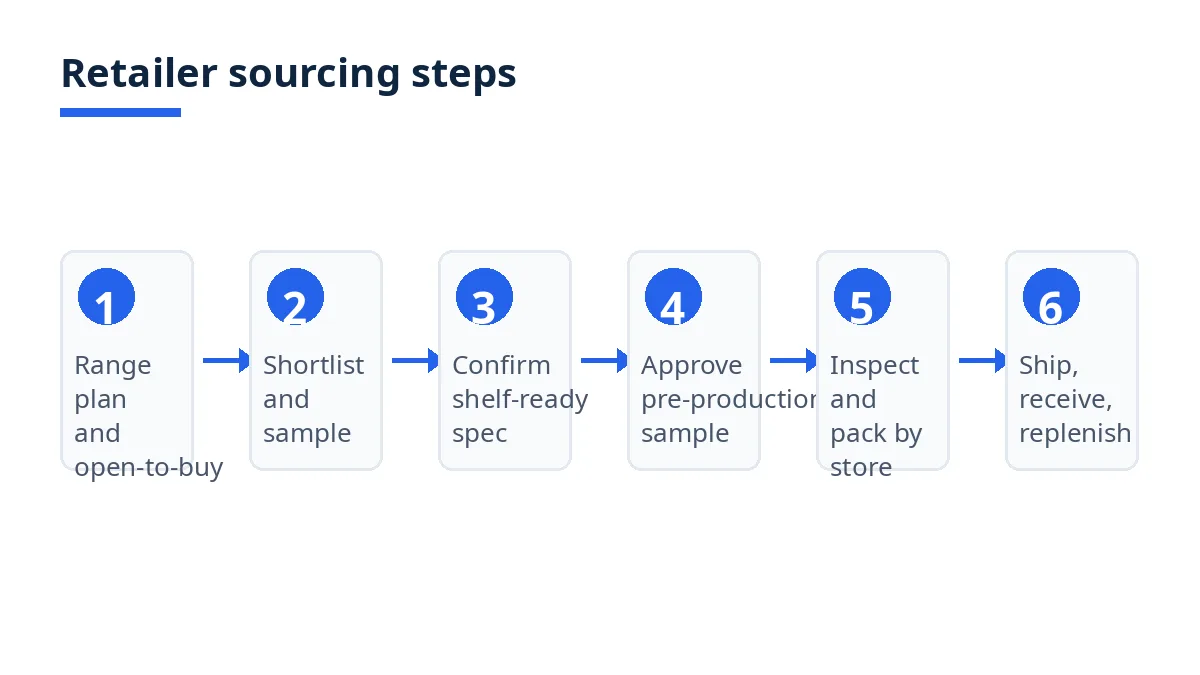
Build the range plan and the open-to-buy for it. List each item, colour and size, the facing it earns, and the launch and replenishment quantity per colour and size. State the seasonal drop dates and the markdown cover you will hold back, so the supplier quotes against a real plan rather than a total.
Shortlist suppliers against the range, not against a catalogue. Ask for the same item in the same construction and colour range from each candidate, and ask which colours are stocked fabric and which are dyed to order. A stocked colour can support a smaller replenishment; a dyed-to-order colour carries a dye-lot minimum.
Confirm the shelf-ready specification in writing. Set the retail pack unit, inner and outer carton counts, barcode placement, ticket and label artwork, care label wording, and store-allocation marking. Send barcode and ticket artwork as files and ask for a scanned proof from a printed sample.
Approve a pre-production sample in the actual fabric, colour, pack and labels. Wash it, measure it after washing, scan the barcode, and check the ticket against the range plan. List corrections in writing and re-approve before bulk production starts.
Inspect by lot and pack by store allocation. Agree the inspection level and acceptance quality limit (AQL) values in the purchase order, following ISO 2859-1, which defines sampling schemes indexed by AQL for lot-by-lot inspection.2 Check shade across the lot, pack by the allocation sheet, and keep one sealed reference sample per colour.
Ship, receive and replenish on the agreed cycle. On arrival, check the shipment against the allocation sheet before breaking cartons, scan a sample of barcodes at the distribution centre, and confirm the repeat trigger: sales level, stock cover, or calendar date. Record shade, pack and barcode results per shipment.
Costs, timelines and documents
What are the typical costs and timelines?
There are no typical costs a guide can state as fact for a retail range, because each supplier prices your fabric, construction, colour count, pack, ticket and label work, carton marking and delivery term separately. The Incoterms 2020 rules set out 11 rules with a clear allocation of cost, risk and obligations,3 so compare quotations only on the same rule and named place.
Cost element | What drives it for a retailer | State in your enquiry |
|---|---|---|
Fabric and dyeing | Construction, weight, colour count, stocked or dyed to order | Fabric spec per item and colour |
Making and finishing | Size range, stitching, hemming, print or embroidery | Size chart and finish per item |
Labels, tickets and barcodes | Label print runs, ticket stock, barcode artwork | Artwork files and ticket type |
Shelf-ready packing | Inner pack unit, carton counts, allocation marking | Pack unit, carton counts, allocation sheet |
Inspection | Lot size, inspection level, AQL values | Inspection level and AQL values in the order |
Freight and delivery term | Incoterm, named place, shipment split | One Incoterm and named place per quotation |
Example figures: a retailer plans a towel range of 4 colours, with a launch shipment of 60 percent of the season quantity and a replenishment shipment of 40 percent, held until early sales are known. If one colour sells at twice the rate of the others, its replenishment quantity rises and the slow colour falls, within the agreed total. The example shows structure only, not a typical quantity, price or lead time.
Sampling depends on fabric availability and correction rounds, and packing by store allocation takes longer than bulk packing. Ask for sampling, production, inspection and packing dates as separate lines, working back from the seasonal drop date.
Which documents are needed?
The retailer document set has two halves: the retail specification set and the export set. The retail set is the range plan, size charts, barcode and ticket artwork, care label artwork, pack specification and store-allocation sheet. The export set is handled at the Bangladesh end, and the retailer should confirm it is complete before shipment.
For export clearance in Bangladesh, goods may not be loaded unless an export declaration, the Bill of Export or Shipping Bill, is submitted to Customs and approved.4 Enclosed documents include the export contract or purchase order where there is no export letter of credit, the commercial invoice, the packing list, the EXP form certified by an authorized dealer, and a certificate of origin issued by the Export Promotion Bureau or a Chamber of Commerce and Industry.4 Keep the packing list matched to the store-allocation sheet so receiving can check cartons against stores without opening every carton.
Bangladesh-specific rules and tips
Classification comes first, because it decides how the range is described on every document. Heading 6302 covers bed linen, table linen, toilet linen and kitchen linen, and subheading 6302.60 covers toilet and kitchen linen of terry towelling or similar terry fabrics, of cotton.5 Treat any heading as indicative and verify it against the tariff of the destination market before confirming the purchase order, because a towel sold as toilet linen and a towel sold as a cleaning cloth can fall under different headings even when the fabric looks similar.
Labelling rules differ by destination, and a retailer selling into several markets needs one label plan per market. In the European Union, Regulation (EU) No 1007/2011 states that a textile product shall be labelled or marked with the name and percentage by weight of all constituent fibres in descending order.6 In the United States, product labels must accurately reflect fibre content, the country of origin, and either the name or registered identification number of the manufacturer or marketer.7 Send the supplier the exact label wording per market, with fibre percentages from a tested sample, and approve a printed label proof before bulk production.
Shade control deserves separate attention. A shelf set fails when the bath towel, hand towel and face cloth in the same colour do not match, or when a replenishment arrives in a different shade. Agree a shade standard per colour, keep a sealed reference sample, and check replenishment lots against it under the same light.
Keep one legal name across every paper: the export declaration names the exporter and the foreign buyer,4 so the name on the quotation, proforma invoice and purchase order should match. Ask which inputs are imported for your range, since an imported input can set the earliest production date and the replenishment lead time.
Mistakes and red flags
What are the most common mistakes?
Ordering on a total quantity instead of a colour and size curve. A range total can look right while one colour is far too deep and another is too shallow to fill its facings. The fix is a curve per item: quantity per colour, per size, per shipment, agreed before quotation.
Approving colour from a photograph. Screen colour shifts with light and device, and a towel colour approved from a photo can arrive a shade away from the shelf set. Approve colour from a physical sample in the actual fabric, kept as the sealed reference.
Approving barcode and ticket artwork without a scan test. A barcode that looks right can still fail to scan if print contrast, quiet zone or size is wrong. Scan a printed sample before bulk packing starts.
Planning one drop for a whole season. A single drop puts the full season of stock risk into one shipment and leaves no budget for replenishment of the colours that sell. Split launch and replenishment at quotation stage, with the trigger written into the purchase order.
Holding no markdown cover. A colour that underperforms still has to leave the shelf before the next seasonal drop arrives. Keep a stated markdown allowance in the open-to-buy, so a slow colour is cleared on plan rather than by an unplanned price cut.
Treating a profile or a badge as a capacity check. Exportain verification is a document review by staff, not a factory inspection, and a badge is not a guarantee of production capacity, product quality or delivery.8 Sample approval, lot inspection and shade control stay with the retailer.
Skipping the replenishment shade check. Check every replenishment lot against the sealed reference sample before it ships, or a different shade can break the shelf set.
Checklist
Before you confirm, every line should be answered in writing.
Range plan set: item, colour and size per facing, launch and replenishment quantity per colour and size.
Open-to-buy split agreed: launch share, replenishment share, markdown cover held back.
Seasonal drop dates fixed, with replenishment trigger stated as a sales level, stock cover or calendar date.
Shelf-ready specification confirmed: retail pack unit, carton counts, barcode placement, ticket and label artwork files sent.
Barcode scanned from a printed sample and ticket position approved.
Label wording per market approved from a printed proof, with fibre percentages from a tested sample.6 7
Pre-production sample washed, measured, scanned and approved in writing, with a sealed reference sample kept per colour.
Inspection level and AQL values in the purchase order.2
Store-allocation sheet agreed and matched to the packing list.
Export set confirmed per shipment: invoice, packing list, EXP form, certificate of origin, Bill of Export.4
Classification checked per item against the destination tariff, with heading 6302 treated as indicative until verified.5
Quotations compared on the same specification, pack and Incoterm.3
How Exportain helps
On Exportain, browse suppliers and post a request for quotation on the RFQ board with your range plan attached: item, colour and size curve, launch and replenishment quantities, shelf-ready pack specification and delivery term, so suppliers quote against the same retail plan. Ask each reply for its stocked and dyed-to-order colours separately, because that split decides which colours can replenish quickly. Read how to buy for the platform steps from search to shipment.
Read the badges for what they record. Exportain Verified means Exportain has checked identity, phone, email and business registration, and Export Verified means it has checked the Export Registration Certificate.8 Factory Verified means it has reviewed photos of the manufacturer factory, while Trading Company Verified means it has reviewed photos of the trading company office or warehouse.8 Verification is a document review by staff, free, and never granted by membership plans, and it is not a factory inspection.8 Sample approval, lot inspection and shade control stay with you.
FAQs
What should I know first about Home Textiles & Towels Sourcing From Bangladesh for Retailers?
Start from the shelf plan, not the factory price. Set the range per item, colour and size, the launch and replenishment split, the shelf-ready pack, and the barcode and label artwork before asking for quotations. Bangladesh home-textile exports reached 231.29 million dollars in July to September 2026, up 11.94 percent year on year, according to Export Promotion Bureau figures reported by TEXtalks.1
What are the typical costs and timelines?
There are no typical figures a buyer can rely on, because each supplier prices your fabric, construction, colour count, pack, ticket and label work and delivery term separately. Compare quotations only on the same specification, pack and Incoterm, since the Incoterms 2020 rules allocate cost, risk and obligations differently for each rule.3 Ask for sampling, production, inspection and packing dates as separate lines, working back from the seasonal drop date.
Which documents are needed?
The retail set is the range plan, size charts, barcode and ticket artwork, care label artwork, pack specification and store-allocation sheet. The export set is the Bill of Export, commercial invoice, packing list, EXP form certified by an authorized dealer, and a certificate of origin issued by the Export Promotion Bureau or a Chamber of Commerce and Industry.4 Keep the packing list matched to the allocation sheet.
What are the most common mistakes?
The most common mistakes are ordering on a total quantity instead of a colour and size curve, approving colour from a photograph, approving barcodes without a scan test, planning one drop for a whole season, holding no markdown cover, and reading a badge as a guarantee of capacity or delivery.8 Each one is fixed at specification stage, before fabric is dyed.
Next steps on Exportain
Browse suppliers, then post your range plan, colour and size curve, shelf-ready pack specification and delivery term on the RFQ board so suppliers quote against the same retail plan. Before you confirm, read the home textiles sourcing guide and the bath towels quality control checklist.
Sources
- Bangladesh's September exports rise 8.54%, but garment recovery remains uneven. TEXtalks (accessed )
- ISO 2859-1:2026 - Sampling procedures for inspection by attributes — Part 1: Sampling schemes indexed by acceptance quality limit (AQL) for lot-by-lot inspection. ISO (accessed )
- Incoterms® 2020. International Chamber of Commerce (ICC) (accessed )
- Customs Clearance Procedures for Export. Bangladesh Customs, National Board of Revenue (accessed )
- HS 2017 - Code 6302: Bed linen, table linen, toilet linen and kitchen linen. United Nations Statistics Division (accessed )
- Regulation (EU) No 1007/2011 on textile fibre names and related labelling and marking of the fibre composition of textile products. European Union, (accessed )
- Cachet of Cashmere: Complying with the Wool Products Labeling Act. Federal Trade Commission (accessed )
- Trust & Safety Center. Exportain (accessed )
About the author
Sourcing from Bangladesh?
Post a request for quotation and suppliers on Exportain can send you their quotes directly.
Post an RFQ