

Home Textiles & Towels Sourcing From Bangladesh for Government and Tender Buyers
Tender-first sourcing of home textiles and towels from Bangladesh: measurable specifications, lot and delivery structure, sample approval, inspection terms and the documents a government or tender buyer needs.
Short answer
A government or tender buyer should buy home textiles from Bangladesh against a written tender document, not a catalogue: a measurable specification per item, lots split by delivery site, a recorded sample approval, and inspection and replacement terms fixed in the contract before production starts.
On this page
Key takeaways
A tender buyer buys against a written tender document: a measurable specification per item, lots split by delivery site, a recorded sample approval, and inspection and replacement terms fixed in the contract.
Heading 6302 covers bed, table, toilet and kitchen linen; state the subheading per item so bidders price the same goods and customs sees the same description on every paper.
Bangladesh e-GP runs public tenders through an electronic portal, and a 2025 amendment ordinance made its use mandatory for all public procurement.
Inspection is agreed before production: inspection level, AQL values per defect class, place of inspection, and rejection, replacement and re-inspection rules in the contract.
Exportain verification is a document and photo review, not a factory inspection, and a badge is not a guarantee of capacity, quality or delivery.
A government or tender buyer does not buy home textiles like a shop buyer. The tender document is specification, evaluation sheet and audit record combined, and the supplier who wins is the one whose goods match that document lot by lot, delivery point by delivery point. The work that decides the outcome happens before any price is compared: the specification is written in measurable terms, the lots are structured so small and large suppliers can both bid fairly, and the inspection and replacement terms are fixed before the contract is signed.
In the Harmonized System, heading 6302 covers bed, table, toilet and kitchen linen.1 Terry towelling of cotton for toilet and kitchen linen sits under subheading 630260, while cotton bed linen sits under its own subheadings, printed or not.1 Bangladesh Bank recorded home textiles export receipts of USD 453.8 million in 2024-25, with terry towel at USD 18.7 million.2 Home textile exports reported to the Export Promotion Bureau grew 7.85 percent year on year in the July to December period to USD 410.81 million.3 The range behind those figures is wide, from towels and bed linen to curtains, table linen and furnishing fabric.3 A tender buyer should therefore name the exact item, not the category, in every line of the tender.
Why this matters for buyers and sellers
For the buyer, the risk in a tender purchase is not only a bad towel. It is a failed audit: goods accepted without a written specification, a sample approved verbally, or an inspection skipped for a tight delivery date. Each gap becomes a finding when public money is involved, and each is avoidable if the tender file already contains the specification, the sample record and the inspection result for every lot.
For the seller, a tender order differs from a commercial order in its paper trail. A towel acceptable to a retailer on a visual check still needs a tender buyer to show why it was accepted: fibre composition on the label, size after washing, colour against the approved sample, and count per carton per delivery point. A supplier who quotes without reading those requirements prices the goods but misses the testing, packing and documentation the tender requires. Delivery structure is the third difference: hospital linen, hostel bedding, barracks towels and guest-house table linen go to several sites on different dates, each signing its own receipt. A tender stating one total quantity and one delivery address attracts a price for a job the buyer does not need, while lots listed by site and date let suppliers price the real work.
Step-by-step: how it works
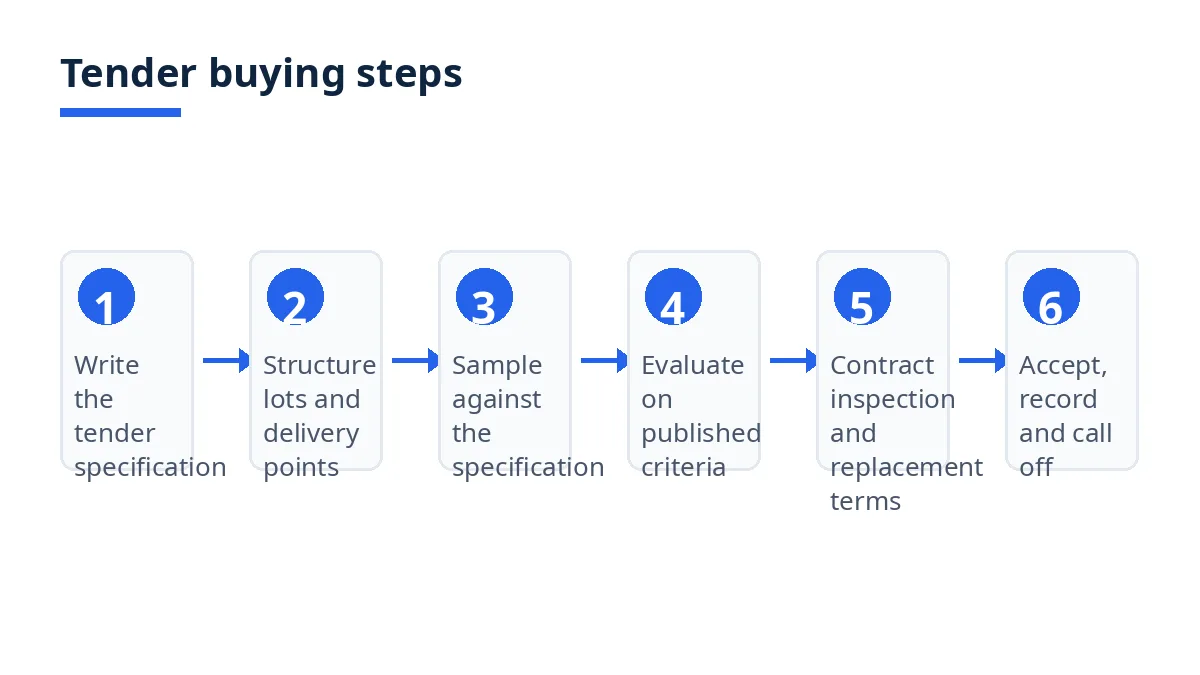
Write the tender specification in measurable terms. For each item, state fibre composition, construction, weight, finished size, colour with a named reference, wash and care requirements, and test methods for properties you will check. Name the packing unit, the carton count and the marking per carton. A specification that says "good quality cotton towel" cannot be evaluated; one that gives fibre, weight and finished size can.
Structure lots and delivery points. Split the tender by item and delivery site, state whether a bidder may bid for one, several or all lots, and give the delivery date or window and part-delivery rule per lot. Lot structure lets a smaller mill bid for the towel lot while a larger mill bids for the full range.
Shortlist suppliers against the specification, not against a catalogue. Ask each candidate for the same item in the same construction and colour, and which colours and constructions are stocked or dyed or woven to order. A stocked item can support a shorter timetable; a dyed-to-order colour carries a dye-lot minimum that may exceed one lot.
Approve a sample against the tender file, not against a photograph. Order a sample in the actual fabric, colour, size and finish, wash it, measure it after washing, and record the approval with date and approver. Keep one sealed reference sample per item; every later lot is checked against it.
Evaluate on the published criteria. Score price, specification compliance, sample result, delivery plan and past performance in the proportions the tender document states, and record the score for each bidder.
Contract the inspection and replacement terms before production. Write the inspection level, acceptance quality limit values, place of inspection, and rejection, replacement and re-inspection rules into the contract, including who pays for re-inspection and the replacement deadline.
Accept, record and call off. On delivery, check count, size, colour and labelling against the reference sample at each site, sign a receipt per lot, and file the inspection result with the delivery note. Under a framework contract, each call-off repeats the same acceptance check.
Example figures: a tender for 10,000 bath towels split across five delivery points is five lots of 2,000, not one lot of 10,000. If one site rejects 200 towels for size after washing, the replacement obligation is 200 towels to that site. The example shows structure only, not a typical quantity, price or lead time.
Costs, timelines and documents
What are the typical costs and timelines?
There are no typical costs or timelines a guide can state as fact for a tender purchase, because each supplier prices your fabric, construction, colour count, lot structure, packing, testing, inspection and delivery term separately. The Incoterms 2020 rules allocate cost, risk and obligations across 11 rules,4 so compare quotations only on the same rule and named place.
Cost element | What drives it for a tender buyer | State in your tender |
|---|---|---|
Fabric and dyeing | Construction, weight, colour count, stocked or dyed to order | Fabric spec per item, colour and lot |
Making and finishing | Size range, hemming, print or embroidery | Size chart and finish per item |
Testing | Properties named in the specification, lab reports per lot | Test methods per lot |
Packing and marking | Pack unit, carton counts, marking per delivery point | Pack unit, carton counts, marking sheet |
Inspection | Lot size, inspection level, AQL values | Inspection level and AQL values in the contract |
Delivery | Lots, sites, dates, Incoterm and named place | One Incoterm and named place per lot |
For timelines, sampling depends on fabric availability and correction rounds, and bulk production on dyeing, finishing and line capacity, so ask for sampling, fabric ready, production, inspection and per-site delivery dates as separate lines, leaving room for evaluation, sample approval and contract signature before production starts.
Which documents are needed?
A tender purchase carries two document sets: the tender dossier and the export set. The tender dossier is the invitation, the specification, the lot and delivery schedule, the evaluation criteria, the sample record, the bid form with prices per lot, and the contract with inspection and replacement terms. Keep the whole file together: it is the audit trail. The export set is the same as for any shipment from Bangladesh: goods may not be loaded unless an export declaration, the Bill of Export or Shipping Bill, is submitted to Customs and approved.5 Enclosed documents include the export contract or purchase order where there is no export letter of credit, the commercial invoice, the packing list, the EXP form certified by an authorized dealer, and a certificate of origin issued by the Export Promotion Bureau or a Chamber of Commerce and Industry.5 Buyer name, item description and quantity on the export papers should match the tender award exactly, so delivery receipt, invoice and tender file agree.
Bangladesh-specific rules and tips
Understand the procurement system when the buying body is in Bangladesh. Bangladesh introduced electronic government procurement through the e-GP system, its portal inaugurated on June 2, 2011.6 The Bangladesh Public Procurement Authority, formerly the Central Procurement Technical Unit, manages it, and the Financial Express reported 1,464 government procuring agencies and more than 114,000 registered tenderers using it.6 Under section 65(1) of the Public Procurement Act 2006, the e-GP system was introduced.6 A 2025 amendment ordinance then made use of the e-GP portal mandatory for all public procurement and withdrew the price range cap for bids introduced in 2016.7 If you are supplying a Bangladesh government body, expect the tender to run through that system with the file kept electronically. If you are a foreign institution buying from Bangladesh, your own procurement rules govern the tender; this section concerns supply and export clearance.
Classify by subheading, not by trade name. Heading 6302 covers bed, table, toilet and kitchen linen, but the subheading changes with the item, the fibre and whether it is printed.1 Terry towelling of cotton for toilet and kitchen linen is 630260, while cotton bed linen sits under 630221 when printed and 630231 when not printed.1 State the subheading per item so bidders price the same goods and customs sees the same description on every paper. See the HS code for bath towels guide and the home textiles sourcing guide.
Write labelling into the specification. If the goods will be sold or used in the European Union, Regulation (EU) No 1007/2011 states that a textile product shall be labelled or marked with the name and percentage by weight of all constituent fibres in descending order.8 For institutional stock that will be laundered commercially, add care labelling and a durable size label, because a label that washes out in the first industrial laundry cycle fails the buyer even when the towel survives.
Fix the inspection plan before production, not at the dock. ISO 2859-1 defines a system of acceptance sampling plans for inspection by attributes, indexed by acceptance quality limit (AQL).9 The AQL is the worst tolerable process average when a continuing series of lots is submitted for acceptance sampling, not a promise that every accepted lot sits below that level.9 Name the inspection level and AQL values per defect class in the contract, and state whether inspection happens at the factory, port or delivery site. See the bath towels quality control checklist for towel, hem and absorbency points, and the best Incoterm for importing home textiles from Bangladesh before fixing the delivery term.
Mistakes and red flags
What are the most common mistakes?
Writing a brand-style specification for a tender. "Premium hotel quality" cannot be scored. Measurable properties can: fibre, weight, size, colour reference, wash performance and packing unit.
Publishing one total quantity for many delivery points. Suppliers price one delivery; the buyer then pays again for splitting and redelivery, or accepts a single delivery that sites cannot store.
Approving a sample without a written record. A sample approved by phone call cannot be produced in an audit. Record the sample, date, approver and corrections in the tender file.
Leaving inspection out of the contract. If inspection level, AQL values and replacement rules are not in the contract, they are negotiated after the goods arrive, when the buyer has no leverage.
Comparing bids on different delivery terms. A lower ex-works price and a higher price delivered to five sites are different offers. Compare only bids on the same Incoterm and delivery points.4
Treating a profile or a badge as tender compliance. A profile is a starting point. It does not prove a supplier can meet a tender specification, and a badge is not a guarantee of capacity, quality or delivery.10 Compliance is proven by the sample, test reports and inspection result, filed lot by lot.
Checklist
Before publishing, every line should be answered in writing.
Each item: fibre, construction, weight, size, colour reference, packing unit.
Lots by item and site, with dates and part-delivery rules.
Evaluation criteria published in the tender document, with scoring fixed before opening.
Sample procedure stated: sample in actual fabric and finish, washed, measured, approval recorded.
Inspection level and AQL values per defect class in the contract.
Rejection, replacement and re-inspection rules agreed before production.
Delivery term fixed: one Incoterm and named place per lot.4
Labelling specified: fibre composition in descending order where required,8 plus care and size labels for institutional laundry.
Export set agreed: invoice, packing list, EXP form, certificate of origin, Bill of Export.5
Tender file complete: invitation, specification, bids, scores, sample record, award, contract, receipts.
How Exportain helps
On Exportain, browse suppliers and post a request for quotation on the RFQ board with your specification summary, lot structure, delivery points and inspection terms, so suppliers quote against the same document. Read the how to buy page before you post.
Read badges for what they record. Exportain Verified means Exportain has checked identity, phone, email and business registration, and Export Verified means it has checked the Export Registration Certificate.11 Factory Verified means it has reviewed photos of the manufacturer factory, while Trading Company Verified means it has reviewed photos of the trading company office or warehouse.11 Verification is a document review by staff, not a factory inspection.10 11 For a tender, the badge shortlists candidates; the sample, test reports and lot inspection decide the award.
FAQs
What should I know first about Home Textiles & Towels Sourcing From Bangladesh for Government and Tender Buyers?
Start from the tender document, not from a catalogue. Home textiles here means the institutional range under heading 6302, bed, table, toilet and kitchen linen,1 bought in lots by delivery site against a measurable specification. Bangladesh home textiles export receipts were USD 453.8 million in 2024-25,2 but depth of supply does not remove the need for a written specification, a recorded sample and a lot inspection plan.
What are the typical costs and timelines?
No typical figures can be relied on, because each supplier prices your fabric, construction, colour count, lot structure, testing, inspection and delivery term separately. The Incoterms 2020 rules allocate cost, risk and obligations for each rule,4 so compare bids only on the same rule and named place. Timelines depend on fabric availability, correction rounds, dyeing, finishing and line capacity, plus evaluation and approval before production.
Which documents are needed?
The tender dossier is the invitation, specification, lot and delivery schedule, evaluation criteria, sample record, bid forms priced per lot, and the contract with inspection and replacement terms. The export set is the Bill of Export, invoice, packing list, EXP form certified by an authorized dealer, and certificate of origin from the Export Promotion Bureau or a Chamber of Commerce and Industry.5
What are the most common mistakes?
Writing an unmeasurable specification, publishing one total quantity for many delivery points, approving a sample without a written record, leaving inspection out of the contract, and comparing bids on different delivery terms.4 Each is cheap to prevent in the tender document and expensive to fix after delivery.
Next steps on Exportain
Browse suppliers, then post your specification summary, lot structure and delivery points on the RFQ board so suppliers quote against the same document. Before you publish, read the home textiles sourcing guide and how to import bath towels from Bangladesh.
Sources
- HS 2017 - Code 6302: Bed linen, table linen, toilet linen and kitchen linen. United Nations Statistics Division (accessed )
- Annual Export Receipts of Goods and Services 2024-25. Bangladesh Bank (accessed )
- Home textile exports bounce back. The Daily Star (accessed )
- Incoterms® 2020. International Chamber of Commerce (ICC) (accessed )
- Customs Clearance Procedures for Export. Bangladesh Customs, National Board of Revenue (accessed )
- e-GP promises a complete procurement system. Financial Express (accessed )
- Procurement law revised to cut graft, boost transparency. The Daily Star (accessed )
- Regulation (EU) No 1007/2011 on textile fibre names and related labelling and marking of the fibre composition of textile products. European Union, (accessed )
- ISO 2859-1:2026 - Sampling procedures for inspection by attributes — Part 1: Sampling schemes indexed by acceptance quality limit (AQL) for lot-by-lot inspection. ISO (accessed )
- Trust & Safety Center. Exportain (accessed )
- Supplier verification: Earn trust badges buyers can see. Exportain (accessed )
- export documents
- supplier verification
- buyer guide
- Bangladesh sourcing
- Bed linen
- home textiles
- Bath towels
About the author
Sourcing from Bangladesh?
Post a request for quotation and suppliers on Exportain can send you their quotes directly.
Post an RFQ


