

Home Textiles for E-Commerce Brands: Sourcing From Bangladesh
For e-commerce brands buying home textiles and towels from Bangladesh: how to build a variant matrix, confirm listing-ready packing and labels, launch small, and replenish without a shade or pack surprise.
Short answer
For an e-commerce brand, sourcing home textiles from Bangladesh starts with the listing, not the total quantity. Build a variant matrix of item, colour, size and pack unit, confirm which colours are stocked and which are dyed to order, approve a listing-ready sample in the actual pack and labels, launch in a small batch, and replenish only the variants that sell, on terms agreed in writing.
On this page
Key takeaways
Build the variant matrix first: each colour and size needs stock, a photograph and a barcode, and a dyed-to-order colour carries a dye-lot minimum a small launch may not meet.
Approve a listing-ready sample in the actual fabric, colour, pack and labels, washed and photographed under listing lighting, before bulk production starts.
Confirm the retail pack unit, barcode placement and care label wording per destination market in writing; a label printed for one market rarely satisfies another.
Launch small and replenish only the variants that sell, on a trigger agreed at quotation stage, keeping one sealed reference sample per colour.
Exportain verification is a document and photo review, not a factory inspection, and a badge is not a guarantee.
An e-commerce brand buying home textiles from Bangladesh buys for a listing page, not for a shop floor. The customer cannot touch the towel, unfold the sheet set, or check the hem before paying, so the photograph, the variant list, the care label and the parcel that arrives have to agree with each other. A good factory price on a towel that photographs grey, arrives in the wrong pack size, or carries a label that does not match the listing will cost more in returns and complaints than it saved in unit cost.
In the Harmonized System, heading 6302 covers bed linen, table linen, toilet linen and kitchen linen.1 That heading is the starting point for classification, but it does not settle the buying decisions that matter online: which variants to list, how many colours to carry, what the pack contains, and how a small first batch can be replenished without a second dye lot changing the shade.
Why this matters for buyers and sellers
For an e-commerce brand, the listing is the product description, the size guide and the quality promise in one place. A sheet set listed in four colours and three bed sizes is twelve variants, and each variant needs its own stock, photograph and barcode. If one colour sells out while the others sit, the listing still looks live while the customer sees a gap. Plan the variant matrix before you ask for a price, because the matrix sets the quantity per colour and per size, and that split decides whether a factory can run the order at all.
For the seller, an e-commerce order differs from a bulk order in its handling. Parcels go to individual customers or to a fulfilment centre, not to one warehouse dock. Each retail unit needs its own pack, label and barcode, and cartons need to be marked by variant rather than by bulk count. That work is done at the factory and has to be specified line by line, or the brand pays a fulfilment centre to repack goods it already paid to pack.
Replenishment is the third difference. Home textiles sell steadily rather than in one peak, so a brand needs a predictable repeat: the same fabric, colour standard and pack, on a known trigger. Agree that trigger in writing at quotation stage, whether it is a stock-cover level, a sales threshold, or a calendar date, because dye lots, label print runs and carton counts are set per shipment.
Step-by-step: how it works
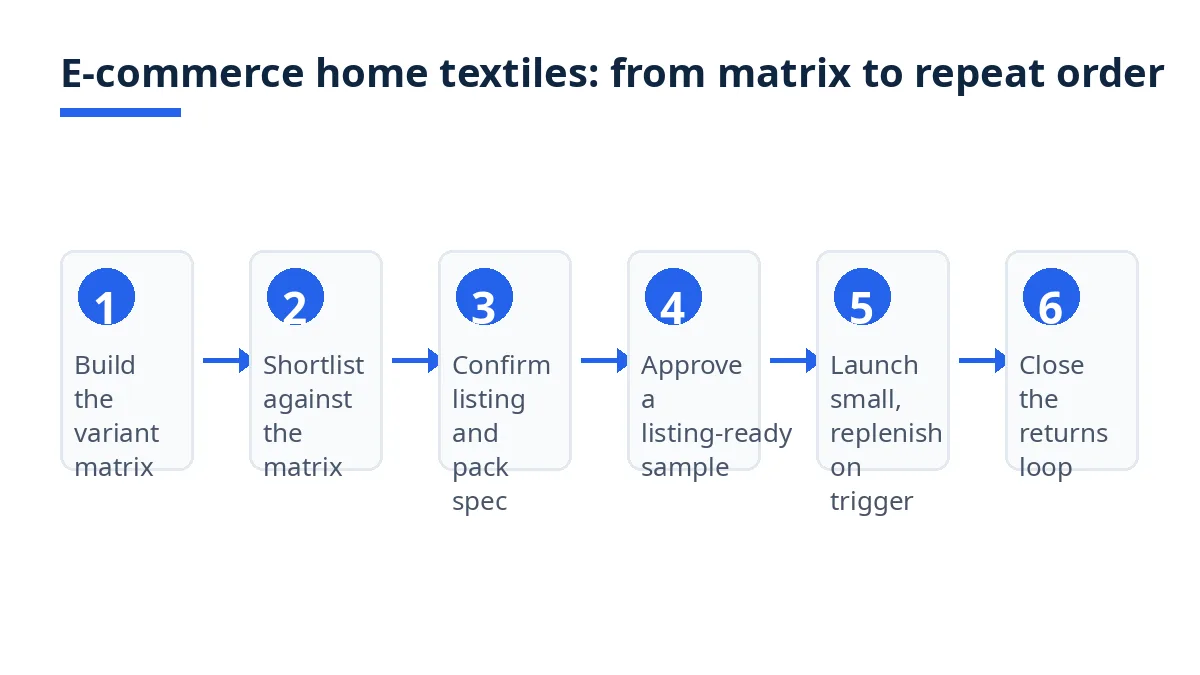
Build the variant matrix first. List each item, colour and size, the pack unit for each variant, and the launch quantity and replenishment quantity per variant. State which variants are essential at launch and which can follow, so the supplier quotes against a real plan rather than a total.
Shortlist suppliers against the matrix, not against a catalogue. Ask for the same item in the same construction and colour range from each candidate, and ask which colours are stocked fabric and which are dyed to order. A stocked colour can support a smaller replenishment; a dyed-to-order colour carries a dye-lot minimum.
Confirm the listing and pack specification in writing. Set the retail pack unit, inner and outer carton counts, barcode placement, care label wording, and the photographs you need: flat product, folded pack, scale reference, and care label close-up. Send barcode and label artwork as files and ask for a scanned proof from a printed sample.
Approve a listing-ready sample in the actual fabric, colour, pack and labels. Wash it, measure it after washing, photograph it under your listing lighting, and scan the barcode. List corrections in writing and re-approve before bulk production starts, because the sample photograph often becomes the listing photograph.
Launch small, then replenish on the agreed trigger. Ship the launch batch, watch which variants sell and which draw returns, and confirm the repeat only for the variants that earned it. Keep one sealed reference sample per colour so the repeat can be checked against the launch batch, not against a photograph.
Close the returns loop before the next order. Record the reason for each return, separate quality faults from wrong-variant and wrong-size deliveries, and put the fix into the next purchase order: a corrected size chart, a clearer pack label, or a tighter inspection point.
Costs, timelines and documents
What are the typical costs and timelines?
There are no typical costs or timelines a guide can state as fact for an e-commerce range, because each supplier prices your fabric, construction, colour count, pack, label work, carton marking and delivery term separately. The Incoterms 2020 rules set out 11 rules with a clear allocation of cost, risk and obligations,2 so compare quotations only on the same rule and named place.
Cost element | What drives it for an e-commerce brand | State in your enquiry |
|---|---|---|
Fabric and dyeing | Construction, weight, colour count, stocked or dyed to order | Fabric spec per item and colour |
Making and finishing | Size range, stitching, hemming, print or embroidery | Size chart and finish per item |
Labels and barcodes | Label print runs, barcode artwork, care label wording | Artwork files and label spec |
E-commerce packing | Retail pack unit, polybag, carton counts, variant marking | Pack unit, carton counts, marking sheet |
Listing photography | Sample photography, reshoots, variant shots | Shot list and lighting reference |
Inspection | Lot size, inspection level, AQL values | Inspection level and AQL values in the order |
Freight and delivery term | Incoterm, named place, shipment split | One Incoterm and named place per quotation |
For timelines, sampling depends on fabric availability and correction rounds, and bulk production on dyeing, finishing, trim delivery and line capacity. Ask for sampling, fabric ready, production and inspection dates as separate lines, not a single delivery week. A small launch batch does not shorten dyeing or finishing; it only reduces the quantity that waits for them.
Which documents are needed?
For export clearance in Bangladesh, goods may not be loaded unless an export declaration, the Bill of Export or Shipping Bill, is submitted to Customs and approved.3 Enclosed documents include the export contract or purchase order where there is no export letter of credit, the commercial invoice, the packing list, the EXP form certified by an authorized dealer, and a certificate of origin issued by the EPB or a Chamber of Commerce and Industry.3
Your order documents are separate from the export set: the variant matrix, itemized quotation, purchase order with the inspection plan, and the approved sample record with photographs. Keep the name on the trade licence, quotation, proforma invoice and payment account consistent, because the export declaration names the exporter and the foreign buyer.3
Bangladesh-specific rules and tips
Classify by heading 6302, then check the subheading per item. Heading 6302 covers bed linen, table linen, toilet linen and kitchen linen,1 and its subheadings separate bed linen, table linen, and terry towelling and other toilet and kitchen linen by material and construction. A towel, a sheet set and a tablecloth can sit under different subheadings, so confirm the code per item with your customs broker before you price the landed cost.
Write labels for each destination market, not one label for all of them. For the European Union, Regulation (EU) No 1007/2011 states that a textile product shall be labelled or marked with the name and percentage by weight of all constituent fibres in descending order.4 For wool-containing items sold in the United States, the Federal Trade Commission states that the label must state the country of origin and the identity, either name or registered identification number, of the manufacturer or other business responsible for marketing the item, and the fibre content.5 Check the current rule for each destination before printing, because a label printed for one market rarely satisfies another.
Read a certificate for what it actually covers. OEKO-TEX STANDARD 100 is a label for textiles tested for harmful substances, and every item bearing the label is certified as having passed safety tests for the presence of harmful substances.6 Its product classes separate direct skin-contact items such as bed linens from home textiles and decoration materials such as curtains,6 so check that the certified article list includes your item and its product class, and that the certificate validity covers your delivery window. A certificate for a similar fabric is not a certificate for your product.
Agree inspection in the purchase order, not at the warehouse door. ISO 2859-1 defines acceptance quality limit (AQL) as the quality level that is the worst tolerable process average when a continuing series of lots is submitted for acceptance sampling.7 Set the inspection level and the AQL values per defect type in writing, and check shade, size after washing, and pack accuracy in the same inspection, because a shade fault found after listing photographs are taken costs a reshoot as well as a remake.
Keep one legal name across every paper. The export declaration names the exporter and the foreign buyer,3 so the name on the trade licence, quotation, proforma invoice and payment account should match. A mismatch discovered at clearance delays the shipment that your listing already promises.
Mistakes and red flags
What are the most common mistakes?
Photographing the sample and shipping a different bulk. The listing photograph should be taken from the approved bulk sample, or re-taken from bulk production, not reused from an earlier proto sample in a different shade or finish.
Listing variants you cannot replenish. A colour that sells well in launch but cannot be repeated at a small quantity, because it was dyed to order in a large lot, will go out of stock and leave the listing half empty. Confirm the replenishment minimum per colour before launch.
Treating the pack as an afterthought. A towel set packed as a bulk dozen cannot be listed as a single retail unit without repacking. Confirm the retail pack unit, polybag, label and barcode before production, not after the cartons arrive.
Comparing quotations on different delivery terms. A lower unit price on a different Incoterm or named place is a different offer. The Incoterms 2020 rules allocate cost, risk and obligations for each rule,2 so compare only replies to the same matrix on the same term.
Reading a profile or a badge as a guarantee. A profile is a starting point for enquiries. A badge is not a guarantee of production capacity, product quality or delivery.8
Skipping the returns review. Returns data is the cheapest product research an e-commerce brand owns. A repeat order placed without reading it repeats the fault that caused the returns.
Checklist
Before you confirm, every line should be answered in writing.
Variant matrix sent: item, colour, size, pack unit, launch and replenishment quantity per variant.
Fabric status per colour recorded: stocked or dyed to order, with the replenishment minimum per colour.
Listing and pack specification confirmed: pack unit, polybag, barcode placement, care label wording, shot list.
Listing-ready sample washed, measured, photographed and approved in writing.
Inspection level and AQL values in the purchase order.7
Quotations compared on the same matrix and Incoterm.2
Labels checked per destination market: fibre content, origin and responsible business.4 5
Certificate scope checked: certified article, product class and validity window.6
Export set agreed: invoice, packing list, EXP form, certificate of origin, Bill of Export.3
Returns review scheduled before the repeat order, with the fix written into the next purchase order.
How Exportain helps
On Exportain, browse suppliers and post a request for quotation (RFQ) on the RFQ board with your variant matrix, pack specification and delivery term, so suppliers quote against the same listing plan. When you accept a quotation, Exportain creates one order and issues one proforma invoice from the accepted terms.8
Read the badges for what they record. Exportain Verified means Exportain has checked identity, phone, email and business registration, and Export Verified means it has checked the Export Registration Certificate (ERC).8 Factory Verified means it has reviewed photos of the manufacturer factory, while Trading Company Verified means it has reviewed photos of the trading company office or warehouse.8 Verification is a document review by staff, free, and never granted by membership plans.9 It is not a factory inspection,8 9 so sample approval and inspection stay with you. See the home textiles sourcing guide for the general sourcing sequence, and the retailers home textiles guide to compare how a store range plan differs from a listing plan.
FAQs
What should I know first about Home Textiles & Towels Sourcing From Bangladesh for E-Commerce Brands?
Know your variant matrix before you ask for a price. The listing, not the total quantity, decides whether the order can run: each colour and size needs stock, a photograph and a barcode, and a dyed-to-order colour carries a dye-lot minimum that a small launch quantity may not meet. Heading 6302 covers bed linen, table linen, toilet linen and kitchen linen,1 but the buying work is the matrix, the pack and the replenishment plan.
What are the typical costs and timelines?
There are no typical figures a buyer can rely on, because each supplier sets its price, minimum and lead time for your matrix. Fabric, construction, colour count, pack and label work, inspection and the delivery term drive the price,2 and sampling, dyeing, finishing and line capacity drive the timeline. Ask for sampling, fabric ready, production and inspection dates as separate lines.
Which documents are needed?
The order documents are the variant matrix, itemized quotation and purchase order, with the inspection plan and the approved sample record attached. The export set is the Bill of Export, commercial invoice, packing list, EXP form certified by an authorized dealer, and a certificate of origin issued by the EPB or a Chamber of Commerce and Industry.3
What are the most common mistakes?
The most common mistakes are photographing a sample and shipping a different bulk, listing variants that cannot be replenished, treating the pack as an afterthought, comparing quotations on different delivery terms,2 and reading a badge as a guarantee. A badge is not a guarantee of production capacity, product quality or delivery.8
Next steps on Exportain
Browse suppliers, then post your variant matrix, pack specification and delivery term on the RFQ board so suppliers state their minimum per colour and their replenishment terms. Before you confirm, read how to buy and the home textiles sourcing guide.
Sources
- HS 2017 - Code 6302: Bed linen, table linen, toilet linen and kitchen linen. United Nations Statistics Division (accessed )
- Incoterms® 2020. International Chamber of Commerce (ICC) (accessed )
- Customs Clearance Procedures for Export. Bangladesh Customs, National Board of Revenue (accessed )
- Regulation (EU) No 1007/2011 on textile fibre names and related labelling and marking of the fibre composition of textile products. European Union, (accessed )
- Cachet of Cashmere: Complying with the Wool Products Labeling Act. Federal Trade Commission (accessed )
- OEKO-TEX Standard 100. OEKO-TEX (accessed )
- SIST ISO 2859-1:2003 - Sampling procedures for inspection by attributes, Part 1: Sampling schemes indexed by acceptance quality limit (AQL). International Organization for Standardization, (accessed )
- Trust & Safety Center. Exportain (accessed )
- Supplier verification: Earn trust badges buyers can see. Exportain (accessed )
About the author
Sourcing from Bangladesh?
Post a request for quotation and suppliers on Exportain can send you their quotes directly.
Post an RFQ


