

Government & Tender Frozen Seafood Sourcing From Bangladesh: Tender Files, Compliance and Audit-Ready Supply
Government and tender buyers sourcing frozen seafood from Bangladesh: tender specifications, framework quantities, cold chain at minus 18 C and the documents to file for audit.
Short answer
For government and tender buyers, frozen seafood from Bangladesh works when the tender fixes species, form, size grade, glaze basis and pack size, requires market approval and a full-journey temperature record at minus 18 degrees Celsius or lower, states the framework quantity and named institutions, and files every call-off delivery against the tender specification for audit.
On this page
Key takeaways
Write the tender as a bid-comparison document: one line per product with species, form, size grade, freezing method, glaze basis and pack size, so bids can be compared on the same product and the same weight basis.
State market approval and cold-chain evidence as tender conditions: the plant on the applicable establishment list for the destination, and a full-journey temperature record at minus 18 degrees Celsius or lower with a written receiving threshold.
For a framework arrangement, name the beneficiary institutions and state the maximum total quantity in the tender documents from the outset, since a reference to usual requirements is not clear enough for transparency.
Require separate bid lines for price and weight basis, freight and insurance, cold storage and inspection charges, and separate dates for sampling, shipment and arrival, rather than accepting a single price and a single date.
File every call-off order, delivery note, temperature record and receiving check against the tender specification, since a delivery that cannot be matched to a call-off order is a gap in the audit file.
A government or tender buyer does not buy frozen seafood the way a shop or a restaurant buys it. The purchase has to survive a file review long after the fish has been eaten: a tender notice, an evaluation sheet, a signed contract, delivery notes, temperature records and an audit trail that ties every carton back to the published specification. For government and tender buyers, frozen seafood from Bangladesh works when the tender is written so that every bidder quotes the same product, on the same weight basis, against the same delivery and inspection rules, and every delivery can be checked against that tender without a new negotiation.
Why tender buying changes frozen seafood sourcing
A tender buyer is buying for institutions that cannot simply change the menu when a delivery is short or a grade changes. A public hospital, a school feeding programme, a residential institution or a catering service for a public body may serve the same dish to a fixed number of people on a fixed day, so a short delivery or a different size grade is a service failure, not a menu adjustment. That is why the specification, rather than the supplier relationship, has to carry the order.
For the seller, a tender account is different from a retail or wholesale account. The supplier bids against a written document, and the bid is judged on responsiveness to it. A bid that leaves the glaze basis, the pack size or the delivery term unclear can be set aside as non-responsive even if the price looks attractive, because the evaluator cannot compare it with other bids on the same basis.
For the buyer, the discipline pays off in the audit. When the full specification is fixed in the tender, the receiving team has a document to check against, the finance team has a price basis to pay against, and the auditor has a chain from tender notice to delivery note. When any point is left vague, each delivery becomes a judgment call, and judgment calls are where tender files fail.
What should I know first about Frozen Seafood & Fish Sourcing From Bangladesh for Government and Tender Buyers?
Know the product form before you draft the tender. Shrimp and prawns are traded head-on shell-on, headless shell-on, peeled and deveined, and peeled deveined tail-on, and fish is traded whole, as fillets and as portions. Each form changes the edible yield and the cost per portion, so two bids for shrimp are not comparable until form, size grade and glaze basis match. State species, form, size grade, freezing method, glaze basis and pack size in the tender, and require bidders to quote against those lines rather than against a species name.
Know the market rules for your destination before you publish the tender. In the European Union, quick-frozen foodstuffs are held at minus 18 degrees Celsius or lower after thermal stabilisation, and labelling for restaurants, hospitals and canteens must include the date of minimum durability, the storage period, the storage temperature and the storage equipment required.1 The European Commission publishes lists of authorised establishments for food of animal origin from outside the EU, with fishery products under Section VIII.2 Put the applicable establishment listing and the health certificate requirement into the tender as eligibility and delivery conditions, not as questions to settle after award.
For the United States, the importer verification rule for fish and fishery products requires the importer either to source from a country with an active memorandum of understanding covering the product, or to run written verification procedures covering product specifications and affirmative steps such as obtaining the processor's HACCP and sanitation records for the lot, or a certificate from a foreign government inspection authority or a competent third party.3 State in the tender who holds that verification file for each lot and what records the supplier must hand over with each delivery.
Step-by-step: how it works
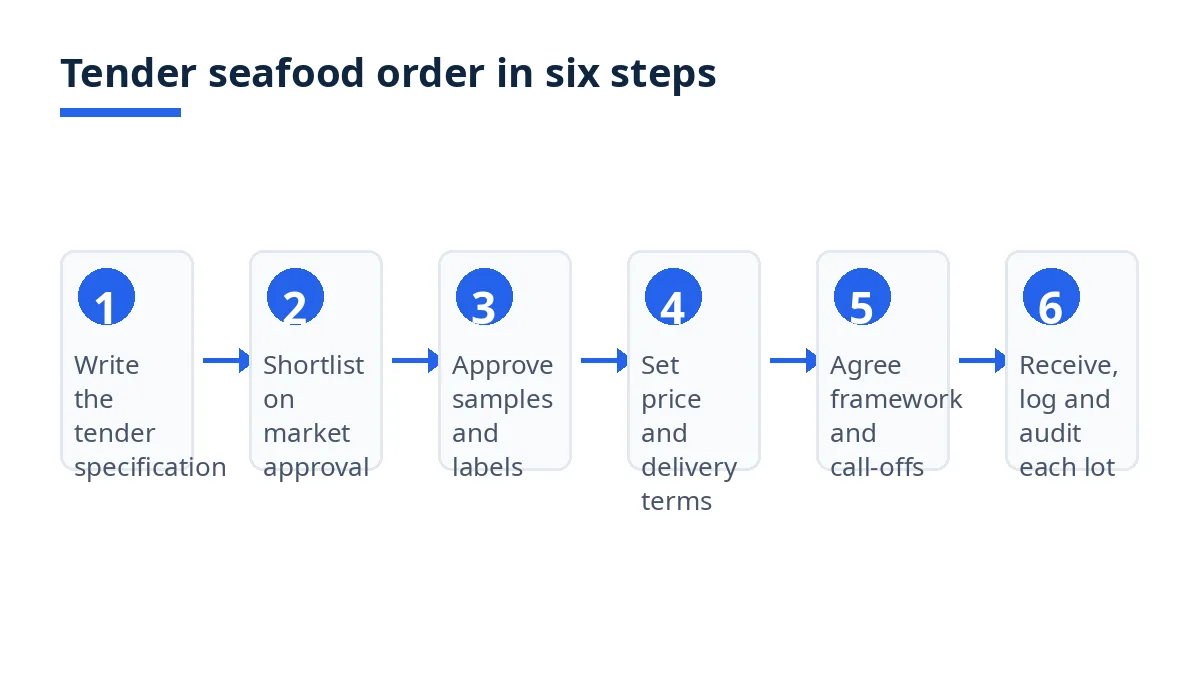
Write the tender specification as a bid-comparison document. One line per product: species, form, size grade, freezing method, glaze basis, pack size, cartons per delivery, delivery points and delivery windows, plus the quality rules, the temperature record requirement and the rejection rule, so a bidder can price the full requirement rather than guessing at it.
Shortlist on market approval and cold-chain evidence, not price alone. Ask each bidder for the plant's market approvals for your destination, its freezing and storage temperatures, and a sample temperature record from a recent shipment. A bidder that cannot produce these with the bid is not the lowest evaluated bid once the cost of a rejected delivery is counted.
Approve samples and labels in writing before award where the tender allows it. Order a sample in the exact pack size, with the exact label, test it to the institution's portion standard, weigh the thawed yield, and check the label against the allergen and provenance wording the institution will use. Record the approval or the corrections in the tender file.
Set the price basis, the delivery term and the payment terms in the contract. State whether the price is per gross or net weight, the maximum glaze percentage, and one Incoterms 2020 rule with a named place for every quotation. The Incoterms 2020 rules allocate cost, risk and obligations between seller and buyer.4 State the payment trigger too: payment against which documents, and after which receiving check.
Agree the framework or call-off structure in advance. For repeat institutional supply, a framework arrangement can cover a period of deliveries rather than a single shipment. The tender documents should identify the institutions that may call off under it and state the maximum total quantity that may be called off, because transparency requires both points to be clear from the outset.5 A framework that leaves quantity open, or that lets unlisted institutions draw on it, creates an audit problem later.
Receive by lot, log temperature, and file the delivery. On arrival, check carton count, lot numbers and the temperature record against the invoice and packing list before the goods enter the freezer. Enter each lot separately, so a quality problem can be traced to one lot rather than the whole stock, and file the delivery note, temperature record and receiving check with the tender file for that call-off.
Costs, timelines and documents
What are the typical costs and timelines?
There are no typical costs or timelines a guide can state as fact for tender seafood from Bangladesh: each supplier prices your species, form, size grade, glaze, pack size and delivery term, and each route carries its own freight and cold-storage charges. In a tender, that uncertainty is handled by the bid format, not by an average. Ask bidders to price as separate lines: product price and weight basis, freight and insurance under the chosen delivery term, destination cold-storage intake and handling, and clearance and inspection charges. Compare bids only when glaze basis, pack size and delivery term match: a lower price per gross kilogram can be a higher price per edible portion once glaze and yield are counted.
Timelines work the same way. Sampling depends on whether the grade and pack are stocked or produced to order, production on raw material availability and the plant's run schedule, and delivery on reefer booking and destination cold-store intake. In the tender, ask for sampling, production-ready, shipment and arrival dates as separate lines, and state the consequence of a late delivery: a replacement delivery window, a penalty clause where the tender rules allow one, or a right to buy the shortfall elsewhere.
Which documents are needed?
For export clearance in Bangladesh, goods may not be loaded unless an export declaration, the Bill of Export or Shipping Bill, is submitted to Customs and approved.6 Enclosed documents include the export contract or purchase order where there is no export letter of credit, the commercial invoice, the packing list, the EXP form certified by an authorized dealer, and a certificate of origin issued by the Export Promotion Bureau or a Chamber of Commerce and Industry.6 For frozen fish, a quality control certificate by the Department of Fisheries is necessary where the destination country requires it.6 The tender buyer, or its importer, should also hold the health certificate and temperature record for the lot, so receiving can match cartons to papers.
The tender file itself is a second set of documents, and it is the set the auditor will read. Keep the tender notice, the specification, the bids, the evaluation sheet, the award decision, the signed contract, each call-off order, each delivery note, each temperature record and each receiving check in one file per contract.
Bangladesh-specific rules and tips
Confirm the classification for your product form. In the Harmonized System, Chapter 03 covers fish, crustaceans, molluscs and other aquatic invertebrates, heading 0303 covers fish, frozen, excluding fish fillets and other fish meat of heading 0304, and heading 0306 covers crustaceans, with subheading 0306.17 covering other shrimps and prawns, frozen.7 Confirm the heading for the exact form you tender, since a wrong heading can hold a shipment at the destination port.
Write the tender so the bidder prices the cold chain, not just the fish. Quick-frozen product is held at minus 18 degrees Celsius or lower,1 and the tender should require a full-journey temperature record, from plant dispatch to delivery-point receiving, with a written receiving threshold and a rejection rule. The threshold should state the temperature at which a delivery is accepted, held for a decision, or rejected, with the name of the person authorised to make that decision.
Use public food procurement practice for the specification, not only for the award. The direct procurement of food by public authorities, and the procurement of catering services using in-house resources or contract caterers, is within the scope of EU green public procurement work on food, which notes that food can be procured directly from producers, manufacturers, wholesalers or importers.8 The same work records that traceability is mandatory for food operators, including catering, and that food business operators must put in place procedures based on HACCP principles.8 Reflect both points in the specification: lot-level traceability from plant to delivery point, and a HACCP-based food safety procedure from the supplying plant, evidenced by records rather than by a claim in the bid.
Plan the framework quantity before the tender is published. A framework arrangement that does not state its maximum quantity at the outset fails the transparency test courts have applied to such arrangements: the contracting authority setting up a framework must specify at the outset the maximum quantity that may be called off, including under subsequent contracts with listed beneficiary authorities, and a reference to usual requirements is not clear enough.5 For a seafood framework, state the maximum total quantity per product line, the delivery points covered, and the period of the framework in the tender documents, before any bidder prices it.
Mistakes and red flags
What are the most common mistakes?
Tendering by species name alone. A tender for shrimp without a form, size grade, glaze basis and pack size cannot be evaluated fairly, because each bidder will price a different product. Every tender line needs the full specification, and every bid should be checked for responsiveness against it before price is compared.
Buying on gross weight without a glaze line. Glaze is the ice coating that protects frozen seafood, and it is also weight on the invoice. If the tender does not state the glaze basis and maximum glaze percentage, the buyer cannot know the net edible weight it is paying for. State both in the tender and in the contract.
Accepting a temperature record that covers only part of the journey. A record from the plant to the port says nothing about the port stay, the sea leg or the destination cold store. Ask for the full journey record, from plant dispatch to delivery-point receiving, with a written receiving threshold.
Leaving the framework quantity open. A framework that states no maximum quantity, or that lets institutions not named in the tender draw on it, creates a transparency and audit problem that no later paperwork can cure.5 State the maximum quantity and the named institutions in the tender documents.
Treating a marketplace badge as a tender qualification. A badge records what a marketplace has checked, not what the institution will receive. On Exportain, checks cover identity, phone and email, business registration, the Export Registration Certificate and photos of the factory or office, reviewed by the Exportain team, and badges cannot be bought. That review is a document and photo review, not a factory inspection or a guarantee, so sample approval, arrival checks and audit filing stay with the tender buyer.
Red flags on a supplier bid. A bid that will not state the glaze basis, the plant's market approvals, or the temperature record; a sample in a different pack or grade from the bid; a price that moves when the delivery term is clarified; or a bidder that cannot name its lot system. Any one of these is a reason to pause the evaluation and ask for clarification in writing, where the tender rules allow it.
Checklist
Before you publish, every line should be answered in the tender file.
Tender specification complete: species, form, size grade, freezing method, glaze basis and pack size per product line.
Delivery points, delivery windows, carton counts and call-off rhythm stated per institution.
Market approval stated as a condition: plant on the applicable establishment list, health certificate confirmed.2
Sample and label approval procedure stated, with approval recorded in the tender file.
Price basis stated: net or gross weight, glaze percentage, pack size and delivery term with a named place.4
Framework terms stated where used: named beneficiary institutions and maximum total quantity.5
Full-journey temperature record required, with a written receiving threshold and rejection rule.1
Documents listed: invoice, packing list, Bill of Export set, certificate of origin, health certificate and temperature record.6
Receiving procedure written: lot check, temperature log, delivery note signed against the call-off order.
Audit file structure set: tender notice, bids, evaluation sheet, award, contract, call-off orders and delivery records in one file.
How Exportain helps
On Exportain, browse suppliers and post the tender specification, delivery points and call-off rhythm on the RFQ board, so suppliers quote against the same tender-grade specification rather than a generic species name. Read how to buy before you post, and ask each reply for its glaze basis, its market approvals for your destination, and its full-journey temperature record.
Read badges for what they record. Exportain's checks cover identity, phone and email, business registration, the Export Registration Certificate and photos of the factory or office, reviewed by the Exportain team, with badges that cannot be bought. That review is a document and photo review, not a factory inspection, so sample approval, arrival checks and audit filing remain the tender buyer's own controls.
FAQs
What should I know first about Frozen Seafood & Fish Sourcing From Bangladesh for Government and Tender Buyers?
Know the form before the price: species, form, size grade, freezing method, glaze basis and pack size decide the yield per portion and whether bids can be compared. Confirm the market rules for your destination, including the EU quick-frozen holding temperature of minus 18 degrees Celsius or lower1 and the applicable establishment list,2 and for the United States the importer verification file.3
What are the typical costs and timelines?
There are no typical figures a tender buyer can rely on: each supplier prices your species, form, size grade, glaze, pack size and delivery term. Ask for price, freight, cold storage and inspection charges as separate lines, and for sampling, production, shipment and arrival dates as separate lines.4
Which documents are needed?
The tender documents are the tender notice, the specification, the bids, the evaluation sheet, the award decision and the signed contract. The export set is the Bill of Export, commercial invoice, packing list, EXP form certified by an authorized dealer, and a certificate of origin,6 plus the health certificate and temperature record for the lot.
What are the most common mistakes?
The most common mistakes are tendering by species name alone, buying on gross weight without a glaze line, accepting a partial temperature record, leaving a framework quantity open,5 and reading a badge as a guarantee. Each is preventable in writing before the tender is published.
Next steps on Exportain
Browse suppliers, then post your tender specification, delivery points and call-off rhythm on the RFQ board so suppliers quote on the same tender specification. Before you publish, read the frozen seafood sourcing guide, the guide to importing frozen shrimp from Bangladesh and the frozen shrimp quality control checklist.
Sources
- Quick-frozen food: summary of Council Directive 89/108/EEC on quick-frozen foodstuffs for human consumption. European Union (accessed )
- Non-EU countries authorised establishments. European Commission (accessed )
- 21 CFR 123.12 — Special requirements for imported products. GovRegs (accessed )
- Incoterms® 2020. International Chamber of Commerce (ICC) (accessed )
- Procurement: Framework Agreements and the need for transparency from the outset. Bevan Brittan LLP (accessed )
- Customs Clearance Procedures for Export. Bangladesh Customs, National Board of Revenue (accessed )
- HS Nomenclature 2017 - Chapter 03. World Customs Organization (accessed )
- EU GPP criteria for food procurement, catering services and vending machines. Publications Office of the European Union (accessed )
About the author
Sourcing from Bangladesh?
Post a request for quotation and suppliers on Exportain can send you their quotes directly.
Post an RFQ


