

Startup Brand Electrical & Solar Sourcing From Bangladesh: Low MOQs, Samples and Launch Timelines
Startup brands sourcing electronics, electrical and solar from Bangladesh: low MOQs, prototype testing, small-batch production, brand-owned specs and packaging, and launch timelines.
Short answer
For startup brands, electronics, electrical and solar sourcing from Bangladesh works when the launch is kept small and specific: one model, one rating, one colour and one plug type, prototypes tested under load, packaging approved from printed proofs, and a small batch ordered against a written specification with its test file and delivery term agreed before production.
On this page
Key takeaways
Freeze one launch specification before you enquire: one model, one rating, one colour and one plug type, with the standard, test evidence and brand-owned details written down, so every supplier prices the same product.
Prove the product with prototypes built to the launch specification and tested under load, with substitute parts declared in writing, and close every correction before the small batch is confirmed.
Ask for the minimum per model, per rating, per colour and per label version, and build the launch around stocked components and colours where the brand allows it, so the small batch stays viable.
Approve packaging and labels from printed proofs as a separate gate, and keep paid set-up lines, artwork files and the test file with the purchase order so the repeat batch matches the first.
For a European Union launch, name the applicable directives in the enquiry and assemble the conformity file during prototyping, not when the batch is packed.
A startup brand does not buy electrical products the way an established retailer does. The first order is small, the specification is still being proved, and the brand on the carton matters as much as the product inside it. For a startup buying electronics, electrical goods or solar products from Bangladesh, the work is therefore different: prove the product with prototypes, lock a specification the factory can repeat at small volume, and plan a launch quantity that tests the market without tying up cash in unsold stock.
Why this matters for buyers and sellers
For the startup, the first order is a market test, not a supply programme. A batch of 300 LED desk lamps or 200 solar home kits tells the founder whether customers want the product, whether the packaging survives delivery, and whether the price leaves a margin after freight, duty and returns.
For the seller, a startup order is small but repeatable: a factory that runs a clean prototype round, holds the specification steady, and ships on the agreed date earns the second order.
The tension between the two sides is real. Small batches cost more per unit, because set-up, testing and packing are spread over fewer units. The negotiation is about choosing where the money goes, so the startup pays for what it actually needs, and not for variety it does not.
What should I know first about Electronics, Electrical & Solar Sourcing From Bangladesh for Startup Brands?
Know your launch specification before you ask for a price. A startup specification has six parts: the product family and model, the rated voltage and frequency for the launch market, the standard and test evidence the market requires, the brand-owned details, the quantity per model and per label version, and the delivery term. Without those fields, no two suppliers are pricing the same product.
Know the market file before you approve a prototype. In the European Union, most electrical and electronic products intended for sale require CE marking, a declaration that the product meets the applicable legal requirements for safety, health and environmental protection, and a product governed by several directives must comply with all of them before the mark is applied.1 The four main directives are the Low Voltage Directive 2014/35/EU, the Radio Equipment Directive 2014/53/EU, the Electromagnetic Compatibility Directive 2014/30/EU and the RoHS Directive 2011/65/EU, with the Low Voltage Directive covering equipment rated between 50 and 1,000 volts for alternating current and 75 and 1,500 volts for direct current.1 Name the applicable directives in the enquiry, not after the prototype is made.
Know that small does not mean informal. The prototype approval, the small-batch specification, the packaging artwork, the test file and the delivery term should all be in writing before money moves. Startups fail most often through undocumented changes: a driver swapped for a cheaper one, a housing colour changed, a carton printed without the brand mark.
Step-by-step: how it works
The sequence below is built for a first launch, from specification to repeat order. Each step ends with something in writing.
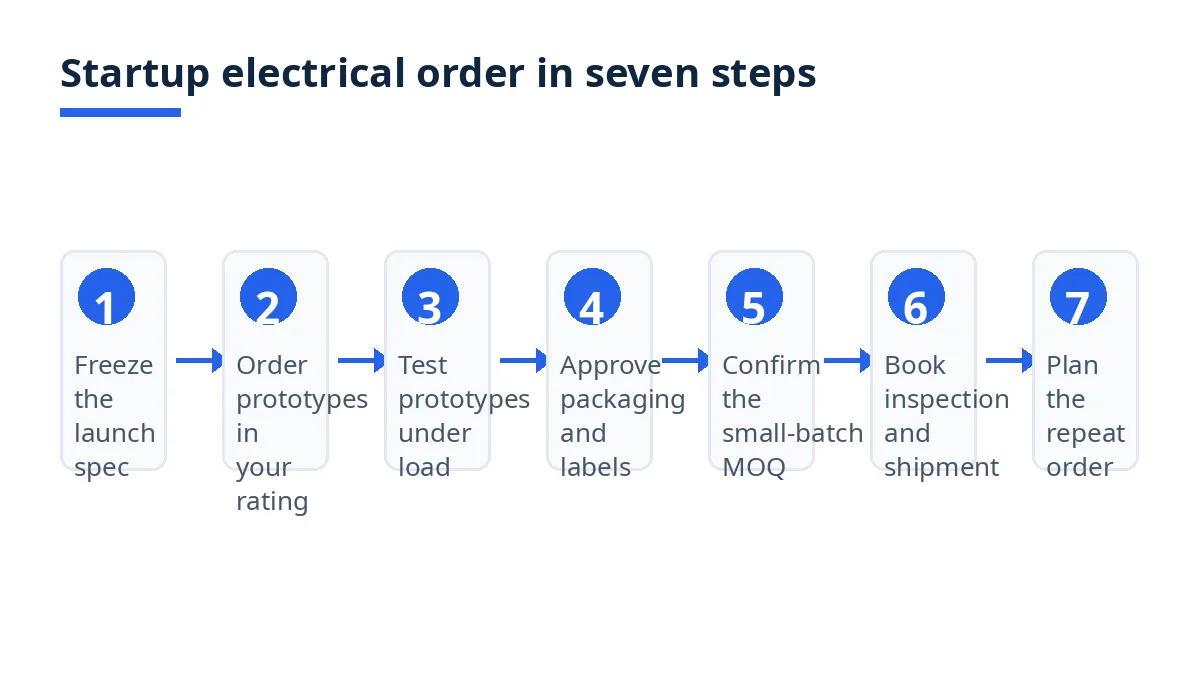
Freeze a launch specification, not a wish list. Write one page per model: product family, rated voltage and frequency, power or current rating, materials, dimensions, plug or connector type, brand-owned details, packing, and the test evidence required. Cut the range before you enquire: one housing colour, one plug type, one carton size.
Order prototypes in your exact rating and market version. Ask for prototypes built to the launch specification, including the brand housing colour and label where the factory can do it, and the components the production batch will use.
Test prototypes the way the market will. Run the lamp at the launch voltage, charge and discharge the battery at the stated rate, and check the solar kit as a complete set, including cable, controller and mounting parts. Record failures by part and by cause, and send corrections in writing with photographs.
Agree the small-batch minimum, per model and per variant. Ask for the minimum per model, per rating, per housing colour and per label version, and which line binds your order. Ask what is stocked and what is made to order, because stocked components and colours are where a lower minimum is most often possible.
Approve packaging and labels as a separate gate. Approve the carton, the retail box if there is one, the label artwork, the brand mark placement and the barcode or SKU position from printed proofs, not from a screen image.
Confirm the production slot, the test file and the delivery term together. Put the production dates, the routine tests, the inspection arrangement and one Incoterms 2020 rule with a named place into the purchase order.2
Receive, check and plan the repeat before you sell out. On arrival, check carton count, model, rating, label and brand marks against the purchase order and packing list, and test a sample from the batch. Take the sales and returns record into the repeat enquiry with the same specification, so the second batch matches the first.
Example figures: a startup launching one LED desk lamp model might prototype 5 units, order a first batch of 300 units in one colour and one plug type, and hold a repeat price at 1,000 units. The numbers are illustrative only.
Costs, timelines and documents
What are the typical costs and timelines?
There are no typical costs or timelines a guide can state as fact for startup electrical orders from Bangladesh: each supplier prices your model, rating, component set, brand-owned details, test file, packing and delivery term. Ask for the cost lines separately: product price per model and per variant, set-up charges for colour, marking, label or carton print runs, testing and test-report charges, packing, inland transport and export handling, and freight and insurance under the chosen delivery term. Compare quotations only when the specification, the variant count and the delivery term match.
Timelines for a launch run in stages, and each stage should be dated separately: prototype build, prototype testing and corrections, packaging proof approval, component purchase, small-batch production, routine testing, inspection, and shipment. Imported components are usually the long stage, because a line can stand ready while the order waits for cells, drivers, chips or compressor parts. Ask for the component position in writing at order confirmation.
Which documents are needed?
For export clearance in Bangladesh, goods may not be loaded unless an export declaration, the Bill of Export or Shipping Bill, is submitted to Customs and approved.3 Enclosed documents include the export contract or purchase order where there is no export letter of credit, the commercial invoice, the packing list, the EXP form certified by an authorized dealer, and a certificate of origin issued by the Export Promotion Bureau or a Chamber of Commerce and Industry.3
The startup buyer should also hold the brand-owned file: the approved specification sheet, the approved prototype record with corrections closed, the packaging and label proofs, the test reports naming the exact model, rating and producing site, and the conformity file for the launch market.
Bangladesh-specific rules and tips
Confirm the classification for your exact product form. In the Harmonized System, Chapter 85 covers electrical machinery and equipment and parts thereof, and its notes set out what the chapter does not cover, including electrically warmed clothing and articles of glass of heading 70.11.4 Insulated cable sits under heading 8544, electric accumulators under heading 8507, and LED light sources under heading 8539, with the distinction between LED modules and LED lamps turning on whether the lamp carries a cap designed for easy installation or replacement in a luminaire.4
Ask about the Bangladesh Standards and Testing Institution position for your product. The Bangladesh Standards and Testing Institution sets Bangladesh Standards and issues certification mark licences for products that meet them, and some products carry mandatory certification for domestic production and sale.5 For an export startup order, the question is narrower: ask the supplier to name the exact Bangladesh Standard or international standard its product is made and tested to, in writing, and to supply the test report against that standard.
Keep one legal name across every paper. The export declaration names the exporter and the foreign buyer,3 so the name on the trade licence, quotation, proforma invoice, test report and payment account should match. For a startup, the same discipline applies to the brand: the brand name, model name and rating on the carton, the label, the test report and the conformity file should be identical.
Design the small batch around stocked inputs. Ask which components, colours and packing materials are stocked for your product family, and build the launch specification around them where the brand allows it. Where a brand-owned part cannot be stocked, ask for its set-up charge and its reuse on the repeat order as separate lines.
Plan the conformity file at prototype stage, not at shipment. For an EU launch, the technical documentation, the test reports and the signed EU Declaration of Conformity should be assembled while the prototype is being corrected, not requested when the batch is packed. The CE mark must be visible, legible and indelible, and affixed to the packaging or accompanying documents if it cannot be affixed to the product itself.1
Mistakes and red flags
What are the most common mistakes?
Ordering by product name alone. A quotation for a solar kit, a lamp or a charger without a model, rating, component set, brand details and test file cannot be compared with another quotation or repeated for a second batch.
Keeping too many variants in the first order. Three colours, two plug types and two carton sizes in a first batch of 300 units can mean six small runs, six set-ups and six label versions. Cut the launch range to what the brand can sell.
Approving a prototype built with substitute parts. A prototype with a different driver, cell or housing material proves the shape of the product, not its performance. Ask what is substitute and what is production-grade on every prototype, in writing.
Treating the test file as paperwork after the sale. A test report for a different model, rating or producing site is background only. Ask for reports naming your model, rating and site, and hold shipment until the file matches the batch.
Paying set-up twice. Keep the paid set-up lines, artwork files and tooling records from the first purchase order and attach them to the repeat enquiry.
Red flags on a supplier reply. A reply that will not state the minimum per model or per variant, will not name the standard and test evidence for your market, sends a prototype in a different rating from the quotation, changes price when the delivery term is clarified, or cannot name the producing site and the bought-in components.
Checklist
Before you confirm, every line should be answered in writing.
Launch specification frozen: model, rating, voltage and frequency, materials, dimensions, plug or connector, brand details, packing.
Variant count cut to the launch range: one colour, one plug type, one carton size unless the brand case is written down.
Prototypes ordered in the exact rating and market version, with substitute parts declared in writing.
Prototypes tested under load and corrections closed in writing with photographs.
Minimum confirmed per model, per rating, per colour and per label version, with the binding line named.
Stocked components, colours and packing recorded; bought-in components and their dates confirmed.
Packaging and label proofs approved from printed proofs, including brand mark placement and SKU position.
Test file agreed: reports naming the model, rating and producing site, plus the conformity file for the launch market.
Set-up charges itemized apart from the unit price, with carry-forward to the repeat order stated.
Price lines separated: product, set-up, testing, packing, transport, freight and insurance under one named delivery term.2
Production slot, testing, inspection and shipment dates agreed as separate lines.
Export set agreed: invoice, packing list, Bill of Export set, EXP form, certificate of origin.3
Arrival check planned: carton count, model, rating, label and brand marks checked against the purchase order before listing.
Repeat price and minimum for the same specification recorded for the second batch.
How Exportain helps
On Exportain, browse suppliers and post the launch specification, variant count and delivery term on the RFQ board, so suppliers quote against the same startup specification rather than a generic product name. Read how to buy before you post, and ask each reply for its minimum per model and per variant, its stocked components and colours, its test evidence for your launch market, and its set-up charges with carry-forward stated.
Read supplier profiles for what they record. A profile shows the document and photo checks recorded for that supplier; it is not a factory inspection and not a guarantee of quality or delivery, so prototype approval, arrival checks and the conformity file stay with the startup buyer.
FAQs
What should I know first about Electronics, Electrical & Solar Sourcing From Bangladesh for Startup Brands?
Know the launch specification before the price: model, rating, voltage and frequency, standard and test evidence, brand-owned details, quantities per model and per variant, and the delivery term. For the European Union, confirm which directives apply to your product, since a product governed by several directives must comply with all of them before the CE mark is applied.1
What are the typical costs and timelines?
There are no typical figures a buyer can rely on: each supplier prices your model, rating, component set, brand details, test file, packing and delivery term. Ask for product price, set-up charges, testing charges, packing, transport, freight and insurance as separate lines, and for prototype, testing, production, inspection and shipment dates as separate lines, with one Incoterms 2020 rule and named place for every quotation.2
Which documents are needed?
The order documents are the launch specification sheet, the approved prototype record, the packaging and label proofs, the test reports naming the exact model, rating and producing site, the conformity file for the launch market, and the purchase order with the delivery term. The export set is the Bill of Export, commercial invoice, packing list, EXP form certified by an authorized dealer, and a certificate of origin issued by the Export Promotion Bureau or a Chamber of Commerce and Industry.3
What are the most common mistakes?
The most common mistakes are ordering by product name alone, keeping too many variants in the first order, approving a prototype built with substitute parts, treating the test file as paperwork after the sale, and paying set-up charges twice on the repeat order.
Next steps on Exportain
Browse suppliers, then post your launch specification, variant count and delivery term on the RFQ board so suppliers quote on the same startup specification. Before you confirm, read how to buy, the electrical products sourcing guide and the electrical cables MOQ guide.
Sources
- CE for Electronics: Understanding EU Directives and Compliance Requirements for the CE Mark. QIMA (accessed )
- Incoterms® 2020. International Chamber of Commerce (ICC) (accessed )
- Customs Clearance Procedures for Export. Bangladesh Customs, National Board of Revenue (accessed )
- Harmonized System - Chapter 85. World Customs Organization (accessed )
- Electrical Products Sourcing Guide. Exportain (accessed )
About the author
Sourcing from Bangladesh?
Post a request for quotation and suppliers on Exportain can send you their quotes directly.
Post an RFQ


