

Retailers Buying Electronics, Electrical & Solar From Bangladesh
Retailers sourcing electronics, electrical and solar goods from Bangladesh: shelf-ready packs, retail compliance and labelling, replenishment rhythms, and the documents to check before the first shipment reaches a store.
Short answer
For retailers, electronics, electrical and solar goods from Bangladesh work when the order is built for the shelf first: the assortment by store format, the shelf-ready pack with barcode and label, the destination-market conformity documents for the exact model, and a written replenishment and returns rule that keeps lines in stock without overfilling the warehouse.

On this page
Key takeaways
Build the order for the shelf first: assortment by store format, shelf-ready pack with barcode and label, and a weekly sales estimate per line, so suppliers quote on the same retail specification.
Check destination-market documents for the exact model before ordering: Low Voltage Directive conformity and CE marking, RoHS substance limits for the EU, and IEC 61215 and IEC 61730 evidence for solar modules.
Approve the retail pack, not just the product: barcode scanned, label read as a customer would read it, plug, cable length and contents checked against the specification in writing.
Confirm the HS heading for each product form, including heading 8544 for cable lines, and hold the Bill of Export set, certificate of origin, declaration of conformity and approved pack artwork before shipment.
Replenish by sell-through with a written minimum stock, reorder quantity and returns rule, so a promotion or seasonal spike is covered by the contract rather than by an urgent call.
A retailer does not buy electronics, electrical goods and solar products the way a project buyer or a wholesaler buys them. The order has to fit a shelf, a price point and a replenishment cycle, not a single installation or a distribution route. For retailers sourcing from Bangladesh, the work starts with the assortment: which LED bulbs, switches, cables, chargers and solar kits earn their shelf space, in which pack sizes, with which labels, and on what reorder rhythm.
A shelf-ready order is decided before any price is compared. The retailer fixes the pack the customer takes home, the barcode and label the till and shelf edge need, the safety and substance rules of the destination market, and the minimum stock that triggers the next order, so two quotations for LED bulbs can be compared on the same wattage, pack count, carton quantity and label.
Why this matters for buyers and sellers
For the retailer, electrical and solar lines carry a risk other lines do not: a non-compliant plug, cable or charger can be pulled from sale, and a solar kit with unclear wattage or warranty wording comes back as a return. Getting the market rules, the pack and the label right before the first shipment protects margin twice, by avoiding a delisting and by avoiding returns that eat the profit on the whole line.
For the seller, a retail account is a repeat programme rather than a single shipment. A retailer that can reorder the same shelf pack, with the same barcode and label, will reorder it on a rhythm, while a supplier that changes a pack count, a plug type or a label without warning forces the retailer to re-planogram every store.
What should I know first about Electronics, Electrical & Solar Sourcing From Bangladesh for Retailers?
Know the retail pack before you ask for a price. State the product, the variant, the units per retail pack, the retail packs per inner and outer carton, the barcode requirement, the label languages and the shelf information the pack must carry, such as wattage, voltage, cable length or solar panel wattage. State the destination market at the same time, because the safety and substance rules, the plug type and the label wording all follow the market.
Know the market rules for your destination before you shortlist suppliers. In the European Union, the Low Voltage Directive 2014/35/EU covers electrical equipment designed for use with a voltage rating between 50 and 1,000 V for alternating current and between 75 and 1,500 V for direct current, and compliant equipment carries the CE marking.1 The RoHS Directive 2011/65/EU restricts hazardous substances in electrical and electronic equipment, with limits of 0.1 percent for lead, mercury, hexavalent chromium, polybrominated biphenyls and polybrominated diphenyl ethers, and 0.01 percent for cadmium, measured in each homogeneous material.2 For solar modules, IEC 61215 sets out design qualification and type approval for terrestrial photovoltaic modules for long-term outdoor use, while IEC 61730 covers safety against electric shock, fire hazard and mechanical risk.3 Ask for the declaration of conformity and test evidence for the exact model and variant you will put on the shelf, not a document for a different model.
Step-by-step: how it works
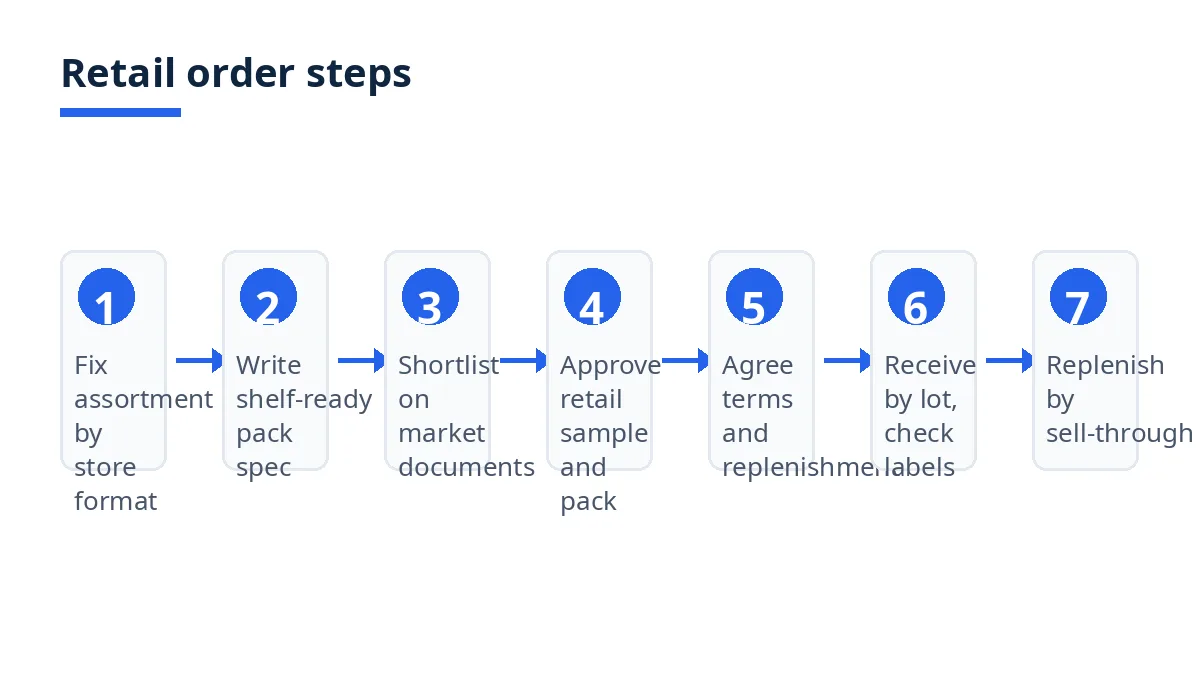
Fix the assortment by store format. List each line by store format: the LED bulbs and switches for a hardware aisle, the chargers and extension leads for an electronics bay, the solar lanterns and home solar kits for an energy display. Give every line a target retail price band, a pack size and a weekly sales estimate per store, so the order quantity follows the shelf plan rather than a supplier catalogue.
Write the shelf-ready pack specification. For each line, state the retail pack contents, the units per inner and outer carton, the barcode, the label languages, the safety markings, the wattage and voltage, the plug type, and any warranty or instruction wording the pack must carry.
Shortlist on destination-market documents, not price alone. Ask for the declaration of conformity, the applicable test reports and the label artwork for the exact model, and check that the plug, voltage and markings match your market. For solar lines, ask for the IEC 61215 design qualification and IEC 61730 safety evidence for the exact module.3
Approve the retail sample, packaging included. Order a sample in the exact retail pack, with the exact barcode and label. Put it on a test shelf, scan the barcode, read the label as a customer would, and check the plug, the cable length and the contents against the specification. Approve or list corrections in writing.
Agree the commercial terms and the replenishment rhythm. State the price per retail pack and per carton, the payment terms, one Incoterms 2020 rule with a named place for every quotation, and the reorder rule: the minimum stock per line, the reorder quantity and the lead time the supplier commits to. The Incoterms 2020 rules give a clear allocation of cost, risk and obligations between seller and buyer.4
Receive by lot and check labels before goods reach the shelf. On arrival, check carton count, lot numbers, barcodes and labels against the invoice and packing list before cartons are broken down for stores. A label error found at the warehouse costs a relabel; the same error found in stores costs a recall from every shelf.
Replenish by sell-through and manage returns in writing. Reorder when a line hits its minimum stock, not when the warehouse feels empty. Agree in advance what happens to faulty or returned units: who pays return freight, how replacements ship, and how a repeated fault is handled.
Example figures: a retailer with 20 stores selling 40 LED bulb packs per store per week would move 800 packs a week, so a first order of 4,800 packs covers six weeks of sales before replenishment. The numbers are illustrative only.
Costs, timelines and documents
What are the typical costs and timelines?
There are no typical costs or timelines a guide can state as fact for retailer electrical goods from Bangladesh: each supplier prices your product, variant, pack size, carton quantity and delivery term, and each route carries its own freight and handling charges. Ask for the product price per retail pack, freight and insurance under the chosen delivery term, destination handling and clearance charges, and the cost of relabelling or repacking if the first shipment needs it, as separate lines. Compare quotations only when pack size, carton quantity and delivery term match: a lower price per unit can be a higher price per shelf pack once pack count and carton quantity are counted.
Timelines work the same way: sampling depends on whether the retail pack and label already exist or must be made, production on component availability and the factory run schedule, and delivery on booking and destination handling. Ask for sampling, production-ready, shipment and arrival dates as separate lines, and agree what happens to a promotion display if a shipment slips.
Which documents are needed?
For export clearance in Bangladesh, goods may not be loaded unless an export declaration, the Bill of Export or Shipping Bill, is submitted to Customs and approved.5 Enclosed documents include the export contract or purchase order where there is no export letter of credit, the commercial invoice, the packing list, the EXP form certified by an authorized dealer, and a certificate of origin issued by the Export Promotion Bureau or a Chamber of Commerce and Industry.5 The retailer, or its importer, should also hold the declaration of conformity, the test reports for the exact model, the approved pack and label artwork, and the import documents its own market requires.
Bangladesh-specific rules and tips
Confirm the classification for each retail line. In the Harmonized System, heading 8544 covers insulated wire, cable and other insulated electric conductors, whether or not fitted with connectors, and optical fibre cables made up of individually sheathed fibres.6 Switches, sockets and lamp-holders fall under their own headings in Chapter 85, and solar cells and modules fall under heading 8541, so confirm the heading for the exact product form you order. A wrong heading can hold a shipment at the destination port and change the duty planned for.
Write the shelf label from the specification sheet, not from a sales description. The wattage, voltage, plug type, cable length, lumen output for a bulb and watt-peak rating for a solar module should come from the approved specification, and any change of variant, plug or rating on a repeat order should trigger a label check before the goods reach stores.
Check the plug, voltage and markings for each market separately. A line that sells in the United States, the United Kingdom, the European Union and the United Arab Emirates may need different plugs, voltage markings and label languages. Split the order by market at the specification stage, with a separate barcode and label artwork for each market where the markings differ.
Plan the seasonal display in the contract, not in a phone call. Solar lanterns, fans and lighting lines spike with seasons and festivals, and a promotion can double weekly sales for a few weeks while the standing order stays flat. Write the promotion rule into the supply agreement: confirmation lead time, pack sizes available at short notice, and the substitute variant if the first choice is out of stock.
Mistakes and red flags
What are the most common mistakes?
Ordering by product name alone. A quotation for LED bulbs without wattage, lumen output, pack count, carton quantity and label language cannot be compared with another quotation, or priced for a shelf. Every order line needs the full retail specification.
Approving a product sample but not the retail pack. A bulb that passes a bench test can still fail at retail if the pack has no barcode, the wrong plug, or a label in the wrong language. Approve the retail pack, with barcode and label, as part of the sample approval.
Accepting a conformity document for a different model. A declaration of conformity and a test report are tied to a model and variant. A document for a similar bulb, a different wattage or an earlier module is not evidence for the product on your shelf. Ask for documents that name the exact model you will sell.1
Letting the specification and the shelf drift apart. A supplier changes a pack count, a retailer changes a price band, and nobody updates the label or the barcode. Tie every specification change to a pack and label check, with one person responsible for it.
Treating a marketplace profile as a factory inspection. A supplier profile records what a marketplace has checked, not what the shelf will receive. Sample approval, arrival checks and shelf checks stay with the retailer buyer.
Red flags on a supplier reply. A reply that will not name the exact model on its conformity documents, will not show the retail pack and label artwork, quotes a price without a pack size or delivery term, or cannot name its lot system. Any one of these is a reason to pause.
Checklist
Before you confirm, every line should be answered in writing.
Assortment fixed by store format, with a target retail price band and a weekly sales estimate per line.
Shelf-ready pack specification complete: retail pack contents, units per inner and outer carton, barcode, label languages, safety markings, wattage, voltage and plug type.
Destination-market documents checked: declaration of conformity and test reports for the exact model, RoHS substance limits confirmed for the EU where applicable.2
Solar lines checked against IEC 61215 design qualification and IEC 61730 safety evidence for the exact module.3
Retail sample approved in the exact pack, with barcode scanned and label read as a customer would read it.
Price basis stated: price per retail pack and per carton, payment terms, and one Incoterms 2020 rule with a named place.4
Classification confirmed: HS heading for each product form, including heading 8544 for cable lines.6
Documents agreed: invoice, packing list, Bill of Export set, certificate of origin, declaration of conformity and approved pack artwork.5
Replenishment rule agreed: minimum stock per line, reorder quantity, lead time and promotion top-up rule.
Returns rule agreed in writing: who pays return freight, how replacements ship, and how a repeated fault is handled.
How Exportain helps
On Exportain, browse suppliers and post the assortment specification, pack sizes, target markets and replenishment rhythm on the RFQ board, so suppliers quote against the same retail specification rather than a generic product name. Read how to buy before you post, and ask each reply for its declaration of conformity for the exact model, its retail pack and label artwork, and its carton quantities.
Post a free RFQ on Exportain and get quotes from Bangladeshi suppliers on the RFQ board, with the pack, label and market for each line stated up front.
FAQs
What should I know first about Electronics, Electrical & Solar Sourcing From Bangladesh for Retailers?
Know the retail pack before the price: product, variant, units per retail pack, units per carton, barcode, label languages, safety markings, wattage, voltage and plug type. Confirm the destination-market rules first, including the Low Voltage Directive voltage ranges and CE marking for the EU,1 the RoHS substance limits,2 and, for solar modules, IEC 61215 and IEC 61730 evidence.3
What are the typical costs and timelines?
There are no typical figures a buyer can rely on: each supplier prices your product, variant, pack size, carton quantity and delivery term. Ask for price per retail pack, freight and insurance, destination handling and clearance charges as separate lines, and for sampling, production, shipment and arrival dates as separate lines, with one Incoterms 2020 rule and a named place on every quotation.4
Which documents are needed?
The order documents are the assortment specification sheet, the itemized quotation and the purchase order, with pack size, barcode and delivery term on both. The export set is the Bill of Export, commercial invoice, packing list, EXP form certified by an authorized dealer, and a certificate of origin issued by the Export Promotion Bureau or a Chamber of Commerce and Industry,5 plus the declaration of conformity and approved pack artwork for the exact model.
What are the most common mistakes?
The most common mistakes are ordering by product name alone, approving a product sample but not the retail pack, accepting conformity documents for a different model, letting the specification and the shelf drift apart, and reading a supplier profile as a factory inspection. Each is preventable in writing before the first shipment.
Next steps on Exportain
Browse suppliers, then post your assortment specification, pack sizes and target markets on the RFQ board so suppliers quote on the same retail specification. Before you confirm, read the electrical products sourcing guide, the quality control checklist for electrical cables and the best Incoterm for importing electrical products.
Sources
- Low Voltage Directive 2014/35/EU for Electrical Equipment. CCIS Expertise (accessed )
- Directive 2011/65/EU (RoHS). Insta (accessed )
- IEC/EN 61215-61730-BIPV. Solar Innova (accessed )
- Incoterms® 2020. International Chamber of Commerce (ICC) (accessed )
- Customs Clearance Procedures for Export. Bangladesh Customs, National Board of Revenue (accessed )
- HS Nomenclature 2002 - Chapter 85. World Customs Organization (accessed )
About the author
Sourcing from Bangladesh?
Post a request for quotation and suppliers on Exportain can send you their quotes directly.
Post an RFQ


