

Hotels and Hospitality Electrical Sourcing From Bangladesh
Hotel electrical sourcing from Bangladesh, room by room: one kit per room type, destination-market safety checks, a sample room approval, and spares ordered with the bulk lot.
Short answer
Hotel and hospitality buyers sourcing electrical products from Bangladesh should start from the room, not the catalogue: define one kit per room type, confirm destination-market safety conformity and test reports before ordering, approve a sample room, and order spares with the bulk lot. Phasing the order floor by floor keeps rooms in service while replacements and finishes stay identical across the property.
On this page
Key takeaways
Define one electrical kit per room type, with finish, colour temperature, voltage, socket type and mounting size, before asking any supplier for a price.
Approve a fitted sample room under the hotel's own lighting, and photograph it as the approval record for every phase.
Confirm destination-market conformity and test reports before ordering; for the EU, check the declaration of conformity under Directive 2014/35/EU.
Order spares with the bulk lot, record finish codes, and phase deliveries floor by floor so rooms stay in service.
Exportain verification is a document and photo review, not a factory inspection, and a badge is not a guarantee.
A hotel does not buy electrical products the way a retailer does. A retailer buys stock to sell, while a hotel buys a working room: the bedside lamp, the switches and sockets, the bathroom fittings, the corridor lighting and the back-of-house equipment must all work together, look the same in every room of the same type, and keep working after the first guest checks in. This guide is written for hotel owners, operators, procurement teams and hospitality groups buying electrical, electronic and solar products from Bangladesh, and it follows the order of a real hotel project: room kit, sample room, conformity, spares, phased delivery and inspection.
Why hotel electrical buying is different
A hotel order fails in ways a general electrical order does not. A finish that differs between two batches shows up in every room a guest walks into. A switch plate that is a few millimetres off the specified size leaves a visible gap in the wall. A lamp with the wrong colour temperature makes one floor look different from the next. None of these are defects in the usual sense, yet each one is visible to guests, and each one is expensive to fix after installation.
Consistency is therefore the first requirement, ahead of unit price. Define one kit per room type: standard room, deluxe room, suite, corridor and back of house. List every item in the kit, with its finish, colour temperature, voltage, plug or socket type and mounting size. When two room types share an item, write that down too, so a supplier quotes the shared item once and you keep one spare pool for both.
The second difference is timing. A hotel refurbishment usually runs floor by floor or wing by wing, while rooms on other floors stay in service. That means delivery must arrive in phases that match the works programme, not in one shipment, and spares must arrive with the first phase, not after the last room is fitted.
The third difference is aftercare. A guest-room lamp or switch fails in service, and the hotel needs the same item, in the same finish, months later. If the original item is out of production or the finish has changed, one room ends up looking different from the rest. Order spares with the bulk lot, keep the specification on file, and agree in writing how long the supplier will hold the same finish for repeat orders.
Step-by-step: how it works
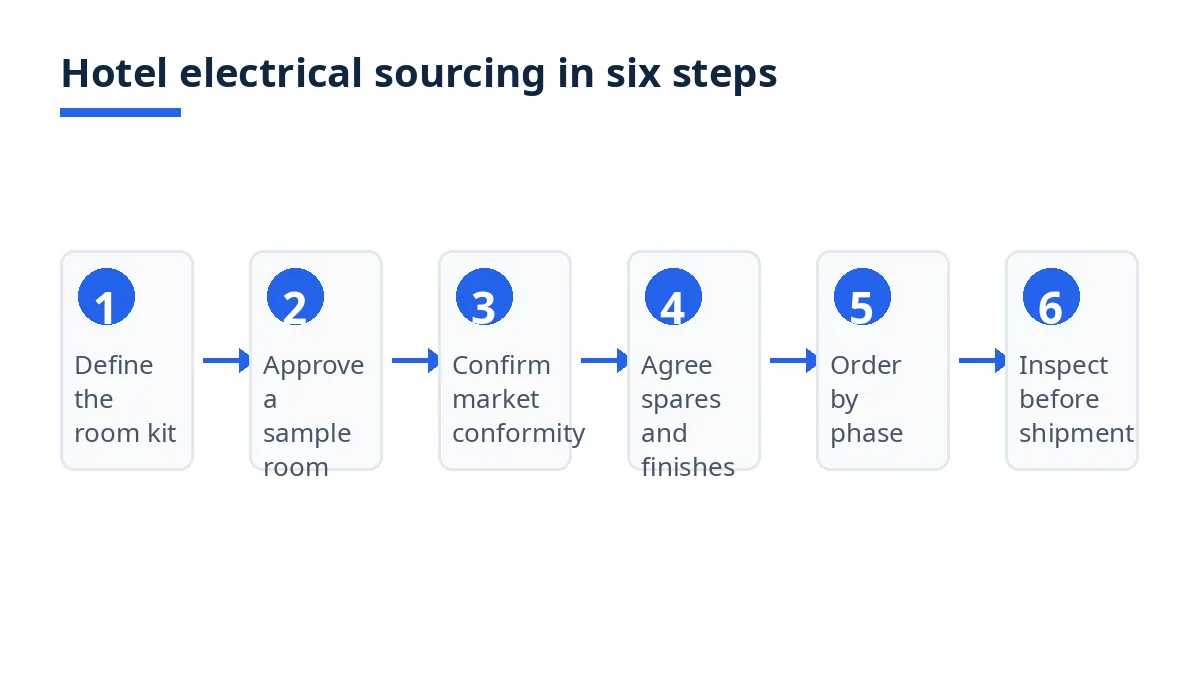
Define the kit per room type. List every electrical item for each room type, corridor and back-of-house area, with finish, colour temperature, voltage, socket type and mounting dimensions. Count quantities per room, then multiply by rooms per phase.
Shortlist suppliers on the kit, not the catalogue. Send the same kit list to each candidate and ask which items they make, which they source in, and which finishes they hold in stock. A supplier who answers item by item is easier to compare than one who replies with a general price list.
Approve a sample room, not just samples. Ask for one full set per room type, fit it in a real room, and check it under the hotel's own lighting, with the actual wall finishes. Photograph the fitted room and record the approved items against the kit list.
Confirm destination-market conformity before ordering. For the European Union, electrical equipment designed for use within 50 to 1,000 V alternating current or 75 to 1,500 V direct current falls under Directive 2014/35/EU, and equipment on sale in the EU must bear the CE marking to show it meets the essential safety requirements of EU legislation.1 Importers must check whether manufacturers have carried out the conformity assessment procedure correctly, and the EU declaration of conformity and technical documentation must be kept for 10 years.1 Ask for the declaration and the test reports for your items, and confirm the marking your own market requires with your importer before you pay a deposit.
Agree spares, finishes and repeat supply in writing. State the spare quantity per item, the finish code, and how long the supplier will supply the same finish. Put the spare lines on the same purchase order as the bulk lot.
Order by phase and inspect before shipment. Release each phase against the works programme, and inspect the goods before they leave Bangladesh, against the approved sample room and the kit list, not against a brochure.
Keep one record for the whole property. File the kit list, the approved sample-room photographs, the conformity documents, the purchase orders and the spare quantities together, so a future procurement manager can reorder the same item without guessing.
Costs, timelines and documents
What are the typical costs and timelines?
There is no typical cost or timeline a guide can state for a hotel electrical order, because the price depends on the items in the kit, the finishes, the quantities per phase, the conformity work for your market and the delivery term. A bedside lamp, a corridor fitting and a solar module sit in different price ranges and different production processes, and a single average would mislead every reader.
Work instead from cost lines you can compare. Ask each supplier to price the same kit list, with the same finishes, on the same delivery term, and to show spares, samples and any conformity testing as separate lines. The Incoterms 2020 rules set out 11 rules with a clear allocation of cost, risk and obligations,2 so compare quotations only on the same rule and named place. See the best Incoterm for importing electrical products from Bangladesh guide when you choose the term.
For timelines, ask for separate dates: sample room ready, bulk production per phase, inspection, and shipment per phase. A supplier who gives one delivery week for a phased project has not planned the phases. Solar items deserve a separate question, because modules and inverters carry their own conformity and testing steps, and Bangladesh's standards body has brought solar modules and panels and inverters under its mandatory quality certificate scheme.3
Example figures: a 120-room hotel refurbishing in three phases of 40 rooms might order the room kit per phase, plus a spare pool of 5 percent per item with the first phase, so a failed bedside lamp in phase one can be replaced from stock while phase three is still in production. The figures describe the structure of a phased order only, not a typical price, quantity or lead time.
Which documents are needed?
For export clearance in Bangladesh, goods may not be loaded unless an export declaration, the Bill of Export or Shipping Bill, is submitted to Customs and approved.4 Enclosed documents include the export contract or purchase order where there is no export letter of credit, the commercial invoice, the packing list, the EXP form certified by an authorized dealer, and a certificate of origin issued by the EPB or a Chamber of Commerce and Industry.4
Your own order file needs more than the export set. Keep the kit list, the approved sample-room record, the conformity documents and test reports for your market, the itemized quotation, the purchase order with spares and finishes, and the inspection report for each phase. If a guest-room item fails in service a year later, that file is what lets you reorder the same finish.
Classification matters for the customs paperwork. Heading 8544 covers insulated wire, cable and other electric conductors, whether or not fitted with connectors.5 Other hotel items fall under other Chapter 85 headings, so confirm the heading for each item with your customs broker rather than assuming one heading covers the whole kit. The electrical products sourcing guide gives a wider view of the category, and the how to import electrical cables from Bangladesh guide covers cable orders in detail.
Bangladesh-specific rules and tips
Ask about the standards behind the product, not just the price. Bangladesh's standards body issues Bangladesh Standards (BDS) for electrical items, and its council has brought solar modules and panels and inverters under the mandatory quality certificate scheme.3 Ask a solar supplier which standard its modules and inverters are certified against, and ask for the certificate itself rather than a statement that one exists. For switches, sockets and cables, ask the same question: which standard, tested by whom, with the report attached.
Check the finish in the hotel's own light. A brass, chrome or matte black finish can look different under warm corridor lighting than in a factory photograph. That is why the sample room matters more than a sample parcel: the finish is approved where guests will see it, against the actual wall colour and flooring.
Plan for voltage and socket differences across your markets. A hotel group buying for properties in several countries may need different socket types, voltages or plug formats for each property. State the destination property for each phase on the purchase order, so a batch meant for one country is never fitted in another.
Keep one legal name across every paper. The export declaration names the exporter and the foreign buyer,4 so the name on the trade licence, quotation, proforma invoice and payment account should match. A mismatch here delays clearance and confuses the spares record later.
Order spares before you need them. The spare pool agreed with the first phase is the cheapest insurance in the whole order.
Mistakes and red flags
What are the most common mistakes?
Ordering from a catalogue instead of a room kit. A catalogue order mixes finishes, colour temperatures and mounting sizes across rooms. A kit order keeps every room of the same type identical, and makes spares simple.
Approving samples without fitting them. A lamp approved on a desk can fail in the room: wrong light colour, wrong switch position, wrong plate size against the wall box. Fit the sample room, photograph it, and approve against the photograph.
Leaving conformity to the end. If the declaration of conformity or the test reports for your market are missing after production, the shipment cannot be fixed quickly. For the EU, importers must check that the manufacturer carried out the conformity assessment correctly,1 and that check belongs before the deposit, not at the port.
Forgetting spares and finish codes. An order with no spare lines and no recorded finish code guarantees a mismatched room later. Spares and finish codes go on the first purchase order.
Comparing quotations on different terms. A lower price on a different delivery term, a different finish or a different spare quantity is a different offer. Compare only replies to the same kit list on the same Incoterm.2
Treating a profile or a badge as a guarantee. A badge is not a guarantee of production capacity, product quality or delivery.6 Verification is a document review by staff, not a factory inspection,6 so sample-room approval and pre-shipment inspection stay with you.
Checklist
Before you confirm, every line should be answered in writing.
Kit list per room type, corridor and back of house, with finish, colour temperature, voltage, socket type and mounting size.
Quantities per room, per phase, and per property where the group buys for several countries.
Sample room fitted, photographed and approved against the kit list.
Destination-market conformity confirmed: declaration of conformity and test reports received and checked.1
Heading confirmed per item with the customs broker; cables under heading 8544.5
Spares per item agreed, with finish codes and a written repeat-supply period.
Quotations compared on the same kit list and the same Incoterm.2
Separate dates for sample room, production per phase, inspection and shipment per phase.
Export set agreed: Bill of Export, commercial invoice, packing list, EXP form, certificate of origin.4
One order file holding the kit list, sample-room record, conformity documents, orders and inspection reports.
How Exportain helps
On Exportain, browse suppliers and post a request for quotation (RFQ) on the RFQ board with your kit list per room type, the phases, the destination market and the delivery term, so suppliers quote against the same specification. The buying journey runs from searching the catalogue through reviewing profiles, posting an RFQ, comparing quotations and arranging freight and inspection.7 Ask each reply for its conformity documents, its spare quantities and its finish codes, not only its unit prices.
Read the badges for what they record. Exportain Verified means Exportain has checked identity, phone, email and business registration, and Export Verified means it has checked the Export Registration Certificate (ERC).6 Factory Verified means it has reviewed photos of the manufacturer factory, while Trading Company Verified means it has reviewed photos of the trading company office or warehouse.6 Verification is a document and photo review, not a factory inspection, and it is free and never purchased.8 It is not a guarantee of capacity, quality or delivery,6 so the sample room and the inspection stay with you. See how supplier verification works on Exportain.
Hotels buying soft furnishings alongside electrical goods can use the same room-kit approach for textiles: see home textiles for hotels and hospitality.
FAQs
What should I know first about electrical sourcing from Bangladesh for hotels and hospitality?
Start from the room, not the catalogue. Define one kit per room type with finish, colour temperature, voltage, socket type and mounting size, approve a fitted sample room, confirm destination-market conformity before ordering, and order spares with the bulk lot. For the EU, equipment within the voltage limits of Directive 2014/35/EU must bear the CE marking, and importers must check the conformity assessment.1
What are the typical costs and timelines?
There are no typical figures a buyer can rely on, because each supplier prices your kit, finishes, phases, conformity work and delivery term. Ask for itemized quotations on the same kit list and the same Incoterm,2 and for separate dates for the sample room, production per phase, inspection and shipment per phase.
Which documents are needed?
The order documents are the kit list, the itemized quotation, the purchase order with spares and finishes, the conformity documents and test reports, and the inspection report per phase. The export set is the Bill of Export, commercial invoice, packing list, EXP form certified by an authorized dealer, and a certificate of origin issued by the EPB or a Chamber of Commerce and Industry.4
What are the most common mistakes?
The most common mistakes are ordering from a catalogue instead of a room kit, approving samples without fitting them in a real room, leaving conformity checks until after production,1 forgetting spares and finish codes, comparing quotations on different terms,2 and reading a badge as a guarantee.6
Next steps on Exportain
Browse suppliers, then post your room kit list, phases and destination market on the RFQ board so suppliers quote spares, finishes and conformity documents against the same specification. Before you confirm, read the electrical products sourcing guide and how to buy from Bangladesh.
Sources
- Directive 2014/35/EU on electrical equipment designed for use within certain voltage limits — summary. European Union (accessed )
- Incoterms® 2020. International Chamber of Commerce (ICC) (accessed )
- BSTI certification mandatory for two more products. The Financial Express (accessed )
- Customs Clearance Procedures for Export. Bangladesh Customs, National Board of Revenue (accessed )
- Classification Detail — HS 2017 Code 8544: Insulated wire, cable and other electric conductors. United Nations Statistics Division (UNSD) (accessed )
- Trust & Safety Center. Exportain (accessed )
- How to source and buy from Bangladesh. Exportain (accessed )
- Supplier verification: Earn trust badges buyers can see. Exportain (accessed )
- Bangladeshi suppliers
- Bangladesh sourcing
- CE marking
- Bangladesh electrical products
- Bangladesh lighting
- Buyer guides
About the author
Sourcing from Bangladesh?
Post a request for quotation and suppliers on Exportain can send you their quotes directly.
Post an RFQ


