

Home Textiles for Hotels & Hospitality: Sourcing From Bangladesh
Hotel linen buying from Bangladesh, done on contract terms: room sets and par levels, wash-tested samples, white-label or branded linen, replenishment cycles and tender buying.
Short answer
Hotels and hospitality buyers sourcing home textiles and towels from Bangladesh should buy by room set and par level, not by item: specify every piece per room, state the wash-performance requirement as a test method plus a cycle count, test samples after commercial laundering, and agree replenishment minimums and stock holding in the first contract so torn or worn pieces can be replaced without re-dyeing a colour.
On this page
Key takeaways
Buy the room set, not the item: specify every piece per room, the par level, and the replacement rate before asking for a price.
Test samples after commercial laundering, not after one home wash: wash performance, shrinkage and colour loss decide whether linen survives hotel use.
State the wash-cycle requirement as a number in the specification and ask for a test report on the production batch.
Order white-label or branded linen as a deliberate choice: branding changes label runs, minimums and re-order lead time.
Run replenishment as a standing cycle with agreed stock of your exact specification, so a torn sheet can be replaced without re-dyeing a colour.
A hotel does not buy towels the way a shop does. A shop buys a range to sell; a hotel buys a room set to survive daily commercial laundering, match every room, and be replaced piece by piece without a guest noticing a difference. That single difference changes the specification, the sample test, the order quantity and the replenishment plan when sourcing home textiles and towels from Bangladesh.
This guide is written for hotel and hospitality buyers: procurement managers for hotel groups, independent hotels, serviced apartments and resorts placing linen programmes. It covers contract-grade durability, room-set quantities, white-label versus branded linen, replenishment cycles, hygiene and fire-safety compliance, and the tender and request for proposal (RFP) process used by hotel chains.
Why this matters for buyers and sellers
For a hotel buyer, linen is a running cost and a guest-experience item at the same time. A sheet that thins after repeated washing, a towel that loses absorbency, or a colour that drifts between deliveries shows up in the room, not in a warehouse. Buying on unit price alone, without a wash-performance specification, moves the cost from the purchase order to housekeeping complaints and early replacement.
For the seller, a hotel programme is repeat business with a fixed specification. Once the fabric, colour, size and label are agreed, the same items can be re-ordered on a cycle, which suits production planning. The seller's risk is different: a hotel colour dyed for one chain cannot be sold to another buyer, and a small replenishment order may fall below the dye-lot or label-run minimum.
Home textiles from Bangladesh cover the hotel range: bed linen, towels, table linen and kitchen linen. In the Harmonized System, heading 6302 covers bed linen, table linen, toilet linen and kitchen linen, and its subheadings separate cotton bed linen from man-made fibre bed linen and terry towelling towels from other toilet and kitchen linen.1 Home textile exports from Bangladesh grew 7.85 percent year on year in the July to December period to $410.81 million, according to data from the Export Promotion Bureau (EPB) reported at the time, with towels, bed linen, sheets and pillowcases among the products in the category.2
Step-by-step: how it works
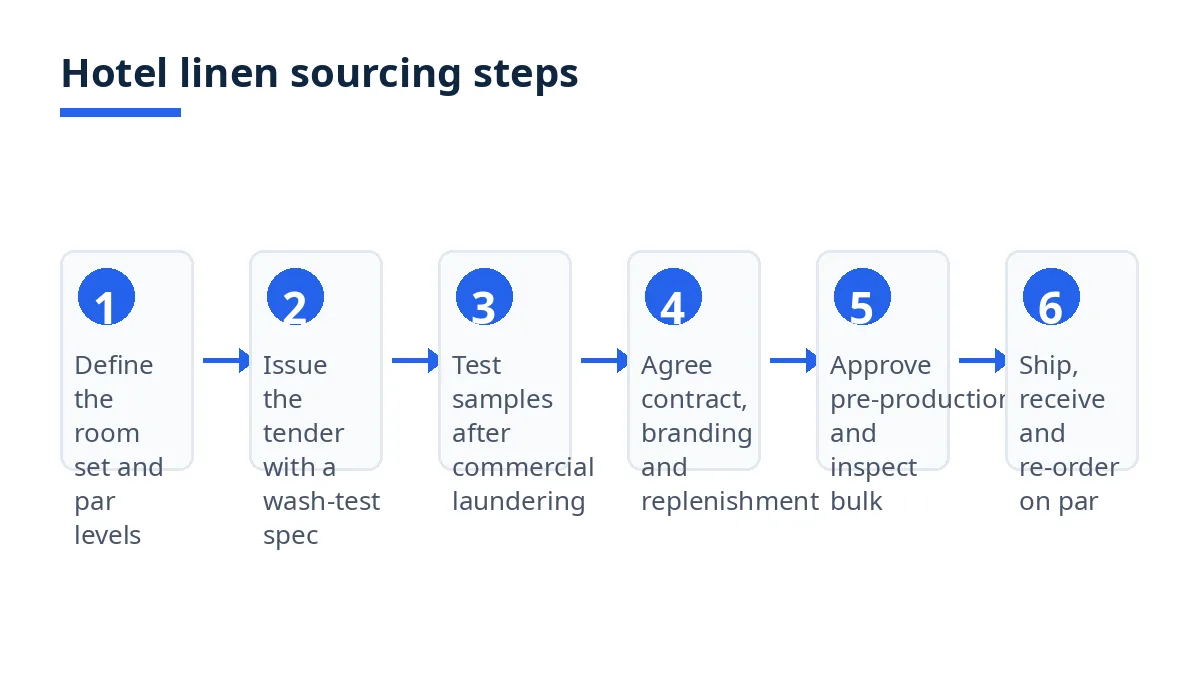
Define the room set and the par level. List every piece per room: flat sheet, fitted sheet, pillowcases, duvet cover, bath towel, hand towel, face cloth, bath mat and, where used, pool towel and table linen. State the par level, meaning how many sets the property holds per room in circulation, in laundry and in reserve. The par level, not the room count alone, sets the order quantity.
Write the tender or RFP with a wash-test specification. State fabric composition and construction, weight, size per piece, colour with a tolerance reference, stitching and hemming, label content, and the wash-performance requirement: the number of commercial wash cycles the item must survive within agreed limits for shrinkage, colour change and appearance. Ask bidders to price the room set, the par stock and the replenishment piece price separately.
Compare samples after commercial laundering. Order samples in the exact fabric, colour and construction. Wash them on a commercial cycle, or have them laundered by the property laundry, then measure, weigh and inspect them against the specification. A sample that passes one home wash proves little about hotel use.
Agree the contract, the brand treatment and the replenishment cycle. Decide white-label (unbranded or house-brand) versus branded linen, the re-order minimum per item and colour, the price validity period, and how long the supplier holds your dyed fabric or finished stock. Record who owns the artwork and the label plates.
Approve pre-production and inspect the bulk. Approve a pre-production sample in the production fabric, colour and labels, measured and laundered, before bulk cutting. Agree an inspection plan for the bulk lot, including checks on size, colour consistency across the lot, stitching, labelling and packing by room set or by item.
Receive, check and re-order on par. On arrival, check counts per item and colour against the packing list, and spot-check sizes and labels. Track consumption per item so replenishment orders are placed before par stock falls short.
Example figures: a 120-room hotel holding 3 par of a room set needs 360 bath towels in circulation plus reserve handling, before spares for damage and loss. These figures show structure only, not a typical order quantity, price or lead time.
Costs, timelines and documents
What are the typical costs and timelines?
No typical costs or timelines can be stated as fact for hotel linen, because each supplier prices your fabric, weight, colour, label treatment, packing and delivery term.
Cost driver | What to state in the tender |
|---|---|
Fabric and weight | Composition, construction and weight per piece |
Colour | Dye-to-order or stocked colour, with tolerance reference |
Room set and par level | Pieces per room and par level, per item |
Branding | White-label, house-brand woven label, or printed label, with artwork |
Wash-performance testing | Required wash cycles and limits for shrinkage and colour change |
Packing | Packed by room set, by item, or by property, with carton marks |
Delivery term | One named delivery term for every quotation |
For timelines, sampling depends on fabric availability and correction rounds, and bulk production on dyeing, finishing, label runs and line capacity. Ask for sampling, fabric ready, production and inspection dates as separate lines, not a single delivery week.
Which documents are needed?
The order documents are the tender or RFP, the itemized quotation, the approved specification and the purchase order, with the room set, par level, wash requirement, brand treatment and replenishment terms on all of them. For export clearance in Bangladesh, goods cannot be loaded until a Bill of Export (Shipping Bill) is submitted and approved, and the standard export documents include the export contract or purchase order, commercial invoice, packing list, EXP form certified by an authorized dealer bank, and certificate of origin issued by the EPB or a Chamber of Commerce.3
Agree one delivery term for every quotation. The Incoterms 2020 rules set out 11 rules, seven for any mode of transport and four for sea and inland waterway transport, allocating cost, risk and obligations between seller and buyer.4 Compare hotel linen quotations only on the same term and named place.
Bangladesh-specific rules and tips
Specify wash performance with a named method, not a promise. ISO 6330:2021 sets out domestic washing and drying procedures for textile testing, and its procedures are used in evaluations including dimensional change, colour fastness to domestic laundering and care labelling.5 For hotel linen, agree in writing whether testing follows a domestic procedure, a commercial laundry procedure, or your own property laundry cycle, and record the number of cycles and the pass limits. A supplier claim of durability without a method, a cycle count and a limit cannot be checked on delivery.
Get fibre and care labelling right for each destination market. Regulation (EU) No 1007/2011 lays down harmonised provisions on textile fibre names and the labelling and marking of fibre composition for textile products sold in the European Union.6 In the United States, the Federal Trade Commission Care Labeling Rule requires care instructions on textile products, and care instructions follow an order covering washing, washing temperature, machine programme, bleaching, drying, ironing and warnings.7 Put fibre content, care content and label placement in the tender, per market.
Treat hygiene and chemical claims as certificate checks. OEKO-TEX Standard 100 tests textile products against a list of harmful substances, and its product classes separate items by skin contact: bed linen sits in Product Class II for products with direct skin contact, while furnishing materials sit in Product Class IV.8 Certificates are valid for 12 months with annual renewal.8 Ask for the certificate number, product class and expiry date, and check the scope covers your exact items.
Ask about flame-retardant and hygiene requirements before sampling. Where your property, your chain standard or your market requires flame-retardant treatment for items such as curtains, bedding or upholstery fabrics, name the required test method and the pass standard in the tender and ask for the test report for the production batch. Do not accept a general statement that an item is flame retardant without a named method and a batch report. Apply the same rule to any hygiene or antimicrobial claim.
Keep one legal name across every paper. The export declaration names the exporter and the foreign buyer,3 so the name on the trade licence, quotation, proforma invoice and payment account should match. For a hotel group, confirm whether the buyer entity on the purchase order matches the entity that will clear the goods on import.
Mistakes and red flags
What are the most common mistakes?
Buying on unit price without a wash specification. The cheapest towel per piece is rarely the cheapest per occupied room night once early replacement is counted. Compare quotations on the same wash requirement, not only the same size.
Sampling once, at home. A sample washed once at home and approved without measuring hides shrinkage and colour loss that commercial laundering reveals. Measure and launder every sample round against the written limits.
Ordering white-label and branded linen interchangeably. A branded label run has its own minimum and lead time, and a re-order of a branded item cannot be substituted with an unbranded piece without the guest noticing. Decide the brand treatment per item before the first order.
Ignoring the replenishment minimum. A hotel that orders a full room set once and assumes single pieces can follow at any time may find the dye lot or label minimum blocks a small re-order. Agree the replenishment minimum per item and colour in the first contract.
Accepting a colour match by eye alone. Colours drift between dye lots. Keep an approved reference sample from the bulk lot and compare each replenishment delivery against it before acceptance.
Treating a profile or a badge as proof of wash performance. A profile is a starting point for enquiries. It does not test whether linen survives commercial laundering, and a badge is not a guarantee of quality, durability or delivery.9
Checklist
Before you confirm, every line should be answered in writing.
Room set defined per room: every piece, size, weight and colour, with a tolerance reference.
Par level agreed per item, with reserve and damage allowance.
Wash-performance requirement stated: method, cycle count and limits for shrinkage, colour change and appearance.5
Samples measured and commercially laundered, then approved in writing.
Brand treatment decided per item: white-label, house-brand or printed label, with artwork ownership recorded.
Replenishment terms agreed: minimum per item and colour, price validity, and stock holding of your specification.
Fibre and care labelling confirmed per destination market.6 7
Certificates checked: number, product class, scope and expiry date.8
Flame-retardant or hygiene requirements named as test method plus batch report, where required.
Inspection plan agreed for the bulk lot, including colour consistency across the lot.
Delivery term and named place stated on every quotation.4
How Exportain helps
On Exportain, browse suppliers and post a request for quotation (RFQ) on the RFQ board with your room set, par level, wash-performance requirement, brand treatment and delivery term, so suppliers quote against the same tender specification. Ask each reply for its replenishment minimum per item and colour and its stock-holding terms.
Read the badges for what they record. Exportain Verified means approved identity, a verified phone and email, and an approved, unexpired business registration, while Export Verified adds an approved, unexpired Export Registration Certificate (ERC), and Factory Verified adds approved factory photos.9 A paid plan never adds a badge, and every submission is reviewed by the Exportain team.9 Verification is a document and photo review, not a factory inspection, so sample approval and wash testing stay with you. Read how to buy before placing an order.
FAQs
What should I know first about Home Textiles & Towels Sourcing From Bangladesh for Hotels and Hospitality Buyers?
Start with the room set and the par level, not the catalogue. Specify every piece per room, the par level per item, the wash-performance requirement as a method plus a cycle count, and the brand treatment per item. Home textile exports from Bangladesh include towels, bed linen, sheets and pillowcases,2 and heading 6302 covers bed linen, table linen, toilet linen and kitchen linen.1 Price the room set, the par stock and the replenishment piece price separately.
What are the typical costs and timelines?
There are no typical figures a buyer can rely on, because each supplier prices your fabric, weight, colour, label treatment, packing and delivery term. Fabric and dye lots, label runs and line capacity drive the price, and sampling, dyeing, finishing and inspection drive the timeline.4 Ask for sampling, fabric ready, production and inspection dates as separate lines, and compare quotations only on the same delivery term and named place.### Which documents are needed?
The order documents are the tender or RFP, the itemized quotation, the approved specification and the purchase order, with the room set, par level, wash requirement, brand treatment and replenishment terms on all of them. The export set is the Bill of Export, commercial invoice, packing list, EXP form certified by an authorized dealer bank, and a certificate of origin issued by the EPB or a Chamber of Commerce.3 Fibre and care labelling follows the destination market rules.6 7
What are the most common mistakes?
The most common mistakes are buying on unit price without a wash specification, approving a sample after one home wash, mixing white-label and branded items, ignoring the replenishment minimum, and reading a badge as proof of wash performance.9 Keep an approved bulk reference sample and compare each replenishment delivery against it before acceptance.
Next steps on Exportain
Browse suppliers, then post your room set, par level and wash-performance requirement on the RFQ board so suppliers quote against the same tender specification. Before you confirm, read how to buy and the guide on how to import hotel linen from Bangladesh.
Sources
- HS 2017 - Code 6302: Bed linen, table linen, toilet linen and kitchen linen. United Nations Statistics Division (accessed )
- Bangladesh's home textile exports bounce back. Asia News Network (accessed )
- Custom Clearance in Bangladesh: Port Procedures and C and F Agent Guide. Bizmend (accessed )
- Incoterms® 2020. International Chamber of Commerce (ICC) (accessed )
- BS EN ISO 6330:2021 Textiles — Domestic washing and drying procedures for textile testing. BSI, (accessed )
- Regulation (EU) No 1007/2011 on textile fibre names and related labelling and marking of the fibre composition of textile products. European Union, (accessed )
- Care Labels. Coats Group (accessed )
- OEKO-TEX Standard 100: Frequently Asked Questions. XM Textiles (accessed )
- Sell Bangladeshi Products to Global Buyers | Exportain. Exportain (accessed )
About the author
Sourcing from Bangladesh?
Post a request for quotation and suppliers on Exportain can send you their quotes directly.
Post an RFQ


