

E-Commerce Brands Electrical & Solar Sourcing From Bangladesh
E-commerce brands sourcing electrical and solar products from Bangladesh: listing-ready specifications, market compliance files, fulfilment routes, and returns handling for online assortments.
Short answer
For e-commerce brands, electrical and solar sourcing from Bangladesh works when each listing is built first: the exact product specification, plug and voltage variant, retail pack, and market compliance file agreed before production, so the listing that goes live matches the parcel the customer receives, including its returns route.

On this page
Key takeaways
Build each listing first: the exact specification, plug and voltage variant, retail pack, and market compliance file agreed before production, so the live listing matches the parcel the customer receives.
Confirm the market route before shortlisting: EU conformity assessment and declaration, FCC certification or Supplier's Declaration of Conformity for US devices, and distance-selling safety information for EU online sales.
Approve the sample, retail pack, and listing text as one written approval, and cost product, packaging, freight, fulfilment, and returns as separate lines.
Confirm the HS heading for each product form, and keep plug, voltage, and language variants separate by order line, carton, and barcode.
Launch small, review customer questions and returns weekly in the first month, and treat a marketplace badge as a document and photo review, not a factory inspection.
An e-commerce brand does not buy electrical and solar products the way a store chain buys them. There is no shelf to fill and no store staff to answer questions. The product page has to do that work: the specification, photographs, safety information, plug type, warranty route, and returns path all have to be right before the first order ships. The order works when built listing-first: one specification sheet per listing and one compliance file per sales market, agreed before production.
That listing-first discipline separates a repeatable online range from a one-off import. A cable, a bulb, or a small solar kit can look simple in a photograph and still fail online: the wrong plug, a label in the wrong language, a missing declaration, or a carton that cannot survive a courier network. This guide covers the e-commerce version of the job, from assortment to launch to returns.
Why this matters for buyers and sellers
For the e-commerce brand, the listing is the storefront, the salesperson, and the instruction manual at once. A buyer cannot pick the product up or ask whether a solar light also charges from a wall outlet. Every answer has to be in the listing text, the images, and the documents that travel with the parcel.
For the seller, an e-commerce account is a programme of small, repeatable shipments rather than one large delivery. The supplier that holds specification, packaging, and labelling steady across small batches earns the repeat order. One that changes a plug type or carton size without warning forces the brand to re-shoot photographs and rewrite listings.
What should I know first about electrical and solar sourcing from Bangladesh for e-commerce brands?
Know the sales market before you ask for a price. In the European Union, CE marking indicates that a product meets the relevant EU legal conformity standards for safety, health, and environmental protection, and it applies only to products falling under EU legislation that requires CE marking.1 Where CE marking is necessary, the manufacturer must carry out a conformity assessment, decide whether a notified body must be involved, set up the technical file, draft and sign an EU declaration of conformity, and attach the CE marking to the product.1 As an importer, you must check that the manufacturer has done this, and the product, packaging, or accompanying documentation must carry your name and contact address, with instructions and safety information in a language easily understood by end users in the destination country.2
For the United States, any electronic device marketed or sold in the US must have Federal Communications Commission approval, with the FCC setting limits on intentional and unintentional radio signals.3 Devices that intentionally radiate radio signals, such as Wi-Fi routers and Bluetooth devices, require certification, while unintentional radiators, such as IT equipment and power adapters, can be authorized either by certification or by a Supplier's Declaration of Conformity.3
For online sales into the EU, the General Product Safety Regulation adds distance-selling duties for online marketplace providers, including a single point of contact for product safety, an interface that displays accessible product information, internal product compliance processes, and registration with the EU Safety Gate portal, plus removal of dangerous products flagged by authorities within two working days.4 A brand selling under its own name can itself count as the manufacturer, so the compliance file must be built for the brand.
Step-by-step: how it works
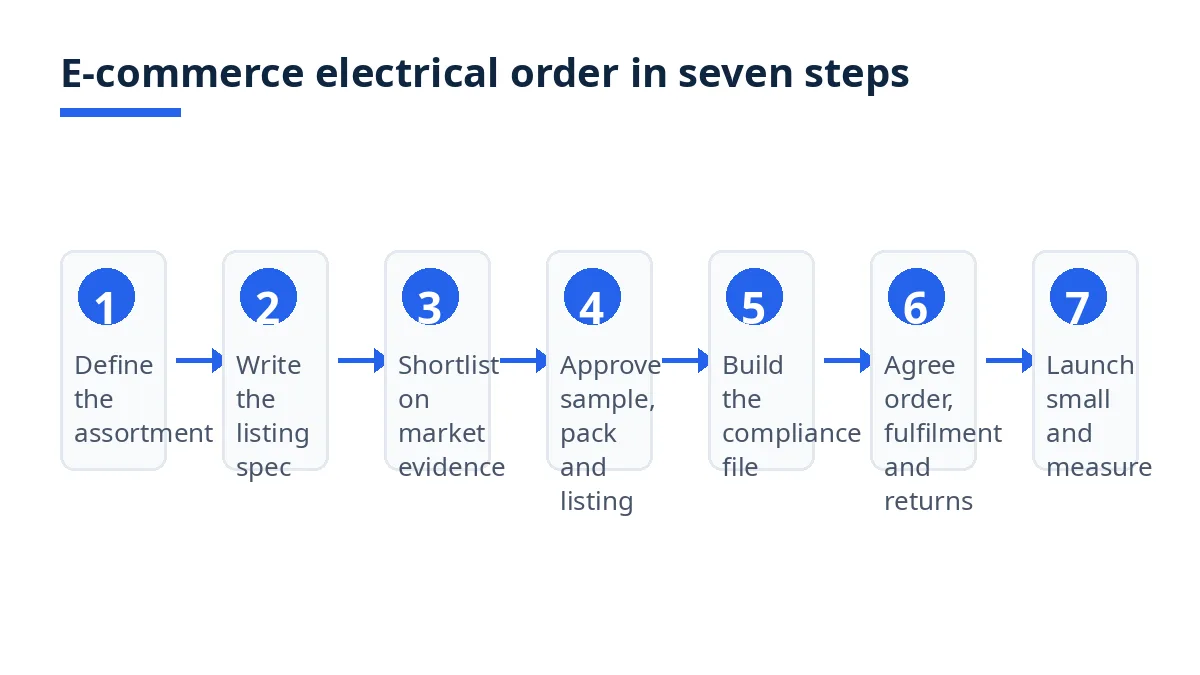
Define the online assortment, not a container load. List each planned listing separately: product type, function, power rating, plug type, voltage, and target market. A solar lantern for the EU, a USB charger for the US, and an extension board for the UAE are three different compliance files, even if one supplier makes all three.
Write a listing-ready specification sheet per product. For each listing, record the full specification a customer would need: function, wattage or capacity, input and output voltage, plug and socket type, cable length and gauge where relevant, materials, dimensions, weight, pack contents, and warranty terms. Add the listing assets to the same sheet: photographs, safety warnings, and the exact specification table wording. Suppliers quote against this sheet, not against a product name.
Shortlist on market evidence, not price alone. Ask for the test reports, declarations, and technical documentation that apply to your market, plus a sample in the exact retail pack. For US radio products, ask whether the route is certification with an FCC ID or a Supplier's Declaration of Conformity, and for EU products ask for the conformity assessment route and the EU declaration of conformity.1 3
Approve the sample, the pack, and the listing together. Order a sample in the exact retail packaging, with the exact label, barcode, and instruction leaflet. Photograph it for the listing, test it at the stated rating, and check the label against the market rules for that destination. Approve sample, packaging, and listing text in writing as one approval.
Build one compliance file per market. Hold the test reports, declarations, technical documentation references, label artwork, and instruction translations in one file per market, per product. For EU distance sales, include the manufacturer and responsible-person details that must be visible to buyers.4 No product goes live in a market until its file for that market is complete.
Agree the order, fulfilment, and returns terms in writing. State the price basis, minimum order quantity, carton configuration, the Incoterms 2020 rule with a named place, payment terms, and the fulfilment route: consolidated shipment to a fulfilment centre, or small-parcel shipment direct to customers. The Incoterms 2020 rules allocate cost, risk, and obligations between seller and buyer.5 Agree the returns route at the same time: who receives returned units, who pays return freight, and what happens to units that cannot be resold.
Launch small, measure, then reorder. Launch with a controlled quantity, watch the first weeks of customer questions, delivery damage, and returns, and fix the listing before scaling. A listing that generates the same question repeatedly needs a specification rewrite, not a larger shipment.
Example figures: a brand launching three listings might order a first batch covering eight weeks of forecast sales per listing and review questions and returns weekly for the first month. The numbers are illustrative only.
Costs, timelines and documents
What are the typical costs and timelines for an e-commerce electrical order?
There are no typical costs or timelines a guide can state as fact for e-commerce electrical products from Bangladesh: each supplier prices your product type, rating, plug variant, pack format, order quantity, and delivery term, and each route carries its own freight and fulfilment charges. Ask for product price, retail packaging, carton and labelling, freight and insurance, fulfilment intake and storage, clearance, and returns handling as separate lines. Compare quotations only when specification, pack format, plug variant, and delivery term match.
Timelines work the same way. Sampling depends on whether the rating and pack are stocked or produced to order, production on component availability, and delivery on freight booking and fulfilment-centre intake. Ask for sampling, production, shipment, and fulfilment-ready dates as separate lines.
Which documents are needed for an e-commerce electrical shipment?
For export clearance in Bangladesh, goods may not be loaded unless an export declaration, the Bill of Export or Shipping Bill, is submitted to Customs and approved.6 Enclosed documents include the export contract or purchase order where there is no export letter of credit, the commercial invoice, the packing list, the EXP form certified by an authorized dealer, and a certificate of origin issued by the Export Promotion Bureau or a Chamber of Commerce and Industry.6 The buyer should also hold the market compliance file, the approved sample specification and listing text, and the import documents its own market requires, so fulfilment intake can match cartons and barcodes to papers.
Bangladesh-specific rules and tips
Confirm the classification for each product form. In the Harmonized System, Chapter 85 covers electrical machinery and equipment and parts thereof, including sound and television recorders and their parts and accessories.7 Cables, motors, lamps, and solar panels fall under different headings within and around that chapter, so confirm the heading for the exact form you order.
Design the retail pack for a courier network, not a pallet. E-commerce parcels are handled many more times than a palletised carton, so the retail pack must protect the product through sorting, last-mile delivery, and a possible return journey. State its dimensions and weight on the specification sheet.
Fix plug, voltage, and language variants per listing. One product with four plug variants is four listings, four labels, and four instruction leaflets. Name the variant on the order line, the carton, and the barcode, and never mix variants in one carton without a variant-level packing list. Instructions must be in a language easily understood by end users in the destination country.2
Plan the returns loop before launch. Electrical and solar products come back for reasons a garment rarely does: wrong plug, misunderstood capacity, or a fault that only shows in use. Write the returns rule into the supply agreement: who inspects returned units, whether the supplier credits, repairs, or replaces, and how repeat faults trigger a listing hold.
Keep small-parcel and consolidated freight separate in the costing. A first launch batch may travel as a consolidated shipment to a fulfilment centre, while reorders may travel as small parcels. Each route has different freight, clearance, and handling lines.5 Cost each route separately and name the rule and named place for each one.
Mistakes and red flags
What are the most common mistakes for e-commerce electrical brands?
Ordering by product name alone. A quotation for a solar light without wattage, battery capacity, panel rating, plug type, and pack format cannot be compared with another quotation. Every order line needs the full listing specification.
Approving a sample but not the retail pack. A sample that passes testing in a plain box can still fail online when the retail pack carries the wrong label or barcode, or no safety information. Approve sample, pack, and listing as one approval.
Borrowing a compliance file from another market. A test report or declaration written for one market does not cover another. For the EU, the manufacturer must complete the conformity assessment, set up the technical file, and sign the EU declaration of conformity.1 For the US, radio products need the correct FCC route for that device.3 One file per market, checked before launch.
Listing a specification the shipment does not match. A listing that promises a capacity, cable length, or charging time the shipped unit does not meet will generate returns. Match the listing text to the approved sample, word for word, and re-check it on every reorder.
Treating a marketplace badge as a guarantee. A badge records what a marketplace has checked, not what the customer will receive. On Exportain, verification checks cover identity, phone and email, business registration, the Export Registration Certificate, and photos of the factory or office, reviewed by the Exportain team.8 That review is a document and photo review, not a factory inspection, so sample approval and listing checks stay with the buyer.
Red flags on a supplier reply. A reply that will not name the conformity route for your market, the plug and voltage variant, or the retail pack format; a sample in a different pack from the quotation; a price that moves when the delivery term is clarified; a supplier that cannot name its batch or serial system. Any one of these is a reason to pause.
Checklist
Before you confirm, every line should be answered in writing.
Assortment defined per listing: product type, rating, plug type, voltage, and target market.
Specification sheet complete per product, including pack contents and warranty terms.
Market evidence received: test reports, declarations, and conformity route per market.
Sample approved with retail pack, label, barcode, leaflet, and listing text as one approval.
Compliance file complete per market, including responsible-person and safety information.
Price basis stated with product, packaging, freight, insurance, fulfilment, and returns lines separate.
Delivery term stated: one Incoterms 2020 rule with a named place per freight route.
Retail pack tested for courier handling, with dimensions and weight recorded.
Plug, voltage, and language variants separated by order line, carton, and barcode.
Returns rule agreed: inspection, credit or replacement, and the fault threshold that pauses a listing.
Launch quantity sized to forecast plus buffer, with a weekly questions-and-returns review in the first month.
How Exportain helps
On Exportain, browse suppliers and post the listing specification sheet, launch quantities, and fulfilment route on the RFQ board, so suppliers quote against the same listing-ready specification rather than a generic product name. Read how to buy before you post, and ask each reply for its conformity route and retail pack format.
Read badges for what they record. Exportain's verification checks cover identity, phone and email, business registration, the Export Registration Certificate, and photos of the factory or office, reviewed by the Exportain team.8 That review is a document and photo review, not a factory inspection.
FAQs
What should I know first about electrical and solar sourcing from Bangladesh for e-commerce brands?
Know the sales market before the price: the EU conformity assessment and declaration route,1 the FCC route for US devices,3 and the distance-selling safety information for online sales into the EU.4 Confirm the classification, plug variant, and retail pack format for each listing before shortlisting.
What are the typical costs and timelines for an e-commerce electrical order?
There are no typical figures a buyer can rely on: each supplier prices your product type, rating, plug variant, pack format, quantity, and delivery term. Ask for product, packaging, freight, fulfilment, clearance, and returns as separate lines, and for sampling, production, shipment, and fulfilment-ready dates as separate lines.5
Which documents are needed for an e-commerce electrical shipment?
The order documents are the listing specification sheet, the itemized quotation, and the purchase order, with plug variant, pack format, and delivery term on both. The export set is the Bill of Export, commercial invoice, packing list, EXP form certified by an authorized dealer, and a certificate of origin issued by the Export Promotion Bureau or a Chamber of Commerce and Industry,6 plus the market compliance file for each destination.
What are the most common mistakes for e-commerce electrical brands?
The most common mistakes are ordering by product name alone, approving a sample without the retail pack, borrowing a compliance file from another market, listing a specification the shipment does not match, and reading a badge as a guarantee.8 Each is preventable in writing before the first listing goes live.
Next steps on Exportain
Browse suppliers, then post your listing specification sheet, launch quantities, and fulfilment route on the RFQ board so suppliers quote on the same e-commerce specification. Before you confirm, read the electrical products sourcing guide, the electrical and solar industry guide, and the landed cost guide.
Sources
- CE marking (EUR-Lex glossary). European Union (accessed )
- General product compliance. European Union (accessed )
- What is FCC Approval for Electronic Devices?. SGS (accessed )
- Comparative Summary of EU GPSR (Regulation (EU) 2023/988) vs UK GPSR. British Retail Consortium (accessed )
- Incoterms® 2020. International Chamber of Commerce (ICC) (accessed )
- Customs Clearance Procedures for Export. Bangladesh Customs, National Board of Revenue (accessed )
- Harmonized System Chapter 85. World Customs Organization (accessed )
- Sell Bangladeshi Products to Global Buyers | Exportain. Exportain (accessed )
About the author
Sourcing from Bangladesh?
Post a request for quotation and suppliers on Exportain can send you their quotes directly.
Post an RFQ


