Quality Control Checklist for Bamboo Furniture From Bangladesh
A culm-first QC checklist for bamboo furniture from Bangladesh: species and maturity, grading, borate treatment, drying and splitting, lamination, dimensions, joints, finish, labels and packing, with fixes for common failures.
Short answer
Use this bamboo furniture quality control checklist to check culm species and maturity, ISO 19624 grading, borate treatment evidence, drying and splitting, strip and lamination glue lines, dimensions, joints, finish, labels and packing on bamboo furniture from Bangladesh before shipment. Agree species, treatment, moisture target, tolerances and test methods in the purchase order.

On this page
Key takeaways
Start with the culm, not the finish: species, maturity and ISO 19624 grading decide whether a bamboo piece can hold its joints and dimensions.
Check treatment evidence before packing: method, solution and timing in the record, with borer signs looked for on every sampled piece, not only on visible faces.
Judge moisture and splits together, since bamboo shrinks across diameter and wall thickness as it dries, and a split through a joint is a different failure from a short end split.
Agree species, construction type, treatment, moisture target, tolerances and test methods in the purchase order, and record actual measurements rather than pass marks alone.
For bamboo chairs, tables, shelving or storage units from Bangladesh, this culm-first checklist checks a shipment before it leaves the factory. Bamboo fails differently from wood: an immature culm, an untreated pole, a split that opens as the piece dries, or a glue line that parts on a laminated board. Check the culm, the treatment record and the drying state before you judge the finish, because lacquer hides all three.
Why this checklist matters
A bamboo piece is a grass stem, not a sawn board. Fibres run along the culm, so a piece splits along its length. Nodes interrupt the fibre run, wall thickness varies along the culm, and the hollow interior shelters borers. A sound-looking chair can fail at a node, a drilled hole, or a split closed with filler and paint.
Borers feed on the sugary sap inside bamboo, so treatment decides whether a failure is insect damage or only cosmetic.1 Bamboo shrinks across diameter and wall thickness as it dries, so a joint cut to a wet culm loosens later.1 Record each point as pass, fail or not applicable against the sample, purchase order and packing specification. Agree acceptance numbers per defect class and the sampling plan in advance under ISO 2859-1, which specifies AQL-indexed sampling schemes for lot-by-lot inspection by attributes.2
Before you start
Do not begin until the references are complete: approved sample per style and finish, purchase order naming species and construction type (round culm, split strip, laminated board), dimensioned drawing, treatment and finish specifications, hardware list, and packing specification. Draw the sample at random across styles, finishes and cartons, never from pieces the factory sets aside. Bring a tape measure, straightedge, wall-thickness calliper, supplier-confirmed bamboo moisture meter, and camera. Ask for the treatment record before you arrive: which culms were treated, by which method, and when.
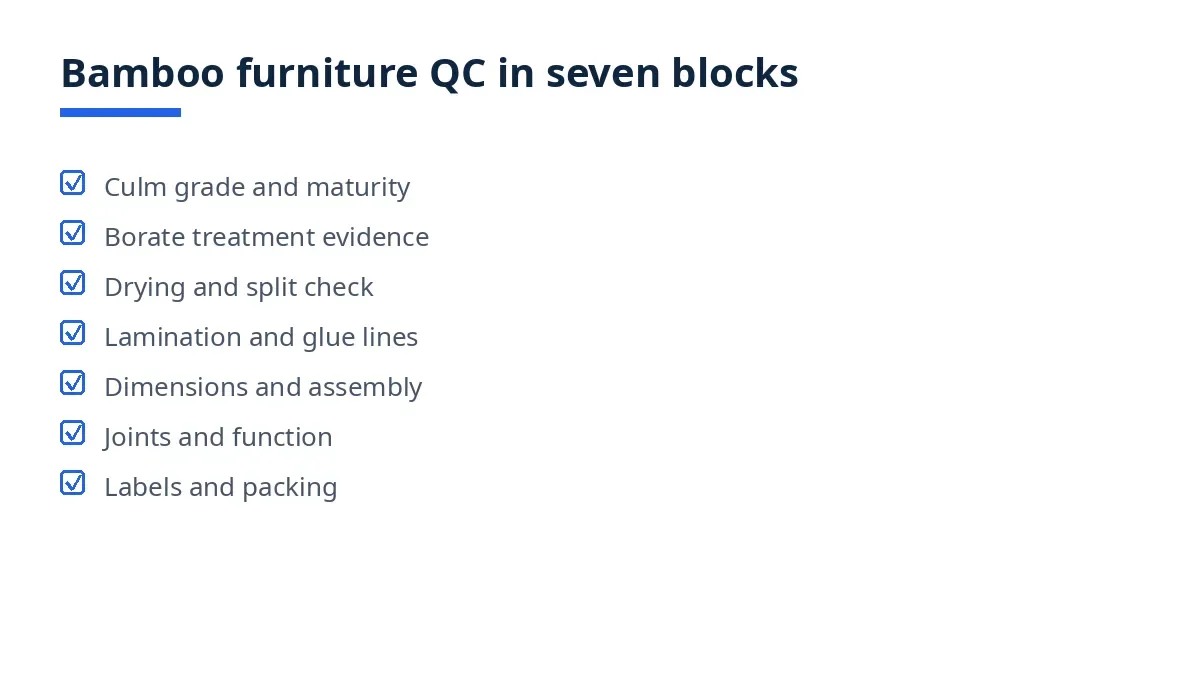
The diagram below summarises the seven blocks, in working order.
The full checklist (numbered, printable)
Culm identity, maturity and grading
Species matches the purchase order (common and scientific names where given); colour, node spacing and surface match the sample.
Maturity record shows mature culms only: UNIDO treats culms older than 3 to 4 years as mature; younger culms of 1 to 2 years must not enter the production chain.1
Grade per ISO 19624: conditional (moisture, age, insect/fungal damage, fissures, indentation), dimensional (diameter, wall, internodal length), geometric (bow, taper, ovality).3
Measure diameter and wall thickness near a node and mid-internode; record actual values vs drawing.
Segregate culms with fissures, indentation, borer holes, fungal staining through the wall, or crushed/ovalised sections.
PO treatment method used (dip diffusion, vertical sap diffusion, other named method); record names method, solution, date.
Treatment while culms were still green, not after full drying: UNIDO states diffusion depends on living cell walls.1
Boron record matches the specified solution: UNIDO describes a 5 percent boron solution, 5-day cold-water submersion, nodes drilled through.1
Live-pest signs: bore dust, small round exit holes, frass in hollow sections, hollow sound on tapping. Powder-post beetles of the Dinoderus group eat bamboo from the inside out.4
Untreated/part-treated pieces segregated, never mixed into finished stock; active-borer pieces removed before packing.
Drying, moisture and splitting
Moisture readings with the supplier-confirmed bamboo meter setting; record per piece; compare with the PO destination target.
Readings consistent across the sample, not clustered high in one carton; taken after treatment and drying.
Splits along the fibre at ends, holes, node edges and laminated edges; record length and position (a short end split differs from a split through a joint).
Suspect split ends: press lightly to see whether filler or paint closing a split without repair reopens it or runs it further.
UNIDO drying notes: bamboo shrinks around 10 percent when drying, as much in diameter as in wall thickness and almost nothing lengthwise; air drying stabilises moisture somewhere around 15 percent; young poles generally crack, slow-dried mature poles do not.1
Strips, lamination and glue lines
Strip-built pieces: strip width, thickness and node placement match the sample; nodes not clustered at one joint or edge; no stepped surface from thickness variation.
Glue lines by eye/hand: no open lines, blade-admitting gaps, starved pale lines, or hard glue ridges on visible faces.
Laminated boards: press and flex a sampled board lightly; delamination shows as a layer lifting at an edge or corner.
No laminated-for-solid substitution, or the reverse, unless the purchase order was amended; record any substitution as a failure.
Load-bearing laminated boards: agree test method and acceptance level first. ISO 22157:2019 covers round-culm moisture, density, mass per unit length, and parallel and perpendicular compression, tension and bending.5
Dimensions, squareness and assembly
Length, width, height, depth vs drawing, actual values; culm diameters at the same points every piece.
Squareness: both diagonals of tops, frames, doors and drawer fronts match within tolerance.
Piece stands level, all feet touching the floor; rocking not corrected by trimming a foot short of the drawing.
Symmetry: legs, rails, stretchers, panels aligned, no racking or twist; curved sections match the sample curve, not a forced bend.
Flat-pack: every listed section, strip, panel, fixing and tool present in a sampled carton; instructions match parts.
Joints, hardware and function
Joints (lashed, pinned, bolted, dowelled, glued, or combined) fully seated, tight shoulders, no gaps; lashings taut, even, no loose ends.
Drilled holes: no radiating splits, crushed wall, or fixings too close to a node or end to hold.
Fixings of the specified size and type, driven straight and seated; no split culm around holes; none missing.
Use-test each piece as its buyer will: sit, open/close, extend, load; nothing loosens, racks, or splits at a joint.
Strength, durability or stability evidence: agree test method and acceptance level first. ISO 7170:2021 covers storage units, ISO 7173:2023 covers chairs and stools, and ISO 19682:2023 covers tables, as strength, durability and stability test methods.6
Surface, colour and finish
Whole surface by hand and eye: splinters, sharp node edges, rough strip edges, dents, scratches, filler through the finish, including hollow ends and under rails.
Finish consistency vs sample everywhere, including inside doors/drawers: colour, sheen, coverage; no runs, misses, or leached pale patches.
Sun-bleached/torched finishes vs sample only: uneven tone from uneven turning during bleaching is a failure, not natural variation.
Stain, oil or lacquer named in the purchase order is the one used; no finish hides an open split, a borer hole or a failed glue line.
Labels and packing
Labels carry market and PO requirements: material (bamboo / laminated bamboo), care, origin, compliance statements; legible, correctly placed.
Carton protection: ends/nodes guarded, pieces separated, hollow ends plugged/capped if the pack requires, hardware bagged.
Carton contents vs packing list: model, finish, quantity, hardware, markings; heavy laminated pieces not above light culm pieces.
Weigh and measure sample cartons; markings and carton count against the packing list.
Common failures and how to fix them
The most frequent failure is splitting after delivery, usually traced to drying or immature culms. A young culm, or a culm dried fast in direct sun lying on the ground, cracks along its length as moisture leaves, and the crack opens further in a dry, heated home.1 Stop, re-check maturity and moisture records, and hold cartons outside the destination target until the supplier explains the gap.
The next failure is borer damage found after packing, traced to treatment timing or coverage. A pole treated after drying, or a pole whose nodes were never drilled through, carries untreated tissue inside a finished piece.1 Segregate affected pieces, re-inspect the lot, and require the supplier to name the treatment actually applied before rework.
Open glue lines usually trace to strip thickness variation or glue starvation: re-check a sample board and rework from the glue line outward, not by filling it. Above the agreed acceptance level, options are re-inspection after sorting or rework, documented partial acceptance, or rejection.
Downloadable template / summary table
Copy the checklist into your inspection sheet, add the species, construction type, treatment record, moisture target and acceptance numbers, and record a result per piece.
Section | Checks | Evidence |
|---|---|---|
Culm and grading | Species, maturity, diameter, wall, fissures | Sample comparison, measurements |
Treatment and pests | Method, timing, solution, borer evidence | Treatment record |
Drying and splitting | Moisture readings, splits, filler | Readings per piece |
Strips and lamination | Strip size, glue lines, delamination | Hand and edge check |
Dimensions and assembly | Measurements, squareness, level | Actual values |
Joints and function | Joint seating, fixings, use tests | Function check |
Surface and finish | Splinters, colour, finish, hidden defects | Hand and eye check |
Labels and packing | Labels, protection, contents | Packing list |
How Exportain helps
Exportain is a B2B marketplace connecting buyers with Bangladeshi suppliers of bamboo furniture, so species, construction type, treatment and moisture target can be agreed at enquiry. Browse suppliers, read the furniture sourcing guide and the HS code for bamboo furniture guide, and use inspection services when you plan the check. Supplier profiles show document and photo checks recorded, not factory inspections. Exportain is not a party to the goods contract and does not inspect goods.
FAQs
When should this checklist be used?
Use it at final inspection, when goods are finished, treated, dried and largely packed; for larger and first orders, also during production, while culms can still be segregated.
Who should complete it?
The buyer, a local agent or an independent inspector can complete it, using the approved sample, the drawing, the treatment record and a random sample.
What are the most common failures?
Splitting during drying, borer damage from late or partial treatment, open glue lines, and finish defects hiding a split or hole.
Can a third party do it?
Yes, if you share the approved sample, the drawing, the treatment specification, the moisture target, tolerances and acceptance levels first.
Next steps on Exportain
Before production, agree species, construction type, treatment, moisture target, tolerances and test methods in writing, then read the pre-shipment inspection guide and the AQL acceptance quality limit explainer, and plan the check with inspection services. Post a free RFQ via RFQs to compare quotes.
Sources
- Bamboo Treatment User Guide. United Nations Industrial Development Organization (accessed )
- ISO 2859-1:2026 - Sampling procedures for inspection by attributes — Part 1: Sampling schemes indexed by acceptance quality limit (AQL) for lot-by-lot inspection. ISO (accessed )
- ISO 19624:2018 - Bamboo structures - Grading of bamboo culms - Basic principles and procedures. International Organization for Standardization (accessed )
- Vernacular Methods Of Treating Bamboo You Should Know. Bamboo U (accessed )
- ISO 22157:2019 - Bamboo structures - Determination of physical and mechanical properties of bamboo culms - Test methods. International Organization for Standardization (accessed )
- ISO/TC 136 - Furniture catalogue: ISO 7170:2021, ISO 7173:2023 and ISO 19682:2023. International Organization for Standardization (accessed )
About the author
Sourcing from Bangladesh?
Post a request for quotation and suppliers on Exportain can send you their quotes directly.
Post an RFQ