Quality Control Checklist for Auto Parts From Bangladesh
A numbered QC checklist for auto parts from Bangladesh: fitment and vehicle compatibility, dimensions and tolerances, materials and finish, braking and suspension parts, rubber seals and hoses, electrical parts, marking and packing, with fixes for common failures.
Short answer
Use this auto parts quality control checklist to check part identity and vehicle fitment, dimensions and tolerances, materials and finish, braking and suspension parts, rubber seals and hoses, electrical parts, and marking and packing on auto parts from Bangladesh before shipment. Agree the sampling plan, tolerances, test methods and acceptance numbers in the purchase order.

On this page
Key takeaways
Agree the sample, tolerances, test methods and acceptance numbers before inspection, and draw the sample randomly across part numbers, lots and cartons.
Check fitment first: a part that looks right but matches the wrong vehicle application fails once fitted, whatever its finish.
Apply general tolerances only where the drawing invokes them, and record actual measurements for critical dimensions, fits and finishes.
Check market rules per destination: brake approval markings for Europe and certified standards for regulated parts in the United States.
If you buy auto parts from Bangladesh, this auto parts quality control checklist gives you a practical way to check a shipment before it leaves the factory. An auto part fails at fitment and function, not only at appearance: a brake pad for the wrong application, a bush with the wrong bore, or a hose with the wrong end fitting all fail once fitted. Work through the part families in your order one at a time, and record actual measurements rather than tick marks alone.
Why this checklist matters
Auto parts differ from most other export goods because the buyer rarely judges the part alone. The part must match a vehicle application, mate with neighbouring components, and hold up under heat, vibration, oil, and road spray. A dimensional error that would be cosmetic on another product can stop a brake, steering, or suspension part from fitting at all, and a material substitution can shorten the life of a rubber or plated part long after delivery. Each point is recorded as pass, fail, or not applicable.
Before you start
Do not begin until the references are complete: an approved sample per part number, the purchase order and packing specification, the drawing with its tolerance note, the vehicle application list with its original equipment cross-reference, and the material and finish specification for each part family. Agree the sampling plan in advance, and draw the sample randomly across part numbers, production lots, and cartons, never from pieces the factory selects. ISO 2859-1 specifies an acceptance sampling system for inspection by attributes, indexed by the acceptance quality limit (AQL), and its schemes apply to end items, components, and raw materials.1 Agree the AQL value per defect class and the handling of safety-related failures in the purchase order; this article states no universal sampling figure, because the correct plan depends on the lot and the part. Where a certificate is claimed, check that its scope covers your part family and that it is current: IATF 16949:2016, based on ISO 9001:2015, strengthened product safety, risk management, traceability, and supplier development when it replaced ISO/TS 16949 in 2016.2
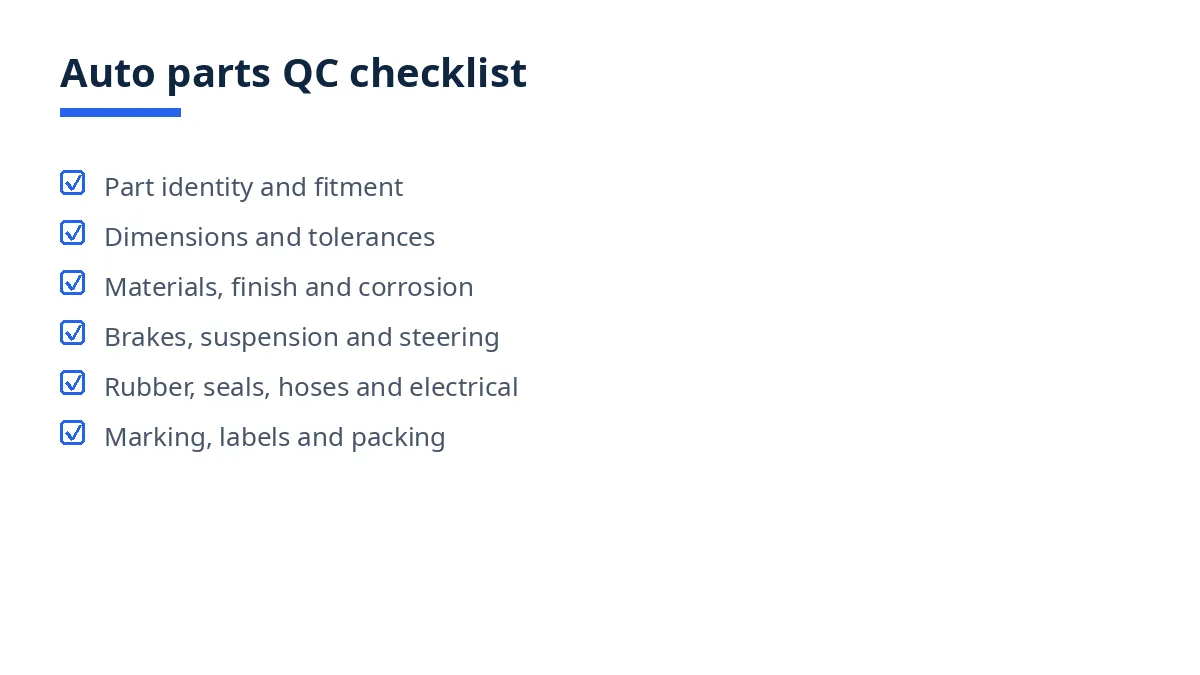
The full checklist (numbered, printable)
Part identity and fitment
Check the part number on the part, label, and carton against the purchase order and drawing; no mixed part numbers in one carton.
Check the vehicle application list and original equipment cross-reference for every part number, including model, year range, and engine variant where named.
Check mounting points, hole positions, and bracket shapes against the sample, and trial-fit sampled parts to their mating component where available.
Check handed parts separately: left and right versions must be labelled as such and never mixed in one carton.
Check kit completeness against the packing specification, and segregate superseded or look-alike part numbers.
Dimensions and tolerances
Measure the critical dimensions on the drawing: overall size, bore and shaft diameters, hole spacing, thread size and pitch, and thickness where stated.
Where the drawing invokes a general tolerance, apply it exactly. Per ISO 2768-1, the linear tolerance classes are f (fine), m (medium), c (coarse), and v (very coarse), and per that standard a dimension over 30 mm up to 120 mm in class m carries a tolerance of plus or minus 0.3 mm.3 Never apply a general tolerance to a dimension with its own stated tolerance.
Check fits that matter in service: a bush must match its shaft, a bearing seat its bearing, and a fastener its threaded hole, without force.
Check flatness on discs, plates, and panels against a flat reference, and check edges and burrs by hand and eye, since no sharp edge or flash may remain where a fitter, seal, or hose contacts the part.
Compare every measurement with the drawing tolerance, record actual values, and re-measure any failure before deciding whether the lot or only that piece is affected.
Materials, finish and corrosion
Check the material named in the specification against the evidence for the lot: steel grade, rubber compound, or plastic type must match the order, and any material certificate must name its lot.
Check plating and coating coverage on every visible surface and inside recesses where specified, looking for thin spots, missed areas, blistering, peeling, and rust, and compare adhesion, colour, and gloss with the sample.
Where corrosion evidence is required, ask for the salt spray method by name. ISO 9227 covers neutral salt spray (NSS), acetic acid salt spray (AASS), and copper-accelerated acetic acid salt spray (CASS); per that standard, the exposure period for a product is given in its product specification, not in the test method.4
Check temporary corrosion protection: parts must be oiled, wrapped, or bagged as specified, with no bare steel travelling unprotected in a damp carton.
Braking, suspension and steering parts
Check brake pads and shoes against the approved sample: friction material, backing plate shape, chamfer, slot, shim, and wear indicator where named.
For replacement brake pads and linings sold into Europe, check the approval marking and its scope. Under ECE Regulation 90, such pads and linings are subject to standardised testing and approval, and released pads are identified by information printed on the rear of the base plate.5
Check brake discs and drums for surface cracks and scoring, and measure thickness and runout against the drawing minimum and limit where stated.
Check shock absorbers, struts, ball joints, tie rod ends, and control arm bushes for oil leaks, rod damage, play, boot damage, missing grease, and thread damage against the sample.
Check springs for free length, coil damage, and coating condition, and segregate any spring with a cracked or deformed coil.
Rubber, seals and hoses
Check rubber parts for cracks, cuts, surface bloom, and deformation, including inside folds and mould parting lines where cracks start.
Check seals, O-rings, and gaskets for profile, cross-section, and dimensions against the sample and drawing, and confirm the specified compound.
Check hoses for bore, wall, reinforcement, and end fitting type and thread, and trial-fit sampled hoses. Where a pressure or leak test is specified, confirm method, lot, and result; never substitute a visual check for a specified pressure test.
Electrical parts
Check lamps by function test: each sampled lamp must light correctly, sit in its housing, and match the connector in the pack.
Check wiring, connectors, and terminals for pin fit, terminal security, insulation damage, and wire colours where named.
Check switches, sensors, and relays by function against the sample, confirm part number and polarity or direction marking, and check for exposed conductor, melted insulation, or a loose crimp.
Marking, labels and packing
Check that every part or its immediate packing carries the part number, application, batch or lot mark, and origin marking the order and market require.
Check market rules for the destination before packing. In the United States, most Federal motor vehicle safety standards apply only to new vehicles, but certain standards apply to parts and equipment whether installed in new vehicles or sold in the aftermarket, including No. 106 (brake hoses), No. 108 (lamps and reflective devices), No. 109 (new pneumatic tires), No. 116 (brake fluids), No. 205 (glazing materials), and No. 209 (seat belt assemblies); a regulated item must be certified as meeting its standard.6
Check the declared classification against the part identity with your broker. Heading 8708 covers parts and accessories of the motor vehicles of headings 8701 to 8705, with subheadings for brakes, gear boxes, axles, road wheels, and suspension systems, but a part named more specifically elsewhere falls under that heading.7
Check carton quantities, weights, and markings against the packing list, and confirm each carton is labelled with part number, quantity, and lot.
Check protection inside the carton: heavy parts separated from lighter parts, sharp edges covered, and moisture protection as specified. No carton may contain a failed part; rejected pieces must be segregated and marked.
Common failures and how to fix them
The most frequent failure is a part that looks right but fits the wrong application, usually because two part numbers share a shape and differ only in a mounting hole or a connector. Stop, compare the suspect part with the approved sample and the application list, and re-sort the lot by part number before more cartons are packed. Next is a mixed batch, where one production lot with a finish or hardness problem is packed across many cartons: segregate by lot mark and re-inspect the affected lot on its own. Rust on arrival usually traces to missing or damaged temporary protection rather than to the plating itself, so check the wrapping and oiling on the next carton before the rest of the shipment is packed. Cracked rubber points to compound, storage, or age: compare the failed pieces with the sample, check the lot and production date, and hold the lot until the cause is known.
Downloadable template / summary table
Copy the checklist into your inspection sheet, add drawing numbers, tolerances, acceptance numbers, and test methods, and record a result per part number.
Section | Checks | Evidence |
|---|---|---|
Identity and fitment | Part number, application, trial fit, kits | Sample comparison, fit check |
Dimensions | Critical sizes, fits, threads, flatness | Measured values |
Materials and finish | Material, plating, corrosion evidence | Certificates, test reports |
Brakes and suspension | Pads, discs, shocks, joints, springs | Approval marks, measurements |
Rubber and hoses | Cracks, seals, hose fittings, leak tests | Sample comparison, reports |
Electrical | Lamps, wiring, switches, sensors | Function tests |
Marking and packing | Labels, market rules, cartons, protection | Packing list, carton check |
How Exportain helps
Exportain is a B2B marketplace connecting buyers with Bangladeshi suppliers of auto parts and light engineering goods, so the drawing, application list, tolerances, and test methods behind this checklist can be agreed at the enquiry stage. Browse suppliers, plan the check with inspection services, and read the pre-shipment inspection guide before the inspection date. Supplier profiles show which document and photo checks have been recorded, not factory inspections. Exportain is not a party to the goods contract and does not inspect goods.
FAQs
When should this checklist be used?
Use it at final inspection, when goods are finished and largely packed. For first orders and for brake, steering, and suspension parts, also use it in production, while fitment and finish can still be corrected.
Who should complete it?
The buyer, a local agent, or an independent inspector can complete it, using the approved sample, the drawing, the application list, and a randomly drawn sample.
What are the most common failures?
Wrong application fitment, mixed part numbers, rust from poor packing protection, cracked rubber, and missing kit hardware are the failures buyers find most often.
Can a third party do it?
Yes, if you share the approved references, drawings, tolerances, acceptance levels, and test methods first, and if the inspector records actual measurements rather than pass marks alone.
Next steps on Exportain
Before production starts, agree your drawings, application lists, tolerances, and test methods, then read the AQL acceptance quality limit explainer and the pre-shipment inspection guide, and plan the check with inspection services. You can also post a free RFQ via RFQs and compare quotes from Bangladeshi suppliers.
Sources
- ISO 2859-1:1999 - Sampling procedures for inspection by attributes — Part 1: Sampling schemes indexed by acceptance quality limit (AQL) for lot-by-lot inspection. International Organization for Standardization (accessed )
- At a Glance: IATF & ISO/TS 16949. NQA (accessed )
- What Is ISO 2768? Complete Guide to Standard Tolerances. Alekvs (accessed )
- ISO 9227 Corrosion Test (Salt Spray). Cotec Labs (accessed )
- Legal Requirements For Brake Pads Linings. HELLA (accessed )
- 02-27-02Morganltr - NHTSA response on regulation of aftermarket parts. National Highway Traffic Safety Administration (accessed )
- HS Code 8708 - Parts and accessories of the motor vehicles of headings 8701 to 8705. Flexport (accessed )
- pre-shipment inspection
- quality control
- aql inspection
- Auto parts
- Bangladesh light engineering
- Auto parts inspection
About the author
Sourcing from Bangladesh?
Post a request for quotation and suppliers on Exportain can send you their quotes directly.
Post an RFQ