Quality Control Checklist for APIs and Pharma Ingredients From Bangladesh
A numbered QC checklist for APIs and pharma ingredients from Bangladesh: CoA and traceability, identity and assay, impurities, residual solvents, microbiology, stability, labels and packing, with fixes for common failures.
Short answer
Use this checklist to check APIs and pharma ingredients from Bangladesh before shipment: confirm the CoA matches the drums and specification, verify identity, assay, impurity, residual-solvent and elemental-impurity results, check microbiology where specified, confirm retest dates and storage, and inspect labels, seals and quantities. Agree the specification, test methods and sampling plan in the purchase order, and let the quality unit make the release decision.
On this page
Key takeaways
Agree the specification, test methods, impurity limits and sampling plan before inspection, and draw samples randomly across drums and depths.
Reconcile the CoA line by line with the specification and the drum labels; a batch-number or missing-test mismatch stops release.
Compare the impurity profile with history and the regulatory submission; a drift without explanation means quarantine, not shipment.
Let the quality unit make the release decision, and record it drum by drum with the CoA in the shipment file.
This apis and pharma ingredients quality control checklist is for buyers checking a bulk shipment of active pharmaceutical ingredients (APIs) or pharma ingredients from Bangladesh before it ships. Unlike a finished medicine, an API is judged on paper and in the laboratory: the specification, the certificate of analysis (CoA), the impurity profile and the packing must all match the batch in the drums. ICH Q7, the GMP guide for APIs, places release decisions with a quality unit independent of production.1
Why this checklist matters
A wrong or mixed-up API cannot be fixed by rework at the port. If the CoA names a different batch from the drums, if the assay is outside specification, or if the impurity profile has shifted since the last shipment, the buyer's own production is at risk. WHO GMP guidance states that no batch is to be released for sale or supply before certification by the authorized person.2
Before you start
Do not begin until the references are complete: the agreed specification (grade, pharmacopoeia where one applies, and test methods), the purchase order, the packing specification, and the previous shipment's CoA. ICH Q7 expects materials to be purchased against an agreed specification from quality-unit-approved suppliers, and incoming materials to be quarantined until sampled, examined or tested and released.1
Agree the sampling plan before the inspector arrives. ISO 2859-1:2026 defines a system of acceptance sampling plans for inspection by attributes, indexed by acceptance quality limit (AQL), with switching rules that tighten inspection when quality deteriorates.3 For bulk powders and liquids, also agree how samples are drawn (how many drums, and what depths where material can stratify), because a single drum-top sample does not represent a lot. See the AQL acceptance quality limit explainer.
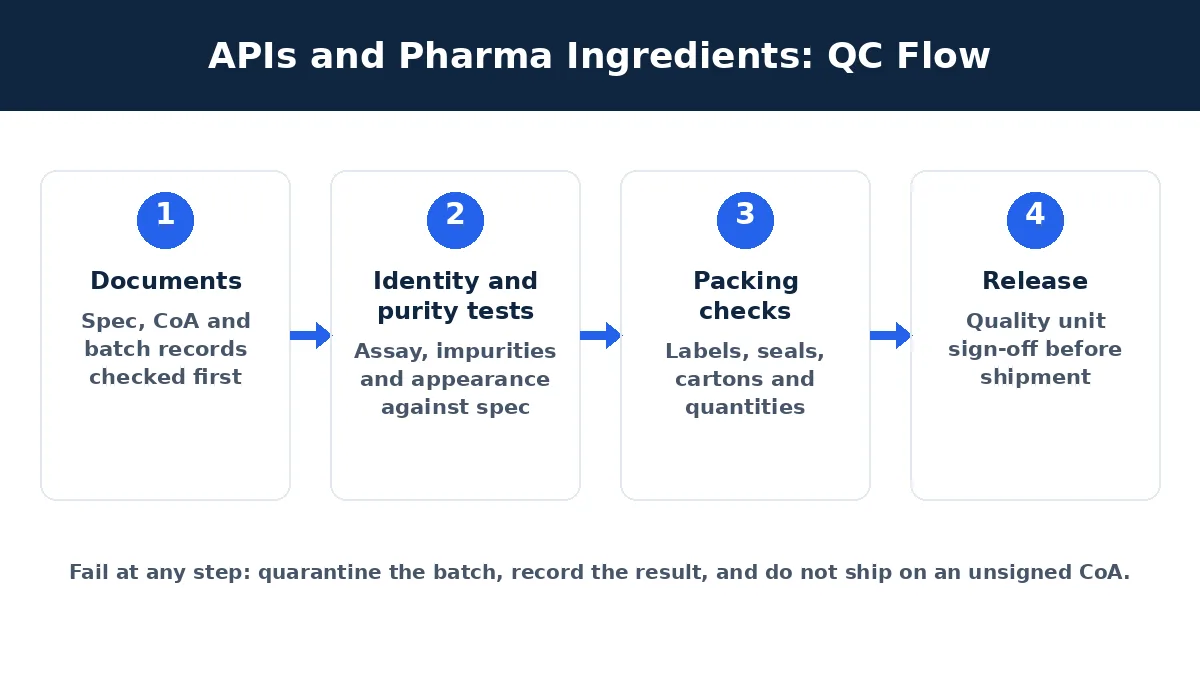
The full apis and pharma ingredients quality control checklist (numbered, printable)
Documents and traceability
Confirm the CoA is authentic for this batch: ICH Q7 states authentic Certificates of Analysis should be issued for each batch on request, listing each test, its limits and results.1
Check the CoA names the API and grade, batch number, release date and retest or expiry date where one applies, and that the same batch number appears on every drum label.1
Confirm the CoA is dated and signed by authorized quality-unit personnel and shows the original manufacturer's name, address and telephone number; where a repacker issued a new certificate, check it references the original manufacturer and batch certificate, a copy of which should be attached.1
Compare the CoA line by line with the agreed specification, not just the headline assay, including any test marked "not performed".
Check batch production and laboratory records are available, and that any deviation, out-of-specification result or retest is documented with its reason.
Confirm the supplier's manufacturing authorization and GMP status documents are current. In Bangladesh, the Directorate General of Drug Administration (DGDA) licenses manufacturers and distributors and inspects facilities for GMP compliance.4
Where the API is made by a third party and supplied through a trader, trace the batch back to the original manufacturer and site, and record the chain.
Identity, assay and physical checks
Check sampled material against the specification description and record any discoloration, lumps, damp patches or foreign matter.
Confirm identity testing used a method named in the specification. USP monographs test identity, strength and purity, and reference standards verify that ingredients meet USP specifications.5
Check the assay result against specification limits, and confirm the method used (for example HPLC or titration) matches the specification or agreed customer method.1
Check loss on drying or water content where specified, because excess moisture can affect assay and stability.
Where a pharmacopoeial monograph applies, confirm which pharmacopoeia and edition the specification follows, and that the supplier's method matches it.
Impurities, residual solvents and elemental impurities
Review the impurity profile against the regulatory submission or historical data, as ICH Q7 directs, to detect changes from raw materials, equipment or process changes.1
Check that organic impurities (starting materials, by-products, intermediates, degradation products) and inorganic impurities are listed with limits under the ICH Q3 framework; Q3A covers impurities in new drug substances and sets reporting, identification and qualification thresholds.6
Check residual solvents against agreed limits: ICH Q3C classifies residual solvents by toxicity and sets permitted daily exposure limits.6
Check elemental impurities where the risk assessment requires it: ICH Q3D uses a risk-based approach with permitted daily exposure values for impurities from all sources, including synthesis catalysts.6
Where a new impurity appears or a known impurity rises against history, quarantine the batch and ask for an explanation and, where specified, identification and qualification data.
Microbiology, endotoxins and contamination (where specified)
Confirm microbiological testing was performed where microbial quality is specified, as ICH Q7 directs for each batch where microbial quality is specified.1
For APIs destined for parenteral use, confirm endotoxin testing and record the method and limit.
Check cross-contamination controls where shared equipment handles more than one API: cleaning records and, where agreed, cleaning validation evidence.
Check that sampled drums were opened and resealed under conditions that protect the material, and that sampling tools were clean and dry.
Stability, retest dates and storage
Confirm the retest or expiry date is supported by stability data. ICH Q7 expects a documented, ongoing program to monitor API stability and confirm storage conditions and retest or expiry dates.1
Check that label and CoA storage conditions match the conditions the shipment will actually face, and that the packing protects against them.
Check that retained samples are kept: ICH Q7 expects identified reserve samples of each API batch to be retained, in the same or a more protective packaging system, for at least two full analyses.1
Labels, packing and cartons
Check every drum label against the CoA and purchase order: name and grade, batch number, quantity, manufacturer, retest or expiry date, storage conditions and hazard markings.
Check that labels are legible, firmly fixed and identical across drums, with no hand-corrected label lacking an amendment note.
Check seals: every drum sealed, no tampering, inner liners intact and of the specified material.
Check that the packing material is suitable for the API and will not contaminate it: ICH Q7 covers packaging materials, label control and packaging operations for APIs.1
Count drums, weigh sample drums, and reconcile quantities with the packing list and purchase order.
Check outer cartons and pallets for damage or damp, and confirm outside markings, batch numbers and quantities match the contents.
Check mixed batches are not packed as one batch: if different manufacturers' batches were combined, the material should be defined as a new batch, tested and supplied with its own certificate.
Sampling and the release decision
Draw the inspection sample randomly across drums and, where material can stratify, from more than one depth, following the agreed sampling plan.3
Record every result with its drum number, so a failure can be traced to specific drums.
Confirm the release decision is made by the quality unit, not production or the trader: ICH Q7 assigns API release or rejection to the quality unit.1
Do not release a batch on a CoA alone where independent testing is required: send the inspection sample to an agreed laboratory and compare it with the supplier's CoA before shipment.
Record the final decision (release, quarantine, re-inspection, or rejection) with reasons, and keep the report with the CoA.
Common failures and how to fix them
The most common failure is a CoA that does not match the drums: a different batch number, a missing test, or limits from a different specification. Stop, reconcile the CoA against the specification line by line, and ask the supplier's quality unit for a corrected, signed certificate referencing the original batch. Never accept a retyped certificate without the original attached where a repacker or trader is involved.1
Next is an impurity profile that has drifted without explanation. Quarantine the batch, compare it with the last three shipments, and ask what changed in raw materials, equipment or process. ICH Q7 requires comparison at appropriate intervals against the submission or historical data.1
Assay failures usually trace to moisture, degradation or a method mismatch. Re-check the method, confirm the laboratory used it, and retest a retained sample before rejecting the lot.
Label and packing failures are the most avoidable: wrong batch numbers, missing retest dates, broken seals or mixed batches. Re-sort and relabel under quality-unit control, preserving the original references, rather than shipping first and correcting paperwork later.
Above the agreed acceptance level, the options are re-inspection after sorting, documented partial acceptance of unaffected drums, or rejection.
Downloadable template / summary table
Copy the checklist into your inspection sheet, add the specification, limits and sampling plan, and record a result per drum and per test.
Section | Checks | Evidence |
|---|---|---|
Documents | CoA, batch records, traceability | Signed CoA, batch file |
Identity and assay | Appearance, identity, assay, moisture | Lab results vs specification |
Impurities | Organic, solvents, elemental | Impurity profile, history |
Microbiology | Microbial, endotoxin, contamination | Lab results where specified |
Stability | Retest date, storage, retained samples | Stability summary |
Packing | Labels, seals, counts, cartons | Drum check, packing list |
Release | Sample, quality-unit decision | Inspection report |
How Exportain helps
Exportain is a B2B marketplace connecting buyers with Bangladeshi suppliers of pharmaceutical products and ingredients, so the specification, CoA requirements and packing terms behind this checklist can be agreed at the enquiry stage. Use inspection services when you plan the check, and read the pre-shipment inspection guide before the inspector travels. Exportain is not a party to the goods contract and does not inspect goods.
FAQs
When should this checklist be used?
Use it at final inspection, when the batch is finished and packed. For first orders and larger lots, also use it during production, while a deviation can still be investigated.
Who should complete it?
The buyer, a local agent or an independent inspector with pharmaceutical laboratory experience can complete it, using the agreed specification, the CoA and a random sample. The release decision belongs to the quality unit.1
What are the most common failures?
A CoA that does not match the drums, a drifted impurity profile, assay or moisture outside specification, and label or seal errors are the failures buyers find most often.
Can a third party do it?
Yes, if you share the specification, limits, sampling plan and acceptance levels first, and the third party reports results drum by drum against the CoA.
Next steps on Exportain
Before production starts, agree your specification, test methods, impurity limits and sampling plan, then read the AQL acceptance quality limit explainer and the pre-shipment inspection guide, and plan the check with inspection services. You can also post a free RFQ via RFQs and compare quotes from Bangladeshi suppliers.
Sources
- Good Manufacturing Practice Guide for Active Pharmaceutical Ingredients Q7. International Council for Harmonisation of Technical Requirements for Pharmaceuticals for Human Use (accessed )
- WHO good manufacturing practices for pharmaceutical products: main principles (Technical Report Series No. 986, 2014, Annex 2). World Health Organization (accessed )
- ISO 2859-1:2026 - Sampling procedures for inspection by attributes — Part 1: Sampling schemes indexed by acceptance quality limit (AQL) for lot-by-lot inspection. ISO (accessed )
- Understanding Pharmaceutical Regulations in Bangladesh: A Comprehensive Overview. Generis Online (accessed )
- The USP Testing Specifications Master Guide. Sure-BioChem (accessed )
- Impurity guidelines in drug development under ICH Q3. AMSbiopharma (accessed )
About the author
Sourcing from Bangladesh?
Post a request for quotation and suppliers on Exportain can send you their quotes directly.
Post an RFQ