Quality Control Checklist for Agricultural Machinery From Bangladesh
A numbered QC checklist for agricultural machinery from Bangladesh: documents and identity, PTO guards and operator protection, engine and transmission, hydraulics, steering and brakes, tyres and tracks, chassis, function testing and export packing, with fixes for common failures.
Short answer
Use this agricultural machinery quality control checklist to check documents and identity, PTO guards, roll-over protection, engine and transmission, hydraulics, steering and brakes, tyres and tracks, chassis and export packing on machines from Bangladesh before shipment. Agree the specification, test evidence, tolerances and acceptance numbers in the purchase order, and record a result per machine with its serial number.
On this page
Key takeaways
Match the machine plate, manual and packing list to the same model and serial range before inspection, and hold any machine whose documents disagree.
Treat the PTO guard, roll-over structure and interlocks as hold points: a wrong, cracked or unrestrained guard fails the machine.
Test hydraulics through full travel under no load and run the machine with its implement, because leaks and faults that are dry at rest show under work.
Agree the specification, model test evidence, tolerances and acceptance numbers in the purchase order, and record a result per machine with its serial number.
If you buy tractors, power tillers, pumps, threshers or implements from Bangladesh, this checklist gives you a practical way to check a machine before it ships. A machine that looks sound in a yard can still fail on guards, hydraulics or documentation, and those faults are costly once the machine is crated. Work through the list against the approved specification, the operator manual and the test evidence for the exact model.
A 2025 review notes that farm machinery testing and certification arrangements were absent as a legal system in Bangladesh for a long period, with new standardization committees formed in February 2025, and that much locally made machinery has not been quality controlled.1 That history is why a buyer checklist matters more than a certificate claim alone: ask for model-specific evidence, and check the machine itself.
Why this checklist matters
Agricultural machinery concentrates risk in moving parts, stored hydraulic energy, heavy frames and operator positions. A missing power take-off guard, a cracked hydraulic hose, a loose roll-over structure or a tyre fitted for the wrong load can injure an operator or stop a season. ISO 4254-1 specifies safety requirements and their verification for self-propelled ride-on machines and mounted, semi-mounted or trailed machines used in agriculture, and the safe-working information the manufacturer must provide.2 Note its scope limit: it does not apply to agricultural or forestry tractors, so tractor checks must lean on the machine-specific standard and tractor test evidence instead.2 Record each point as pass, fail or not applicable, with the actual value or photograph where measurable. Agree defect classes and acceptance numbers in the purchase order before inspection starts.
Before you start
Do not begin until the references are complete: the purchase order and technical specification, the operator manual for the exact model, the parts list, and the packing specification. ISO 3600 specifies the content and format of operator manuals for tractors and agricultural machinery, including safety, operation, routine maintenance and adjustments.3 If the manual does not match the model and serial range on the machine, stop and resolve that mismatch first.
Agree the sampling plan in advance. ISO 2859-1 defines acceptance sampling schemes indexed by acceptance quality limit (AQL) for lot-by-lot inspection, with switching rules that tighten inspection when quality deteriorates.4 Sample across models, configurations and production dates, and never let the factory select the machines to be inspected. For tractors, ask which OECD Tractor Code tests apply: performance (Code 2), protective structures under dynamic and static test (Codes 3 and 4), noise at the driving position (Code 5) and falling-object protective structures (Code 10).5 See the AQL acceptance quality limit explainer before you set acceptance numbers.
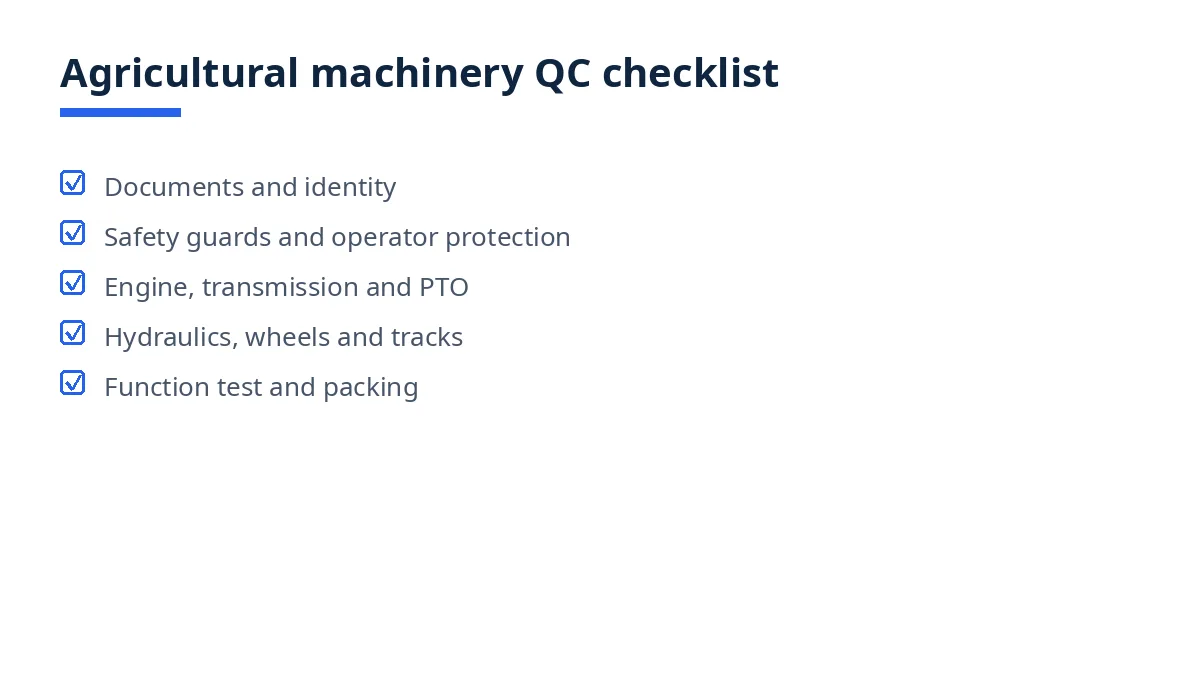
The full checklist (numbered, printable)
Documents, identity and manuals
Match the machine plate model, serial number and year to the purchase order, manual and packing list.
Confirm the operator manual is for this exact model and serial range, in a language the end user can read.3
Check the parts list and tools against the specification, including fasteners, filters and wear parts.
Check every safety label and hazard pictorial for presence, legibility and correct position.
Check the model test evidence: which standard or code it cites, which body issued it, and whether it names this model or only a family.
Guards, operator protection and controls
Check every guard over belts, chains, gears, fans and rotating shafts for presence and secure fixing, with none left off after inspection.
Check the power take-off (PTO) driveline guard along its full length, and confirm the restraining device stops it rotating with the shaft.
Check the PTO guard for holes, deformation, cracks or part separation. Under ISO 5674, it passes only with no holes or deformation leaving the shaft unprotected and no breakage, crack or part separation.6
Check the roll-over protective structure (ROPS) and, where fitted, the falling-object protective structure (FOPS) for correct fit, undamaged members and tight fixings, with no unapproved welds.
Check the operator platform, steps and handholds for secure fixing and non-slip surfaces, and confirm seat, seat belt where fitted, and controls match the manual.
Check every control for correct labelling and free movement, and confirm engine and emergency stops work from the operator position.
Test each safety interlock named in the manual in turn, and record the result.
Engine, transmission and PTO
Check the engine for oil, fuel and coolant leaks at joints, filters and drain plugs, and confirm fluid levels sit within the marks.
Start the engine from cold where the manual allows it, and watch for abnormal knocking, misfiring or unstable idle over the warm-up period.
Check clutch and gear selection through every gear in the specification, including reverse, for clean engagement with no jumping out of gear.
Check the PTO shaft type, spline count and rated speed against the specification and implement, and confirm the master shield and clearance zone match.
Engage the PTO at the manual speed, check for vibration, noise or guard contact through the working angle range, and disengage cleanly.
Check belts and chains for tension, alignment and wear against the parts list, and refit guards after adjustment.
Hydraulics, steering and brakes
Check hydraulic hoses, pipes and fittings for chafing, cracking, bulging and leaks, with routing, clips and guards matching the manual.
Operate every hydraulic function through its full travel under no load, checking for smooth movement, drift or leakage, and record any function that sticks or creeps.
Check hydraulic oil level and filter condition against the manual, and confirm the filled oil grade matches the manual.
Check steering through full lock both ways for free movement and abnormal play, and confirm steering stops and linkages are secure.
Check service and parking brakes on a level surface as the manual directs, confirming the machine holds and stops as specified.
Tyres, tracks and chassis
Check every tyre for size, ply or load rating, tread condition and sidewall cuts, and confirm pressures match the manual or plate.
Check wheels, hubs, studs and nuts for tightness and correct seating, with no substitute wheel size changing ground clearance.
For tracked machines, check track tension, shoes, rollers and idlers for wear, cracks and loose fixings, with tension matching the manual.
Check the chassis and frame for cracks, bent members, poor welds and corrosion, with attention to hitch points and axle mounts.
Check the hitch, drawbar and three-point linkage for wear, correct pin sizes and secure locking.
Function test, rust-proofing and export packing
Run the machine with its intended implement where the order includes one, checking it performs the specified function without overheating or stalling.
Check paint, coatings and rust-proofing on bare steel, inside toolboxes and under guards, matching the export packing plan.
Check that loose parts, tools and attachments are listed, packed and labelled, with nothing for first use left loose.
Check crate packing: the machine is blocked, braced and lashed so it cannot move, sharp edges are protected, and fluids are drained or secured.
Check crate markings against the packing list: model, serial number, gross weight and destination, and photograph the packed machine before closing the crate.
Common failures and how to fix them
The most frequent failure is a PTO guard that is present but wrong: too short at full extension, cracked at a joint cone, or fitted without its restraint so it spins with the shaft. Stop, fit the correct guard for the shaft length and joint type, refit the restraint, and re-check through the full working angle.6
Next is a hydraulic leak that only shows under load. A hose dry at idle can weep at working pressure, so test every function through its full travel rather than at rest, replace the hose or fitting rather than repeatedly tightening a damaged one, and re-test after repair.
A third common failure is a paperwork mismatch: the manual, plate and packing list name different models or serial ranges. Hold the machine, get the correct manual and corrected documents for the exact serial range, and do not accept a generic manual as a substitute.3 Other repeat failures include a ROPS with an unapproved weld repair, tyres of mixed size on one axle, and a machine crated without bracing. Each is a hold point: repair or replace to the specification, re-inspect, and record the re-inspection.
Downloadable template / summary table
Copy the checklist into your inspection sheet, add the specification values, tolerances and acceptance numbers, and record a result per machine with its serial number.
Section | Checks | Evidence |
|---|---|---|
Documents | Plate, manual, parts list, labels | Serial record, photos |
Guards and protection | Guards, PTO guard, ROPS, controls | Guard checks |
Engine and PTO | Leaks, gears, PTO speed and angle | Function test |
Hydraulics and brakes | Hoses, functions, steering, brakes | Leak and hold checks |
Tyres and chassis | Tyres, tracks, frame, hitch | Measurements, photos |
Packing | Function test, rust-proofing, crate | Packed photos, packing list |
How Exportain helps
Exportain is a B2B marketplace connecting buyers with Bangladeshi suppliers of agricultural machinery, so the specification behind this checklist can be agreed at the enquiry stage. Use inspection services when you plan the check, and read the pre-shipment inspection guide. Supplier profiles show which document and photo checks have been recorded, not factory inspections. Exportain is not a party to the goods contract.
FAQs
When should this checklist be used?
Use it at final inspection, when the machine is complete, tested and largely packed. For first and larger orders, also use it during production, while guards and hydraulics can still be corrected without re-crating.
Who should complete it?
The buyer, a local agent or an independent inspector can complete it, using the specification, the operator manual for the exact model and a sample drawn across the order.
What are the most common failures?
A wrong or damaged PTO guard, a hydraulic leak under load, a manual and plate mismatch and poor export bracing are the failures buyers find most often.
Can a third party do it?
Yes, if you share the specification, the manual, the acceptance numbers and the model test evidence first, and require a report per machine.
Next steps on Exportain
Before production starts, agree your specification, acceptance numbers and packing plan, then read the AQL acceptance quality limit explainer and the pre-shipment inspection guide.
Sources
- Farm Machinery Testing and Standardization in Bangladesh: A Policy Review. Journal of Agricultural Machinery and Bioresources Engineering, (accessed )
- ISO 4254-1:2013 - Agricultural machinery — Safety — Part 1: General requirements. International Organization for Standardization (accessed )
- ISO 3600:2022 - Tractors, machinery for agriculture and forestry, powered lawn and garden equipment — Operator's manuals — Content and format. International Organization for Standardization (accessed )
- ISO 2859-1:2026 - Sampling procedures for inspection by attributes — Part 1: Sampling schemes indexed by acceptance quality limit (AQL) for lot-by-lot inspection. ISO (accessed )
- OECD Standard Codes for the Official Testing of Agricultural and Forestry Tractors - General Texts (February 2026). Organisation for Economic Co-operation and Development (accessed )
- ISO 5674:2004 - Tractors and machinery for agriculture and forestry — Guards for power take-off (PTO) drive-shafts — Strength and wear tests and acceptance criteria. International Organization for Standardization (accessed )
- pre-shipment inspection
- quality control
- Bangladesh exports
- aql inspection
- Agricultural machinery
- Tractors
About the author
Sourcing from Bangladesh?
Post a request for quotation and suppliers on Exportain can send you their quotes directly.
Post an RFQ