Typical MOQ for Workwear and Uniforms in Bangladesh (and How to Negotiate It Down)
No single workwear and uniforms MOQ in Bangladesh: how fabric roll yield, uniform size runs, PPE component lots and replenishment floors set the minimum per colour and size, and how to change the structure to order less.
Short answer
There is no single typical MOQ for workwear and uniforms from Bangladesh. Each factory sets its minimum per colour, per size run, per component lot and per treatment batch for your specification, driven by cloth roll yield, dye lots, protective tape and finish batches, embroidery set-up and the workforce size range. Ask for every floor in writing, then negotiate the structure: fewer colours, stocked cloth, shared rolls across the set and set-up paid apart from the unit price.
On this page
Key takeaways
There is no single typical MOQ for workwear and uniforms from Bangladesh, because each factory sets its minimum per colour, per size run, per component lot and per treatment batch for your specification.
Cloth roll yield comes first: a jacket-and-trouser set is cut from one roll, so a colour below the roll yield still draws on a whole roll.
The workforce size run is a separate floor: edge sizes need enough pieces to cut without wasting the marker, so state the quantity per size and per leg length.
Protective tape, finishes and closures carry their own lots, and replenishment orders carry a separate floor, so agree both in writing at the time of the first order.
Negotiate the structure, not the exception: fewer colours, stocked cloth, shared rolls across the set, and set-up paid apart from the unit price.
A uniform order in Bangladesh is planned around cloth before it is planned around headcount. Twill, canvas and drill arrive on rolls of a set width and length, and a jacket-and-trouser combination has to be cut from that roll as a pair, with both garments drawing on the same metres. Example figures: a 200-metre roll and a combined consumption of 3.0 metres per set gives 66 sets, since 200 divided by 3.0 is 66.7. Order a colour below the roll yield and the factory still opens a whole roll.
What should I know first about workwear and uniforms?
Workwear buying differs from fashion buying because the unit of need is a dressed workforce, not a garment. Every employee needs the jacket and the trouser in matching cloth and colour, in a size that fits, carrying the same reflective tape, closures and logo. That shared specification is what creates the minimums: cloth is consumed by the roll, tape is consumed by the roll, finishes are applied in batches, and embroidery is set up once per logo and placement.
The workforce size run is a floor of its own. Jackets run across chest sizes, trousers across waist sizes and leg lengths, and the sizes at the edges of the range still have to be cut efficiently from the marker. Example figures: 540 sets spread over nine jacket sizes gives 60 sets per size, while the same 540 sets spread over nine trouser sizes and four leg lengths gives 15 sets in each size-and-length cell, which can sit below a cutting floor. Send the quantity for every size, leg length and colour, and name the smallest and largest sizes in the enquiry rather than leaving them inside a total.
Protective parts carry floors that plain uniforms do not. Reflective tape is supplied on rolls, flame-resistant finishes are run through treatment batches, and reinforced knees, knee-pad pockets and heavy-duty zips arrive in their own lots. Example figures: tape consumption of 4 metres per jacket against a 200-metre tape roll gives 50 jackets per roll. A taped jacket and an untaped jacket can share a tech pack layout and still carry different minimums, because the tape, the treatment and the component lots behind them differ.
Floor | Why it binds | Enquiry line |
|---|---|---|
Cloth roll | Fixed roll length and width, set consumption | Cloth, colour, metres per set |
Size run | Marker use across sizes and leg lengths | Quantity per size, length, colour |
Protective parts | Tape rolls, treatment batches, closure lots | Tape, finish, closure specification |
Embroidery | Digitising and set-up per logo and placement | Logo, size, placement, thread colours |
Repeat orders | Dye lot, marker and set-up on a small top-up | Top-up floor, repeat price, holding terms |
Why this matters for buyers and sellers
For a buyer, the risk is a roster that cannot be dressed on the first day of a contract. When an edge size or a long leg length falls under its floor, those workers either wait for a later run, or the buyer pays a surcharge to cut them, or the size is dropped from the programme.
For a seller, the floor is protection against material that has no second buyer. Cloth dyed to a corporate colour, tape cut to one jacket pattern, embroidery digitised for one logo and labels printed with one company name cannot be moved to another customer, and a short run still consumes a full roll, a full treatment batch and a line changeover. Woven garment exports reached $4.61480 billion in July to September 2026, within ready-made garment exports of $10.57856 billion, according to data released by the Export Promotion Bureau (EPB).1
Step-by-step: how it works
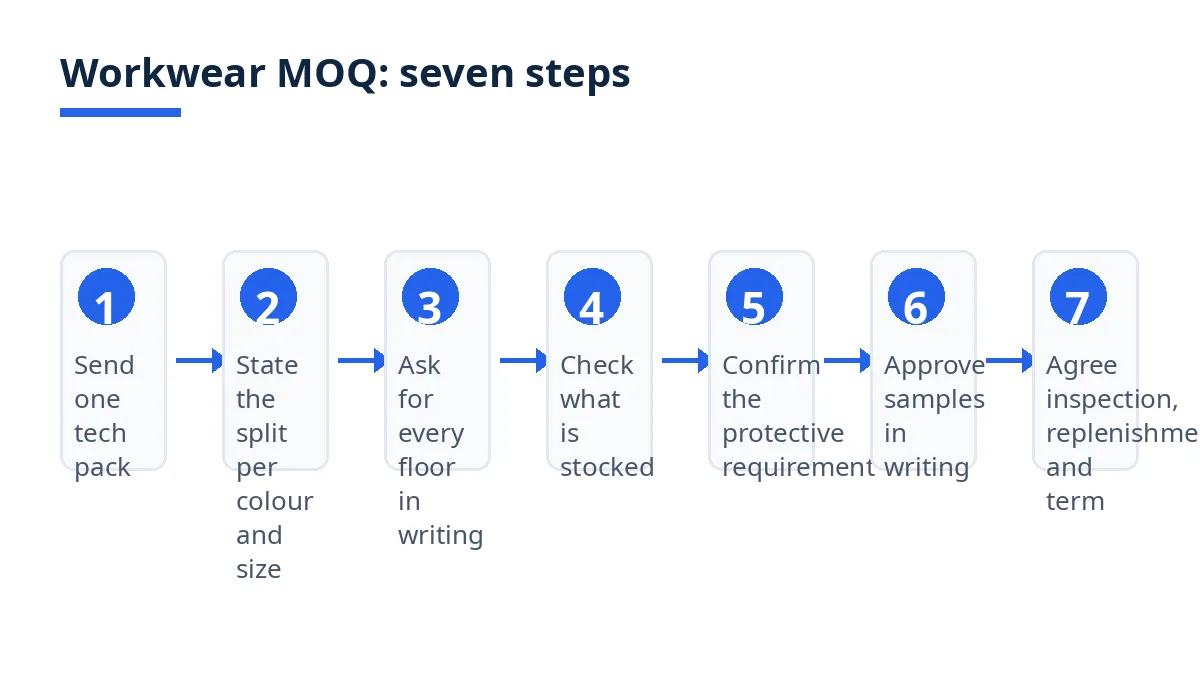
Send one tech pack to every candidate. Include cloth composition, construction and weight, the jacket and trouser patterns, pocket and reinforcement positions, tape width and placement, the protective finish, closures, embroidery artwork and placement, and the full size chart.
Break the total into its cells. List sets per colour, jackets and trousers separately where their quantities differ, and quantities per size and per leg length. A total without that breakdown cannot produce a usable minimum.
Get every floor as a separate line. Request the roll yield per colour, the floor per size and per leg length, the floor for each tape, treatment, zip, button and embroidery lot, and any separate label, tag and carton floors, and ask which line binds for the split sent.
Find out what is held in stock. Record for each twill or canvas colour whether it is held in stock or dyed to order, and whether tape, zips, buttons and thread are stock items. Stocked inputs are the most common route to a lower floor.
Settle the protective requirement before sampling. State the protective function each garment must perform, the standard it is tested against, and who holds the test report. Protective garments sold into the European Union fall under Regulation (EU) 2016/425, which divides personal protective equipment into three risk categories with different conformity assessment procedures.2
Approve samples in writing. Order a proto sample, then a pre-production sample in the actual cloth, colour, tape, finish, embroidery and labels, in a middle size and in one edge size. Measure, wash and test it, then approve it or list corrections in writing.
Write inspection, repeat and delivery terms into the order. Put the inspection level and acceptance quality limit (AQL) values into the purchase order, following ISO 2859-1, which defines a system of acceptance sampling plans indexed by AQL for lot-by-lot inspection.3 State one delivery term and named place on every quotation: the Incoterms 2020 rules set out 11 rules with a clear allocation of cost, risk and obligations,4 so minimums should be compared only on the same term.
Levers that change the structure of the minimum. Cutting the colour count is the strongest lever, because each colour multiplies dye lots, tape runs, trim sets and cutting runs. Sharing one cloth across the jacket, the trouser and a related piece such as a bib overall or a vest lets the roll yield be reached across the combined set. Where the floor comes from embroidery digitising, a treatment batch or a tape run, ask for that cost as a separate line rather than folded into the unit price, so the run can be shorter and the same set-up can serve the repeat order.
Costs, timelines and documents
What are the typical costs and timelines?
A single published price or lead time for workwear and uniforms would mislead, because each factory prices the cloth, the set construction, the tape and treatment, the embroidery, the reinforcement, the label and carton runs, the finishing and packing, and the delivery term chosen.4 A protective finish or a tested tape adds batch and test costs that a plain uniform does not carry, and a corporate colour dyed to order adds a dye-lot cost that a stocked colour avoids.
Timelines split the same way. Sampling depends on whether the cloth is stocked, when the treatment batch can be scheduled and how many correction rounds the sample needs, while bulk production depends on dyeing, treatment batches, tape delivery and line capacity. Ask for sampling, cloth-ready, treatment-complete, production and inspection dates as separate lines, rather than accepting one delivery week for the whole order.
Which documents are needed?
The order papers are the tech pack with the full size run, the itemised quotation showing every floor, and the purchase order carrying the minimum per colour, per size and per component, plus the protective test reports where the garment carries a protective function. Export clearance follows the Bangladesh Customs export procedure.5
Bangladesh-specific rules and tips
Check association claims with the association. When a supplier claims membership of the Bangladesh Garment Manufacturers and Exporters Association (BGMEA), confirm it with the association itself. The association lists around 4,500 member factories, with woven makers accounting for roughly six in ten.6 Membership indicates an active woven business; it says nothing about the minimum on offer or the capacity for a particular set.
Draw the line between ordinary uniforms and protective equipment early. Ordinary working clothes and uniforms that do not specifically protect the safety and health of the worker sit outside the personal protective equipment definition used in EU workplace rules, while garments that do protect against a hazard fall under Regulation (EU) 2016/425, with Category I covering minimal risks and Category III covering risks that may cause very serious consequences.2 The category decides the testing and the paperwork, so settle it before sampling.
Match the label wording to the tech pack. Labels are checked at destination, so the fibre wording on the garment must match the tech pack exactly. EU labelling rules require every fibre to be named with its share by weight, listed from largest to smallest.7 Copy that list into the tech pack in the same order, so the label, the quotation and the shipping papers all carry the same wording.
Mistakes and red flags
What are the most common mistakes?
Quoting a single total. The governing floor is usually per colour, per size or per component lot, so a total on its own hides the cell that will fail. Send the split and ask for the binding line by name.
Counting a set as one garment. A set has two patterns, two size charts and two cutting markers. Confirm the jacket floor and the trouser floor separately, and confirm whether the cloth floor is reached across the set combined or by each piece alone.
Swapping a plain uniform for a protective garment. Changing the tape, the finish or the cloth after sampling can void the test basis of a protective garment. Lock the protective specification before the pre-production sample is cut.
Comparing minimums from different specifications. A lower floor on a lighter twill, an untaped jacket instead of a taped one, stock labels or a different delivery term is a different offer. Compare only replies to the same tech pack, the same size run and the same Incoterm.4
Leaving an agreed concession unwritten. Any lower floor, shared roll, held cloth or set-up charged separately should appear on the quotation and the purchase order, with the split and the sizes it covers. A concession that exists only in conversation is difficult to enforce on a repeat order.
Being charged twice for the same set-up. Carry the paid set-up lines from the first purchase order into the repeat enquiry, so the top-up is priced as a repeat and the digitising, treatment or tape set-up is not charged a second time.
Reading a profile or a badge as proof of capacity. A listing shows that a supplier can be contacted about a set; it does not test whether the factory can cut the size run, hold the colour or meet the protective standard. For what verification records cover and what they do not, the trust-centre record is the reference.8
Sampling only a middle size. Sampling under ISO 2859-1 checks a lot against an agreed AQL,3 and a middle-size sample on its own does not show whether the smallest and largest sizes cut and sew cleanly. Include an edge size in the pre-production sample.
Checklist
Hold the order until the quotation or the purchase order answers every item below.
Tech pack on file: cloth, set pattern, pockets, reinforcement, tape, finish, closures, embroidery, labels, sizes, packing.
Order split on file per set, colour, size and leg length, jackets and trousers shown separately, edge sizes named.
Binding floor identified across colour, size, component lot and treatment batch.
Cloth position on file per colour: held in stock or dyed to order, with the roll yield for each colour.
Component floors on file for tape, finish, zip, button, embroidery, label, tag and carton, apart from the garment floor.
Protective category and test-report holder settled before sampling.2
Set-up charges shown apart from the unit price, paid set-ups carried forward to repeat orders.
Pre-production sample on file in actual cloth, tape and finish, in a middle size and an edge size, approved in writing.
Repeat floor, repeat price and cloth or tape holding agreed in writing.
Inspection level and AQL values entered in the purchase order.3
Quotations lined up on the same specification, size run and Incoterm.4
How Exportain helps
On Exportain, browse suppliers and post a request for quotation (RFQ) on the RFQ board with a tech pack summary, the split per colour and size, the protective requirement and the delivery term, so replies quote against one specification. Ask each reply for its per-colour, per-size and per-component floors and for its repeat-order floor. Verification on Exportain is a document and photo review by staff, not a factory inspection,9 and a badge is not a guarantee of production capacity, product quality or delivery.8
FAQs
What should I know first about workwear and uniforms?
A workwear order dresses a workforce, so the unit is a jacket-and-trouser set in matching cloth and colour across a size run, with shared tape, closures and branding. Floors apply per colour, per size, per component lot and per treatment batch, and the lowest floor inside a split governs the order. Industrial and occupational lines under heading 6203 cover men's workwear ensembles, jackets, trousers and overalls by fibre.10
What are the typical costs and timelines?
No figure published in a guide can be relied on for a specific order, because each factory sets its price, floor and lead time for the specification in front of it. Cloth, set construction, tape and treatment, embroidery, the size run and the delivery term drive the price,4 while sampling, dyeing, treatment batches, tape delivery and line capacity drive the timeline.
Which documents are needed?
The papers for the order are the tech pack with the full size run, the itemised quotation and the purchase order, with the floor per colour, per size and per component shown on both, plus protective test reports where the garment carries a protective function.2 Export clearance follows the Bangladesh Customs export procedure.5
What are the most common mistakes?
The recurring errors are quoting only a total, counting a set as one garment, swapping a plain uniform for a protective garment, comparing floors from different specifications or terms,4 leaving a concession unwritten, and reading a badge as proof of capacity.8
Next steps on Exportain
Browse suppliers, then post a tech pack summary, the split per colour and size, the protective requirement and the delivery term on the RFQ board so replies state their floor per colour, per size and per component. Also read how to import workwear and uniforms from Bangladesh and the workwear and uniforms quality control checklist.
Sources
- RMG exports rise 6.10pc to US$10.58b in July-Sept of FY27. The Financial Express, (accessed )
- PPE - OSHwiki. European Agency for Safety and Health at Work (accessed )
- ISO 2859-1:2026 - Sampling procedures for inspection by attributes — Part 1: Sampling schemes indexed by acceptance quality limit (AQL) for lot-by-lot inspection. ISO (accessed )
- Incoterms® 2020. International Chamber of Commerce (ICC) (accessed )
- Customs Clearance Procedures for Export. Bangladesh Customs, National Board of Revenue (accessed )
- Bangladesh Garment Manufacturers and Exporters Association (BGMEA). Devex (accessed )
- Regulation (EU) No 1007/2011 on textile fibre names and related labelling and marking of the fibre composition of textile products. European Union, (accessed )
- Trust & Safety Center. Exportain (accessed )
- Supplier verification: Earn trust badges buyers can see. Exportain (accessed )
- Men's or boys' suits, ensembles, jackets, blazers, trousers, bib and brace overalls, breeches and shorts (other than swimwear). GOV.UK (accessed )
- MOQ
- supplier verification
- buyer guide
- woven garments
- Bangladesh sourcing
- bangladesh garments
- Workwear and uniforms
About the author
Sourcing from Bangladesh?
Post a request for quotation and suppliers on Exportain can send you their quotes directly.
Post an RFQ