Typical MOQ for Women's Dresses in Bangladesh (and How to Negotiate It Down)
No single women's dresses MOQ in Bangladesh: how cloth rolls, print lots, embellishment set-ups and size runs set the minimum per silhouette and colour, and how to reshape a dress range to clear them.
Short answer
There is no single typical MOQ for women's dresses from Bangladesh. Each factory sets its minimum per silhouette, per colour and per length, driven by cloth roll yield, print runs, embellishment set-ups and size-run markers. Ask for each floor in writing, then negotiate by sharing cloth across silhouettes, cutting colours, holding embellishment to one placement, or paying set-up apart.
On this page
Key takeaways
There is no single typical MOQ for women's dresses from Bangladesh, because each factory sets its minimum per silhouette, per colour and per length for your specification.
Cloth roll yield, print runs, embellishment set-ups and size-run markers are the four floors that set the minimum, and the binding one is rarely the garment total.
Ask for the roll yield per colour, the print minimum in metres or dresses, and the embellishment set-up per placement in writing, with the split per silhouette, colour, length and size.
Negotiate the structure first: one cloth across silhouettes, fewer colours, embellishment held to one placement, stocked cloth and trims, and set-up paid as a separate line.
Exportain verification is a document and photo review, not a factory inspection, and a badge is not a guarantee of capacity, quality or delivery.
Ask a factory in Bangladesh for the smallest women's dress order it will cut, and the answer will come back as several numbers, not one. The figure for a plain midi in a stocked cloth will not match the figure for a beaded maxi in a dyed print, even when both dresses come from the same sewing line. That split is the whole subject of this guide: a dress order clears or stalls line by line, and the line that stalls it is often a small one.
The reason sits in how much cloth a dress consumes. A dress pattern spreads across bust, waist, hip and length, so one garment can draw three metres or more, while a top cut from the same fabric might draw half that. When cloth arrives on rolls of a fixed length, a colour that yields only a few dozen dresses still consumes whole rolls, and the leftover cloth has to be paid for, carried into a repeat, or cut away from the order. Start every enquiry from that arithmetic, and the rest of the minimums fall into place around it.
Four thresholds usually decide whether a dress range can be cut at all. The first is the cloth roll: how many dresses of one colour a roll yields at the dress length you specified. The second is the print lot: the shortest printed length a printer will run for your artwork, or the number of screens a placement print needs. The third is the embellishment set-up: the digitising, tooling and material lots behind each decorated panel. The fourth is the size and length split: how many pieces fall into each size and each length once the total is divided. A range can pass three of these and still fail on the fourth.
Example figures: a 140-metre roll cut at 3.4 metres per maxi dress yields about 41 dresses, since 140 divided by 3.4 is 41.2. A colour ordered at 25 maxis therefore leaves most of a roll unused, and the factory will ask who carries that balance. The same roll cut at 2.4 metres per knee-length dress yields about 58 dresses, so length alone can move a colour from short to workable. These numbers illustrate the arithmetic only; they are not a typical minimum, price or lead time for any factory.
Why this matters for buyers and sellers
For a buyer, the thresholds decide how much money ends up tied in colours and lengths that sell slowly. A first order meant to test one dress can quietly become a commitment to five colours of three lengths, because each combination had to reach its own cut-off before cutting began. Testing one silhouette in one colour first, then adding colours once the fit and the fabric are proven, keeps that commitment visible and small.
For a seller, the same thresholds protect inputs that cannot be sold to anyone else. Cloth dyed to your shade, a print run carrying your artwork and a beaded panel digitised for your bodice have no second buyer if the order shrinks after they are made. A factory that holds its line on a colour minimum is usually protecting that committed material, not refusing a small buyer on principle.
The market context makes getting this right worth the effort. Ready-made garment exports from Bangladesh were reported at US$38.70 billion in fiscal year 2025-26, a slip of 1.64 percent on the year, with woven garments holding up better than knitwear.1 Dresses sit inside that woven trade, and a buyer who understands roll and print arithmetic can have a practical conversation with a factory instead of trading round numbers that neither side can honour.
Step-by-step: how it works
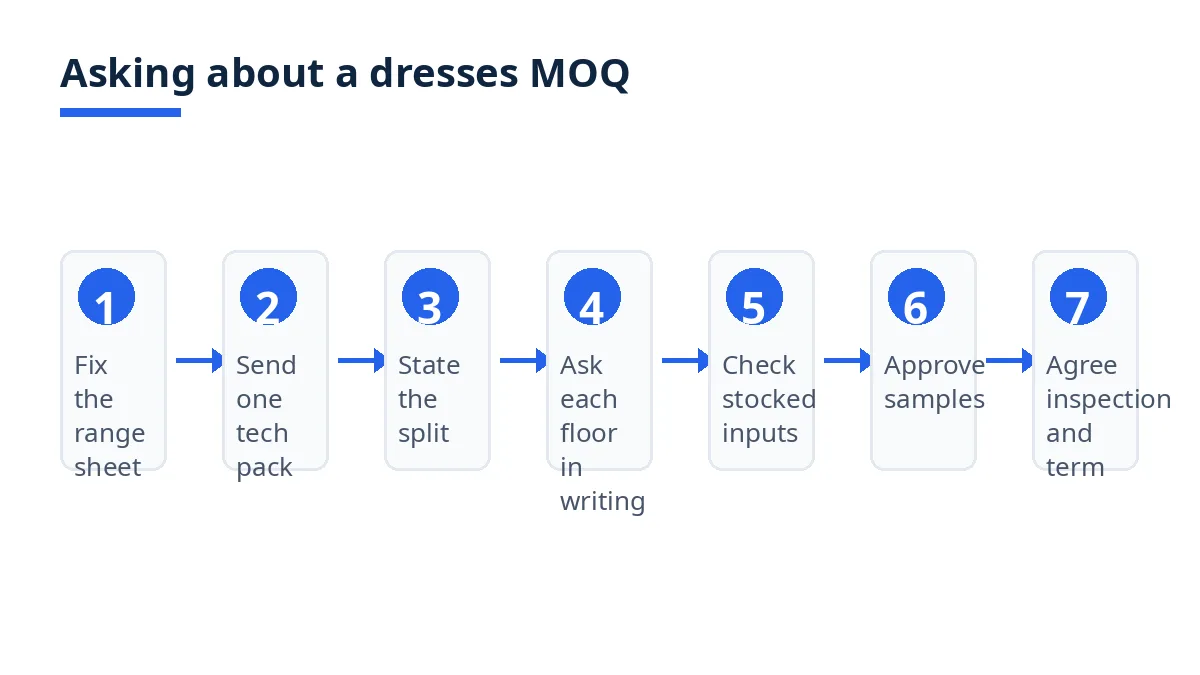
Lock the style list before contacting factories. Settle the shapes, the lengths, the cloth for each shape and the colour list. Any change after a quotation reopens at least one threshold, because a fresh shape needs its own pattern and marker and a fresh colour needs its own roll balance.
Circulate an identical specification pack to every candidate. Cover cloth type, weight and width, lining, shape, sleeve and neckline, the size chart and the ratio between sizes, artwork and print method, decoration method and placement, trims, labels and packing. Identical packs are what make unlike minimums comparable.
Break the total into its parts. State how many pieces go to each shape, each colour, each length and each size. A bare total cannot be answered with a usable minimum, because the factory cannot tell which line is short.
Request each threshold in the factory's own units. Find out how many dresses one roll yields in each colour, whether a print minimum is counted in metres or in finished dresses, what the set-up charge is for each decorated placement, and which line is tightest for your split. Keep the replies in writing.
Reshape the order where a line is short. The strongest moves change the structure, not the asking price. Cut the same cloth across two or three shapes so they share one roll balance. Drop a colour rather than a shape, since colours multiply roll balances, print runs and trim sets at once. Keep decoration to a single placement, such as the bodice alone, so the other panels carry no set-up at all. Ask what cloth colours and trims are already in stock, since stocked inputs remove the dye and roll thresholds entirely. Where a threshold comes from screens, digitising or label runs, request that set-up as a separate charge, so a shorter first run is possible and the repeat order reuses the same set-up.
Sign off samples made in the real materials. Take a first sample, then a pre-production sample in the actual cloth, colour, print, decoration and labels. Measure it, wash it, and confirm approval or list corrections in writing before bulk cutting starts.
Fix inspection and delivery terms before confirming. Put the inspection level and the acceptable quality limits into the purchase order, following the sampling system in ISO 2859-1.2 Name one delivery term and one named place on every quotation, so minimums are compared on the same basis.
Costs, timelines and documents
Prices and lead times
Published dress prices rarely survive contact with a real specification, because the price moves with your cloth, the complexity of the shape, the print method, the number of decorated placements, the trim and label runs, finishing and packing, and the delivery term you choose. The Incoterms 2020 rules set out 11 rules that allocate cost, risk and obligations between buyer and seller, so the term on the quotation changes what the price includes.3 Rank quotations only when they share the same term and the same specification pack.
Lead times move for similar reasons. Sampling depends on whether the cloth is stocked or dyed to order and on how many correction rounds the sample needs. Bulk production depends on print and decoration queues, trim deliveries and line capacity. Request sampling, cloth-ready, print-ready, decoration-ready, production and inspection dates as separate lines, rather than accepting a single promised ship date.
Papers for the order
Three papers carry the order: your specification pack, the factory's itemised quotation, and the purchase order you both sign. Both the quotation and the order should carry the minimum for each shape, colour and length. For shipment, check the current export clearance steps with your supplier and forwarder.4
Bangladesh-specific rules and tips
Check association claims at the source before you rely on them. The Bangladesh Garment Manufacturers and Exporters Association (BGMEA) represents the readymade garment industry, including woven garments, knitwear and sweaters, and a claim of membership is best confirmed with the association itself.5 Membership signals an active garment business; it says nothing on its own about the minimum on offer or capacity for your particular dress.
Keep the exporter name identical on every paper. A mismatch between the trade licence, the quotation, the proforma invoice and the payment account creates delays that have nothing to do with sewing. Ask early which inputs will be bought in for your specification: linings, specialty zips, beads and sequins are often imported, and an imported input can set both the minimum and the earliest production date.
Classification and labelling deserve the same early check. In the Harmonized System, heading 6204 covers dresses and related articles for women or girls, not knitted or crocheted, and subheading 620443 covers dresses of synthetic fibres on the same basis.6 If you sell into the European Union, Regulation (EU) No 1007/2011 governs textile fibre names and labelling of fibre composition, so the label must describe the cloth actually cut for the order, and a cloth substitution after sample approval needs a label check as well as a price check.7
Mistakes and red flags
Chasing a single total number. The tightest line is usually one shape, one colour or one length. An order can clear its total and still leave one colour short of its roll yield, which then draws a surcharge, a carried-forward balance or removal from the range.
Ranking quotes built on different specifications. A lower figure quoted on a stocked cloth, a plainer shape or a different delivery term is a different offer. Only replies to the same specification pack, on the same cloth and the same term, can be ranked against each other.3
Adding a shape after quotation. A late shape means fresh pattern work, grading, a marker and a sample, even when the cloth and colour stay unchanged. It arrives as a second round of pattern charges and can push the order back in the production queue.
Leaving the end sizes unchecked. Demand piles into the middle sizes and thins toward the ends, so a size curve that reads well in total can still strand the smallest and largest sizes below the cutting line. Confirm the quantity inside each size, within each colour, before confirming.
Reading a badge as a capacity check. The check behind a badge reviews documents and photos; it does not inspect a factory or test whether it can make your dress. Use it as a starting point, then judge capacity from samples, references and the written thresholds.
Settling for a verbal minimum. A figure given on a call and never written down is easy to dispute once cloth is ordered. If it is not on the quotation and the purchase order, treat it as not agreed.
Checklist
Do not confirm until each point below has a written answer from the factory.
Style list locked: shapes, lengths, cloth per shape, colour list.
Specification pack circulated: cloth, lining, shape, sleeve, neckline, artwork, decoration, trims, labels, sizes, packing.
Breakdown supplied for every shape, colour, length and size, with a single size ratio for each colour.
Roll yield per colour confirmed, with the tightest line named.
Print minimum confirmed in metres or dresses, per method and placement.
Decoration set-ups charged separately per placement, with paid set-ups on record.
Trim, label, tag and carton floors settled separately from the dress figure.
Stocked cloth colours and trims noted before colours are finalised.
Pre-production sample in real materials: measured, washed, approved on paper.
Inspection level and acceptable quality limits written into the purchase order.2
Quotations ranked on the same specification and delivery term.3
Export papers settled with your supplier and forwarder.4
How Exportain helps
Use the suppliers page to find candidates, and put your specification summary, breakdown per shape, colour and length, and delivery term on the RFQ board, so suppliers quote against the same specification. Ask each reply for its roll yield, print minimum and decoration set-up, not only its total figure. When you accept a quotation, Exportain creates one order and issues one proforma invoice from the accepted terms, as described in the Trust and Safety Center.8
A badge records a document and photo check, and it is not a promise about capacity, quality or delivery. See how supplier verification works on Exportain before you rely on a badge.9
FAQs
What should I know first about women's dresses?
The first thing to accept is that no directory lists one dress minimum. The figure is set shape by shape, colour by colour and length by length, by cloth roll yield, print lots, decoration set-ups and size markers. Woven dresses sit under HS heading 6204, which covers dresses for women or girls, not knitted or crocheted.6
What are the typical costs and timelines?
No published figure will hold for your dress, because each factory prices, sets its minimum and schedules around your specification. Cloth, shape complexity, print, decoration, the breakdown and the delivery term shape the price,3 while cloth availability, print and decoration queues and line capacity shape the timeline.
Which documents are needed?
Keep the paper trail short: specification pack, itemised quotation, purchase order, with the minimum for each shape, colour and length written into the last two. Shipment clearance is a separate step to confirm with your supplier and forwarder.4
What are the most common mistakes?
Five errors recur: chasing a single total, ranking quotes built on different cloths or terms,3 adding a shape late, leaving end sizes unchecked, and treating a badge as proof of capacity. A badge records a document and photo check, not a promise about capacity, quality or delivery.9
Next steps on Exportain
When the style list is settled, use the suppliers page to find candidates and the RFQ board to collect their threshold replies in one place. The MOQ definition guide explains the general term before you read factory replies.
Sources
- EU share erodes as Bangladesh RMG exports slip 1.64% to $38.70 billion in FY26. United News of Bangladesh (accessed )
- ISO 2859-1:2026 - Sampling procedures for inspection by attributes — Part 1: Sampling schemes indexed by acceptance quality limit (AQL) for lot-by-lot inspection. ISO (accessed )
- Incoterms® 2020. International Chamber of Commerce (ICC) (accessed )
- Customs Clearance Procedures for Export. Bangladesh Customs, National Board of Revenue (accessed )
- Bangladesh Garment Manufacturers and Exporters Association (BGMEA). Devex (accessed )
- Classification Detail — HS Code 620443. United Nations Statistics Division (accessed )
- Regulation (EU) No 1007/2011 on textile fibre names and related labelling and marking of the fibre composition of textile products. European Union, (accessed )
- Trust & Safety Center. Exportain (accessed )
- Supplier verification: Earn trust badges buyers can see. Exportain (accessed )
- MOQ
- supplier verification
- buyer guide
- woven garments
- Bangladesh sourcing
- bangladesh garments
- Women's dresses
About the author
Sourcing from Bangladesh?
Post a request for quotation and suppliers on Exportain can send you their quotes directly.
Post an RFQ