Women's Dresses Lead Time From Bangladesh: Production and Shipping Timeline
Plan a women's dresses lead time from Bangladesh by approval gates: pattern and grading, fit and drape, bodice construction, print placement, hem, labelling, pressing and folding, then inspection, documents, and loading.
Short answer
A women's dresses lead time from Bangladesh runs on approval gates, not a single production run: pattern and grading, fit and drape, bodice, neckline, and sleeve construction, print and embroidery placement, hem finishing, wash-care labelling, then pressing, folding, inspection, export documents, and loading. Every duration is an illustrative planning example only. Replace it with the dated figures in the written quote and the dated forwarder estimate before setting a selling date.

On this page
Key takeaways
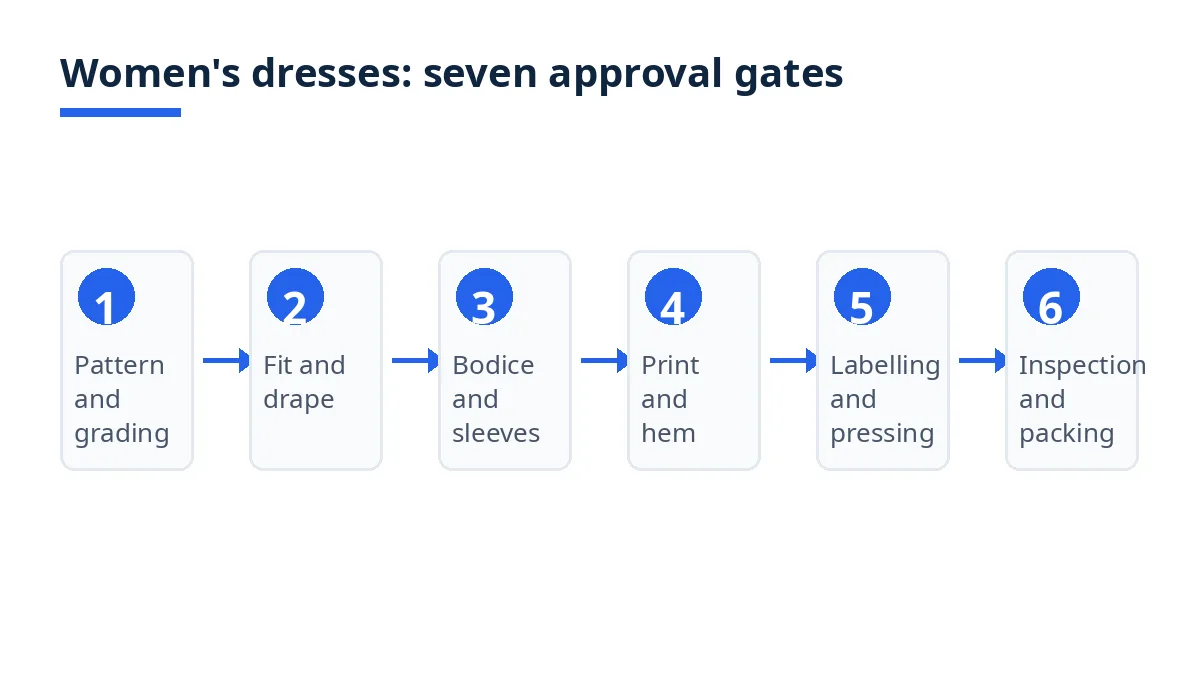
A women's dresses order runs on approval gates in a fixed order: pattern and grading before cutting, fit and drape before bodice construction is locked, bodice construction before print placement is locked, and print, hem, and labelling before inspection and packing.
Treat print and embroidery placement as a buyer-spec item: state the motif position against the neckline, waist seam, center front, and hem in writing, and check it on more than one size, since grading can move a motif across a seam.
Check the hem on the hung dress, not flat on a table: measure it at several points around the skirt, since panels cut on different grains fall differently and a flat approval can hide an uneven swing.
Read every duration as an illustrative planning example only, replace it with the dated figures in the written quote and the dated forwarder estimate, and keep a buffer after fit approval, after hem approval, and after inspection.
A women's dress order from Bangladesh is decided at the pattern table, on the fit model, and at the hem. A dress that measures correctly on paper can still fail when the bodice pulls across the bust, when a neckline gapes, when a sleeve cap puckers, when a placed print lands across a seam, or when a skirt hem swings unevenly because panels were cut off grain. This guide reads a women's dresses order through approval gates, so a buyer can see which decision is holding the order at any point. A gate is a named approval or document that must close before the next stage starts. Every duration here is an illustrative planning example only, or an item to confirm in the written quote and the dated forwarder estimate.
Why this matters for buyers
A dress joins two fitting problems in one garment. The bodice must fit the bust, waist, and shoulder, while the skirt must fall and swing from that bodice without pulling the waistline out of place. A change in one part moves the other: lengthening a bodice moves the waist seam, grading a bodice changes the armhole the sleeve must match, and changing a skirt panel changes how the hem hangs. That is why a dress order needs gates in a fixed order. The dress-specific order is: pattern and grading before cutting, fit and drape before bodice construction is locked, bodice construction before print placement is locked, and print, hem, and labelling before inspection and packing.
Step-by-step: how it works
Read a women's dresses order against seven gates, in this order.
Gate 0: Pattern, grading, and fit sample
Gate 0 fixes the pattern before bulk cutting starts. The buyer states the size range, the body measurements, and the finished garment measurements in the tech pack, and the seller confirms the pattern for the sample size and the grading rules for the other sizes. Pattern grading adds or subtracts different amounts in different areas, because the body does not grow uniformly in every direction as size increases, and shoulder width, hip circumference, and torso length change at different rates.1 Grading is not a fitting alteration: if a pattern fits in most places but not one, a targeted alteration gives a better result than grading the whole pattern.1 A Gate 0 approval should name the pattern, the grade rules by measurement point, and the sample size, plus the check that the graded sleeve curve still matches the graded armhole.
Gate 1: Drape and silhouette approval
Gate 1 approves how the dress looks on a body, not only how it measures flat on a table. The buyer checks the silhouette from the front, side, and back: does the bodice sit cleanly, does the waist seam sit level, does the skirt fall without twisting, and does the fabric drape as designed. A lining changes this reading, because lining a dress bodice adds structure and support and can enhance drape and fit.2 Gate 1 closes only with a fit sample approved in writing, with every correction recorded. Fit measured flat is a measurement check only; drape is judged on a form or fit model at this gate, and again after any fabric, lining, or construction change.
Gate 2: Bodice, neckline, and sleeve construction
Gate 2 approves the construction of the upper dress. The buyer checks the bodice shaping, whether by darts, princess seams, or pleats, the neckline shape and finish, the armhole shape, and the sleeve set, length, and cap ease. Neckline styles for a dress bodice include V-neck, sweetheart, and halter shapes, and sleeve types include sleeveless, short, and long sleeves.2 Check that the neckline lies flat without gaping, that the shoulder seam sits on the shoulder, that the sleeve cap is smooth, and that the sleeve hem is even. The buyer-spec items here are the neckline depth and finish, the sleeve style and length, and the bodice shaping method, each checked on the finished dress rather than on a flat pattern piece. If the neckline or sleeve changes after Gate 2, the order returns to Gate 2.
Gate 3: Print and embroidery placement as a buyer-spec item
Gate 3 approves where decoration sits on the dress. For a placed print or an embroidered motif, placement is a buyer-spec item, not a factory default: the buyer states, in writing and on a marked sample or diagram, where the motif sits relative to the neckline, the waist seam, the center front, and the hem. A motif that sits correctly on the sample size can land across a seam or fall half off a panel once the pattern is graded, so placement must be checked on more than one size. Embellishments for a dress bodice include lace overlay, beading, and embroidery.2 Gate 3 closes only with a placed sample approved in writing, naming the motif, its position, its size, and the sizes it was checked on.
Gate 4: Hem finishing
Gate 4 approves the hem as a construction check. The buyer states the hem style, depth, and finish for the skirt hem and any sleeve hem, and checks the hem on the hung dress. Hem finishing options for a dress include a rolled hem, bias tape, and serged edges.2 A hem approved flat can still swing unevenly when worn, because skirt panels cut on different grains fall differently, so Gate 4 includes a hang check: the hem is measured at several points around the skirt, and any panel that falls long or short is corrected before bulk sewing. If the fabric, panel layout, or hem style changes, Gate 4 reopens.
Gate 5: Wash-care labelling as a buyer-spec item
Gate 5 fixes the wash-care labelling wording. The buyer states the care instructions, fiber content wording, size marking, and country-of-origin marking required for the destination market, in writing, for this order. Labels for garments exported from Bangladesh carry the required information such as size, material composition, care instructions, and country of origin.3 Any market-specific requirement the buyer needs is a buyer-spec item to confirm in writing for this order, not a blanket rule for every market. Gate 5 closes when the label wording, position, and care symbols are approved in writing, and the labels are checked on a finished dress, not only on a label sheet, so a label sewn into a lined bodice or under a facing is still readable and in the agreed position.
Gate 6: Pressing, folding, inspection, and packing
Gate 6 runs bulk production only after Gates 0 to 5 have closed, and it ends with pressing, folding, inspection, and packing. Pressing and folding are a packing stage, not an afterthought: the buyer states the fold method, whether the dress is folded or hung, and the carton assortment, and checks a packed carton against that standard. Final inspection measures the packed dress against the approved samples for each gate. Goods that fail inspection stay out of the packed cartons.
Costs, timelines and documents
Costs move with fabric, print or embroidery work, lining, labelling, inspection, freight, and the delivery term, and the timetable moves with sample revisions, fit corrections, print repositioning, hem corrections, and document arrival. The table below is a stage framework only.
Stage | Illustrative planning example only | Gate that closes the stage |
|---|---|---|
Pattern and grading | Illustrative example: 2 weeks | Gate 0 pattern approved |
Fit, drape, and silhouette | Illustrative example: 2 weeks | Gate 1 fit sample approved |
Bodice, neckline, and sleeve | Illustrative example: 2 weeks | Gate 2 construction approved |
Print and embroidery placement | Illustrative example: 1 week | Gate 3 placed sample approved |
Hem finishing | Illustrative example: 1 week | Gate 4 hem approved on the hung dress |
Wash-care labelling | Illustrative example: 1 week | Gate 5 wording approved |
Bulk, pressing, folding, inspection, packing | Illustrative example: 4 weeks | Gate 6 report and packing list complete |
Documents and transit | Confirm in the dated forwarder estimate | Documents complete, goods loaded |
A worked example shows how the gates change a date. A buyer orders an A-line midi dress with a placed floral print on the skirt, puff sleeves, and a V-neckline. The first fit sample comes back with the floral motif cut across the waist seam, the neckline gaping when worn, and the skirt hem swinging long on one panel. Gates 1, 2, and 3 stay open for fit, neckline, and motif corrections, and the motif must be rechecked on the smallest and largest sizes. The corrected sample is approved, but the hem then falls unevenly after pressing, so Gate 4 stays open for a panel grain correction and a second hang check. Each reopened gate moves bulk sewing, and no gate can be skipped to recover the date.
For cost reading, use example figures only to compare quotes, and replace them with the written quote before planning. Illustrative example only: a single shipment at USD 28,400 on one delivery term, USD 1,950 for ocean freight, and USD 340 for marine insurance. Those figures are not a price for any real order, and they do not include destination handling, duty, broker fees, or inland delivery unless the quote says so.
The document set gates loading and clearance. Export documentation for garments from Bangladesh includes commercial invoices, packing lists, bill of lading or air waybills, export declaration forms, and certificates of origin.3 Goods shall not be loaded or shipped for export unless an export declaration, known as the Bill of Export or Shipping Bill, is submitted to Customs in the prescribed format and approved by the Customs authority, and the documents enclosed with it include the commercial invoice, the packing list, the EXP form certified by authorized dealers, and the certificate of origin.4 The Incoterms guide on Exportain explains the 11 rules and the split between cost and risk under each rule.5 Write the rule, named place, and edition together in the contract.
Bangladesh-specific rules and tips
Bangladesh-specific timing comes from the document chain as much as from production. The export document set must be complete before loading, and a buyer who treats loading as a factory date, rather than a document date, will misread the schedule. Ask the seller to confirm, in writing, who prepares each document and by which gate date, and confirm the EXP form and certificate of origin owners early, since both sit inside the Bill of Export set.4 A second point is print and hem capacity: confirm that a placed-print run and a hem correction can be repeated at bulk dates, not only on the sample, and that the bulk fabric lot matches the approved sample lot for drape.
Mistakes and red flags
Approving a pattern on one size and treating it as approved across the size range.
Approving fit on a flat table and never judging drape and silhouette on a form or fit model.
Approving print or embroidery placement on the sample size only, and finding it across a seam on another size.
Approving a hem flat and never doing a hang check on the finished dress.
Starting bulk before the print placement, hem, and label wording are approved in writing.
Treating a quoted delivery date as a loading date when the document set is not yet complete.
Comparing quotes on different delivery terms without pricing each quote to the same point.
Accepting a reply that names a date but no gate, sample, or document that closes each stage.
Checklist
Use this checklist before bulk starts.
[ ] Pattern, grade rules, and sample size named, with the graded sleeve matched to the graded armhole.
[ ] Fit and silhouette approved on a form or fit model: bodice fit, level waist seam, skirt fall.
[ ] Bodice construction approved: shaping method, neckline shape and finish, armhole, sleeve set and length.
[ ] Print or embroidery placement approved in writing, with position, size, and sizes checked named.
[ ] Hem style, depth, and finish approved, with a hang check on the finished dress.
[ ] Care, fiber content, size, and origin wording approved, with label position checked on the finished dress.
[ ] Pressing, folding, and carton standard agreed, with a packed carton checked against it.
[ ] Bulk inspection plan agreed: grading, drape, bodice, print placement, hem, labels, measurements.
[ ] Invoice, packing list, EXP form, certificate of origin, and shipping bill owners and dates confirmed.
[ ] Dated forwarder estimate received, replacing every illustrative planning example here.
How Exportain helps
Exportain gives buyers a place to put the gate table from this guide into a sourcing request, so each reply can be compared gate by gate rather than date by date. A buyer can list the pattern and grade rules, the fit and drape standard, the neckline and sleeve points, the print placement rule, the hem standard, the label wording, and the document dates as requirements, and ask each seller to reply against them in writing.
FAQs
What should I know first about women's dresses?
Start with the order of approvals: pattern and grading before cutting, fit and drape before bodice construction is locked, bodice construction before print placement is locked, print and hem before labelling, and labelling, pressing, and folding before inspection and packing.
What are the typical costs and timelines?
Read costs and durations as a stage framework only. Every duration is an illustrative planning example, and every cost figure is an example figure for comparing quotes. Replace both with the written quote and the dated forwarder estimate before setting a selling date, and keep a buffer after fit approval, after hem approval, and after inspection.
Which documents are needed?
The core set is the commercial invoice, packing list, bill of lading or air waybill, export declaration, and certificate of origin, with the EXP form certified by authorized dealers enclosed with the Bill of Export or Shipping Bill.4 Confirm who prepares each document and by which gate date.
What are the most common mistakes?
The most common mistakes are approving a pattern on one size only, approving fit without judging drape, approving print placement on the sample size only, approving a hem without a hang check, and starting bulk before the print placement, hem, and label wording are approved. Each reopens a gate.
Next steps on Exportain
Browse the Exportain suppliers page and compare replies gate by gate.
Read the Incoterms guide for shipments from Bangladesh before agreeing a delivery term.
Post the gate table as a requirement on the Exportain RFQs page and ask each seller to reply against each gate in writing.
Sources
- Pattern Grading All You Need to Know. Sewing For A Living (accessed )
- Creating a Perfect Fit: How to Line a Dress Bodice. ShunVogue (accessed )
- How to export garments overseas from Bangladesh. DHL (accessed )
- Customs Clearance Procedures for Export. Bangladesh Customs, National Board of Revenue (accessed )
- Incoterms for Shipments From Bangladesh. Exportain (accessed )
- Incoterms
- export documents
- quality control
- buyer guide
- Bangladesh sourcing
- bangladesh garments
- Women's dresses
About the author
Sourcing from Bangladesh?
Post a request for quotation and suppliers on Exportain can send you their quotes directly.
Post an RFQ