

Typical MOQ for Women's Blouses in Bangladesh (and How to Negotiate It Down)
No single women's blouses MOQ in Bangladesh: what sets the minimum per colour, roll, sleeve, neckline and embellishment, how to ask, and how to negotiate or structure a smaller order.
Short answer
There is no single typical MOQ for women's blouses from Bangladesh. Each factory sets its minimum per colour, per roll and per component for your specification, driven by fabric rolls, dye or print batches, sleeve and neckline runs, embroidery digitising and embellishment lots, and button and label runs. Ask for every floor line by line in writing, then negotiate the structure or the set-up costs.
On this page
Key takeaways
There is no single typical MOQ for women's blouses from Bangladesh, because each factory sets its minimum per colour, per roll and per component for your specification.
Blouse fabric rolls, dye or print batches, sleeve and neckline component runs, embroidery digitising and embellishment lots, and button and label runs are the floors that set the minimum.
Ask for the MOQ per colour, per roll, per component and per embellishment placement in writing, with set-up costs itemized apart from the unit price.
Negotiate the structure first: fewer colours, one cloth shared across necklines, one embellishment placement, stocked cloth and trims, and set-up paid as a separate line.
Exportain verification is a document and photo review, not a factory inspection, and a badge is not a guarantee.
Picture a first order of 600 blouses split across four colours, three necklines and two sleeve lengths. On paper the total looks comfortable. In practice the order breaks into twenty-four small cells, some holding as few as 25 blouses, and each cell has to satisfy its own floor before cutting can start. That grid, not the headline total, is what decides whether a blouse order can run in Bangladesh, and it is the first thing to work through with any factory.
The floor that usually bites first is the cloth roll. Blouse fabric is bought by the roll at a fixed width, and the cutting marker lays body fronts and backs, sleeves, collar stands, plackets and facings across that width. Example figures: a 120-metre roll with consumption of 1.15 metres per blouse yields about 104 blouses, since 120 divided by 1.15 is 104.3, so a colour ordered at 60 blouses still draws on a full roll and leaves the balance to be agreed, carried forward, or paid for. Shade can also drift slightly between rolls, so check shade continuity at sample stage.
Next come the component floors, and blouses carry more of them than a plain garment. A cap sleeve, a bishop sleeve and a sleeveless bodice are not interchangeable trims on the same body; each needs its own pattern piece, fusing, stitching sequence and pressing form. The same holds for a V neckline against a boat neckline, or a mandarin collar against a flat collar. Change one of those pieces after quotation and the factory is setting up a different operation, even when the body cloth, the colour and the total quantity stay exactly where they were.
Embellishment adds a third set of floors, often the highest in the whole order. An embroidered motif has to be digitised for its exact placement and size, and that digitised file belongs to one panel on one blouse. Lace inserts, sequin motifs, beadwork, smocking and pintucks each arrive in their own lots or need their own handling, so a single embellished front can demand a larger run than the plain back and sleeves it sits on. When a blouse carries embellishment on the yoke, the cuff and the hem, it carries three floors, not one.
Those floors also point to the strongest negotiation levers, and they work best before a price is argued. Dropping one colour lifts every remaining colour closer to its roll and dye floor. Cutting two necklines from the same stocked cloth lets them share one roll balance. Moving embellishment to a single placement removes the other digitising and lot floors entirely.
Bangladesh offers a wide woven base in which to test those floors. The Bangladesh Garment Manufacturers and Exporters Association (BGMEA) started with 12 members in the early 1980s and now counts around 4,500 member factories, with about 60 percent producing woven garments, and member factories account for 100 percent of the country's woven garment exports.1 Total exports reached $13.1 billion in the first quarter of fiscal year 2026-27, up over 6 percent year on year, according to Export Promotion Bureau data.2 Factory choice is plentiful; a shared minimum is not.
In the Harmonized System, heading 6206 covers blouses, shirts and shirt-blouses for women or girls, not knitted or crocheted.3 For sales into the European Union, Regulation (EU) No 1007/2011 requires the fibre names and their percentages by weight, in descending order, on the textile label, so the label must describe the cloth actually cut for the order.4
Floor | Why it binds on a blouse | Put this in your enquiry |
|---|---|---|
Cloth roll | Fixed roll length and width against per-colour quantities | Cloth, width and quantity for each colour |
Dye or print batch | One vessel or print run per colour and design | Stocked cloth or dyed to order, print method |
Sleeve and collar pieces | Separate patterns, fusing and pressing per shape | Sleeve shape, collar shape, neckline shape |
Embellishment | Digitising per placement, lots per material | Method, motif size, placement, material |
Buttons and labels | Ordered per colour and per size | Button, label, tag and carton specification |
Size curve | Ratio of sizes inside each colour | Quantity per size inside each colour |
Example figures: a buyer orders 720 blouses in two colours at 360 per colour, and each colour clears its roll and dye floors, while the same 720 blouses spread over eight colours at 90 per colour can fall short of both floors in every colour, even though the total is unchanged. The example shows structure only, not a typical MOQ, price or lead time.
Why this matters for buyers and sellers
For a buyer, the blouse grid decides how much money sits in slow colours and slow necklines, and whether a first order can test a single sleeve shape before a full range is committed. A range that looks modest in total can still strand stock, because a colour that misses its roll floor cannot be cut at all.
For a factory, the floors protect work that cannot be transferred to another buyer. Cloth dyed to your shade, a collar pressed to your shape, a digitised motif for your yoke and buttons matched to your colour have no second buyer, and the dye vessel, the roll and the component set-up are consumed even on a short run. That is why the same factory can accept a large plain blouse order and decline a smaller embellished one: the embellished order opens more floors, and fewer blouses must pay for each one.
Step-by-step: how it works
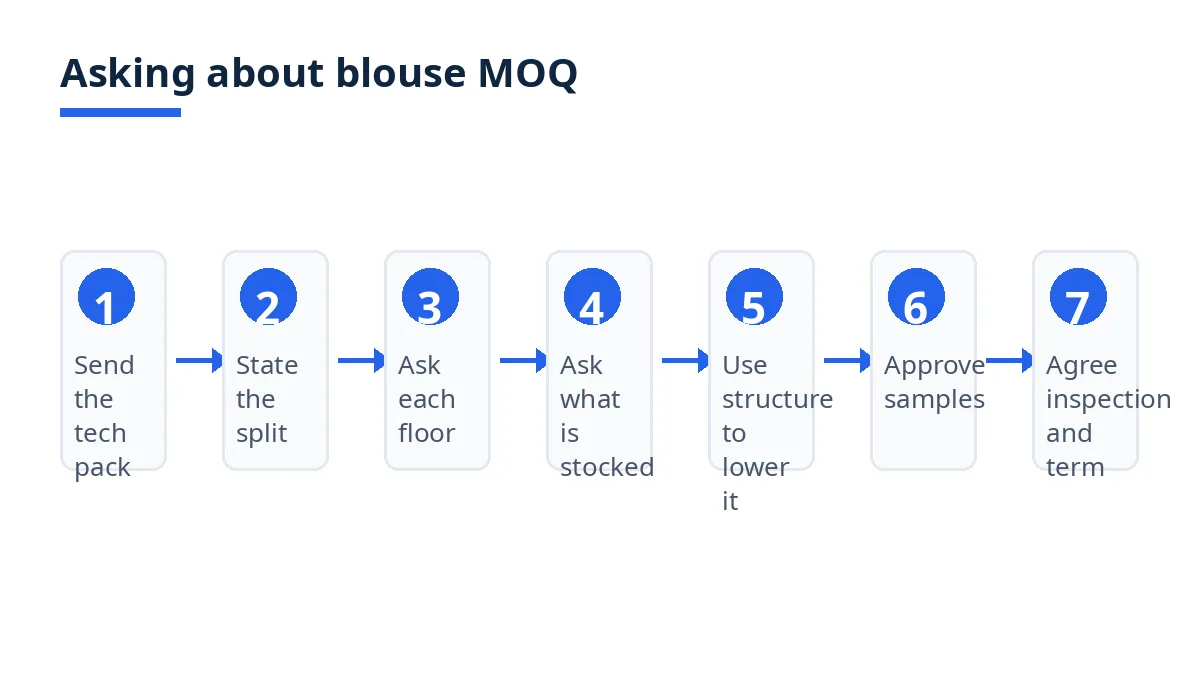
Send one tech pack to every candidate. Include cloth composition, construction and weight, body and sleeve shape, collar and neckline shape, button and trim specification, embellishment method, motif size and placement, labels, size chart and packing.
State the grid, not only the total. Give quantities per colour, per sleeve shape, per neckline and per size. A total without that grid cannot be answered with a usable blouse minimum.
Ask for each floor separately. Ask for the minimum per colour and dye or print batch, per roll, per sleeve and collar piece, per embellishment placement and material lot, and per button and label run, and ask which floor binds for your grid.
Check what is already stocked. Note whether each cloth and colour is held in stock or dyed to order, and whether buttons, lace and labels are stock items. Stocked inputs are where a lower minimum is most often available, because the roll and the dye batch already exist.
Reshape the order before asking for an exception. Remove a colour, share one cloth across two necklines, keep embellishment to one placement, or pay set-up as a separate line, and get the revised minimum in writing for the new grid before confirming anything.
Approve samples in writing. Order a proto sample, then a pre-production sample in the actual cloth, colour, sleeve, collar, neckline and embellishment. Measure it, wash it, check the embellishment after washing, then approve it or list corrections in writing.
Settle inspection and the delivery term before confirming. Write the inspection level and AQL values into the purchase order, following ISO 2859-1,5 and state one Incoterm and named place on every quotation.6
Costs, timelines and documents
No guide can state typical blouse costs or timelines as fact, for the same reason it cannot state a typical blouse MOQ. Each factory prices your cloth, sleeve and neckline construction, embellishment, button and label runs, finishing, packing, and delivery term.6 An embellished blouse carries more fixed set-up than a plain one at the same quantity, because digitising, sampling and material lots cost the same whether the run is short or long, and those fixed costs spread across fewer blouses when the run is small.
On timing, sampling turns on cloth availability, digitising and correction rounds, while bulk production turns on dyeing or printing, embellishment delivery and line capacity. Ask for sampling, cloth-ready, embellishment-ready, production and inspection dates separately.
Three papers carry the order: the tech pack, the itemized quotation and the purchase order. The minimum for each colour, each component and each embellishment placement belongs on the quotation and again on the order, so nothing is lost between what was quoted and what was confirmed. For the export set, check the current requirements on the Bangladesh Customs export clearance page.7
Bangladesh-specific rules and tips
Check association claims with the association. When a supplier claims BGMEA membership, confirm it with BGMEA itself. BGMEA represents the readymade garment industry, including woven garments, and its member factories account for 100 percent of woven garment exports,1 but membership describes the factory's standing in the industry, not the minimum it will offer for your blouse or its capacity for your sleeve and embellishment work.
One name, spelled one way, on every paper. Customs papers name the exporter and the overseas buyer,7 so the name on the trade licence, the quotation, the proforma invoice and the payment account should agree exactly. A spelling drift between those papers is usually found late, when fixing it costs days rather than minutes.
Find out which inputs are bought in for your order. Buttons, lace, sequins, beads and some blouse cloths may be purchased specifically for your specification, and a bought-in embellishment can set both the minimum and the earliest start date. Agree the size ratio for each colour before production, and ask whether a shortage of one embellishment material halts the whole colour or only the embellished panel.
Mistakes and red flags
Quoting a headline total and nothing else. The floor that blocks an order is usually per colour, per component or per embellishment placement. An order can clear the headline total and still fall short of the dye floor for one colour, the collar run for one neckline, or the motif lot for one panel, which then attracts a surcharge or a removal.
Growing the range without counting the new floors. Each added colour opens a dye batch, each added sleeve shape opens a component run, and each added neckline opens a collar and finishing run. A range that grows by one colour and one neckline can open several floors at once, so price the range as a grid, not as a total.
Comparing offers built on different blouses. A lower minimum on stocked cloth, a plain neckline, no embellishment or a different delivery term is a different offer. Compare only replies to the same tech pack on the same Incoterm.6
A concession that lives only in conversation. Get any reduced floor, shared roll, shared dye lot or waived charge written onto the quotation and the purchase order, naming the grid and the neckline it applies to. A concession granted for an unadorned blouse does not automatically carry over to the embellished version of the same style.
Digitising and label artwork billed a second time. Digitising and label artwork are paid once, then reused. File the paid set-up lines from the first order, with the motif, placement and label artwork identified, and send that file with the repeat enquiry so the same work is not billed again.
Do not mistake a badge for capacity. A profile page lets you start an enquiry; it cannot show whether a factory handles your sleeve shape, your collar press or your embellishment run, and a badge guarantees nothing about capacity, quality or delivery.8 9
Skipping the wash check on embellishment. Embroidery, sequins and beads have to survive washing on the actual blouse cloth, and that check belongs in the sample approval, before bulk cutting, not after it.
Checklist
Work down this list with the factory's written answers beside you, and confirm nothing until every line has a reply.
Tech pack sent: cloth, body and sleeve shape, collar and neckline, buttons, embellishment, labels, sizes, packing.
Grid per colour, sleeve shape, neckline and size, with one size ratio per colour.
Minimum per colour, roll and dye or print batch confirmed; binding floor named.
Sleeve, collar and neckline minimums confirmed apart from the body minimum.
Digitising and embellishment lot minimums confirmed per placement.
Button, label, tag and carton minimums confirmed apart from the garment minimum.
Cloth status per colour recorded: stocked or dyed to order, roll balance agreed.
Set-up costs itemized apart from the unit price; paid set-ups recorded for repeats.
Pre-production sample measured, washed and approved in writing, including embellishment.
Inspection level and AQL values written into the purchase order.5
Quotations compared on the same specification and Incoterm.6
Export clearance requirements confirmed with the supplier for the current shipment.7
How Exportain helps
On Exportain, browse suppliers and post a request for quotation (RFQ) on the RFQ board with your tech pack summary, grid per colour, sleeve and size, and delivery term, so suppliers quote against the same blouse. Ask each reply for its per-colour, per-component and per-embellishment minimums. Supplier verification on Exportain is a document and photo review, not a factory inspection, and a badge is not a guarantee.8 9 See how supplier verification works on Exportain.
FAQs
What should I know first about women's blouses?
There is no single minimum to look up. The minimum is set per colour, per roll and per component by cloth, dye or print batches, sleeve and neckline runs, digitising and embellishment lots, and button and label runs. Woven women's blouses fall under HS heading 6206, which covers blouses, shirts and shirt-blouses for women or girls, not knitted or crocheted.3
What are the typical costs and timelines?
No dependable typical figures exist, because every factory prices and schedules your own specification. The cloth, the sleeve and neckline work, the embellishment, the grid and the chosen delivery term set the price,6 while sampling rounds, dyeing or printing, embellishment supply and line availability set the dates.
Which documents are needed?
You need the tech pack, the itemized quotation and the purchase order, each showing the minimum per colour, per component and per embellishment placement. For the export set, check the current requirements on the Bangladesh Customs export clearance page.7
What are the most common mistakes?
Buyers most often trip on the same five points: quoting only a headline total, enlarging the range without counting its new floors, weighing offers built on different blouses or terms,6 trusting a concession that was never written down, and treating a badge as proof of capacity. A badge is not a guarantee of capacity, quality or delivery.8
Next steps on Exportain
The practical first move is to put the grid in front of suppliers: browse suppliers, then post the tech pack summary, the colour-and-size grid and the delivery term on the RFQ board, and compare the replies floor by floor. Two reads before you confirm: how supplier verification works on Exportain and the MOQ definition guide.
Sources
- Bangladesh Garment Manufacturers and Exporters Association (BGMEA). Devex (accessed )
- Exports up over 6% to $13.1bn in Q1 of FY27. Dhaka Tribune, (accessed )
- Classification Detail — HS Code 620620. United Nations Statistics Division (accessed )
- Regulation (EU) No 1007/2011 on textile fibre names and related labelling and marking of the fibre composition of textile products. European Union, (accessed )
- ISO 2859-1:2026 - Sampling procedures for inspection by attributes — Part 1: Sampling schemes indexed by acceptance quality limit (AQL) for lot-by-lot inspection. ISO (accessed )
- Incoterms® 2020. International Chamber of Commerce (ICC) (accessed )
- Customs Clearance Procedures for Export. Bangladesh Customs, National Board of Revenue (accessed )
- Trust & Safety Center. Exportain (accessed )
- Supplier verification: Earn trust badges buyers can see. Exportain (accessed )
- MOQ
- supplier verification
- buyer guide
- woven garments
- Bangladesh sourcing
- bangladesh garments
- Women's blouses
About the author
Sourcing from Bangladesh?
Post a request for quotation and suppliers on Exportain can send you their quotes directly.
Post an RFQ


