

Women's Blouses Lead Time From Bangladesh: Production and Shipping Timeline
Women's blouses lead time guide from Bangladesh: fabric and drape, neckline, placket, sleeve, panel print and size-curve approvals, with a worked voile-blouse example.
Short answer
A women's blouse lead time from Bangladesh runs on approval gates, not a single production run: lightweight fabric and drape, graded pattern and size curve, pressed neckline, button placket, placed print or embroidery, sleeve finishing, bulk sewing, pressing, labeling, inspection, export documents, and transit. Every duration is an illustrative planning example only. Replace it with the written quote and the dated forwarder estimate before setting a selling date.

On this page
Key takeaways
Lightweight cloth and drape are approved before cutting: a flat swatch alone does not prove how a blouse will hang, so a hung drape sample and a shade lot must be named.
Pattern and grading are approved as a size curve, not a single size: the graded pattern, first blouse, and measurement table for every size close together.
Neckline and placket are approved on pressed, fastened samples: a neckline that looks clean flat can pucker once pressed, and a placket that closes at the hem can gap at the bust point.
Print and embroidery are approved as placed panel samples in more than one size: artwork on a page does not prove where a motif will sit on a graded panel.
Sleeve finishing, pressing, labeling, inspection, and documents are separate gates: the sleeve option must be named in writing, and export documents gate loading, so every duration must be replaced by the written quote and the dated forwarder estimate.
A women's blouse order is decided in small approvals long before bulk sewing starts: cloth and drape, a clean neckline, a placket that closes without pulling, and a motif that lands in the same place on every panel. A fault approved on a sample will repeat across the whole order.
This guide uses a gate framework: a gate is a named approval, sample, or document that must close before the next stage starts. Every duration here is an illustrative planning example only, or an item to confirm in the written quote and the dated forwarder estimate. No duration here is a promise for any real order.
Why this matters for buyers and sellers
For a buyer, the risk sits in parts that look simple on a photograph: a neckline that puckers after the facing is turned, a placket that gaps between buttons, a cuff that grips unevenly, and a motif that drifts toward a side seam on larger sizes. Each fault is cheap to catch on a sample and costly to repair across packed cartons.
The blouse-specific point is the order: cloth and drape before cutting, neckline before bulk assembly, placket and buttons before finishing, panel decoration before sleeve finishing, and labeling as a written buyer-spec item before packing. Production follows a connected sequence, and a problem created before cutting may not become visible until sewing, while a fabric defect missed during inspection may later appear on a cut panel.1
Step-by-step: how it works
Read the order against seven gates.
Gate 0: Lightweight woven fabric approval and drape and hand-feel approval
Gate 0 fixes the cloth before cutting. Blouse cloth is light, so weight, weave, shade, and width matter together with how the cloth falls and feels in the hand. A Gate 0 approval should name the weave, shade reference, width, and lot that cutting will follow, plus a drape sample: a length of the approved cloth hung as the finished blouse will hang, not only a flat swatch in a book. Ask the seller to confirm in writing whether the cloth is in stock, is to be dyed or finished for this order, or is to be woven for this order. A new lot reopens Gate 0, and a change in finish reopens the drape approval.
Gate 1: Pattern, grading, size-curve approval, and the first blouse
Gate 1 produces the first complete blouse from the approved cloth, with pattern, neckline, placket, sleeves, and body in place. Patterns are created and graded to fit different sizes, and a prototype garment is made and adjusted for fit and quality.2 For blouses, grading is a size curve, and the curve must be approved as a set.
Check neckline, shoulder slope, bust shaping, armhole, sleeve setting, and hem on the first blouse, recording every correction in writing. Gate 1 closes only when the graded pattern, first blouse, and measurement table for every size are approved together. A blouse that fits in the middle can still pull at the neckline or armhole at the ends of the curve.
Gate 2: Collar and neckline finishing approval
Gate 2 approves the neckline as a finished edge, not as a drawn line. A neckline may carry a collar, a facing, a binding, or a clean turned edge, and each route behaves differently on light cloth. In blouse construction, the neckline is staystitched, the seam allowances are clipped, and the edge is pressed to the inside before the collar or facing is closed.3 Ask for the sample to be pressed, not merely sewn, before approval. A Gate 2 approval should name the neckline route, the facing or binding cloth, and the sample that proves the result: a neckline lying flat without puckering, a collar sitting evenly on both sides of the center, and an edge that keeps its shape after pressing. If the neckline route, facing cloth, or pressing route changes, Gate 2 reopens.
Gate 3: Button placket and button attachment approval
Gate 3 approves the closing before bulk sewing locks it in. A blouse placket is a narrow, visible strip, and its buttons and buttonholes are part of the design, not only a fastening. In blouse construction, the placket is stitched over the front piece, turned, folded, pressed, and edgestitched, and buttonholes and buttons are then placed on the placket, collar, and cuff positions.3
A Gate 3 approval should name the button, its size and color, the buttonhole size and stitch setting, the placket width and overlap, and the attachment method, with a sample the buyer can fasten and unfasten down the full placket. Check spacing at the bust point as well as at the hem, because a placket that closes at the hem can gap where the blouse curves. If a button, placket width, or stitch setting is substituted, Gate 3 reopens.
Gate 4: Print and embroidery placement approval on blouse panels
Gate 4 approves decoration where it will sit on the body, not only as artwork on a page. Garment construction includes an embellishment stage in which decorative elements such as embroidery or screen prints are added.2 Placement is the gate: a motif approved on one front panel can drift across a graded size curve or across a seam. A Gate 4 approval should name the artwork, the panel and position for each size, the distance from fixed points such as the neckline, placket edge, and hem, and a placed sample on a cut panel in the smallest and largest sizes. Check the motif after pressing, because pressing can shift a light panel. If the artwork, print route, or panel changes, Gate 4 reopens.
Gate 5: Sleeve finishing approval, cuff or elastic as buyer-spec options
Gate 5 approves how each sleeve ends, and the buyer must state the option in writing. A sleeve may end in a cuff, an elastic casing, a plain hem, or a tab. In blouse construction, a cuff is stitched, turned, and edgestitched with the sleeve sandwiched between its layers, while a gathered sleeve uses gathering stitches before the cuff is closed.3 A Gate 5 approval should name the sleeve ending, the cuff width or elastic width and tension where elastic is chosen, and a sample sleeve the buyer can try for grip and fall. For elastic, check tension on the smallest and largest sizes, because one setting will not grip evenly across the curve. If the sleeve ending or elastic setting changes, Gate 5 reopens.
Gate 6: Bulk sewing, pressing, wash-care labeling, inspection, and documents
Gate 6 runs bulk sewing only after Gates 0 to 5 have closed. During bulk, check work against the approved samples: shade, drape, neckline, placket, panel placement, sleeve ending, and measurements. A fault tracing back to an earlier gate sends the order back to that gate, not forward to packing.
Pressing and finishing follow sewing, and garments are inspected, ironed, and checked for defects before they are tagged and packed.2 Temperature, pressure, and time in pressing can change the result, and the same settings may not suit every fabric or decoration.1 A Gate 6 approval should name the pressing route, the fold and carton assortment, and the labeling wording the buyer requires in writing: wash-care, fiber content, size, and country-of-origin wording for the destination market. Any market-specific labeling requirement is a buyer-specification item to confirm in writing for this order, not a blanket rule for every market. Final inspection checks finished blouses against every earlier gate, with defective garments repaired before packing.
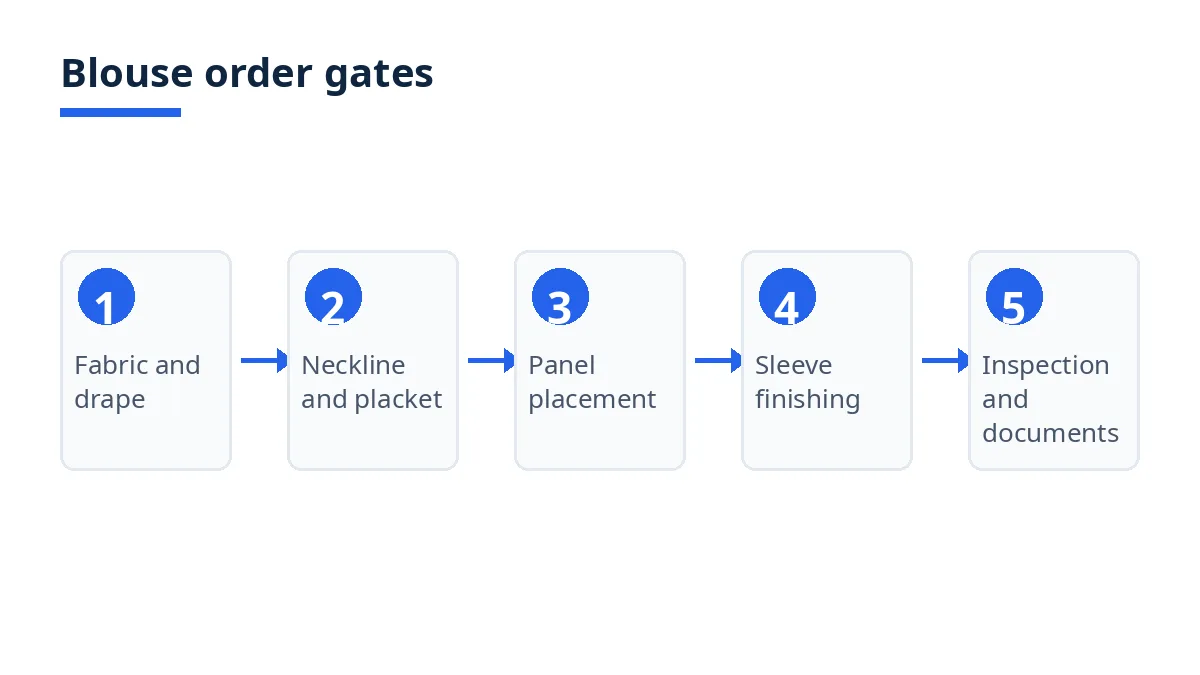
Costs, timelines and documents
Costs move with cloth, finishing route, buttons, print or embroidery, inspection, freight, and the delivery term, and the timetable moves with sample revisions and document arrival. Every duration below is an illustrative example only.
Stage | Illustrative planning example only | Gate that closes the stage |
|---|---|---|
Lightweight fabric and drape approval | Illustrative example: 2 weeks | Gate 0 cloth, shade lot, and drape sample approved |
Pattern, grading, and first blouse | Illustrative example: 1 week | Gate 1 graded pattern, size curve, and blouse approved |
Collar and neckline finishing | Illustrative example: 1 week | Gate 2 pressed neckline sample approved |
Button placket and button attachment | Illustrative example: 1 week | Gate 3 fastening sample approved |
Print and embroidery placement | Illustrative example: 1 week | Gate 4 placed panel samples approved |
Sleeve finishing, cuff or elastic | Illustrative example: 1 week | Gate 5 sleeve sample approved |
Bulk sewing, pressing, and labeling | Illustrative example: 2 weeks | Gate 6 inspection against samples passed |
Documents and transit | Confirm in the dated forwarder estimate | Documents complete, goods loaded |
A worked example shows how the gates change a date. A buyer orders a sage-green lightweight voile blouse with a V-neckline, a covered button placket, three-quarter sleeves with elastic cuffs, and a small embroidered motif on the left front panel. The fabric approval passes, but the pressed neckline puckers at the V point, so Gate 2 stays open. The revised neckline passes, but the motif sits closer to the side seam on the largest size, so Gate 4 stays open. Bulk sewing runs cleanly, but the elastic cuffs grip unevenly across sizes, so Gate 5 stays open.
For cost reading, use example figures only to compare quotes, and replace them with the written quote. Illustrative example only: a single shipment at USD 12,800 on one delivery term, USD 980 for ocean freight, and USD 180 for marine insurance. Those figures are not a price for any real order, and they exclude destination handling, duty, broker fees, and inland delivery unless the quote says so.
The document set gates loading and clearance. Goods shall not be allowed to load or ship for export unless an export declaration, known as the Bill of Export or Shipping Bill, is submitted to Customs in the prescribed format and approved by the Customs authority.4 Documents enclosed with it include the commercial invoice, the packing list, the EXP form certified by Authorized Dealers, and the certificate of origin.4 Keep the invoice, packing list, inspection report, and shipping bill consistent on quantity and description. The Incoterms guide on Exportain explains the cost and risk split under each rule.5 Write the rule, named place, and edition together in the contract.
Bangladesh-specific rules and tips
Bangladesh-specific timing comes from the document chain as much as from production: the export document set must be complete before loading, and a buyer who treats loading as a factory date, rather than a document date, will misread the schedule. Ask the seller to confirm in writing who prepares each document.
A second point is shade and drape continuity across lots. A defect found before cutting is usually easier to manage than the same defect found after many components have been cut or sewn.1 For an order split across lots, ask how shade and drape will be matched lot to lot.
A third point is the finishing queue at the end of an order: pressing, panel checks, and labeling for light blouses need capacity for the bulk quantity, not only the sample, confirmed in writing.
Mistakes and red flags
Approving cloth on a flat swatch without a shade lot and a hung drape sample.
Approving a neckline on an unpressed sample as a finishing approval.
Approving a placket at the hem only, not at the bust point.
Approving decoration as artwork, with no placed sample in more than one size.
Approving only a middle size, not the full size curve.
Changing buttons, placket width, facing cloth, or elastic tension after approval without a new sample.
Setting a selling date from the first sample date, with no buffer after panel placement and final inspection.
Accepting a reply that names a date but no gate, sample, or document.
Checklist
Checklist before bulk.
[ ] Weave, shade, width, lot in tech pack; Gate 0 drape sample named.
[ ] Graded pattern, size curve, first blouse approved; every size measured.
[ ] Neckline route, facing cloth, pressed sample approved.
[ ] Button, buttonhole setting, placket width, overlap approved on a sample.
[ ] Artwork, panel, position, fixed-point distances approved on placed samples.
[ ] Sleeve ending, cuff width or elastic tension, sample sleeve approved.
[ ] Bulk inspection plan agreed: shade, drape, neckline, placket, panel, sleeve, measurements.
[ ] Pressing route, fold, carton assortment approved on a packed sample.
[ ] Wash-care, fiber, size, origin wording approved for this order.
[ ] Invoice, packing list, EXP form, origin certificate, shipping bill owners confirmed.
[ ] Delivery term, named place, edition in contract; cost split confirmed.
[ ] Dated forwarder estimate received, replacing every illustrative example.
[ ] Buffer held after panel approval and after final inspection.
How Exportain helps
Exportain gives buyers a place to put the gate table from this guide into a sourcing request, so each reply can be compared gate by gate rather than date by date. A buyer can list the fabric and drape, size curve, neckline, placket, panel, and sleeve approvals as requirements, and ask each seller to reply against them in writing.
FAQs
What should I know first about women's blouses?
Start with the order of approvals: cloth and drape before cutting, neckline before bulk assembly, placket and buttons before finishing, panel decoration before sleeve finishing, labeling as a written buyer-spec item, and documents before loading.
What are the typical costs and timelines?
There is no single figure fitting every women's blouse order. Costs move with cloth, finishing route, buttons, print or embroidery, inspection, freight, and the delivery term, and the timetable moves with sample revisions and document arrival. Use the illustrative examples here only to read a quote, and replace them with the written quote and the dated forwarder estimate.
Which documents are needed?
The export set gates loading and clearance from Bangladesh: the contract or purchase order, commercial invoice, packing list, EXP form, certificate of origin, and shipping bill, with the bill of lading or air waybill issued by the carrier.4 The approval set gates bulk: fabric and drape, graded pattern and first blouse, pressed neckline, placket, placed panels, sleeve, and approved label wording.
What are the most common mistakes?
The most common mistakes are approving cloth without a drape sample, approving a neckline before pressing, approving a placket at one point only, approving decoration as artwork without a placed panel sample, approving a sleeve ending without a written option, and approving only a middle size.
Next steps on Exportain
Compare the gate table against current listings on the Exportain supplier directory, check the cost and risk split for your delivery term in the Incoterms guide, and post the gate requirements through Exportain RFQs.
Sources
- Garment Manufacturing Automation: Process-by-Process Guide. OSHIMA (accessed )
- The Step-by-Step Garment Production Process. Shanghai Garment (accessed )
- Tutorial: make the Carme blouse. Fabrics Store (accessed )
- Customs Clearance Procedures for Export. Bangladesh Customs, National Board of Revenue (accessed )
- Incoterms for Shipments From Bangladesh. Exportain (accessed )
About the author
Sourcing from Bangladesh?
Post a request for quotation and suppliers on Exportain can send you their quotes directly.
Post an RFQ


