

Typical MOQ for Winter Coats in Bangladesh (and How to Negotiate It Down)
No single winter coat MOQ applies in Bangladesh. This guide explains how shell, lining, insulation, colour and size lots set the minimum, and how fewer variants, stocked inputs and written terms can bring it down.
Short answer
There is no single typical MOQ for winter coats from Bangladesh. Each supplier sets minimums per style, per colour, per size and per fabric, lining and insulation lot, and the largest binds the order. Buyers bring the binding minimum down by cutting colours and sizes, using stocked inputs, sharing lots across styles and paying set-up costs as a separate line, with every agreement confirmed in writing.
On this page
Key takeaways
There is no single typical MOQ for winter coats from Bangladesh: each supplier sets minimums per style, colour, size and input lot, and the largest binds the order.
Shell, lining and insulation lots, plus trim, label and carton runs, set the floor; changing a colour, fabric or closure restarts part of the work.
Example figures show the trap: 900 coats in three colours can fail a 400-piece per-colour minimum even though the total looks large enough.
Negotiation works by changing the order: fewer colours and sizes, stocked inputs, shared lots and set-up paid as a separate line, all confirmed in writing with AQL inspection terms.
Ask two suppliers for the winter coats MOQ in Bangladesh for the same coat and you can receive two different minimums, two different counting bases and two different prices, with no contradiction between them. The coat is the same in the photograph. The order is not the same, because each supplier counts the minimum against a different set of lots and set-ups, and each coat variant restarts part of that work.
A winter coat is built from separate inputs that are each bought, dyed or made in lots: a shell fabric, a lining, insulation, closures, trims and labels. Change the shell colour and you start a new dye lot. Change the insulation weight and you start a new fill allocation. The minimum is the smallest run that covers those lots and set-ups without leaving the supplier with dyed fabric, matched lining and printed labels that no other buyer can use. This article explains how that minimum is built for winter coats, how to read it on a quotation, and how to bring it down by changing the order rather than by pressing for an exception on the same order.
Why this matters for buyers and sellers
For the buyer, the minimum decides how much cash is tied up in one style and whether a first order can test a coat before a larger repeat. A coat ordered in many colours and sizes spreads the same total across many small lots, and the smallest lot is the one that fails. For the seller, the minimum protects lots bought or dyed for that buyer alone, which cannot be moved to another order, so a short run still carries the full lot cost and line change.
The coat itself sets the floor before any negotiation starts. Shell weight and construction, lining type, insulation type and weight, closure type, pocket work, trim finish and label and packing specification each add a lot or a set-up. A heavy shell, a quilted lining and a two-way zip are not the same order as a light shell, a plain lining and a single zip, even when both are called winter coats.
Classification and labelling also belong in the early specification. The Harmonized System identifies each traded product by a six-digit code, applied by more than 200 countries and economies, and used to assess duties and taxes and to collect trade statistics.1 Treat any heading a supplier suggests as indicative only, and confirm the full code for the destination tariff before filing. For the European Union, a textile product shall be labelled or marked with the name and percentage by weight of all constituent fibres in descending order.2
Step-by-step: how it works
Work through the six steps below in order, and keep every answer in writing against the same specification.
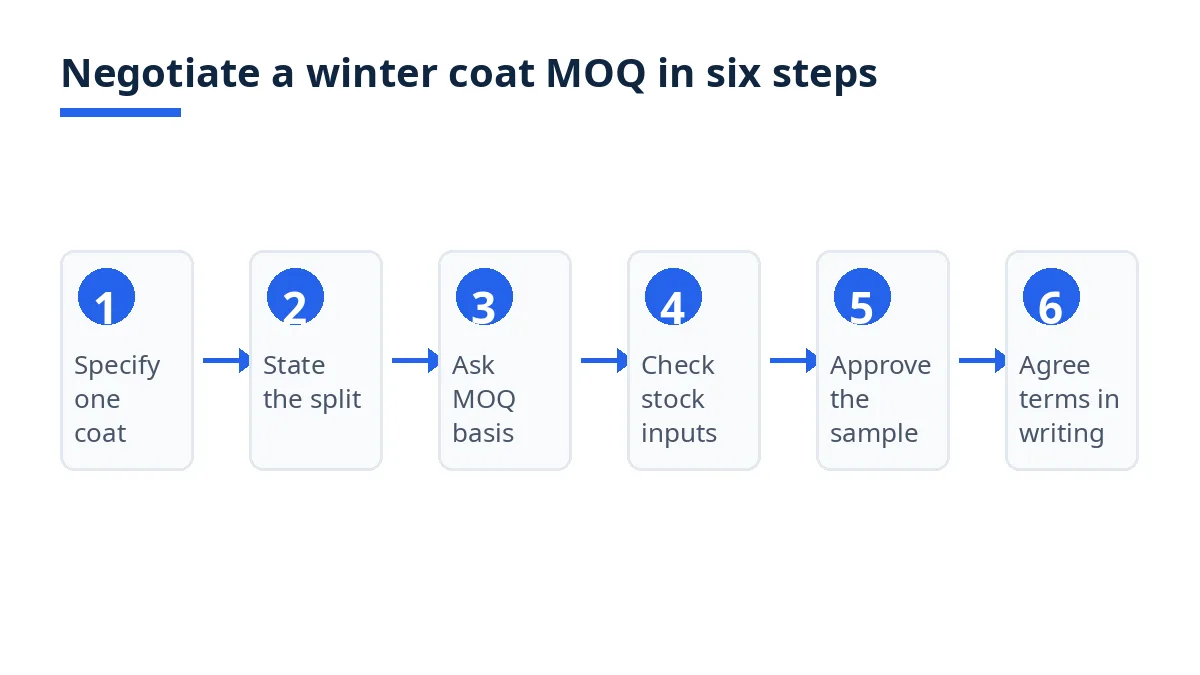
Write one specification for every supplier. Name the shell fabric, weight and construction, the lining, the insulation type and weight, the closure and pocket work, the size chart with tolerances, the colours, the trims, the labels and the packing. Add the destination markets and the delivery term with a named place.
State the split, not only the total. Give the quantity per style, per colour and per size. A total without a split cannot be answered with a usable minimum, because the binding minimum is usually per colour or per size within a colour.
Ask for the minimum on each basis, in writing. Ask for the MOQ per style, per colour, per size, per shell lot, per lining lot and per insulation lot, and for any separate trim, label, tag and carton minimums. Ask which line binds for your split, and record the answer on the quotation.
Ask what is stocked and what must be bought or dyed. Record whether each shell colour, lining and trim is in stock or must be bought or dyed for the order. Stocked inputs are where a lower minimum is most often possible, because the lot already exists.
Approve a sample in the production materials. Order a proto sample, then a pre-production sample in the actual shell, lining, insulation, closures, trims and labels. Measure it against the size chart, wash it, test the closures and pocket work, and approve it or list corrections in writing.
Agree inspection and commercial terms before you confirm. Write the inspection level, the acceptance quality limit (AQL) values and the defect classifications into the purchase order. ISO 2859-1 provides sampling schemes indexed by AQL for lot-by-lot inspection by attributes, and AQL is the quality level that is the worst tolerable process average when a continuing series of lots is submitted for acceptance sampling.3 State one Incoterm and named place for every quotation. Incoterms 2020 sets out 11 rules that allocate cost, risk and obligations between seller and buyer, so compare minimums and prices only on the same rule and the same named place.4
Costs, timelines and documents
What are the typical costs and timelines?
There are no typical costs or timelines for winter coats that a buyer can rely on as fact, because each supplier prices the shell, lining, insulation, closures, trims, labels, packing and delivery term for one specification and one split. The table below sets out what moves the price.
Price driver | What it changes | State it in the enquiry |
|---|---|---|
Shell fabric | Fabric and dye lot, weight, finish | Fabric, weight, construction, colour |
Lining | Lining lot and shade match | Lining type and colour |
Insulation | Fill lot and weight | Insulation type and weight |
Closures and trims | Trim lot per colour and style | Zip, buttons, toggles, pocket work |
Labels and packing | Print runs per market and brand | Label, tag and carton specification |
Split | Quantity per colour and per size | Size curve per colour |
Delivery term | Freight, insurance and risk point | One Incoterm and named place4 |
Example figures: a quotation prices 900 coats in three colours at one unit price, with a per-colour minimum of 400 coats. The split puts 300 coats in each colour, so the total clears any total minimum while each colour falls below the per-colour floor. The same 900 coats in two colours at 450 per colour clear the per-colour floor, and the same 900 coats in one colour clear it with room to spare. Example figures only.
For timelines, ask for each gate as a separate date: sample approval, shell and lining ready, insulation delivery, cutting, sewing, finishing and inspection. Sampling depends on fabric availability and correction rounds. Bulk production depends on dyeing, lining and insulation delivery and line capacity. A single delivery week that hides those gates cannot be held to account when one gate slips.
Which documents are needed?
The order set is the specification, the itemized quotation with the minimum on each basis, the purchase order, the sample approval record and the inspection terms. Keep the paid set-up lines from the first order with the repeat enquiry, so set-up paid once is not paid again.
For export clearance in Bangladesh, goods shall not be allowed to load or be stuffed in containers for export unless an export declaration, known as the Bill of Export or Shipping Bill, is submitted to Customs and approved.5 Documents enclosed with the Bill of Export include the export contract or purchase order where there is no export letter of credit, the commercial invoice, the packing list, the EXP form certified by an authorized dealer, and a certificate of origin issued by the Export Promotion Bureau or a Chamber of Commerce and Industry.5 Keep one legal name for the exporter across the trade licence, quotation, invoice, packing list and payment account, because the declaration names the exporter and the foreign buyer.5
Bangladesh-specific rules and tips
Confirm membership and identity claims at the source. If a supplier claims membership of the Bangladesh Garment Manufacturers and Exporters Association (BGMEA), confirm the record with the association. BGMEA runs an online Membership Management System through which member factories can update membership information, make payment and generate an e-certificate of membership.6 Ask for the trade licence and the Export Registration Certificate, and check that the legal name and address match on every document.
Ask which inputs are imported for the coat. Shell fabric, insulation, zips and some trims may be bought in for the specification, and an imported input can set both the minimum and the earliest production date. Record the source and delivery date for each imported input, and agree what happens if it arrives late or in a different lot.
Approve label proofs word for word, per market. Fibre composition, care wording and origin marking differ by market, and the European Union rule on fibre names and percentages applies to textile products made available on the Union market.2 Approve each label proof against the approved shell and lining composition before the label run, and require a new approval if the composition changes.
Agree the size curve and the subcontracting position in writing. Record the size ratio per colour, size by size, and ask which stages are done in the named facility and which are sent elsewhere. If the workload or the subcontracting position changes after the quotation, ask for the change in writing with a new start date.
Mistakes and red flags
What are the most common mistakes?
Asking for a total minimum only. The binding minimum is usually per colour, per size or per lot. An order can clear the total and still fall below the per-colour minimum for one colour, which then carries a surcharge, a removal or a refused colour.
Comparing minimums on different specifications or terms. A lower minimum on a lighter shell, a different insulation weight, stock labels or a different delivery term is a different offer. Compare only replies to the same specification on the same Incoterm and named place.4
Accepting a lower minimum verbally. Record any agreed lower minimum, shared lot or waived set-up on the quotation and the purchase order, with the split and the dates it applies to. A verbal exception that is not on the order cannot be enforced when the lot position changes.
Changing a colour, fabric or closure after the quotation. A late change restarts the dye lot, the shade approval, the trim run or the sample, and it needs a new minimum, a new sample and a new price. Treat every change as a new version of the quotation, not as a note on the old one.
Reading a badge or a photograph as an inspection. A profile and a badge are a starting point for enquiries. A badge records document and photo checks that staff have reviewed and approved, not a factory inspection, and it is not a guarantee of capacity, quality or delivery.7
Trading away the sample or the inspection to win a lower minimum. A washed pre-production sample and an agreed inspection standard protect a small order most, because the goods cannot be reworked once shipped. Do not remove either control to close a price gap.
Checklist
Before confirming a winter coat order, every line below should be answered in writing.
One specification sent to every supplier: shell, lining, insulation, closures, sizes, colours, trims, labels, packing, markets, delivery term.
Split stated per style, per colour and per size, with a size curve for each colour.
Minimum confirmed on each basis: style, colour, size, shell lot, lining lot, insulation lot, trims, labels, tags, cartons; binding line named.
Stock position recorded per input: stocked or bought or dyed for the order.
Set-up costs itemized apart from the unit price; paid set-ups recorded for the repeat.
Pre-production sample in production materials measured, washed, closure-tested and approved in writing.
Inspection level, AQL values and defect classifications in the purchase order.3
Quotations compared on the same specification, split, Incoterm and packing.4
Export set agreed: Bill of Export, commercial invoice, packing list, EXP form, certificate of origin.5
Membership, registration and legal name checked at the source, with one name on every document.6
What should I know first about winter coats?
Know the coat as a set of lots, not as one garment. Shell, lining, insulation, closures, trims and labels each carry a lot or a set-up, and the binding minimum is the largest of the minimums that apply to the split. The Harmonized System gives each traded product a six-digit code used by more than 200 countries and economies for duties and statistics, so confirm the full code for the destination before filing.1
What are the typical costs and timelines?
There are no typical costs or timelines for winter coats as a category. Shell, lining, insulation, closures, trims, labels, packing, the split per colour and size, and the delivery term move the price, and sampling, dyeing, input delivery and line capacity move the timeline. All arithmetic in this article is labelled Example figures. Ask for a cost breakdown by line and a date for each gate, and compare suppliers on the same breakdown.
Which documents are needed?
The order set is the specification, the itemized quotation, the purchase order, the sample approval record and the inspection terms. The shipment set is the Bill of Export, the commercial invoice, the packing list, the EXP form certified by an authorized dealer, and a certificate of origin issued by the Export Promotion Bureau or a Chamber of Commerce and Industry.5 Keep one legal name on every document in both sets.
What are the most common mistakes?
The most common mistakes are asking only for a total minimum, comparing minimums on different specifications or delivery terms,4 accepting a lower minimum verbally, changing a colour or fabric after the quotation without a new minimum and sample, and reading a badge or a photograph as an inspection. A badge records document and photo checks, not a factory inspection, and it is not a guarantee.7
Next steps on Exportain
Browse suppliers and send the same specification and split to each shortlisted supplier, so every reply states its minimum on each basis. Read how supplier verification works on Exportain before treating any badge as more than a document and photo review, and read the MOQ meaning guide so the counting basis on each quotation is clear before prices are compared.
Post a free RFQ on Exportain and get quotes from Bangladeshi suppliers → https://exportain.com/rfqs
Sources
- An Overview of Harmonized System Codes. U.S. Department of Commerce, International Trade Administration, (accessed )
- Regulation (EU) No 1007/2011 on textile fibre names and related labelling and marking of the fibre composition of textile products. European Union, (accessed )
- ISO 2859-1:2026 — Sampling for Inspection by AQL. American National Standards Institute (ANSI) (accessed )
- Incoterms® 2020. International Chamber of Commerce (ICC) (accessed )
- Customs Clearance Procedures for Export. Bangladesh Customs, National Board of Revenue (accessed )
- BGMEA launches Membership Management System to provide faster and simpler services. BGMEA (accessed )
- Supplier verification: Earn trust badges buyers can see. Exportain (accessed )
About the author
Sourcing from Bangladesh?
Post a request for quotation and suppliers on Exportain can send you their quotes directly.
Post an RFQ


