Winter Coats Exporters in Bangladesh: Verified Supplier Checklist
A supplier-verification checklist for winter coats from Bangladesh: identity and export documents, coat capability proof, closures and hood records, samples and tests, labels and certificates, and a recorded pass, fix or fail decision.
Short answer
Use this checklist to judge a winter-coat supplier in Bangladesh before accepting a quotation or paying: check identity, trade licence and Export Registration Certificate on the documents themselves; ask for pattern, grading, lot and closure proof on garments; require a sample in production materials and test reports naming the lot; approve label proofs word by word per market; and record a pass, fix or fail decision for each item in one order file.
On this page
Key takeaways
A badge records a document and photo review by Exportain staff, not a factory inspection or a guarantee of capacity, quality, or delivery; check the documents, garments, and records yourself.
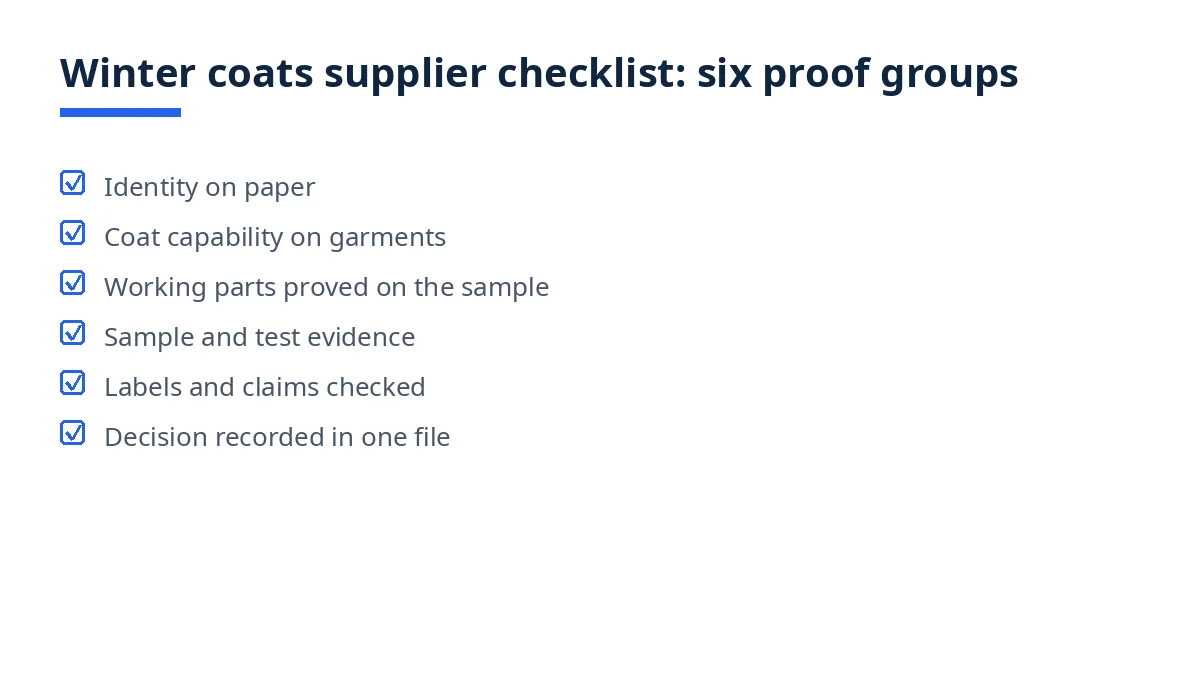
Work one file per supplier through six proof groups: identity, coat capability, working parts, samples and tests, labels and claims, and the recorded decision.
Agree the sampling basis, defect classes, and acceptance numbers in the purchase order, and keep a sealed sample in production materials as the shipment reference.
Approve label proofs word by word for each sales market, and hold the certificate for the shipment before any claim appears on the coat or label.
A winter coat is judged when it is worn, not when it is photographed: a hood can pull when raised, a storm placket can gap over layers, and fill can escape through a seam. This checklist helps buyers judge winter coats exporters bangladesh suppliers by the proof behind the coat, before a quotation is accepted or money is paid.
Use one copy for each supplier. Every item asks for something the supplier can show, state in writing, or record. A catalogue photograph, a profile badge, or a spoken assurance is not proof on its own. It covers buyers in the United States, the United Kingdom, the European Union, and the United Arab Emirates.
Why this checklist matters
A winter coat is a layered garment, and each layer can hide a weakness in another: a heavy shell can mask thin fill, and a hood can sit well flat and pull the collar out of shape when raised. Checking the supplier first puts the proof before bulk cutting starts.
A badge on an Exportain profile helps at the shortlist stage, and its limits matter. Verification is a document review by Exportain staff, not a factory inspection, and a badge is not a guarantee of capacity, quality, or delivery.1 Read the badge meanings in the guide to how supplier verification works on Exportain, then complete the items below from the documents and records themselves.2
Before you start
Prepare one written coat specification: shell, lining, interlining, and fill; length and silhouette; hood, collar, closure, pocket, and cuff construction; size range and colours; trims; labels; and packing. Add the sales markets and a version number and date.
Agree the inspection basis before production. ISO 2859-1:2026 defines acceptance sampling plans indexed in terms of the acceptance quality limit (AQL), with switching rules that move to tightened inspection when defects increase.3
What winter coats exporters bangladesh proof looks like
Proof means a named piece of evidence that can be filed: a document copy, a sample record, a report naming the material tested, or a written statement. The diagram below sets out the six proof groups.
The full checklist (numbered, printable)
Mark each item pass, fix before order, or fail, and file the evidence named. Do not order while a fail item is open.
Identity and export standing, proved on paper
Same legal name and address on the quotation, invoice, and each document supplied; compare them line by line.
Trade licence and tax record. The trade licence and, where provided, the taxpayer identification number (TIN) and incorporation documents, with names checked against item 1.1 2
Export Registration Certificate (ERC) copy, with the company name checked, filed for the order.1 2
Association membership record, where BGMEA or BKMEA membership is claimed, confirmed with the association; BGMEA runs an online Membership Management System that issues an e-certificate of membership.4
Coat-making capability, proved on garments
Maker-or-trader statement in writing, naming the facility that will produce the order, and any outside work declared.1 2
Pattern and grading record: the size range graded, the fit trial record over the layers the coat will be worn with, and who signed the fit off.
Lot control record: how shell, lining, and fill lots are kept separate between styles and colours, and how a lot change is re-approved.
Current workload with dates: what is in production now, and when the line for this order would start, recorded with the date given.
Minimum quantity counting basis: per order, per style, per colour, or per size; see the guide to MOQ, minimum order quantity.
References for comparable coats, recording what each confirms about coat type, specification, and delivery.
Working parts: closures, hood, pockets, and cuffs
Closure specification in writing: zip type and supplier, button or snap type, storm placket construction, and the second closure where one covers the zip.
Zip and closure demonstration on the sample, recorded, including any catching or misalignment found.
Hood pattern and adjustment record: hood depth and shape, drawcord adjustment through its full range, finished cord ends, and a written drawcord statement for each market.
Pocket construction statement: pocket position and size by size, pocket bag material and construction, and reinforcement at pocket corners and openings, checked against the sample.
Cuff and hem adjustment record: how cuffs and hems adjust and hold, recorded on the sample, on both sides.
Samples, tests, and the inspection agreement
One specification version for every supplier, with a version number and date; record every change as a new version.
Sample in production materials: the actual shell, lining, interlining, and fill that will ship, with the closures, trims, and labels that will ship; keep a sealed sample as the shipment reference.
Test reports naming the lot: each report the order requires, naming the standard, the material tested, and the result.
Inspection agreement in writing, before production: sampling basis, defect classes, acceptance numbers, inspector, and rejected-lot terms, using ISO 2859-1:2026 as the attributed standard.3
Labels, claims, and destination paperwork
Label proof approved word by word, per market: fibre wording, percentages, care wording, and origin wording, checked on the proof itself, not from a photograph.
European Union fibre labelling: check the proof against Regulation (EU) No 1007/2011, under which a textile product shall be labelled or marked with the name and percentage by weight of all constituent fibres in descending order.5
United States wool and cashmere wording: labels showing fibre content, country of origin, and the name or registered identification number of the manufacturer or marketer, with fibre content tested periodically, since the importer is legally responsible for proper labelling.6 For a cashmere claim, check the Act's definition: "cashmere" may be used only for dehaired undercoat fibres meeting its diameter limits.6
Certificate scope for every claim: hold the certificate for the shipment and check scope, products, supplier, and dates; under OEKO-TEX STANDARD 100, the label is awarded only if all components meet the criteria, including zips and buttons, and coats fall in Product Class III.7
Classification treated as indicative: any Harmonized System heading supplied by the seller, until the full code is confirmed for the destination tariff; the Harmonized System comprises more than 5,000 commodity groups, each identified by a six-digit code, and is used by more than 200 countries and economies.8
Packing, commercial record, and the decision
Packing method agreed for a bulky coat: hanging or folded packing, compression where used, the rest period after compression where stated, and the recovery check against the sample, plus carton assortment and markings.
Versioned quotation: unit price, minimum quantity and counting basis, lead time by gate, delivery term with edition and named place, payment terms, and validity, with payment terms and any funds hold agreed in writing before paying; Exportain holds money only when both parties agree to a funds hold.1
Decision and order file: every item marked pass, fix before order, or fail, with the checklist, documents, sample record, reports, label proofs, and quotation versions filed in one order file; do not order while a fail item is open.
Common failures and how to fix them
A catalogue coat mistaken for capability is the most common failure: photographs of coats sold, but no pattern record, no lot record, and no sample in production materials. Fix it with items 5 to 7 and item 17, filed before any quotation is accepted.
A sample that proves the wrong coat arrives in a different shell or a lighter fill. Fix it by holding the sample against item 17, listing every difference in writing.
Hood and closure faults show when the coat is worn, not when it is flat. Fix them with the demonstration records in items 12, 13, and 15, re-checked on the sealed sample before bulk is approved.
Label failures start with a hang tag that does not match the care label, such as a sleeve tag naming cashmere in wording the fibre label does not support.6 Fix them by approving every label and tag word by word on the proof in item 20.
Certificate failures start with a certificate held for the wrong scope or period. Fix them by checking scope, products, and dates in item 23; under OEKO-TEX STANDARD 100, a certificate is valid for 12 months.7
Downloadable template / summary table
Copy the checklist into one vetting sheet per supplier, adding the specification version and sales markets.
Group | Items | Evidence to file | Decision |
|---|---|---|---|
Identity and export standing | 1 to 4 | Licence, ERC, record | Pass, fix, or fail |
Coat-making capability | 5 to 10 | Pattern, lot, references | Pass, fix, or fail |
Working parts | 11 to 15 | Closure, hood, pocket, cuff | Pass, fix, or fail |
Samples, tests, inspection | 16 to 19 | Sample, reports, agreement | Pass, fix, or fail |
Labels, claims, paperwork | 20 to 24 | Proofs, certificates, code | Pass, fix, or fail |
Packing, commercial, decision | 25 to 27 | Packing plan, quotation, file | Pass, fix, or fail |
Score a supplier only after every group has a decision.
How Exportain helps
Exportain is a B2B marketplace where buyers can find Bangladeshi suppliers of winter coats, compare profiles, and send the same specification to more than one supplier. Browse suppliers, open each profile, and read its trust and verification checklist for the document and photo checks behind each badge, remembering those checks are document and photo reviews, not factory inspections.1 2 Post an RFQ through RFQs with the specification version and sales markets attached.
FAQs
When should this checklist be used?
Use it before accepting a quotation and before the first payment, and again when the specification, fill, colour plan, or sales market changes.
Who should complete it?
The buyer, a sourcing agent, or an independent inspector can complete it, provided one named person owns the file and works from the same specification version as the supplier.
What are the most common failures?
A catalogue coat mistaken for capability, a sample in substitute materials, hood and closure faults found only when worn, a hang tag that does not match the fibre label, and a certificate held for the wrong scope. Fix each by asking for the proof itself, and recording the correction in writing.
Can a third party do it?
Yes, if the third party receives the specification version, sales markets, inspection basis, and acceptance numbers before starting. The buyer keeps the decision in item 27.
Next steps on Exportain
Send the specification version and this checklist to each shortlisted supplier, and compare versioned quotations on the same fields. Browse suppliers and read the guide to how supplier verification works on Exportain, then post a free RFQ via RFQs and compare quotes from Bangladeshi suppliers of winter coats.
Sources
- Trust & Safety Center. Exportain (accessed )
- How Supplier Verification Works on Exportain. Exportain, (accessed )
- ISO 2859-1:2026 - Sampling procedures for inspection by attributes — Part 1: Sampling schemes indexed by acceptance quality limit (AQL) for lot-by-lot inspection. ISO (accessed )
- BGMEA launches Membership Management System to provide faster and simpler services. BGMEA (accessed )
- Regulation (EU) No 1007/2011 on textile fibre names and related labelling and marking of the fibre composition of textile products. European Union, (accessed )
- Cachet of Cashmere: Complying with the Wool Products Labeling Act. Federal Trade Commission (accessed )
- OEKO-TEX STANDARD 100 for textiles tested for harmful substances. Hohenstein (accessed )
- What is the Harmonized System (HS)?. World Customs Organization (accessed )
About the author
Sourcing from Bangladesh?
Post a request for quotation and suppliers on Exportain can send you their quotes directly.
Post an RFQ