Windbreakers Exporters in Bangladesh: Verified Supplier Checklist
A printable checklist for vetting windbreaker exporters in Bangladesh: identity and export documents, shell capability, samples and test evidence, finish and label checks, and the commercial record to agree before ordering.
Short answer
Use this checklist to vet a windbreaker exporter in Bangladesh before ordering: check identity, trade licence, Export Registration Certificate, and association claims against the documents themselves; judge shell capability from samples in production materials and lot-level test evidence; agree the inspection basis and acceptance numbers in the purchase order; and check finish declarations, label proofs, certification scope, and the export document set for each sales market.
On this page
Key takeaways
A badge records a document and photo review by Exportain staff, not a factory inspection or a guarantee of capacity, quality, or delivery; check the documents, samples, and inspection terms yourself.
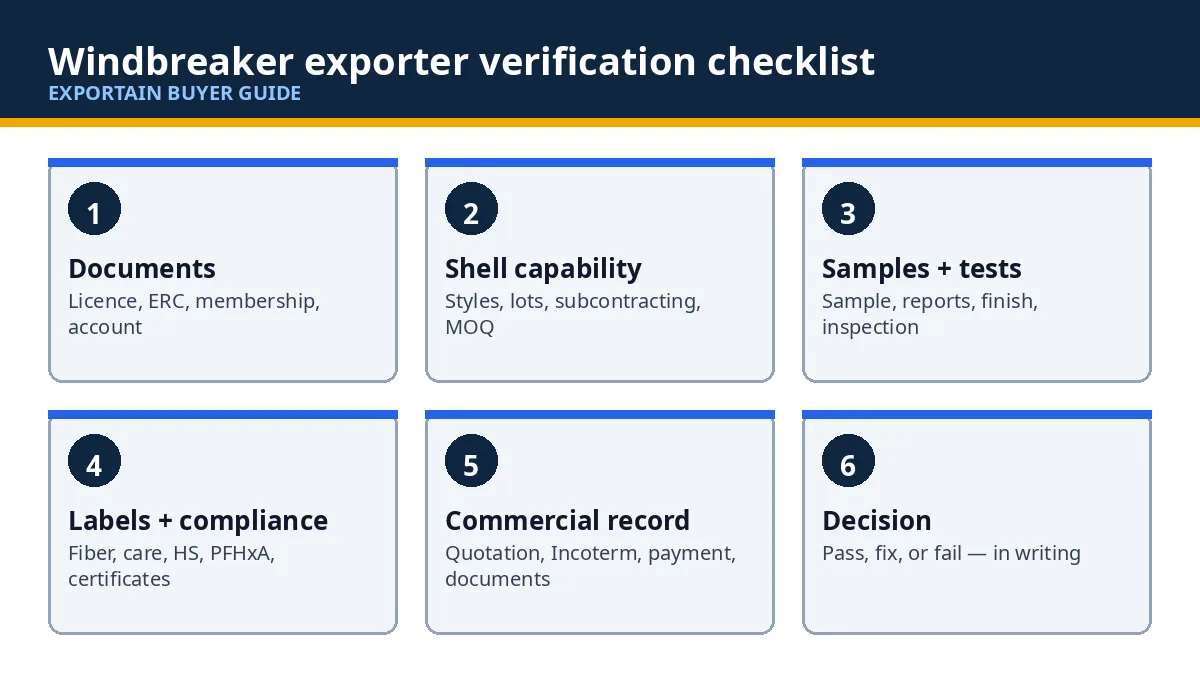
Work one file per supplier through six blocks: documents, shell capability, samples and quality evidence, labels and compliance, commercial record, and a recorded pass, fix, or fail decision.
Agree the sampling basis, defect classes, and acceptance numbers in the purchase order; this checklist sets no AQL value, sample size, or acceptance number.
Approve label proofs word for word for each sales market, hold the finish declaration and certificate for the shipment, and check that every test report names the lot it covers.
This checklist helps a buyer in the United States, the United Kingdom, the European Union, or the United Arab Emirates judge a windbreaker exporter in Bangladesh before accepting a quotation or sending payment. It sets no prices, minimums, or delivery dates. For one supplier at a time, it records which documents were seen, which shell capability was shown, and which market rules were checked. Keep one file per supplier.
A windbreaker is a shell product. Its faults are shell faults: a weave that lets wind through, a finish that stops beading, a seam tape that lifts, or a zip that snags. Most are set before bulk production, in the shell lot, the finish, and the pattern. The checks that catch them are document checks and sample checks: a test report naming the lot it covers, a finish declaration, a sample in the production shell, and a label proof checked word by word.
Why this checklist matters
A windbreaker combines a shell fabric, a finish or coating, seam treatment, trims, labels, and packing. A fault in any one of them is hard to correct after bulk production starts. A finish applied to the wrong lots, a shell lot substituted after sample approval, or a zip changed without a new sample each produce a finished jacket that does not match the approved sample.
Exportain verification helps at the shortlist stage, and its limits matter. Verification is a document review by Exportain staff, not a factory inspection and not a check against a government database, and a badge is not a guarantee of production capacity, product quality, or delivery.1 Each badge records one check: Exportain Verified, identity, phone, email, and business registration; Export Verified, the Export Registration Certificate (ERC); Factory Verified, reviewed factory photos; Trading Company Verified, reviewed office or warehouse photos.1
Before you start
Prepare one written specification naming the shell fabric, weave, weight, coating or laminate, finish chemistry, seam construction, hood and pocket construction, size range, colors, trims, labels, and packing; the sales markets; and the performance claims the jacket will carry. Agree the inspection basis before production, so the sampling basis and acceptance numbers are written down. ISO 2859-1:2026 defines sampling plans indexed by acceptance quality limit (AQL), the maximum average percentage of defective items considered acceptable during random sampling.2 The numbers you accept are your purchase-order terms, not figures from this article. This checklist sets no AQL value, sample size, or acceptance number.
The diagram below sets out the six blocks of the checklist in the order to complete them.
The full checklist
Documents and identity
Legal name and address. Check the same legal name and address on the quotation, invoice, and every document supplied.
Trade licence and tax records. Ask for the trade licence and, where provided, the taxpayer identification number (TIN) and incorporation documents, and check the names against item 1.1
Export registration. Ask for a copy of the Export Registration Certificate (ERC) and check the company name on it. The Export Verified badge records that staff checked the ERC.1
Association membership claims. If a supplier claims BGMEA or BKMEA membership, ask for the membership record and confirm it with the association. BGMEA runs an online Membership Management System that issues an e-certificate of membership.3
Manufacturer or trading company. Ask the supplier to state in writing whether it makes the windbreakers or trades them, and which facility will produce the order. Factory Verified and Trading Company Verified record reviewed photos, not a visit.1 4
Payment account name. Ask for the business bank account name and check it against the verified company name. On Exportain, a verified payment-account line means the account was checked against the verified company name.4
Shell capability
Windbreaker experience. Ask which windbreaker styles the supplier has made, in which shell fabrics, weaves, coatings, and seam constructions, judging from samples and records, not a catalogue photograph.
Shell and finish control. Ask how shell lots, finish batches, and coating runs are kept separate between styles and colors, and how a lot or batch change is recorded and re-approved.
Subcontracting. Ask in writing whether any stage, such as coating, seam taping, printing, or packing, is done outside the named facility, and record each outside stage.
Size and color plan. Ask the supplier to confirm the size range and color list in writing, including shade matching across body, sleeves, hood, and pocket fabric.
Current workload. Ask what is in production now and when the line for your order would start, and record the answer with a date.
Minimum quantity basis. Ask how the minimum order quantity is counted, per order, per style, per color, or per size, and record the basis with the specification. See the guide to MOQ meaning.
Samples and quality evidence
Specification version. Give every supplier the same specification version, with a version number and date, and record every change as a new version.
Sample in production materials. Ask for a sample in the actual shell fabric, finish, lining, trims, and labels that will ship, and approve it or list corrections in writing.
Fit, hood, and pack checks. Check the sample for fit, hood fit and adjustment, storm flap overlap, zip operation, toggle function, seam finishes, and the pack-into-pocket action where the style packs.
Shell test reports. Ask for each test report the order requires, and check that it names the test standard, the material or lot tested, and the result. For wind resistance, air permeability is measured under a prescribed pressure differential, with methods including ISO 9237.5 For water penetration, ISO 811 specifies a hydrostatic pressure method.6 For surface wetting, ISO 4920 specifies a spray test, and states that it is not intended for use in predicting rain-penetration resistance.7
Breathability evidence. Where a breathability claim will be made, ask for the test method and the lot tested. The sweating guarded-hotplate test measures thermal resistance and water-vapour resistance under steady-state conditions.8 Do not accept a spray rating as breathability evidence.
Finish durability. Ask for the spray rating as made and after the agreed number of washes, with the finish chemistry named.
Seam and tape checks. Check seam tape adhesion on the sample, including hood and shoulder seams, before and after washing where required, and record which seams are taped.
Inspection standard. Agree the inspection standard in writing before production: sampling basis, defect classes, acceptance numbers, inspector, and rejected-lot terms. ISO 2859-1:2026 provides AQL-indexed sampling schemes with switching rules that move to tightened inspection when defects increase.2 Keep a sealed sample as the shipment reference.
Records. File the sample record, test reports, finish declarations, and inspection agreement with the order record, under one legal name for each party.
Labels and destination compliance
European Union fiber labeling. For EU sales, check the label proof against Regulation (EU) No 1007/2011, under which a textile product shall be labelled or marked with the name and percentage by weight of all constituent fibers in descending order.9 Check the proof itself, not a photograph, and check shell, lining, mesh, and pocket fibers separately.
United States labeling. For United States sales, check that labels accurately reflect fiber content, country of origin, and the name or registered identification number of the manufacturer or marketer, and show a safe cleaning method.10 The importer is legally responsible for proper labeling.10
Care and origin labels. Check care instructions against the finish and coating limits, country-of-origin wording, and any other label the destination market requires, on the proof for each market, before the label run.
Classification, indicative only. Treat any Harmonized System heading as indicative until the full code is confirmed for the destination tariff. Heading 6201 covers anoraks, wind-cheaters, and wind-jackets, men's or boys', not knitted or crocheted, with subheading 6201.93 for man-made fibers.11 The matching women's and girls' subheading is 6202.93.12
Finish chemistry and PFHxA. Ask for the finish chemistry in writing, with the chemical supplier named. From 10 October 2026, Regulation (EU) 2024/2462 restricts PFHxA, its salts, and PFHxA-related substances in textiles in clothing for the general public, at 25 parts per billion for the sum of PFHxA and its salts, or 1,000 parts per billion for the sum of PFHxA-related substances.13 Hold the declaration and test evidence for the lots that ship.
Harmful-substances claims. If a harmful-substances claim will appear on the product, check the certificate scope, covered components, and dates. Under OEKO-TEX STANDARD 100, the label is awarded only if all components meet the criteria, including fabric, threads, lining, dyes, finishes, and accessories such as zips.14
Commercial and shipment record
Quotation version. Ask for a versioned quotation stating unit price, minimum quantity and counting basis, lead time, Incoterm, payment terms, and validity.
Delivery term and named place. State the Incoterm, its edition, and the named port or place on every quotation compared. The Incoterms 2020 rules give a clear allocation of cost, risk, and obligations across 11 rules.15
Payment terms. Agree payment terms, any funds hold, and the documents triggering each payment, in writing, before paying. Exportain is not a party to the goods contract and does not inspect goods, book freight, or clear customs.4
Export document set. Agree the set before loading: the Bill of Export must be approved by Customs, with the contract or purchase order, invoice, packing list, EXP form, and certificate of origin enclosed.16
Decision and file. Mark each item pass, fix before order, or fail. Do not order while a fail item is open. Keep the checklist, documents, sample record, and quotation versions in one order file.
Common failures and how to fix them
Reading a badge as a factory inspection is the most common failure. A badge records document and photo checks, not a guarantee of capacity, quality, or delivery.1 Fix it by completing items 1 to 6 from the documents themselves.
A spray rating used as proof of waterproofing is the next failure. The spray test measures surface wetting, not penetration.7 Fix it by requiring hydrostatic evidence, seam treatment, and closures that match the claim.6
A finish change without a new test record is a quiet failure. Fix it by treating every finish, coating, or shell lot change as a new version, with a new lot approval and a new test report naming the lot.
Sample failures start with a sample made in different materials from bulk. Fix it by requiring the sample in the production shell and finish, keeping a sealed sample, and checking that each test report names the lot it covers.
Label failures start with approval given from a photograph. Fiber wording, percentages, care wording, and origin wording cannot be checked reliably from a photograph.9 10 Fix it by approving the proof itself, word for word, for each market.
Document mismatches are the quietest failure: the quotation, invoice, and certificate name different companies. Fix it by running the consistency check in item 32 before payment.16
Downloadable template and summary table
Copy the checklist into one vetting sheet per supplier. Add the specification version, the sales markets, and the acceptance numbers agreed in the purchase order, and record a result and the evidence seen for each item.
Block | Items | Evidence to file | Decision |
|---|---|---|---|
Documents and identity | 1 to 6 | Licence, ERC, membership record, account name | Pass, fix, or fail |
Shell capability | 7 to 12 | Samples, subcontracting note, quantity basis | Pass, fix, or fail |
Samples and quality evidence | 13 to 21 | Sample record, test reports, finish declarations, inspection agreement | Pass, fix, or fail |
Labels and destination compliance | 22 to 27 | Label proofs, certificates, classification note, finish declaration | Pass, fix, or fail |
Commercial and shipment record | 28 to 32 | Quotation versions, document set, decision | Pass, fix, or fail |
Score a supplier only after every block has a decision. A supplier with an open fail item is not ready to order from. Keep the sheet with the order record so a repeat order starts from the last agreed version.
How Exportain helps
Exportain is a B2B marketplace where buyers find Bangladeshi suppliers, post requests for quotation, and compare versioned quotations. Use suppliers to shortlist factories, open each profile's trust and verification checklist, and send each shortlisted supplier the same specification version and this checklist. Read the how-to-buy guide before you post.
When should this checklist be used?
Use it before accepting a quotation and before the first payment, and again when the style, shell, finish, size and color plan, or sales market changes. A repeat order on the same specification, markets, and supplier can reuse the last sheet, with the new quotation version, sample record, and label proofs added.
Who should complete it?
The buyer, a sourcing agent, or an independent inspector can complete it, provided one named person owns the file and works from the same specification version as the supplier. The supplier supplies the documents, samples, and written answers; the person completing the checklist records what was seen.
What are the most common failures?
A badge read as a factory inspection, a spray rating used as proof of waterproofing, a finish change without a new test record, a sample made in substitute materials, a label approved from a photograph, and documents that name different companies.1 9 6 7 Fix each one the same way: stop, ask for the document, proof, or test report itself, and record the correction in writing before ordering.
Can a third party do it?
Yes, if the third party receives the specification version, the sales markets, the agreed inspection basis, and the acceptance numbers before starting. A third party can check documents, samples, and labels against that record, but cannot create the specification or agree the commercial terms. The buyer keeps the decision in item 32.
Next steps on Exportain
Browse Bangladeshi suppliers and open each profile checklist before shortlisting, reading each badge for the document or photo check behind it.1 4 Send each shortlisted supplier the same specification version and this checklist, agree the inspection basis and label proofs in writing, and compare versioned quotations on the same fields.
Post a free RFQ on Exportain and get quotes from Bangladeshi suppliers → https://exportain.com/rfqs
Sources
- Trust & Safety Center. Exportain (accessed )
- ISO 2859-1:2026 - Sampling procedures for inspection by attributes — Part 1: Sampling schemes indexed by acceptance quality limit (AQL) for lot-by-lot inspection. ISO (accessed )
- BGMEA launches Membership Management System to provide faster and simpler services. BGMEA (accessed )
- How Supplier Verification Works on Exportain. Exportain, (accessed )
- ISO 9237:1995 - Textiles - Determination of the permeability of fabrics to air. International Organization for Standardization (accessed )
- ISO 811:2018 - Textiles - Determination of resistance to water penetration - Hydrostatic pressure test. International Organization for Standardization (accessed )
- ISO 4920:2012 - Textile fabrics - Determination of resistance to surface wetting (spray test). International Organization for Standardization (accessed )
- Measuring thermal and water vapour resistance. SATRA (accessed )
- Regulation (EU) No 1007/2011 on textile fibre names and related labelling and marking of the fibre composition of textile products. European Union, (accessed )
- Cachet of Cashmere: Complying with the Wool Products Labeling Act. Federal Trade Commission (accessed )
- HS, 2012 - Code 6201. United Nations Statistics Division (accessed )
- HS, 2012 - Code 620293. United Nations Statistics Division (accessed )
- Commission Regulation (EU) 2024/2462 amending Annex XVII to Regulation (EC) No 1907/2006 as regards undecafluorohexanoic acid (PFHxA), its salts and PFHxA-related substances. European Union (accessed )
- OEKO-TEX STANDARD 100 for textiles tested for harmful substances. Hohenstein (accessed )
- Incoterms® 2020. International Chamber of Commerce (ICC) (accessed )
- Customs Clearance Procedures for Export. Bangladesh Customs, National Board of Revenue (accessed )
About the author
Sourcing from Bangladesh?
Post a request for quotation and suppliers on Exportain can send you their quotes directly.
Post an RFQ