

Wholesale Workwear and Uniforms From Bangladesh: Prices, MOQ and Reliable Suppliers
Wholesale workwear and uniforms from Bangladesh are bought as a programme, not a single style: bulk pricing, durability costs, size-run assortments, replenishment ordering and branding charges decide the cost. This guide sets out each driver, with example figures, so buyers can compare quotes on one specification.
Short answer
To buy wholesale workwear and uniforms from Bangladesh, define the uniform programme first: wearer, job, fabric, size-run assortment and branding. Send one tech pack to several suppliers, compare itemized quotations on the same delivery term, approve a washed wearer-trial sample in writing, and agree replenishment terms before bulk production. Each factory sets its own price and minimum for your specification.
On this page
Key takeaways
A uniform programme is bought as a set of garments, sizes and branding, not as a single style, so the size-run assortment and replenishment terms belong in the first specification.
Fabric weight and blend, durability finishes, reflective tape and corporate branding are the main price drivers, and each should be priced as a separate line in every quotation.
EN ISO 20471 classes and the named test standard for any protective claim must be stated in the enquiry, and branding must be kept clear of reflective tape.
Approve the pre-production sample in writing only after a wear and wash trial, and inspect a complete wearer set together, including shade matching within the set.
Exportain verification is a document and photo review, not a factory inspection, and a badge is not a guarantee of production capacity, product quality or delivery.
A wholesale workwear order is rarely one garment in one colour. A buyer fitting out a workforce, or a distributor stocking a uniform range, is buying a programme: jackets, trousers, shirts, coveralls or bib and brace overalls that must match each other, fit a spread of body sizes, survive repeated laundering, and stay available for new starters. The unit price on a quotation only makes sense once that programme is defined.
Bangladesh supplies both sides of this market. Woven garments, the construction most workwear uses, earned $4.614 billion in July to September of fiscal year 2026-27, within ready-made garment exports of $10.578 billion, according to Export Promotion Bureau data reported by The Financial Express.1 Knitwear, which covers polo shirts, fleece tops and other uniform layers, earned $5.963 billion in the same quarter.1 The Bangladesh Knitwear Manufacturers and Exporters Association, established in 1996, represents approximately 2,540 knitwear member factories.2 No two factories price a uniform programme the same way, because each prices the fabric, durability finish, branding and size split specified.
Why this matters for buyers and sellers
A fashion garment is judged on a rail. A uniform is judged on a workforce, day after day, and the cost of a wrong choice is multiplied by every wearer. If a trouser fabric bags at the knee, a jacket zip fails, or a colour fades unevenly across a team, the buyer faces a visible inconsistency across staff, plus replacement pieces that must match the original batch.
That repeat-wear demand is what separates workwear pricing from fashion pricing. Fabric weight, weave density, seam construction, bar tacks at stress points and wash durability decide how many wash cycles a garment survives before it is replaced, and therefore what the programme costs per wearer per year rather than per piece at the dock. A cheaper garment replaced twice as often is the expensive option.
For sellers, a uniform programme is steadier business than a single seasonal style. The first bulk order is followed by replenishment: replacement sizes, new-starter packs and damaged-item swaps. A factory that holds the fabric, the dye recipe and the branding artwork can refill sizes quickly, while a factory that treats each order as a fresh start cannot. Judge a supplier on programme capacity, not only on the first-order price.
Size is the other programme problem. A fashion range sells through a size curve weighted to the middle of the market, but a uniform range must cover the actual workforce, including the smallest and largest wearers. Shorting an end size leaves staff without uniform, and over-ordering it leaves branded dead stock.
Step-by-step: how it works
The steps below follow a uniform programme from brief to replenishment.
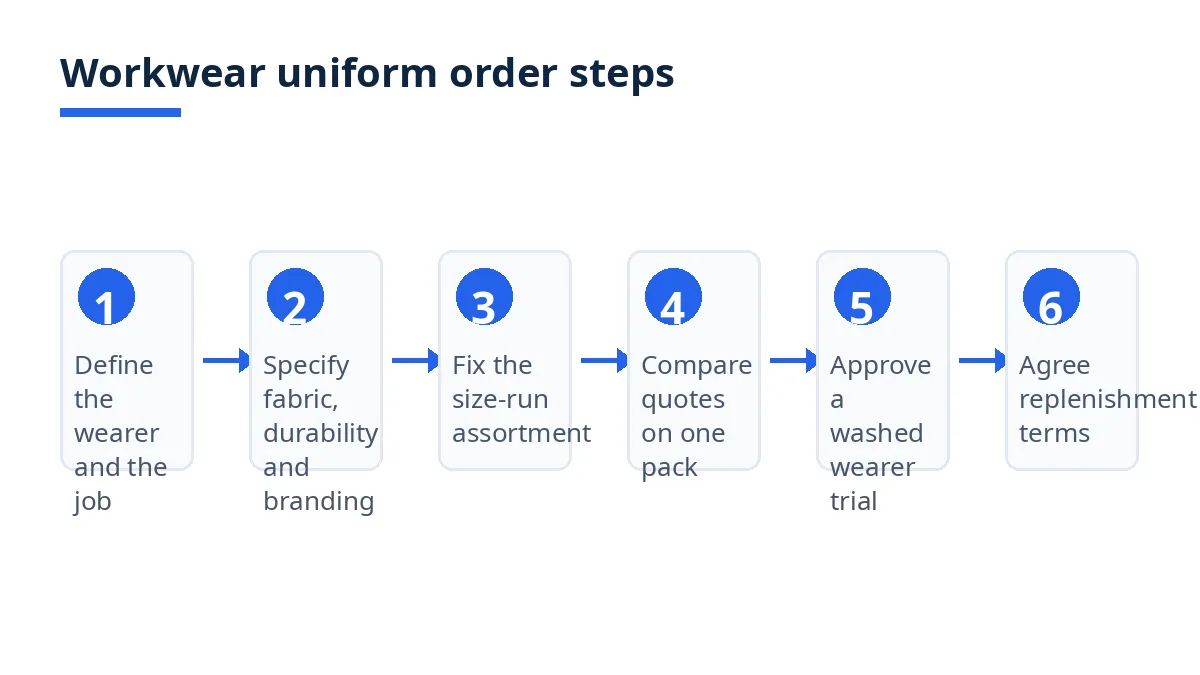
1. Define the wearer and the job. Write down who wears each garment, what work they do, and what hazard or visibility requirement applies. A warehouse team and a road crew need different fabrics and standards. For high-visibility garments, state the class required: EN ISO 20471 defines three classes by minimum areas of fluorescent and retroreflective material, with Class 3 giving the highest visibility.3
2. Specify fabric, construction and durability. State the fibre blend, fabric weight, weave or knit, colour, and the durability tests the garment must pass, including wash cycles and colour fastness. Add seam type, pocket layout, fastening type, and reinforcement at knees, elbows and pocket mouths. EN ISO 13688 sets general requirements for protective clothing covering ergonomics, durability, ageing, size designation and marking, and the information the manufacturer must supply.3
3. Fix the size-run assortment. Give the quantity per size for each garment, not only the order total. State the size chart, how fit samples will be checked on real body shapes, and the tolerance for finished measurements. Changing the assortment after quotation changes the price.
4. Send one pack to several suppliers and compare like with like. Ask each factory to quote the same garments, fabric, size split and delivery term, with branding, packing and inspection as separate lines. A quotation bundling branding into the unit price cannot be compared with one charging it separately.
5. Run a wearer trial and a wash test before bulk. Approve the pre-production sample in writing, then put it through the wear and wash routine the workforce will actually use. Check fit on more than one body shape, fastenings after repeated use, and whether reflective tape and branding survive laundering. A sample that only passes a visual check has not been tested.
6. Agree bulk, inspection and replenishment in writing. Confirm bulk quantity per size, the inspection plan, packing per wearer set or carton, and replenishment terms: holding period for fabric, dye recipes and artwork, minimum repeat per size, and repeat price basis.
Costs, timelines and documents
Workwear prices move on a small set of drivers. A buyer who names each one in the enquiry gets comparable quotations.
Cost driver | What it changes | State in your enquiry |
|---|---|---|
Fabric weight and blend | Heavier, denser cloth costs more per metre and wears longer | Fibre blend, weight, weave, colour |
Durability finishes | Wash-and-wear and water resistance add process steps | Each finish, with test method |
Reflective tape and trims | Tape area and grade, heavy-duty zips and buttons add material cost | Tape layout, class, trim specification |
Corporate branding | Embroidery stitch count or print colours are fixed set-up costs | Artwork, method, size, placements |
Size-run fragmentation | Many sizes in small quantities raise cutting cost per piece | Quantity per size, per garment |
Packing per wearer set | Bagging a full set per wearer costs more than bulk carton packing | Packing method, carton marking |
Delivery term | The Incoterms rule chosen decides who pays freight and insurance | Named Incoterms 2020 rule and place |
Example figures: a buyer ordering a two-piece uniform programme of 1,200 sets, split across six sizes, might see the unit price fall as the order grows, because embroidery digitising, print screens and pattern work are fixed costs spread over more pieces. Example figures: the same programme with branding on four placements instead of one will carry a higher set-up line, even though the garment itself is unchanged. Example figures: splitting the 1,200 sets so that the smallest and largest sizes take only 40 sets each can raise the per-piece cost of those sizes, because cutting and handling do not shrink with the quantity. Treat every such figure as illustrative only. Each factory sets its own price for the specification it is given.
Timelines follow the same logic. Example figures: sampling and a wearer trial can take several weeks, bulk production follows sample approval rather than running alongside it, and replenishment of a single size is faster than a fresh programme because the fabric and artwork already exist. Example figures: a buyer who approves a sample late should expect the bulk delivery date to move by the same amount, since production slots are booked against approval, not against the first enquiry. Ask each supplier for its timeline in writing, broken into sampling, approval, bulk production and shipment.
Documents the buyer must supply are straightforward: a tech pack per garment, a size chart with measurement tolerances, branding artwork in a production-ready format, care-label and fibre-content wording, the test and inspection requirements, and a packing instruction per wearer set or carton. For sales into the European Union, Regulation (EU) No 1007/2011 sets harmonised rules for textile fibre names and labelling.4 On the Bangladesh side, export clearance runs through the Bill of Export process described by Bangladesh Customs.5
For the tariff side, woven workwear sits largely under heading 6203 for men's or boys' garments and the corresponding women's heading 6204. Heading 6203 covers suits, ensembles, jackets, blazers, trousers, bib and brace overalls, breeches and shorts, other than swimwear, for men or boys, not knitted or crocheted.6 Confirm the full code for each garment with your customs broker, since a jacket, a trouser and a coverall in one programme can fall under different lines. For a plain-language explanation of how minimum quantities work, see the MOQ guide.
Bangladesh-specific rules and tips
Four Bangladesh-specific points shape a workwear programme more than they shape a fashion order.
First, woven capacity and knit capacity are different supplier pools. A programme mixing woven trousers with knitted polo shirts may need two factories, or a supplier that openly subcontracts one part. Ask which garments are made in-house and which are placed elsewhere, and put that answer in writing before approving the sample.
Second, shade continuity matters more for uniforms than for fashion. A replacement trouser dyed six months after the original must match the jacket it is worn with. Ask how the factory records the dye recipe, whether it keeps a retained swatch, and what shade tolerance it accepts between bulk lots. Agree the check method before the first order.
Third, protective and high-visibility claims need the standard named, not implied. EN ISO 20471 Class 1 requires at least 0.14 square metres of background material and 0.10 square metres of retroreflective material, Class 2 requires 0.50 and 0.13, and Class 3 requires 0.80 and 0.20.3 A garment described only as high-visibility, with no class and no test evidence, has not been specified.
Fourth, inspection should be planned around the programme, not the carton count. ISO 2859-1:2026 defines acceptance sampling plans indexed by acceptance quality limit, where AQL is the maximum average percentage of defective items considered acceptable during random sampling.7 For uniforms, add checks a sampling plan does not cover: size split, branding position and colour, tape area after washing, and shade matching within a set. Inspect a complete wearer set together.
Mistakes and red flags
The most expensive workwear mistakes share a pattern: a detail left out of the specification, discovered after bulk production.
Ordering a fashion size curve instead of a workforce assortment is the first. A curve that peaks in the middle and tails off at the ends looks efficient on paper and leaves the smallest and largest wearers without uniform. Build the assortment from actual staff measurements, and protect the end sizes even when their quantities are small.
Placing branding over reflective tape is the second. Areas of retroreflective material covered by branding or logos are excluded from the overall amount counted toward the visibility class, so a large chest logo can quietly drop a garment below its claimed class.3 Keep branding clear of tape, and re-check the visible material area after the artwork is placed.
Approving a sample without a wash and wear test is the third. Workwear fails in laundering and in use, not on a hanger. A sample approved on appearance alone can shrink, fade or lose tape adhesion in the first month of service, and by then the bulk quantity is already made.
Treating a marketplace badge as a factory inspection is the fourth. Exportain verification is a document and photo review by staff, not a factory inspection, and a badge is not a guarantee of production capacity, product quality or delivery.8 The seller verification page states the same limit in plain terms: verification is a document and photo review, not a factory inspection.9 Use badges as one input, then run your own checks: sample approval, a written specification, and an agreed inspection plan.
Red flags include a lump-sum price with no breakdown, a delivery date promised before sample approval, no minimum per size, and reluctance to name the fabric mill or test standard.
Checklist
Use this list before sending an enquiry and again before approving bulk production.
Wearer, job and hazard defined per garment, with visibility or protection class named
Fabric blend, weight, colour and durability tests stated, with wash-cycle expectations
Quantity per size for every garment, with a size chart and measurement tolerances
Branding artwork in production format, with method, size and placement, clear of reflective tape
One tech pack sent to every supplier, with branding, packing and inspection priced separately
Pre-production sample approved in writing after a wear and wash trial on several body shapes
Shade-continuity method agreed for replenishment, with dye-recipe records and retained swatches
Inspection plan agreed, covering size split, branding, tape area after washing, and shade matching
Replenishment terms in writing: holding period, minimum repeat per size, repeat price basis
Delivery term stated as a named Incoterms 2020 rule, with cost, risk and obligations allocated10
How Exportain helps
Exportain connects international buyers with Bangladeshi suppliers through supplier listings and a request-for-quotation route, so a buyer can send one uniform programme specification to several suppliers and compare itemized quotations side by side. Browse suppliers by product area, then post the programme as a single request so every factory quotes the same garments, size split and branding. Read how supplier verification works before shortlisting, and remember that verification is a document and photo review, not a factory inspection. Exportain is not a party to the goods contract and does not inspect goods, book freight or clear customs.
FAQs
What should I know first about workwear and uniforms?
Know that you are buying a programme, not a style. The garments must match each other, fit the actual workforce, survive repeated laundering, and remain available for replenishment. Define the wearer, the job, the fabric, the size split and the branding before asking for a price.
What are the typical costs and timelines?
There is no single typical price or timeline, since each factory prices your specification. Example figures: branding set-up, reflective tape and durability finishes are the lines most likely to surprise a first-time buyer, because they are fixed or semi-fixed costs that do not fall with quantity. Example figures: sampling and a wearer trial add weeks before bulk production, and replenishment of an existing programme is faster than a fresh order because fabric and artwork are already held. Ask for itemized costs and a staged timeline in writing.
Which documents are needed?
The buyer supplies a tech pack per garment, a size chart with tolerances, production-ready branding artwork, care-label and fibre-content wording, test and inspection requirements, and a packing instruction. The supplier's side includes the itemized quotation, the approved sample record, and the shipment documents agreed under the chosen delivery term. Keep every approval in writing.
What are the most common mistakes?
The common mistakes are ordering a fashion size curve instead of a workforce assortment, placing branding over reflective tape, approving a sample without a wash and wear test, and treating a marketplace badge as a factory inspection. Each is avoidable at specification stage, and each is costly once bulk production has run.
Next steps on Exportain
Start with the programme specification, then use Exportain to compare quotations on it. Browse suppliers, read how supplier verification works, and post a request for quotation with the full tech pack, size split and branding attached.
Sources
- Merchandise exports rise 6.34pc to $13.09b in Q1 FY27: EPB. The Financial Express, (accessed )
- BKMEA at a Glance. BKMEA (accessed )
- Workwear regulations. TB Group (accessed )
- Regulation (EU) No 1007/2011 on textile fibre names and related labelling and marking of the fibre composition of textile products. European Union, (accessed )
- Customs Clearance Procedures for Export. Bangladesh Customs, National Board of Revenue (accessed )
- Classification Detail — HS Code 6203. United Nations Statistics Division (accessed )
- ISO 2859-1:2026 - Sampling procedures for inspection by attributes — Part 1: Sampling schemes indexed by acceptance quality limit (AQL) for lot-by-lot inspection. ISO (accessed )
- Trust & Safety Center. Exportain (accessed )
- Supplier verification: Earn trust badges buyers can see. Exportain (accessed )
- Incoterms® 2020. International Chamber of Commerce (ICC) (accessed )
- MOQ
- supplier verification
- buyer guide
- Bangladesh sourcing
- bangladesh garments
- Workwear and uniforms
- Wholesale
About the author
Sourcing from Bangladesh?
Post a request for quotation and suppliers on Exportain can send you their quotes directly.
Post an RFQ


