Wholesale Women's Dresses From Bangladesh: Prices, MOQ and Reliable Suppliers
Wholesale women's dresses from Bangladesh have no single price or MOQ. See how silhouette, fabric drape, size runs, embellishment, and finishing set the quote, and how to compare suppliers on the same specification.
Short answer
There is no single wholesale price or minimum order quantity for women's dresses from Bangladesh. Each factory prices your specification, driven by the silhouette and length, the fabric and its drape, the graded size run, decoration such as embroidery or lace, and finishing such as lining, hems, and pressing. Ask for minimums per style and per colour in writing, and compare quotes only on the same tech pack and delivery term.
On this page
Key takeaways
A dress is priced as a silhouette, a fabric with a drape, a graded size range, decoration, and finishing, so two quotes on different specifications are different products.
Woven dresses fall under HS heading 6204 and knitted dresses under HS heading 6104, and the construction decides the cutting, decoration, and inspection points.
The binding minimum is usually per style and per colour, not the order total, and a colour that misses its floor can carry a surcharge or removal.
Size grading, embellishment scaling, lining, hem finishes, and hanging versus flat packing each move the unit price and must be stated in the enquiry.
Sample approval at the smallest and largest sizes, a written inspection plan, and one delivery term on every quotation keep a dress order comparable.
A dress fails in ways a plain top rarely does. A bodice can measure correctly while the skirt swings unevenly, a hem can look level on a hanger and dip at the side seams once a body moves inside it, and a motif that sits neatly across a medium chest can crowd a small frame or stretch thin across a larger one. Fit at the top, movement at the bottom, and decoration across sizes decide whether a wholesale dress range sells through or stalls in the sizes a shop cannot shift.
Bangladesh makes dresses in two constructions that behave differently from the first cut onward. Woven dresses fall under heading 6204, with subheading 620443 covering dresses of synthetic fibers within that group.1 Knitted or crocheted dresses fall under heading 6104.2 A woven dress holds a fixed shape cut from stable cloth, while a knitted dress stretches and springs back, so the pattern, the way a hem is finished, and the points a checker examines are not interchangeable between the two.
Scale is not a problem for a buyer here. Bangladesh ready-made garment exports were reported at US$ 38.70 billion in fiscal year 2025-26, down 1.64 percent from US$ 39.34 billion the year before, with woven garments down only 0.61 percent against a 2.53 percent fall in knitwear, according to Export Promotion Bureau figures reported by United News of Bangladesh.3 For knitted dresses, the Bangladesh Knitwear Manufacturers and Exporters Association counts roughly 2,540 member factories; it was founded in 1996.4 A buyer can therefore gather several dress quotations; the work is making sure each quotation describes the same dress.
Why this matters for buyers and sellers
A buyer commits money size by size, not style by style. Every color and every size becomes its own stock line, and a dress that fits the middle of the range but pulls across the bust, rides at the waist, or flares unevenly at the largest size leaves dead stock exactly where replacement is hardest. A long skirt magnifies any difference between one side seam and the other, so sorting the drape and the grade before bulk cutting protects the full range.
A seller faces a different kind of exposure. One dress style can require a full pattern set, a separate marker for each fabric width, a decoration setup, a lining pass, and a pressing routine for a skirt that takes longer to press than a straight garment. Each setup is charged across the pieces in the run, so a short run carries a heavier setup cost per piece, and some factories turn short dress runs away rather than absorb it. That is why the binding minimum for a dress order is usually tied to a style or a color, not to the order total.
Step-by-step: how it works
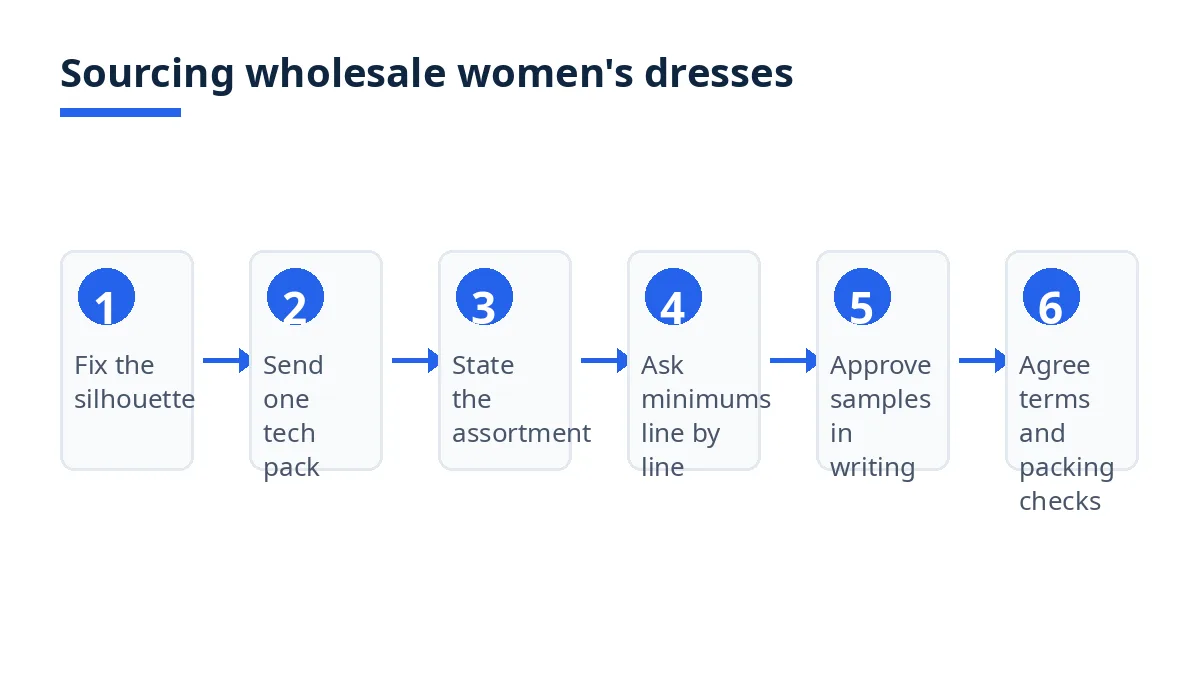
Draw the dress before pricing it. Record the construction, neckline, sleeve, waist treatment, skirt shape, and length measured from one fixed point, such as the shoulder seam or the waist seam. A shift, a fit-and-flare, and a tiered maxi are different cutting jobs, and a price given for an unnamed shape cannot sit beside a price given for a named one.
Send every candidate the same dress pack. Include fabric composition, weight, and construction, the drape you expect, lining, a size chart with a graded measurement table, decoration method and placement, hem and edge finish, label wording, and the packing method. Say whether dresses travel folded flat or hanging, because hanging changes carton size and freight volume.
Break the order into its real lines. Give quantities per style, per color, and per size, with a separate size curve for each color. A bare total hides the line that actually binds, since a color short of its floor can attract a surcharge or be dropped from the run.
Ask for each minimum separately. Request the floor per style, per color, per dye lot, per decoration setup, and per trim and label run, and ask which of those floors governs your assortment. Note for each color whether the fabric is held in stock or dyed to order, and whether lace, lining, and buttons are stock items or bought in.
Approve samples at the ends of the range, not only the middle. First check a prototype for shape, then check a pre-production piece in the real fabric, color, lining, decoration, and labels. Measure it flat and on a form, wash it by the care method, and look at hem fall, drape at the side seams, and fit at the smallest and largest sizes before signing or listing corrections.
Lock inspection and delivery wording before confirming. Write the inspection level and acceptance values into the signed order under ISO 2859-1,5 and name one delivery rule and place on each priced reply, because Incoterms 2020 assigns cost, risk, and duties per rule.6 Settle carton assortment, count per carton, hanging or folding, and the final check on hem length, decoration fastness, and label accuracy before goods leave the floor.
Costs, timelines and documents
No guide can state a standard dress price or lead time as fact, because a factory prices your cloth, shape, decoration, lining, finish, packing, and delivery rule. The four dress-specific drivers below are where a quotation usually moves.
Drape and cloth behavior. A fluid cloth such as viscose, rayon challis, or georgette shifts under the cutter and needs slower handling, and a print must be matched where it crosses a seam, which wastes cloth. A stiffer cotton poplin cuts faster and holds a structured bodice, but it will not fall the same way in a full skirt. Width matters too: a wide skirt panel cut from a narrow cloth wastes more fabric, and that waste lands in the unit price. Bias-cut panels add another wrinkle, since bias stretches during sewing and a hem cut true on the table can lengthen after hanging overnight.
Size-run and grading cost. Grading a dress is not stretching a pattern evenly. Bust, waist, hip, and skirt length each grow by different amounts, darts move rather than simply widen, and drape changes as a skirt panel widens. Markers are made for size groups, and a size that sells in small numbers still needs its own marker and cutting time. Ask how a factory grades bodice and skirt separately, and whether the largest sizes need a different hem or lining treatment, since a lining cut to a medium pattern and stretched onto a large dress will pull the outer cloth out of shape.
Embellishment cost. Embroidery, sequins, beadwork, lace applique, smocking, pleats, and ruching each carry a setup and a handling time. A motif must be rescaled and rechecked at each size so it does not crowd a small bodice or thin out on a large one. Bead and sequin weight is its own problem: heavy decoration on a neckline or shoulder can drag the dress down on a hanger and distort the fit on a body, so a factory may add a stabilizer or a facing that a plain dress never needs. Hand work is charged by time, so dense decoration on a bodice with a plain skirt prices differently from the same motif spread over the whole dress.
Finishing cost. Lining doubles the cutting and adds a second sewing pass plus attachment at the neckline or armhole, and a lining in a heavier cloth than the shell can drag a hem down. Hem finishes diverge widely: a blind hem, a rolled hem, a lettuce edge on a knitted dress, and a horsehair braid stiffening inside a full skirt each need different machine settings and checking time. Pressing a full or tiered skirt takes longer than pressing a straight garment, and a dress sent hanging needs garment covers and larger cartons than one folded flat.
Example figures: take a single style offered in three colors, each with five sizes. Where the floor applies per color, the buyer must clear it in all three colors separately, not once across the whole order. Shifting quantity between colors lifts the remaining colors without changing the total. These figures illustrate structure only, not a typical price, minimum, or lead time.
Timelines follow the same logic. Sampling waits on cloth availability and correction rounds, bulk work waits on dyeing, decoration, lining, and line capacity, and finishing waits on pressing and packing time. Get a separate date for each stage instead of one delivery week.
The papers before cutting are your specification pack, a priced reply broken down by line, and a signed order carrying the floors for each style and color. For shipment paperwork, follow the published Bangladesh customs export procedure.7
Bangladesh-specific rules and tips
Match the factory to the construction. A woven dress line and a knit dress line run different machines, markers, and finishing routines. Ask which construction a factory runs in-house and which step, such as embroidery or pleating, goes to a subcontractor, since a subcontracted step sets its own floor and lead time and can hold an otherwise ready order.
Treat association claims as a starting point. Where a supplier claims membership of a trade body, confirm it with that body. BKMEA represents the knitwear sector and about 2,540 knitwear member factories,4 which signals an active knitwear business, not a price, a floor, or capacity for a particular dress.
Keep one legal name on every paper. Use one registered name on the license, the priced reply, the proforma invoice, and the bank account: the export declaration carries the exporter and buyer names, and a name that differs between papers can stall the file at the document stage.7
Settle fiber content and care labeling early. If you sell into the European Union, the bloc's 2011 textile labeling regulation, numbered 1007/2011, governs fiber names and composition marking.8 Agree the percentages, the care method, and the label wording before bulk cutting; changing labels on finished dresses is slow and costly.
Mistakes and red flags
Approving a sample in the middle size only. A dress signed off at a medium size can fail at both ends of the range, where bust, waist, and skirt grade apart. Check the smallest and largest sizes on a form before bulk approval, and look at the hem after the sample has hung, not only while it lies flat.
Lining up quotations for different dresses. A lower price on an unlined dress with a plain hem, a lighter cloth, or a different delivery rule is a different offer. Put every reply beside the same dress pack and the same delivery rule before comparing numbers.6
Letting a motif drift across sizes. A motif placed for a medium bodice can crowd a small size or look sparse on a large one, and heavy beadwork can pull a neckline down. Ask for motif size and placement at the smallest and largest sizes, not only at the sample size.
Accepting a spoken exception on a floor. Write any agreed lower floor, shared dye lot, or waived setup on the quotation and the purchase order, with the assortment it covers, so a repeat order is priced on the same terms.
Reading a profile as proof of dress capability. A profile can open an enquiry, but it does not show whether a factory can cut your silhouette, hold your drape, or finish your hem. Judge that from the sample, the graded sizes, and the washed pre-production piece.
Skipping the wash and hang check to save time. A dress that measures correctly flat can change after washing, above all in a fluid or knitted cloth. Wash the pre-production sample by the care method, hang it, and recheck hem fall and fit before approving bulk.
Checklist
Work through these lines and get each one answered in writing before placing the order.
Silhouette, length from a fixed point, neckline, sleeve, and waist treatment recorded.
Dress pack sent: cloth, drape, lining, decoration, hem finish, labels, packing.
Each color gets its own size curve, and the assortment is split by style, color, and size.
The binding line is named, and floors are confirmed for style, color, decoration, and trim runs.
Cloth status per color recorded: held in stock or dyed to order.
Motif size and placement confirmed at the smallest and largest sizes.
Written sign-off on the pre-production piece after measuring, washing, and hanging it, with hem fall and drape checked.
Acceptance values for inspection are written in the signed order.5
Every priced reply is judged against the same dress pack and delivery rule.6
Packing method, carton assortment, and count per carton settled.
Supplier confirms shipment papers against the published customs procedure.7
How Exportain helps
Exportain lets a buyer lay a dress pack, a color-and-size assortment, and a delivery rule before suppliers in one place, so unlike quotations are easier to spot.
FAQs
What should I know first about women's dresses?
A dress is bought as a shape, a cloth with a drape, a graded size range, and a finishing routine, not as a single item. Woven dresses fall under heading 6204 and knitted dresses under heading 6104,1 2 and the construction decides the cutting, decoration, and inspection points. Price and the binding floor are set per style and per color for your specification, driven by cloth, size run, embellishment, and finishing.
What are the typical costs and timelines?
No reliable typical figure exists, because each factory prices your specification alone. Cloth and drape, skirt volume, grading, decoration setup, lining and hem work, packing, and the delivery rule set the price,6 and sampling, dyeing, decoration, and line capacity set the calendar. Get a date for each stage.
Which documents are needed?
Before cutting, you need the specification pack, a line-by-line priced reply, and a signed order that states the floors for each style and color. Shipment papers follow the published Bangladesh customs export procedure.7 Use one registered name throughout, since the declaration carries the exporter and buyer names.7
What are the most common mistakes?
The most common mistakes are approving a sample in the middle size only, lining up quotations for different dresses or delivery rules,6 letting a motif drift across sizes, accepting a spoken exception on a floor, and reading a profile as proof of dress capability. Sample approval and inspection stay with the buyer, and the washed, hung pre-production piece is the check that catches most dress failures.
Next steps on Exportain
Use the supplier directory as a starting point, route the dress pack and the color-and-size split via the RFQ board, and read the supplier-verification explainer before any confirmation.
Sources
- Classification Detail — HS Code 620443. United Nations Statistics Division (accessed )
- Classification Detail — HS Code 6104. United Nations Statistics Division (accessed )
- EU share erodes as Bangladesh RMG exports slip 1.64% to $38.70 billion in FY26. United News of Bangladesh (accessed )
- BKMEA at a Glance. BKMEA (accessed )
- ISO 2859-1:2026 - Sampling procedures for inspection by attributes — Part 1: Sampling schemes indexed by acceptance quality limit (AQL) for lot-by-lot inspection. ISO (accessed )
- Incoterms® 2020. International Chamber of Commerce (ICC) (accessed )
- Customs Clearance Procedures for Export. Bangladesh Customs, National Board of Revenue (accessed )
- Regulation (EU) No 1007/2011 on textile fibre names and related labelling and marking of the fibre composition of textile products. European Union, (accessed )
About the author
Sourcing from Bangladesh?
Post a request for quotation and suppliers on Exportain can send you their quotes directly.
Post an RFQ