

Wholesale Sweaters From Bangladesh: Prices, MOQ and Reliable Suppliers
Wholesale sweaters from Bangladesh are bought as assortments: styles, colors and sizes with a quantity for each combination. How stock and made-to-order routes, size and color breaks, MOQ structure and repeat orders work.
Short answer
Wholesale sweaters from Bangladesh are ordered as assortments of styles, colors and sizes, with a quantity for each combination. Stock lots ship from goods already made, while made-to-order production knits to the buyer specification. Size and color breaks set the real minimum, and shade, size and replenishment terms should be agreed in writing before the first shipment.
On this page
Key takeaways
A wholesale sweater order is an assortment: styles, colors and sizes planned together, with a quantity for each combination.
Size and color breaks decide the real minimum, because a large total can still fail if one color or size sits below the run a dye lot needs.
Stock lots ship from goods already made; made-to-order production knits to the buyer specification and needs sampling and shade approval.
Agree replenishment, shade matching and size curves in writing before the first shipment, and judge a supplier on repeat consistency.
Exportain verification is a document and photo review, not a factory inspection, and a badge is not a guarantee.
Wholesale sweaters from Bangladesh are bought as assortments, not as single styles. A wholesale buyer plans the styles, colors and sizes that will sell together, then orders that mix in quantities a knitting factory can run without changing yarn, dye lots and linking setups for every small batch. That planning decides whether the order arrives as a balanced range or as stock that sells out in one size and sits unsold in another.
The supply base is the knitwear sector. The Bangladesh Knitwear Manufacturers and Exporters Association (BKMEA), established in 1996, represents approximately 2,540 knitwear member factories.1 Knitwear exports reached $5.963 billion in the July to September 2026 quarter, up 6.88 percent year on year, within ready-made garment exports of $10.578 billion, according to data released by the Export Promotion Bureau (EPB).2 Choice is rarely the problem. The narrower problem is matching an assortment to a factory that knits that gauge and yarn regularly, and repeating the mix without drift in shade, size or finish.
This guide covers wholesale buying only: assortments and size and color breaks, stock against made-to-order production, replenishment, wholesale channels, and price and MOQ structures. Illustrations are labelled as example figures, and no market price or MOQ is stated as fact.
Wholesale sweaters from Bangladesh: the picture in brief
A wholesale order is an assortment: styles, colors and sizes planned together, with a quantity for each combination.
Size and color breaks decide the real minimum. A large total can still fail if one color or size sits below the run a dye lot needs.
Stock lots ship from goods already made. Made-to-order production needs sampling, shade approval and a longer timeline.
Replenishment is separate from the first order. Agree before the first shipment how repeats, shade matching and size curves will be handled.
Judge a supplier on repeat behavior: consistent shade and size, honest stock counts, and clear notice when a color or size cannot be repeated.
Why this matters for buyers and sellers
For a buyer, the assortment is the product. A retailer, distributor or brand sells a range covering the sizes customers ask for, in the colors that sell, at the same time. If the size curve is wrong, middle sizes sell out early. Wholesale buying starts from the selling floor backward: which sizes move, which colors carry the range, and how deep each combination must be before the next delivery.
For a seller, a wholesale order is a production run, not a parcel. Yarn is bought and dyed in lots, machines are set for a gauge, linking and finishing run in sequence, and labels and cartons are prepared for the whole lot. A mid-run change, such as adding a color, can mean a new dye lot, which is why suppliers ask for the full assortment in writing before quoting.
Step-by-step: how it works
Work through the steps in order, keeping every agreement in writing.
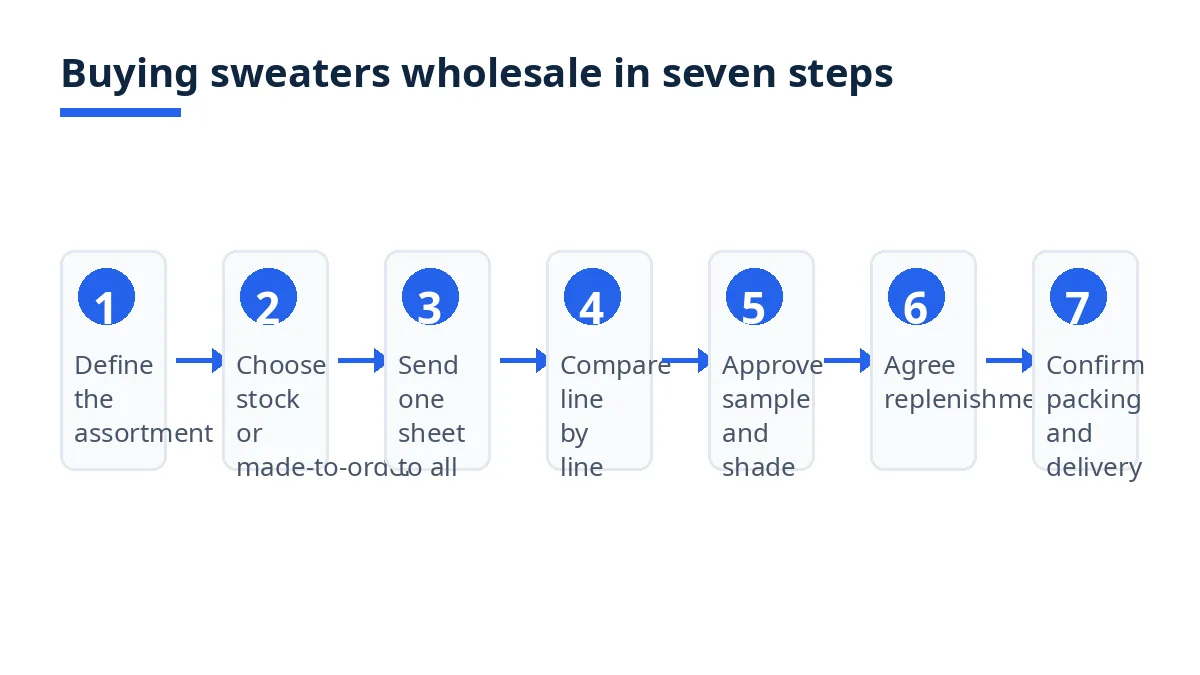
Define the assortment before you ask for prices. List each style, its colors, size range, and quantity per size and color, plus yarn and fiber content, gauge, stitch structure, trims, labels and packing. A supplier cannot price a wholesale lot from a style name alone.
Choose stock or made-to-order for each style. Stock lots are goods already knitted, in fixed colors and sizes. Made-to-order production knits your colors, sizes and labels. A plain core color may suit stock buying, while a private-label seasonal color needs made-to-order production.
Send the same assortment sheet to every candidate. Every supplier should quote the same styles, colors, sizes, quantities, packing and delivery term, and flag any combination it cannot supply rather than silently changing it.
Compare replies line by line. Check yarn and fiber content, gauge, color count, size curve, label and carton spec, and the delivery term. A reply that changes the size curve or drops a color is a different offer.
Approve the selling sample and the shade standard. For made-to-order styles, approve a sample in production yarn and trims, washed the way the care label says, and keep an approved shade standard for each color. For stock lots, ask for the actual lot: photos, carton markings and a count by size and color.
Agree replenishment before the first shipment leaves. Record whether each style and color can be repeated, the repeat quantity structure, how shade will be matched to the first lot, and how long a repeat takes.
Confirm packing, marking and delivery in the order. State the pack per carton, the size and color break inside each carton, the carton markings, and the delivery term and named place.
Costs, timelines and documents
How wholesale sweater prices are structured
A wholesale sweater price is built from parts, and each part moves with the assortment. Yarn is often a major part: fiber, count and ply decide how much yarn each sweater uses, and a coarser gauge uses more yarn per garment than a fine gauge at the same size. Dyeing is charged by lot, so each color carries its own lot cost. Knitting, linking, washing and finishing follow the gauge and construction. Decoration, such as embroidery, intarsia or applique, adds a charge per placement. Labels, hang tags, polybags and cartons are separate lines. Freight, insurance and import duty depend on the delivery term and the destination, not on the sweater itself.
Example figures, for structure only: one style in one color needs one dye lot and one shade approval, while the same style in four colors needs four of each. Adding colors costs more than adding pieces. No figure here is a market price.
What sets the MOQ structure in a wholesale order
MOQ in wholesale sweater buying is a structure, not one number: a minimum per style, per color, per dye lot and per size run, and the binding line is the one your assortment hits first. Stock lots carry a different structure: a minimum per lot, per color or per carton, set by what is on the shelf. The guide to MOQ, or minimum order quantity explains how minimums are defined. Ask for every minimum in writing and test your sheet against each one.
Example figures, for structure only: a buyer plans 900 pieces across three colors at 300 per color. If the per-color minimum is higher than 300, the sheet fails on every color. The same 900 pieces across two colors at 450 per color can clear the line. Structure only, not a typical MOQ, price or lead time.
How timelines differ between stock and made-to-order
Stock lots move on the time to count, inspect, pack and ship goods that already exist. Made-to-order production adds sampling, dyeing, shade approval, knitting, linking, washing and finishing, inspection and packing, in sequence. Ask for sampling, shade approval, production start, inspection and shipment dates as separate lines, not a single delivery week.
Which documents are needed?
The order documents are the assortment sheet, itemized quotation, approved sample record and purchase order, each carrying the quantity per style, color and size. The export set includes the Bill of Export (Shipping Bill), which must be submitted and approved before goods can be loaded, plus the export contract or purchase order, commercial invoice, packing list, EXP form certified by an authorized dealer bank, certificate of origin issued by the EPB or a Chamber of Commerce, VAT registration certificate and TIN certificate.3 For classification, sweaters fall under HS heading 6110, covering jerseys, pullovers, cardigans, waistcoats and similar knitted or crocheted articles, broken down by fiber: wool or fine animal hair, cotton, man-made fibers and other textile materials.4 Read the guide to the HS code for sweaters before you finalize the specification.
Bangladesh-specific rules and tips
Buy from the knitwear pool, and check the claim at the source. Sweaters are knitted garments, so the supplier pool is the knitwear sector, and BKMEA represents approximately 2,540 knitwear member factories.1 Confirm any membership claim against the association record. Membership shows registration, not capacity for your gauge, colors or quantities.
Put fiber content and labelling on the assortment sheet from the start. Wholesale buyers resell into markets with their own labelling rules, and the label must match the sweater. If you sell into the European Union, Regulation (EU) No 1007/2011 states that a textile product shall be labelled or marked with the name and percentage by weight of all constituent fibers in descending order.5 State the fiber content, label wording and label position in the specification, and check the first production labels against it.
Use one delivery term for every quotation, and state the named place. The Incoterms 2020 rules set out 11 rules that allocate cost, risk and obligations between seller and buyer.6 Under FOB, risk passes when goods are on board the vessel and the buyer arranges the main carriage, while under CIF the seller pays freight and minimum insurance to the destination port but risk still passes on board at origin.6 Compare quotes only on the same rule and named place.
Plan around the selling season. Sweater demand peaks ahead of cold seasons in destination markets, and factory capacity tightens as those windows approach. Place made-to-order orders early enough for sampling and a correction round, and keep stock-lot buying for top-up quantities and proven colors.
Ask which inputs are bought in for your lot. Yarn, dyes, zips, buttons and some trims may be bought in for your specification, and a bought-in input can set both the minimum and the earliest production date. Record availability per color before you confirm, and agree what happens if a trim color is short.
Mistakes and red flags
What are the most common wholesale sweater mistakes?
Planning a total instead of an assortment. A single total hides the size and color breaks that decide whether the lot can run and whether it will sell. Order by style, color and size, and test the sheet against every minimum line.
Treating a stock lot as repeatable. Stock lots are finite. A lot that sells well may not exist in the same colors and sizes next month. Before you build a range around a stock lot, ask what is actually on the shelf and whether any of it can be repeated by production.
Approving a sample in the wrong yarn or shade. A sample in substitute yarn or an approximate shade proves the style, not the bulk goods. Approve made-to-order styles in production yarn and trims, washed as the care label directs, and keep the shade standard for repeats.
Comparing quotes on different assortments or terms. A lower headline price on fewer colors, a different yarn or a different delivery term is a different offer. Compare only replies to the same sheet on the same Incoterm and named place.6
Leaving replenishment until the first lot sells out. By then the yarn lot may be gone, the shade may have shifted and the line may be booked. Agree repeat structure, shade matching and repeat timing in the first order.
Paying for a change that was never written down. A color added, a size ratio changed or a label swapped after approval needs a revised quotation and purchase order. Verbal changes create disputes about which assortment was actually ordered.
Red flags include a supplier that will not state quantities per color and size, a quote with no itemized lines, a stock lot with no carton-level count, and a refusal to name the producing factory. Any one is a reason to slow down and ask for the missing line in writing.
Checklist
Before you confirm, every line below should be answered in writing.
Assortment sheet complete: styles, colors, sizes, quantity per combination.
Stock or made-to-order recorded per style.
Minimums confirmed per style, color and size; binding line named.
Yarn, fiber content, gauge, stitch, trims, labels and packing specified per style.
Sample approved in production yarn and trims, washed and measured; shade standard kept.
For stock lots: carton-level count by size and color confirmed for the actual lot.
Itemized quotation received: yarn, dyeing, making, decoration, labels, packing, delivery term.
Quotations compared on the same assortment, specification and Incoterm with a named place.6
Replenishment agreed: repeat structure, shade matching, timing.
Labelling checked against destination rules for the fiber content stated.5
Export set agreed: Bill of Export, commercial invoice, packing list, EXP form, certificate of origin.3
Carton breakdown confirmed: pack per carton, size and color break, markings.
HS heading 6110 subheading confirmed by fiber.4
How Exportain helps
On Exportain, browse suppliers and filter knitwear listings, then post your assortment sheet as a request for quotation (RFQ) on the RFQ board so suppliers quote the same styles, colors, sizes and delivery term. Ask each reply for its quantity structure per color and size and the itemized lines behind the headline price.
Read profile badges for what they record. Exportain verification is a document and photo review by staff: it is free, membership plans never grant a badge, and it is not a factory inspection.7 See how supplier verification works on Exportain for what each badge covers. A badge is a starting filter for enquiries, not a conclusion about shade consistency, repeat capacity or delivery.
FAQs
What should I know first about buying sweaters wholesale?
Wholesale buying is assortment buying: styles, colors and sizes planned together, with a quantity for each combination. Size and color breaks decide the real minimum, and the supplier should be judged on repeat consistency. Sweaters fall under HS heading 6110, covering jerseys, pullovers, cardigans, waistcoats and similar knitted or crocheted articles.4
What do wholesale sweater costs and timelines depend on?
Costs depend on yarn and fiber, gauge, dye lots per color, knitting and finishing, decoration, labels and packing, and the delivery term and destination. Timelines depend on whether the lot is stock or made to order. No typical wholesale price or lead time can be stated as fact.
Which documents are needed for a wholesale sweater order?
The order documents are the assortment sheet, itemized quotation, approved sample record and purchase order. The export set includes the Bill of Export, commercial invoice, packing list, EXP form, certificate of origin, VAT registration certificate and TIN certificate.3 Labelling must match the fiber content stated, including the EU rule on fibre names and percentages in descending order.5
What are the most common wholesale sweater buying mistakes?
The most common mistakes are planning a total instead of an assortment, treating a finite stock lot as repeatable, approving a sample in substitute yarn or shade, comparing quotes on different assortments or terms,6 leaving replenishment until the first lot sells out, and accepting changes verbally.
Next steps on Exportain
Browse suppliers to shortlist knitwear sellers, then post your assortment sheet on the RFQ board so each reply quotes the same styles, colors, sizes and delivery term. Before you confirm, read how supplier verification works on Exportain.
Sources
- BKMEA at a Glance. BKMEA (accessed )
- Merchandise exports rise 6.34pc to $13.09b in Q1 FY27: EPB. The Financial Express, (accessed )
- Custom Clearance in Bangladesh: Port Procedures and C and F Agent Guide. Bizmend (accessed )
- Classification Detail — HS Code 6110. United Nations Statistics Division (accessed )
- Regulation (EU) No 1007/2011 on textile fibre names and related labelling and marking of the fibre composition of textile products. European Union, (accessed )
- Incoterms 2020 Explained: All 11 Rules. Blue Ocean Academy (accessed )
- Supplier verification: Earn trust badges buyers can see. Exportain (accessed )
About the author
Sourcing from Bangladesh?
Post a request for quotation and suppliers on Exportain can send you their quotes directly.
Post an RFQ


