

Wholesale Sportswear and Activewear From Bangladesh: Prices, MOQ and Reliable Suppliers
Wholesale sportswear from Bangladesh has no single price or MOQ: what sets the minimum per style and colour, the cost drivers, documents, and supplier checks.
Short answer
Wholesale sportswear and activewear from Bangladesh is bought per style, per colour and per fabric, not at one market price or one market minimum. Each factory sets its price and minimum order quantity from fabric type and weight, elastane content, decoration, trims, labels and the delivery term. Compare quotations only on the same tech pack, split and term, and verify documents and samples before you pay.
On this page
Key takeaways
There is no single wholesale price or MOQ for sportswear and activewear from Bangladesh, because each factory prices your specification per style and per colour.
Fabric type and weight, elastane content, decoration set-up, trims, labels and packing are the drivers that set the price and the floor.
Compare quotations only on the same tech pack, split per colour and delivery term, with set-up charges itemized apart from the unit price.
Example figures in the guide show order structure only, not a typical MOQ, price or lead time.
Exportain verification is a document and photo review, not a factory inspection, and a badge is not a guarantee.
Wholesale sportswear and activewear from Bangladesh is not sold at one market price or one market minimum. A leggings style in a synthetic elastane fabric, a cotton tracksuit and a sublimated team kit are three different products, made on different lines, from different fabrics, with different set-up work. Each factory prices your specification and sets its minimum per style and per colour.
The Bangladesh Knitwear Manufacturers and Exporters Association (BKMEA), established in 1996, is the apex trade body for the knitwear sector and represents approximately 2,540 knitwear member factories.1 Knitwear exports reached $5.963 billion in July to September 2026, up 6.88 percent year on year, within ready-made garment exports of $10.578 billion, according to data released by the Export Promotion Bureau (EPB).2 That scale gives a buyer choice, not a shared wholesale price list.
Why this matters for buyers and sellers
What should I know first about sportswear and activewear?
The first thing to know is that wholesale in this category means factory-direct ordering against a tech pack, in quantities that cover fabric, dyeing or printing, and line set-up for your style. It does not mean buying finished stock at a fixed trade price. Your quantity per style and per colour, not your order total, decides whether a factory can run the order and what the unit price will be.
Fabric decides most of the quote. Sportswear and activewear use knitted fabrics, often with elastane for stretch, in weights and finishes set by the end use. A heavier fabric, a higher elastane share, moisture-management or other performance finishes, and brushed or interlock constructions each change fabric cost and the lot the fabric must be bought or knitted in. State composition, construction, weight and finish in the tech pack, and whether each colour is stocked or made to order.
Decoration is set-up work. Sublimation printing, screen printing, heat transfer, embroidery and reflective details each need artwork preparation and a set-up per design, size or placement. That work is fixed whether the run is short or long, so a factory recovers it in the minimum, in a set-up charge, or in a higher unit price on a short run.
Fit and size range change consumption. A wide size range, extended sizes, and matched sets sold as one unit change how much fabric each unit consumes. State the size range and ratio per colour, not only the total.
Trims, labels and packing have their own runs. Drawcords, elastic, zips, branded labels, hang tags and retail packing are ordered per style and per colour, each with its own minimum. An order can meet the garment minimum and still fall below a label run.
In the Harmonized System, heading 6112 covers track suits, ski suits and swimwear, knitted or crocheted, with subheadings split by fibre, including track suits of cotton and track suits of synthetic fibres.3 Other sportswear styles sit under other headings by garment type and fibre, so confirm the heading for each style rather than using one code for a full range. If you sell into the European Union, Regulation (EU) No 1007/2011 states that a textile product shall be labelled or marked with the name and percentage by weight of all constituent fibres in descending order.4 See the HS code for sportswear and activewear guide for the heading by garment type.
Driver | What it changes | State in your enquiry |
|---|---|---|
Fabric | Lot size, unit cost, lead time | Composition, construction, weight, finish |
Colour | Dye or print run per colour | Quantity per colour |
Decoration | Set-up per design and placement | Method, size, placement, artwork file |
Size range | Fabric consumption per unit | Sizes and ratio per colour |
Trims and labels | Separate lots and print runs | Trim, label, tag and packing spec |
Delivery term | Which costs sit in the unit price | One Incoterm and named place |
Example figures: a buyer orders 2,400 units split across four styles at 600 per style and three colours at 200 per colour in each style. The total looks like a wholesale quantity, while each colour run sits below the factory minimum for that fabric. The same 2,400 units in two styles and two colours clear the per-style and per-colour lines at the same total. The example shows structure only. It is not a typical MOQ, price or lead time.
Step-by-step: how it works
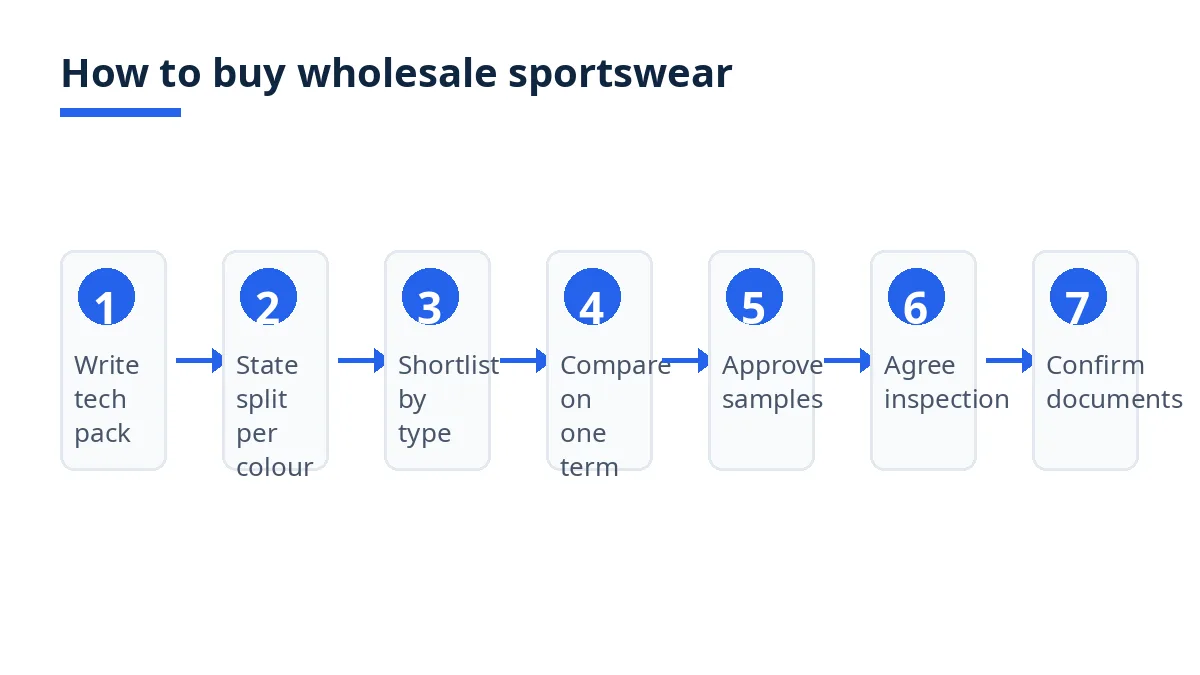
Write one tech pack per style. State fabric composition, construction, weight and finish, measurements and tolerances, size range, decoration method and placement, trims, labels, and packing. A price asked without a tech pack is a guess, and factories answer guesses with different assumptions.
State the split, not only the total. Give quantity per style, per colour and per size. Ask each factory to state its minimum per style and per colour, and which line is binding for your split.
Shortlist by factory type, not by price alone. Match the factory type to your fabric and decoration: a factory set up for synthetic performance fabric and sublimation is a different offer from a cotton knit factory, even at the same unit price. See sportswear and activewear manufacturers in Bangladesh for the types and what each suits.
Compare quotations on one basis. Ask every factory to quote the same tech pack, the same split and the same delivery term, with set-up charges itemized apart from the unit price. The Incoterms 2020 rules set out 11 rules with a clear allocation of cost, risk and obligations,5 so a lower price on a different term is not a lower landed cost.
Approve samples in writing. Order a proto sample, then a pre-production sample in your actual fabric, colour, decoration and labels. Measure it, wash it, check stretch and recovery and decoration fastness against your spec, then approve or list corrections in writing.
Agree inspection before production starts. Write the inspection level and acceptance quality limit (AQL) values into the purchase order. ISO 2859-1 defines a system of acceptance sampling plans for inspection by attributes, indexed by acceptance quality limit (AQL) for lot-by-lot inspection.6 See the sportswear and activewear quality control checklist for style-level points.
Confirm the order documents. Put the agreed price, minimums, split, set-ups, sample approval, inspection terms and delivery term on the quotation and purchase order, under one legal name for the supplier. Record any agreed exception in writing on both documents.
Costs, timelines and documents
What are the typical costs and timelines?
There are no typical wholesale costs or timelines a guide can state as fact. Each factory prices your fabric, construction, decoration, trims, label and packing runs, quantity per colour, and the delivery term you choose.5 Two quotations for the same drawing can differ because one includes sublimation set-up, branded elastic and retail packing in the unit price and the other lists them apart, or because one is quoted on a term that includes freight and the other is not.
Read a quotation by its parts. Ask for fabric, making, decoration, trims, labels and packing as separate lines, set-up charges apart from the unit price, and the term next to the price. Then add freight, insurance where the term leaves it to you, duty under the heading for each style,3 and inspection. That total, on one term, is the only fair comparison.
For timelines, sampling depends on fabric availability and correction rounds, and bulk production on fabric supply, dyeing or printing, trim delivery and line capacity. Ask for sampling, fabric ready, production, inspection and dispatch dates as separate lines, not a single delivery week.
Which documents are needed?
The order documents are the tech pack, the itemized quotation and the purchase order, with fabric, decoration, split and delivery term stated the same way on each. For export clearance in Bangladesh, goods may not be loaded unless an export declaration, the Bill of Export or Shipping Bill, is submitted to Customs and approved.7 Enclosed documents include the export contract or purchase order where there is no export letter of credit, the commercial invoice, the packing list, the EXP form certified by an authorized dealer, and a certificate of origin issued by the EPB or a Chamber of Commerce and Industry.7
Keep fibre composition wording identical across the tech pack, labels, invoice and packing list. For the European Union, the label must name all constituent fibres by percentage by weight in descending order,4 and a composition that changes between the sample and the bulk fabric is a labelling fault as well as a quality fault.
Bangladesh-specific rules and tips
Confirm association claims at the source. If a supplier claims BKMEA membership, confirm it with the association itself. BKMEA represents the knitwear sector and its member factories,1 so membership signals an active knitwear business. It does not confirm capacity for synthetic performance fabric, sublimation, or your order size. Ask which stages the factory runs in its own facility.
Keep one legal name across every paper. The export declaration names the exporter and the foreign buyer,7 so the name on the trade licence, quotation, proforma invoice and payment account should match.
Ask which inputs are imported for your order. Elastane yarns, specialist performance fabrics, reflective transfers and some zips may be bought in for your specification. An imported input can set both the minimum and the earliest production date, so record its lead time on the purchase order.
State the destination market at enquiry stage. Labelling and fibre naming differ by market, and the European Union fibre rule above4 is one example. A factory quoting without a destination cannot price the correct labels and packing.
Mistakes and red flags
What are the most common mistakes?
Asking for a wholesale price without a tech pack. Without fabric, weight, decoration and packing, each factory prices a different garment. The lowest reply is usually the thinnest specification, not the best offer.
Comparing prices on different terms or splits. A price on one Incoterm,5 for a different colour split, or with set-ups included rather than itemized, is a different offer. Bring every quotation back to the same tech pack, split and term before you rank them.
Treating the order total as the minimum that matters. The binding minimum is per style and per colour. An order can clear the total and still fail on one colour, which then carries a surcharge, a fabric substitution, or removal from the order.
Approving a sample in a substitute fabric. A proto in a similar fabric tests fit and construction only. Colour, stretch, recovery, print quality and hand feel can only be judged on the pre-production sample in the actual fabric and decoration.
Reading a profile or a badge as a supplier test. A profile is a starting point for enquiries. It does not test whether a factory can make your style, and a badge is not a guarantee of capacity, quality or delivery.8
Skipping inspection on a first order. Sampling under ISO 2859-1 checks a lot against an agreed AQL,6 and the first order is where spec drift, packing errors and label faults are found.
Checklist
Before you confirm, every line should be answered in writing.
Tech pack per style: fabric, weight, finish, sizes, decoration, trims, labels, packing.
Split stated per style, colour and size, with one size ratio per colour.
Minimum confirmed per style and per colour; binding line named.
Fabric status per colour recorded: stocked or made to order.
Decoration, trim, label and packing costs itemized; set-ups apart from unit price.
Quotations compared on the same specification, split and Incoterm.5
Heading confirmed per style; fibre composition wording agreed for labels.3 4
Pre-production sample in actual fabric measured, washed and approved in writing.
Inspection level and AQL values in the purchase order.6
Export set agreed: invoice, packing list, EXP form, certificate of origin, Bill of Export.7
How Exportain helps
On Exportain, browse suppliers and post a request for quotation (RFQ) on the RFQ board with your tech pack summary, split per style and colour, destination market and delivery term, so suppliers quote against the same specification. Ask each reply for its minimum per style and per colour and its itemized set-ups. When you accept a quotation, Exportain creates one order and issues one proforma invoice from the accepted terms.8
Read the badges for what they record. Exportain Verified means Exportain has checked identity, phone, email and business registration, and Export Verified means it has checked the Export Registration Certificate (ERC).8 Factory Verified means it has reviewed photos of the manufacturer factory, while Trading Company Verified means it has reviewed photos of the trading company office or warehouse.8 Verification is a document review by staff, free, and never granted by membership plans.9 It is not a factory inspection,8 9 so tech pack checks, sample approval and inspection stay with you. See how supplier verification works on Exportain and the MOQ guide before you negotiate the split.
FAQs
What should I know first about sportswear and activewear?
Wholesale sportswear and activewear from Bangladesh is ordered per style, per colour and per fabric against a tech pack. There is no single market price or minimum, because fabric type and weight, elastane content, decoration set-up, trims, labels and the delivery term set both. Knitted tracksuits sit under HS heading 6112, which covers track suits, ski suits and swimwear, knitted or crocheted.3
What are the typical costs and timelines?
There are no typical figures a buyer can rely on. Each factory sets its price and timeline for your specification, split and term,5 and sampling, fabric supply, dyeing or printing and line capacity set the dates. Ask for itemized costs and stage dates in writing, and compare totals only on the same term.
Which documents are needed?
The order documents are the tech pack, itemized quotation and purchase order. The export set is the Bill of Export, commercial invoice, packing list, EXP form certified by an authorized dealer, and a certificate of origin issued by the EPB or a Chamber of Commerce and Industry.7
What are the most common mistakes?
The most common mistakes are asking for a price without a tech pack, comparing quotations on different specifications, splits or terms,5 treating the order total as the only minimum, approving a sample in a substitute fabric, and reading a badge as a guarantee. A badge is not a guarantee of capacity, quality or delivery.8
Next steps on Exportain
Browse suppliers, then post your tech pack summary and split per style and colour on the RFQ board so suppliers state their price and minimum on the same basis. Before you confirm, read sportswear and activewear manufacturers in Bangladesh and how to import sportswear and activewear from Bangladesh.
Sources
- BKMEA at a Glance. BKMEA (accessed )
- Exports up over 6% to $13.1bn in Q1 of current fiscal. United News of Bangladesh (accessed )
- HS, 2012 - Code 6112: Track suits, ski suits and swimwear; knitted or crocheted. United Nations Statistics Division (accessed )
- Regulation (EU) No 1007/2011 on textile fibre names and related labelling and marking of the fibre composition of textile products. European Union, (accessed )
- Incoterms® 2020. International Chamber of Commerce (ICC) (accessed )
- ISO 2859-1:2026 - Sampling procedures for inspection by attributes — Part 1: Sampling schemes indexed by acceptance quality limit (AQL) for lot-by-lot inspection. ISO (accessed )
- Customs Clearance Procedures for Export. Bangladesh Customs, National Board of Revenue (accessed )
- Trust & Safety Center. Exportain (accessed )
- Supplier verification: Earn trust badges buyers can see. Exportain (accessed )
About the author
Sourcing from Bangladesh?
Post a request for quotation and suppliers on Exportain can send you their quotes directly.
Post an RFQ


