Wholesale Socks From Bangladesh: Prices, MOQ and Reliable Suppliers
No single wholesale sock price or MOQ in Bangladesh: what sets the minimum per style, colour and size range, how to ask in pairs and dozens, and how to compare quotes on one term.
Short answer
Wholesale socks from Bangladesh have no single price or MOQ: each factory sets its minimum per style, colour and size range for your specification. Compare itemized quotations on one tech pack and one delivery term, agree the size curve in pairs and dozens, approve a pre-production sample in writing, and inspect bulk against it under an agreed AQL plan.
On this page
Key takeaways
Wholesale sock price, MOQ and lead time are set by each factory for your specification, so compare itemized quotations on one tech pack and one delivery term.
The binding minimum is usually per colourway or per size range, not the order total, so state your quantity split per colourway and per size, in pairs and dozens, when you ask.
Socks sit under HS heading 6115, which covers hosiery including socks, knitted or crocheted; confirm the full fibre subheading for your exact style before you calculate duty.
Approve the pre-production sample in writing, check foot length, cuff recovery and pairing, and inspect bulk against it under an agreed AQL plan before shipment.
Exportain verification is a document and photo review, not a factory inspection, and a badge is not a guarantee.
A sock order goes wrong in places a garment order rarely does. One carton can hold the right number of pairs and still be unsellable: the two socks inside it came from different dye lots, the cuff on one size goes slack after washing, or the dozen breakdown inside the carton does not match the size curve your stores sell. Buying wholesale socks from Bangladesh therefore starts with the pair, the dozen, and the carton as three separate quantities, and every later choice has to be checked against all three.
No factory publishes one wholesale sock price or minimum order quantity that applies to every buyer. Each factory prices the sock you describe, in the yarn and gauge you choose, for the colorways and size run you need, and its minimum is usually tied to one colorway, one dye lot, or one size range rather than to your order total.
Why this matters for buyers and sellers
A sock is knitted as a tube and shaped as it goes. Machine gauge sets how fine or coarse the fabric feels and how much yarn each pair consumes. The heel is turned during knitting, the toe is closed afterwards, and the cuff is knitted with elastic yarn so it grips without cutting in. Cushioning is added where the foot strikes, under the heel and the ball of the foot. A buyer who specifies only "crew sock, cotton blend" leaves the factory to guess the gauge, the heel and toe method, the cuff, and the cushioning zone.
For the seller, the constraint is rarely the total pair count. A factory sets its machines for one gauge and one yarn, dyes yarn in lots matched to one colorway, and boards finished socks in matching batches. A small colorway still needs its own dye lot, setting, and boarding run, so the price per pair climbs as the quantity per colorway falls.
The sector is large: BKMEA lists about 2,540 member knitwear factories on its at-a-glance page,1 and ready-made garment exports reached $10.578 billion in July to September 2026, with knitwear at $5.963 billion, according to Export Promotion Bureau data reported by The Financial Express.2
What should I know first about socks?
Know the sock on the foot before you discuss money. A usable tech pack names the style and leg length, the gauge, the yarn composition and count, the heel and toe method, the cuff type, height and elastic content, the cushioning zones, the foot length for every size, the color and pattern of each colorway, the pairing and boarding method, the label wording, and the split by colorway and size. It also states the grouping: pairs per dozen, dozens per carton, and whether a carton holds one size, one colorway, or a fixed assortment.
Classification belongs at the start of the commercial work. Heading 6115 of the Harmonized System covers hosiery, including socks, knitted or crocheted.3 Inside that heading, the subheading turns on fibre, so a cotton-rich sock and a synthetic sock can carry different duty treatment. Pin down the full code for your exact fibre mix before you work out landed cost, and keep the tech pack percentages identical to those on the label.
Labels for the European Union follow the structure of Regulation (EU) No 1007/2011, which first fixes the permitted fibre names and then sets how those names appear on the product.4 The label lists every constituent fibre by its regulated name, with each share by weight, in descending order. For a sock, the trap is the small components: elastic yarn in the cuff and reinforcement yarn in the heel and toe count too, and leaving them off creates a mismatch between the tech pack, the quotation, and the retail label.
Two disciplines hold the rest of the order together. The first is an inspection agreement written before production, covering the sampling level, the acceptance numbers, and the defect list — for socks, that list must include pairing faults, shade differences between dye lots, cuff slackness after washing, heel placement, and toe-seam comfort. Sampling under ISO 2859-1 gives the framework for lot-by-lot inspection by attributes.5 The second is a single delivery term on every quotation, so prices are compared on the same allocation of cost and risk under the 11 Incoterms 2020 rules.6
Step-by-step: how it works
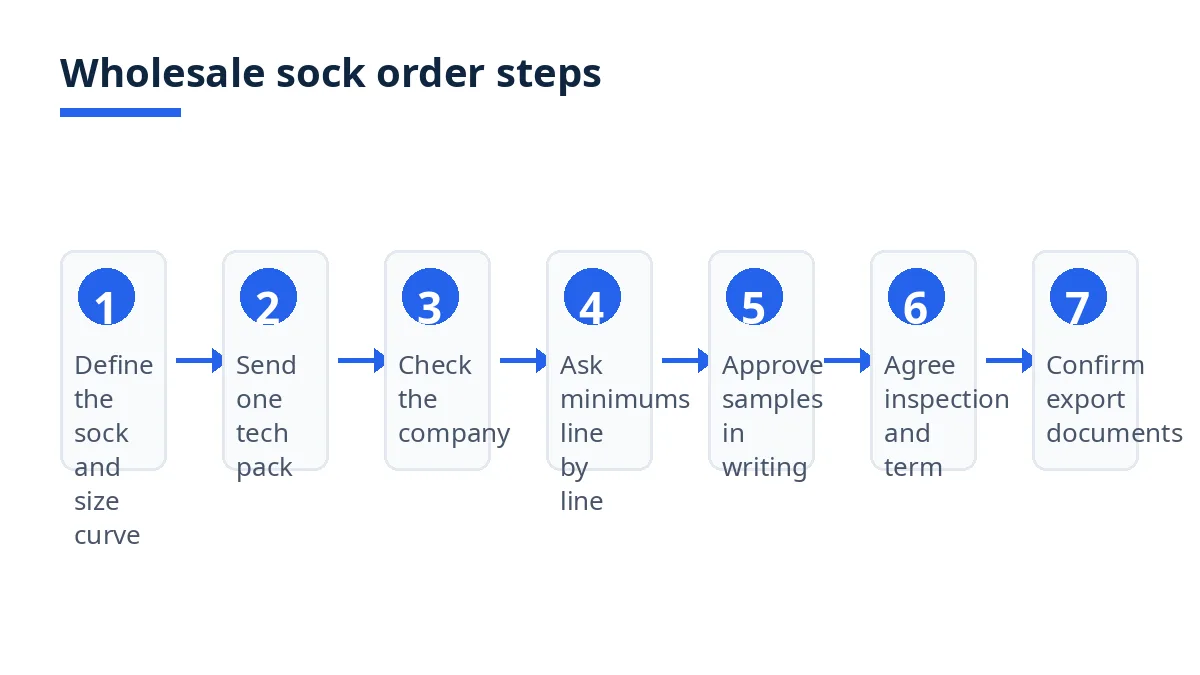
Lock the construction and the size curve. Set the gauge, heel and toe method, cuff, cushioning, and foot length for each size, then build the size run as a table: sizes across the top, colorways down the side, pairs in every cell. Convert it into dozens, because the factory plans in dozens.
Send one tech pack to every candidate factory. Include the construction details, the colorway and size table in pairs and dozens, the pairing and boarding method, the label wording, the packing, and the delivery term. Ask for the price per pair and per dozen as separate lines.
Establish who actually knits the socks. Ask whether the company knits in its own plant or places production elsewhere, and record the legal company name. Ask to see the trade licence and, where the supplier exports, the Export Registration Certificate (ERC), and check the name matches the quotation.
Ask for every minimum, not one minimum. Request the minimum per style, per colorway, per dye lot, and per size range, plus separate minimums for yarn, elastic, labels, tags, and cartons, and ask which line is binding for your table.
Approve samples in stages and in writing. Start with a proto sample to confirm style and fit, then a pre-production sample in your actual yarn and color, with your heel, toe, cuff, and labels, packed as bulk. Measure the foot length, stretch and release the cuff, wash the pair, wear-check the toe seam, and confirm the two socks in each pair match in shade and size.
Put inspection and the delivery term into the purchase order. Write the sampling level, the acceptance numbers, and the sock-specific defect list into the order, alongside one Incoterm and named place that every quotation used.5 6
Reconcile the export papers before the cartons leave. Confirm who prepares each document, check that names, quantities, and values agree across the set, and confirm the packing list reads in dozens as well as in pairs. Hold shipment until the export filing is approved.
Costs, timelines and documents
Price in socks is driven less by the garment category than by the construction choices inside the pair. A finer gauge uses more machine time per pair. A shaped heel and a closed toe add steps. Cushioning adds yarn under the foot. Dyeing to your colorway adds a lot set-up that a stocked yarn color avoids. Boarding, pairing, and dozen packing add handling after knitting, and labels and cartons each carry their own print run. The delivery term then decides which freight and risk costs sit inside the quoted price.6
What are the typical costs and timelines?
Example figures: a buyer plans 2,400 pairs across four colorways, which is 600 pairs, or 50 dozen, per colorway. If the factory sets a 60-dozen minimum per colorway, each colorway falls 10 dozen short and the order needs 2,880 pairs to clear all four. The same 2,400 pairs across two colorways gives 100 dozen per colorway and clears the same minimum comfortably. The arithmetic is the point: changing the colorway count changes whether a minimum binds, even when the pair total never moves. Example figures are structure only, not a typical MOQ, price, or lead time.
For timelines, ask for sampling, dyeing, knitting, boarding, inspection, and shipment as separate dates rather than one delivery week. Dye-lot approval and boarding capacity are the two stages most likely to slip.
Which documents are needed?
Tick each document against the others before shipment:
Tech pack, itemized quotation, and purchase order. The minimum per style, per colorway, and per size range should appear on the quotation and again on the purchase order, with the same numbers in both.
Written sample approvals and the inspection report. The approvals should name the sample that was measured, washed, and pairing-checked, and the report should record the sampling level, acceptance numbers, and pairing result.
Export declaration and supporting papers. Goods may not be loaded until the Bill of Export, or Shipping Bill, has been submitted to Customs and approved.7 The enclosed set includes the export contract or purchase order where no export letter of credit exists, the commercial invoice, the packing list, the EXP form certified by an authorized dealer, and a certificate of origin from the Export Promotion Bureau or a Chamber.7
Bangladesh-specific rules and tips
Check association claims with the association, not the sales pitch. If a supplier describes itself as a BKMEA member, confirm that claim with BKMEA directly.1 Membership describes a knitwear business, not a machine gauge or dye-lot capacity, so judge the factory on its answers to your tech pack.
Match the payment account to the paper trail. Before paying, compare the account name with the legal name on the quotation, the proforma invoice, and the trade licence. Where a second name appears — a trading arm, a sister unit, a differently spelled name — ask for the connection in writing and pause payment until the explanation is on record. A mismatch found after payment is a dispute.
Write the size curve in foot lengths with tolerances, and test the cuff after washing. Size letters alone do not define a sock: a medium in one factory can be a different foot length in another. State each size as a foot length in centimetres with a tolerance, the cuff stretch and recovery you expect after washing, and where the heel should sit when worn. The three fit faults that most often spoil an order — a cuff that slips once washed, a heel that sits short of the ankle, a toe seam that rubs — all show up on the pre-production sample.
Mistakes and red flags
What are the most common mistakes?
Building the size run in pairs and never converting it to dozens. A size curve drawn only in pairs hides the factory's real planning unit. Convert every colorway and size cell into dozens, and check that each colorway total divides into whole dozens.
Approving a color from a photo of one sock. Shade is judged on a pair, after boarding, under consistent light — not on a single flat sock on a screen. Ask for a paired, boarded color approval in your actual yarn, and compare both socks in the pair against each other and against your reference.
Letting a concession live in a chat message. A lower minimum for one colorway, a shared dye lot, a waived boarding set-up: each changes the price or the feasible split, and each needs to sit on the quotation and the purchase order. A concession that exists only in messages cannot be checked at inspection.
Signing off a sample that was never washed or worn. A sock that measures correctly flat can still fail in use. Wash the pre-production pair, stretch and release the cuff several times, and check the toe seam and heel position on a foot. Skipping washing and wear means approving an unfinished test.
Assuming a badge answers a machine question. A badge records a document or photo review; it does not confirm that a factory runs your gauge, holds your yarn, or boards your style. Keep the badge as a first filter, and judge capacity from the factory's answers on gauge, dye lots, and boarding. Exportain's verification pages describe what each badge records.8 9
Checklist
Construction locked: gauge, yarn, heel and toe, cuff and elastic, cushioning.
Size run as a table by colorway and size, in pairs, dozens, and cartons.
Carton assortment written down: single size, single colorway, or fixed size ratio.
Minimums confirmed per style, per colorway, per dye lot, per size range; binding line named.
Elastic, label, tag, and carton minimums confirmed separately.
Pre-production sample measured, washed, wear-checked, pairing-checked, approved in writing.
Inspection level, acceptance numbers, and sock defect list in the purchase order, including the pairing check.5
Quotations compared on one tech pack and one Incoterm, named place.6
Export set reconciled: invoice, packing list in pairs and dozens, EXP form, origin certificate, Bill of Export.7
How Exportain helps
Start from the sock table rather than from a price request. On Exportain, browse suppliers and post the colorway and size table, the construction summary, and the dozen and carton counts on the RFQ board, so every reply quotes against the same specification. Ask each reply for its minimums per style, per colorway, per dye lot, and per size range, and its price per pair and per dozen as separate lines. When you accept a quotation, Exportain creates one order and one proforma invoice from the accepted terms.8 See how supplier verification works on Exportain for verification background, and the MOQ definition guide for the minimum-quantity concept.
FAQs
What should I know first about socks?
Know the construction and the size run before you ask for a price: gauge, yarn, heel and toe, cuff and elastic, cushioning, foot lengths, and the split by colorway and size. Socks sit under HS heading 6115, which covers hosiery including socks, knitted or crocheted,3 so confirm the full code before you calculate duty.
What are the typical costs and timelines?
No typical figures can be relied on, because each factory sets its price, MOQ, and lead time for your specification. Gauge, yarn, heel and toe work, cushioning, dye lots, boarding, and packing drive the price,6 while dye-lot approval, boarding, and inspection drive the timeline.
Which documents are needed?
Think of one order as two files that must agree. The commercial file holds your tech pack, the quotation broken into lines, and the purchase order repeating the same per-colorway, per-dye-lot, and per-size minimums. The shipment file holds the Bill of Export, the invoice, the packing list, the EXP form certified by an authorized dealer, and the origin certificate from the Export Promotion Bureau or a Chamber, and loading waits until the Bill of Export is approved.7 Check names, quantities, and values across both files, and read the packing list in dozens as well as pairs.
What are the most common mistakes?
The most common mistakes are drawing the size run in pairs without converting it to dozens, approving a color from a single unboarded sock, leaving a concession in a chat message, signing off a sample never washed or worn, and reading a badge as proof of machine capacity.8
Next steps on Exportain
Read the MOQ definition guide first, so the minimums in your enquiry are stated per colorway, per dye lot, and per size range. Then browse suppliers and post the colorway and size table on the RFQ board so replies arrive as comparable, dozen-based quotations.
Sources
- BKMEA at a Glance. BKMEA (accessed )
- RMG exports rise 6.10pc to US$10.58b in July-Sept of FY27. The Financial Express, (accessed )
- Classification Detail — HS Code 6115. United Nations Statistics Division (accessed )
- Regulation (EU) No 1007/2011 on textile fibre names and related labelling and marking of the fibre composition of textile products. European Union, (accessed )
- ISO 2859-1:2026 - Sampling procedures for inspection by attributes — Part 1: Sampling schemes indexed by acceptance quality limit (AQL) for lot-by-lot inspection. ISO (accessed )
- Incoterms® 2020. International Chamber of Commerce (ICC) (accessed )
- Customs Clearance Procedures for Export. Bangladesh Customs, National Board of Revenue (accessed )
- Trust & Safety Center. Exportain (accessed )
- Supplier verification: Earn trust badges buyers can see. Exportain (accessed )
About the author
Sourcing from Bangladesh?
Post a request for quotation and suppliers on Exportain can send you their quotes directly.
Post an RFQ